
Your knee is still puffy three days after surgery. Your Achilles loosens up halfway through dance class, then barks again that night. Your shin settles down for a run, then flares when you try to build mileage. That's the athlete's version of inflammation. It's not abstract. It's the thing that keeps training inconsistent and makes progress feel fragile.
At PTU, we look at laser therapy for inflammation the same way we look at any sports rehab tool. It's useful when it helps an athlete tolerate better movement, better loading, and better return-to-sport progress. It's not a shortcut. It's not a magic light. It's a targeted modality that can help calm an irritated system so rehab moves again.
Table of Contents
- The Athlete's Struggle with Stubborn Inflammation
- How Laser Therapy Fights Inflammation at a Cellular Level
- Common Sports Injuries We Treat with Laser Therapy
- What to Expect During Your Laser Session at PTU
- Benefits, Risks, and Setting Realistic Expectations
- Frequently Asked Questions and Your Next Step
The Athlete's Struggle with Stubborn Inflammation
A lot of athletes walk in thinking inflammation is the whole problem. Usually, it's only part of the problem. The core issue is that the normal healing response has become poorly timed, too irritable, or out of proportion to the workload you're asking that tissue to handle.
That shows up differently depending on the sport. A runner from Plymouth may feel a tendon that warms up but never completely settles. A field athlete from Taunton may keep re-spraining an ankle that still looks swollen by the end of practice. A post-op ACL athlete in Bridgewater, Massachusetts may be doing the right exercises and still feel stuck because the knee stays angry.
Practical rule: Inflammation isn't automatically bad. Early on, it's part of repair. The problem starts when swelling, pain, and tissue irritability keep blocking the next step in rehab.
That's where laser can fit. It's one tool we may use to help modulate the inflammatory response, reduce pain, and create a better window for movement. For athletes also looking at lifestyle strategies, this guide on how to reduce joint inflammation naturally can be a useful companion to rehab, especially when sleep, nutrition, and training load are part of the picture.
The research base is stronger than many people realize. A major systematic review on low-level laser therapy and inflammation found a consistent anti-inflammatory effect across multiple laboratory models using wavelengths from 633 to 904 nm, and the review concluded that in some animal studies it was as effective as NSAIDs. For sports rehab, that matters because it tells us this isn't just a trendy recovery add-on.
Laser also works best when it's part of a larger training plan. If the tissue can't tolerate your current volume, intensity, landing mechanics, or strength demands, symptom relief alone won't hold. That's why athletes often pair treatment with a structured strength and conditioning program for athletes so the body can handle the next phase of sport.
How Laser Therapy Fights Inflammation at a Cellular Level
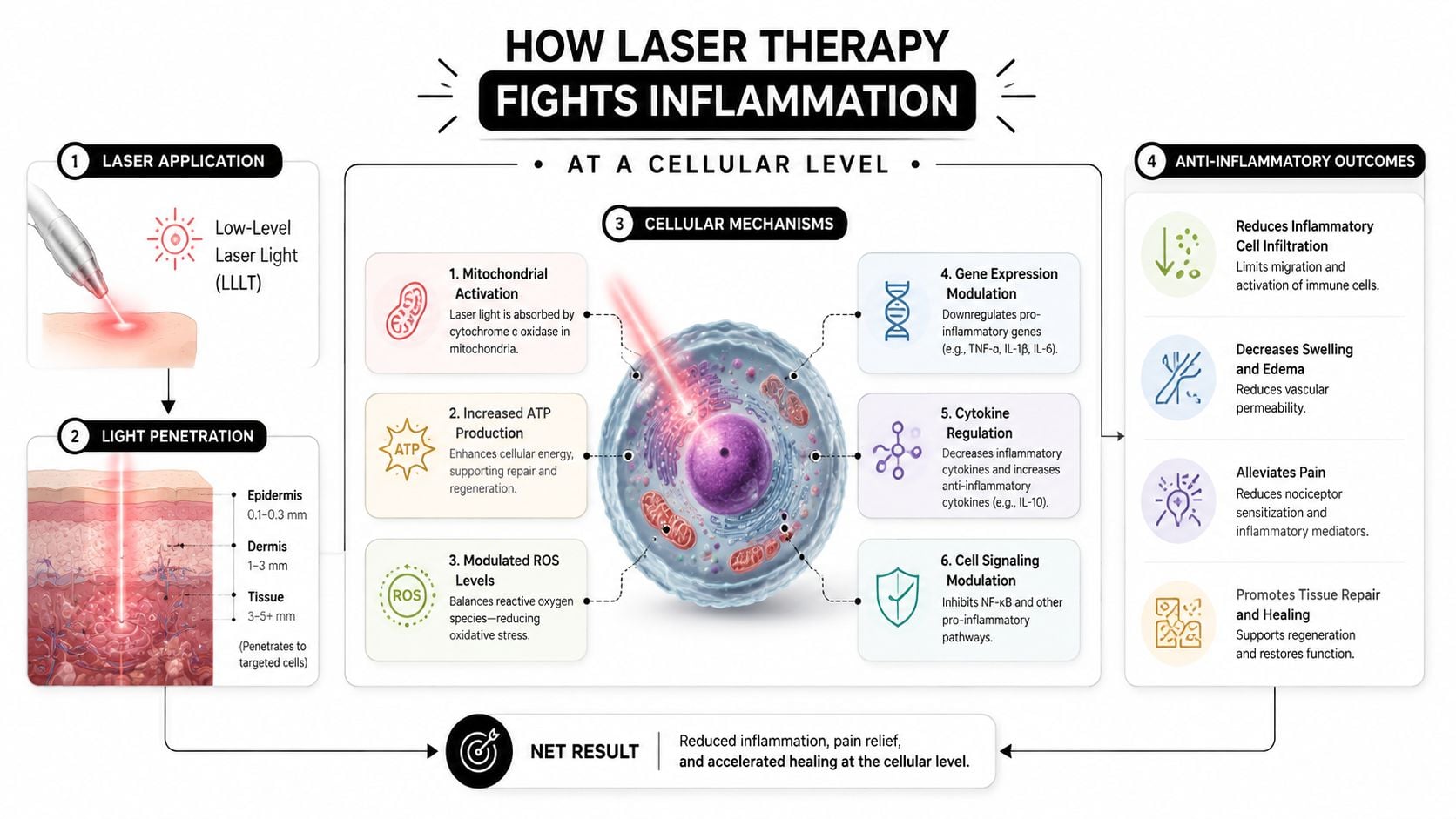
Laser therapy for inflammation is often called photobiomodulation. The term sounds technical, but the idea is simple. Specific wavelengths of light interact with cells in a way that helps them do repair work more efficiently.
This is not a heat treatment
Athletes sometimes hear “laser” and think of something hot, aggressive, or destructive. That's not what we're talking about here. In rehab, the goal is not to burn tissue or ablate anything. The goal is to stimulate a biologic response.
Think cellular energy, not surface-level relief
A useful analogy is a phone battery. When your phone is at low charge, every task gets slower. Cells under stress behave similarly. Injured tissue still needs to manage inflammation, repair structure, and restore function, but it may not be doing those jobs efficiently.
A peer-reviewed review on tendon injury and photobiomodulation describes how low-level laser therapy can increase cytochrome c oxidase activity in mitochondria, help restore respiration by displacing nitric oxide, and increase ATP production. That matters because ATP is the energy currency cells use for repair.
The same review also describes how laser therapy can down-regulate pro-inflammatory signaling, including IL-6 and TNF-α mRNA expression, while also supporting angiogenesis through VEGF-related signaling. In plain English, the treatment may help calm inflammatory chemistry and improve local blood vessel support at the same time.
Better cellular energy doesn't mean instant healing. It means the tissue may be better prepared to respond to the loading and rehab you're asking it to do.
Why dosing matters
This is the part most athletes never hear. The light itself isn't the whole treatment. Dose, wavelength, timing, and tissue depth all matter.
A superficial irritated tendon, a swollen post-op knee, and a deep hip issue are not the same target. The clinician has to decide whether laser makes sense for the diagnosis, where to apply it, and how it fits with the rest of the plan. That's one reason licensed sports physical therapists treat laser as a precision tool, not a default add-on.
In practice, the biggest mistake is using laser as if all inflammation is the same. It isn't. Some tissues need quieting down. Some need graded loading more than anything. Most need both, in the right order.
Common Sports Injuries We Treat with Laser Therapy
Athletes usually ask one question first. Will this help my injury?
The answer depends on the diagnosis, how reactive the tissue is, and what else is happening in your plan of care. In a sports physical therapy setting, laser tends to make the most sense when inflammation, pain, or swelling is limiting exercise quality or delaying progression.
Where it tends to fit well
Common examples include overuse problems, recent sprains, and post-surgical swelling that keeps an athlete from moving normally. Runners and dancers often come in with tissue that isn't fully torn or unstable, but is too irritated to load well. That's a good example of where laser may help open up a more productive rehab session.
It can also be useful around joints. A clinical review covering inflammatory joint conditions and laser therapy reported statistically significant decreases in morning stiffness and pain in inflammatory arthritis studies. One cited program reported an 86% efficacy rate in the laser group versus 40% in an NSAID-treated group. While that data comes from inflammatory joint disorders rather than every sports injury, it supports the broader point that laser can produce measurable changes, not just vague symptom relief.
For athletes trying to avoid unnecessary procedures, rehab strategy matters just as much as the modality. Someone with a knee that's irritated after twisting, cutting, or squatting may also benefit from understanding meniscus tear rehab without surgery when imaging and symptoms point toward a conservative path.
Conditions Treated with Laser Therapy at PTU
| Condition | How Laser Therapy Helps |
|---|---|
| Tendinopathy | May help calm reactive tissue so loading is more tolerable |
| Muscle strain | Can be used when pain and local irritation are limiting early movement |
| Ligament sprain | May support pain reduction and swelling management around the injured area |
| Plantar fasciitis | Often fits when morning pain and tissue irritability are blocking walking or running progression |
| Bursitis | May help reduce local inflammatory irritation so movement is less provocative |
| Post-op ACL recovery | Useful when swelling and pain are limiting quad activation, range of motion, and exercise tolerance |
| Rotator cuff rehab | Can help reduce shoulder irritability so strengthening and control work go better |
| Overuse injuries in runners | Often paired with gait modification, calf and hip loading, and training changes |
| Dance-related foot and ankle pain | Can reduce symptom intensity while turnout control, landing mechanics, and strength are addressed |
A few sport-specific examples we see often:
- Runner with an irritated Achilles: laser may calm the area enough to start or progress calf loading instead of skipping strength work again.
- Basketball athlete after ankle sprain: reducing local pain can make balance drills, hopping progressions, and cutting prep more productive.
- ACL athlete with a swollen knee: less reactivity can improve tolerance for extension work, quad re-training, and gait restoration.
The real win isn't that the area feels better on the table. The win is that you can squat, land, cut, push off, or run with better quality afterward.
What to Expect During Your Laser Session at PTU
Athletes usually do better when they know exactly what's coming. A laser session in sports rehab should feel straightforward, not mysterious.
Step one is always the diagnosis
We don't start with a machine. We start with the problem in front of us.
A licensed DPT reviews the injury history, sport demands, aggravating patterns, and healing timeline. Then we test the things that matter. Range of motion, swelling behavior, irritability, strength, tendon response, hopping tolerance, gait, landing mechanics, or post-op limitations.
That evaluation determines whether laser belongs in the plan at all. If the main issue is poor load management, movement compensation, or a strength gap, the answer may be exercise progression first. If swelling and pain are blocking progress, laser may help create enough change to make the next part of treatment useful.
What the session feels like
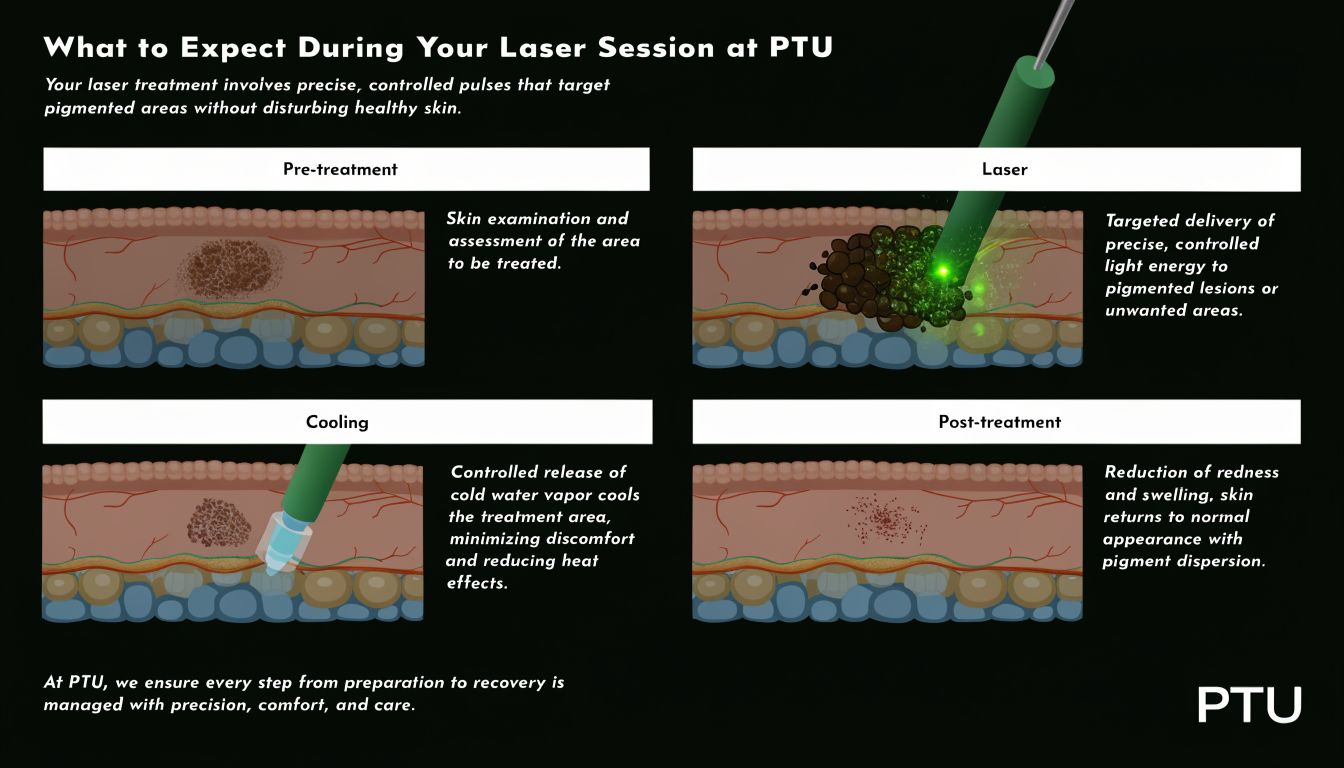
The treatment itself is usually simple. The applicator is placed over the target area while the therapist uses settings matched to the tissue and goal of treatment.
Most athletes describe it as comfortable. The bigger point is that it's brief and focused. You're not stuck lying there hoping passive care fixes everything.
Typical session flow looks like this:
- Assessment first: we identify whether the tissue is irritable, overloaded, swollen, guarded, or deconditioned.
- Laser to the target area: the goal is to address pain and inflammation in the specific structure or region that's limiting progress.
- Immediate re-test: we check whether motion, pain, or movement quality changed enough to matter.
- Active follow-up: we use that window for the exercise or skill work you truly need.
What happens right after matters more
This is the part athletes miss when they try to judge laser in isolation. If a patellar tendon is calmer, we don't waste that moment. We load it. If a post-op knee bends more easily, we use that opening for mobility, quad work, and gait training.
That's where a sports PT model matters. A runner might go from laser into treadmill analysis and cadence or loading changes. A dancer might move into foot intrinsic control, calf strength, and turnout mechanics. A field athlete may shift into deceleration drills or return-to-sport prep once the tissue settles enough to train correctly.
At PTU, that can include dry needling, manual therapy, running gait analysis, dance therapy, and return-to-sport testing when those tools match the case. Laser is there to support the plan, not replace it.
If a modality doesn't change what you can do next, it probably isn't solving the right problem.
A good session leaves you with a clear purpose. Sometimes that's less pain with stairs. Sometimes it's better quad engagement after ACL surgery. Sometimes it's the ability to tolerate eccentric calf work without the tendon flaring later that day. The target changes. The principle doesn't.
Benefits, Risks, and Setting Realistic Expectations
Laser therapy for inflammation has real upsides, but it also gets oversold. Athletes deserve the honest version.
Where laser can help
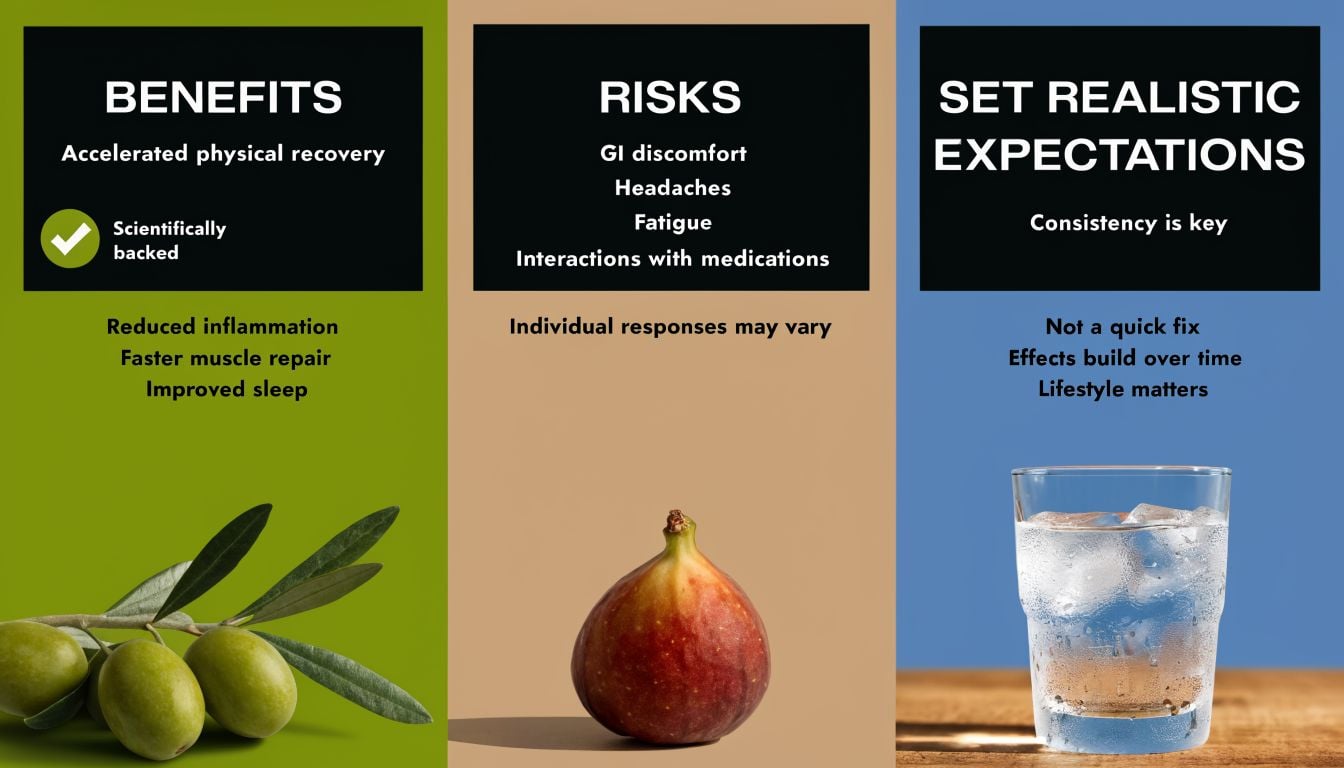
The biggest benefit is that it gives us a non-invasive, drug-free option to address pain and inflammatory irritability while keeping rehab moving. That matters for athletes who need to keep training something, even if the injured area needs temporary modulation.
Useful goals often include:
- Reducing pain enough to train well: if symptoms are shutting down strength work, mobility, or mechanics, laser may improve tolerance.
- Managing swelling after injury or surgery: this can be especially helpful when joint motion and muscle activation are lagging.
- Supporting tissue recovery: for some tendon, ligament, and soft tissue presentations, it may help create a better healing environment.
When we pause or avoid it
There are also times not to use it. In sports medicine, common precautions include avoiding treatment over the eyes, over an active cancer site, over a developing fetus, or in situations where implanted devices or other medical factors need extra consideration. That's why an in-person medical screen matters.
Even when laser is safe, it may still be the wrong answer. If the diagnosis is off, if the tissue needs a different kind of loading, or if the athlete keeps outrunning the healing timeline, laser won't rescue a flawed plan.
Acute versus chronic is not a simple yes or no
This is the nuance most internet content skips. Athletes want a simple answer for the swollen knee after a tournament, the angry ankle after surgery, or the tendon flare this week. The evidence doesn't support a blanket yes.
A 2020 systematic review on photobiomodulation and related anti-inflammatory applications noted that while the treatment has promising anti-inflammatory uses, the literature is mixed and heavily dependent on condition, timing, and treatment parameters. That's the important takeaway. Laser can help, but it doesn't help every inflamed tissue in the same way.
So the practical expectation is this:
- Some athletes feel a clear change quickly
- Others improve more gradually as sessions are paired with the right exercise progression
- Some cases need a different intervention entirely
That isn't a weakness in the treatment. It's just good clinical reasoning. A swollen knee after ACL surgery, a chronic Achilles tendinopathy, and a fresh hamstring strain are all “inflammation” in casual conversation. In practice, they're very different problems.
Frequently Asked Questions and Your Next Step
FAQ
Q: Does laser therapy hurt?
Most athletes tolerate it well. The treatment is generally comfortable, and the bigger issue is whether it changes pain, swelling, or movement enough to improve the rehab session that follows.
Q: How many sessions will I need?
That depends on the diagnosis, irritability level, stage of healing, and how you respond. Some athletes use it for a short stretch during a reactive phase. Others need it as part of a broader post-op or overuse rehab plan.
Q: Is laser therapy enough on its own?
Usually not. In sports rehab, passive care rarely carries the whole case. The best results come when symptom control is paired with strength, mobility, tendon loading, gait work, sport-specific progressions, or return-to-sport testing.
Q: Can it help after surgery?
It can, especially when swelling and pain are limiting motion or muscle activation. Post-op athletes still need a full rehab progression, but reducing irritability can make that progression easier to tolerate.
Q: Is it better for acute injuries or chronic problems?
Neither category wins automatically. What matters more is the exact tissue involved, the stage of healing, and whether the dosing matches the problem.
Q: Is insurance involved?
Coverage can vary by plan and by service structure. The cleanest next step is to review practical details with the clinic directly through the PTU FAQ page.
If you're in South Shore Massachusetts, including Bridgewater, Buzzards Bay, Middleborough, Plymouth, East Bridgewater, West Bridgewater, Raynham, or Taunton, the most useful question isn't “Does laser work?” It's “Does laser make sense for my injury, right now, in the context of my sport?”
That answer takes an evaluation. A runner may need gait changes and calf loading more than symptom relief. A dancer may need foot control and training modification. A post-op ACL athlete may need swelling control so the knee can finally move and the quad can start doing its job.
If inflammation is dictating your training, get it assessed by a sports PT team that can connect symptom control to actual performance rehab. Physical Therapy U serves athletes and active adults in Bridgewater, Buzzards Bay, and Middleborough with sport-specific rehab, post-op care, running gait analysis, dance therapy, dry needling, and return-to-sport testing. Book an evaluation to find out whether laser therapy belongs in your plan.
