
You feel wrist pain when you catch a clean, push out of a handstand, post on the floor in dance, or even turn a doorknob after practice. That's usually the point when athletes stop asking, “Can I train through this?” and start wondering if they're headed for a long layoff.
In sports physical therapy, wrist rehab works best when it's specific. Not generic rest. Not random stretches from social media. The right plan identifies what structure is overloaded, calms symptoms without deconditioning you, then rebuilds strength, control, and tolerance so you can return to your sport with confidence.
At PTU, our sports physical therapy team works with active people across the South Shore Massachusetts region, including athletes from Bridgewater, Plymouth, Taunton, East Bridgewater, West Bridgewater, Raynham, Buzzards Bay, and Middleborough. If your goal is to get back to lifting, tumbling, dancing, throwing, climbing, or training without guarding your wrist, this guide will show you what that process typically looks like.
Table of Contents
- An Athlete's Guide to Overcoming Wrist Pain
- Understanding Common Causes of Wrist Pain in Athletes
- Your First Physical Therapy Visit What to Expect
- Evidence-Based Treatments for Wrist Pain Recovery
- Building Your Progressive Wrist Exercise Program
- Beyond Rehab Return to Sport and Performance
- Your Path to Recovery in Southeastern Massachusetts
An Athlete's Guide to Overcoming Wrist Pain
A lot of wrist injuries start the same way. Training feels normal, then one rep, one fall, or one week of extra volume changes things. Now you're modifying push-ups onto fists, skipping front rack work, avoiding tumbling, or marking choreography because loading your hand on the floor hurts.
For athletes, that creates two problems at once. The wrist hurts, and your training identity gets disrupted. You're not just trying to feel better. You're trying to get back to your lifts, your season, your class schedule, or your next race block without losing momentum.
That's where physical therapy for wrist pain should feel different in a sports clinic than in a generic rehab setting. The question isn't only, “Where does it hurt?” The better question is, “What does your wrist need to tolerate again?”
Practical rule: If your rehab doesn't connect directly to your sport demands, it's incomplete.
A baseball player needs force transfer through the hand and forearm. A dancer needs weight-bearing tolerance, line, and control in end range. A lifter needs compression tolerance, grip strength, and confidence under load. Those are different problems, even if all three people say, “My wrist hurts.”
At PTU, that athlete-first lens matters. In Bridgewater, Massachusetts and across our South Shore Massachusetts locations, rehab is built around the full arc of recovery. We evaluate the injury, restore motion and strength, adjust training load, then progress to sport-specific drills and return-to-sport testing.
That shift matters because wrist rehab often improves when it's active, structured, and time-limited rather than open-ended. Conservative care can work very well when the plan matches the problem and the athlete follows through consistently.
Understanding Common Causes of Wrist Pain in Athletes
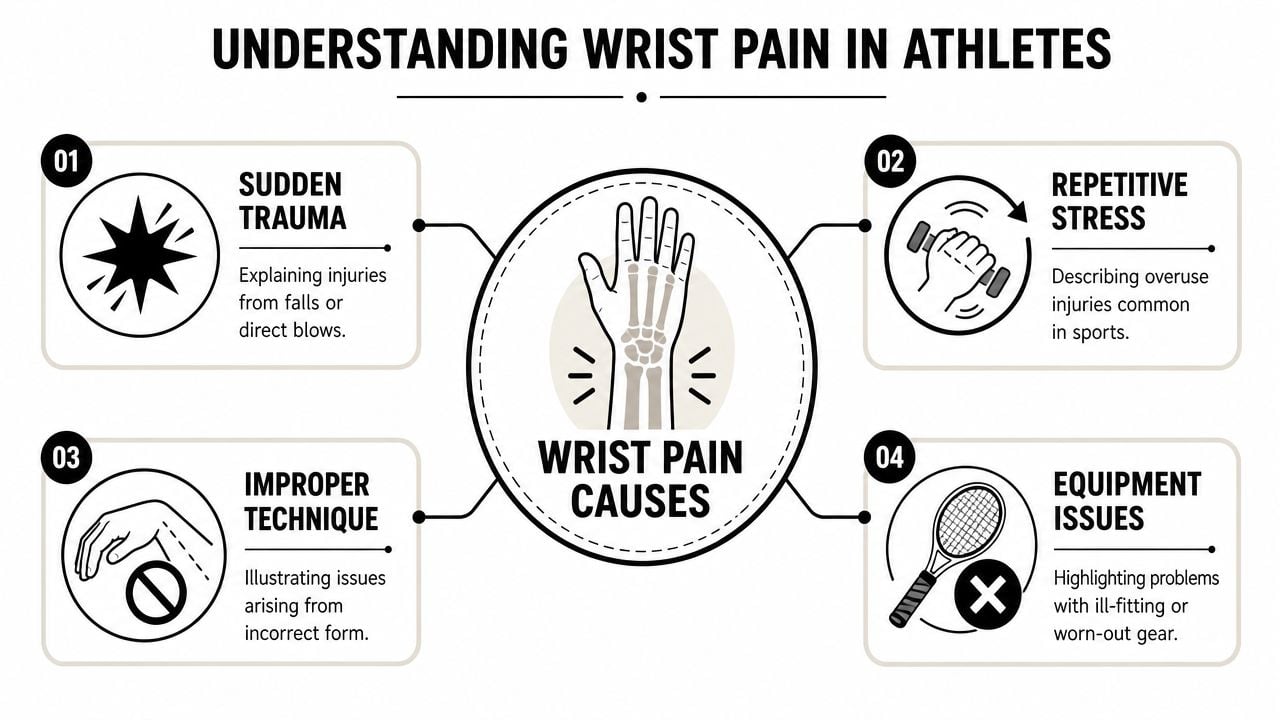
Wrist pain in athletes usually falls into a few buckets. The mechanism matters because a sore wrist after a fall is not the same as a wrist that gradually starts barking during handstands, cleans, or long practices.
When pain starts with one moment
A classic sports mechanism is the fall on an outstretched hand, often shortened to FOOSH. You go down, the hand reaches out automatically, and the wrist absorbs force faster than the muscles can control it. That can irritate ligaments, jam the joint, stress bone, or create lingering stiffness and pain with loading.
Contact sports, basketball, soccer, lacrosse, and trail running all produce this pattern. So do dance slips and gymnastic dismounts. In these cases, the story is often clear. “It happened right then.”
Here's the trade-off. Some athletes assume a brace and rest will solve everything. Rest may calm symptoms, but if stiffness, weakness, or instability remain, pain often returns as soon as training ramps back up.
When pain builds over time
Overuse wrist pain usually feels less dramatic but more stubborn. Lifters feel it during front rack positions, push-ups, or heavy pressing. Dancers notice it during floor transitions or repeated weight-bearing. Gymnasts and climbers often feel it as a loading threshold problem. The wrist handles some demand, then complains when volume or intensity rises.
In these cases, I usually frame the issue as a loading error, not just “inflammation.” The tissue isn't always weak in a simple way. More often, the wrist is being asked to handle a level, direction, or frequency of force that exceeds current capacity.
Common contributors include:
- Repetitive stress: Repeated extension, gripping, impact, or weight-bearing without enough progression.
- Technique faults: Collapsing into end range, poor bar path, limited shoulder mobility, or poor upper-body force distribution.
- Segmental instability: The wrist, forearm, elbow, and shoulder stop sharing load well.
- Equipment factors: Worn grips, poor handle setup, or positions that force the wrist into irritating angles.
Wrist pain rarely means your body is fragile. More often, it means your loading strategy needs to change.
Athletes also get pain from a mismatch upstream or downstream. A stiff thoracic spine, weak scapular control, or limited forearm rotation can dump extra stress into the wrist. That's one reason self-diagnosis gets tricky. The sore spot isn't always the source of the problem.
Your First Physical Therapy Visit What to Expect
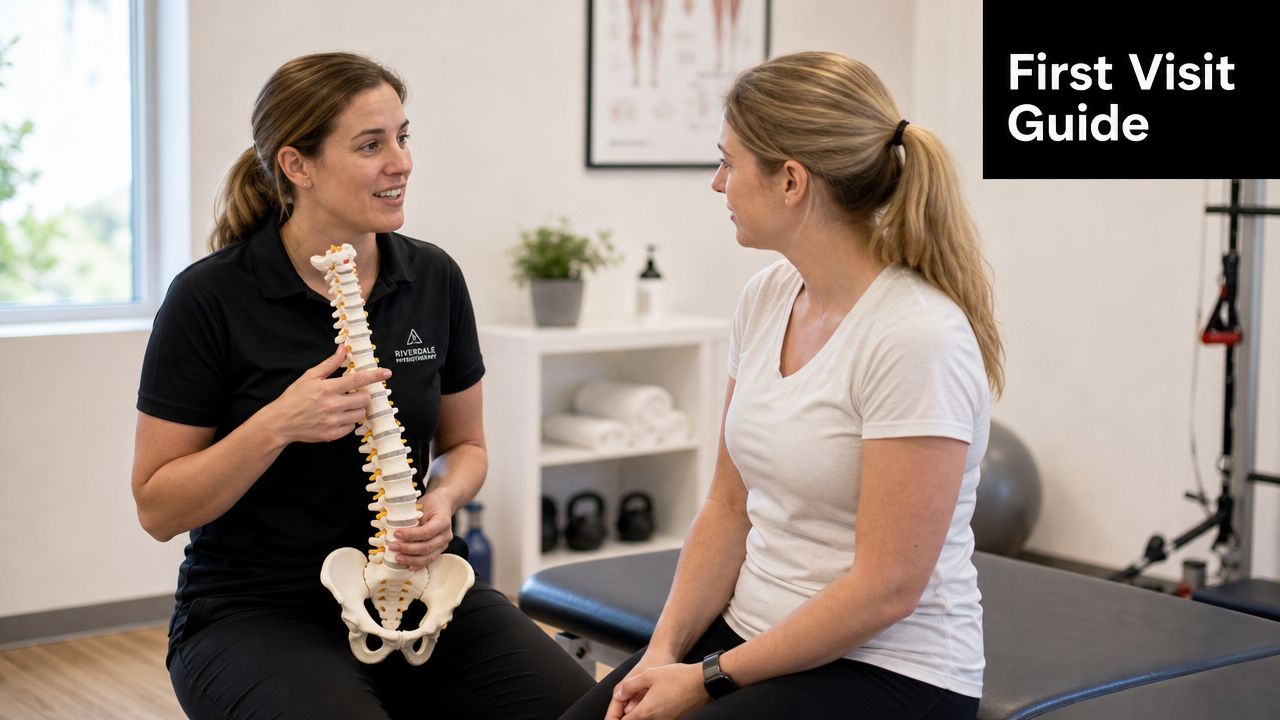
A good first visit should feel less like a checklist and more like a focused investigation. In a sports PT setting, we're not only trying to name the irritated tissue. We're figuring out why your wrist got overloaded and what you need it to do again.
The conversation comes first
Your evaluation starts with your story. We ask when the pain began, whether it followed a fall or built up gradually, what movements trigger it, and what you've already tried. For athletes, we also need your training details. Sport, position, event, current schedule, upcoming competition, and whether you're trying to keep practicing through it.
This part shapes everything else. A volleyball player with pain during diving and hand contact has a different rehab path than a powerlifter who can't tolerate extension in the front rack.
We also talk about goals early. Some patients want daily life to feel normal again. Others want to bear weight confidently, grip hard, or return to post-op training with a plan that matches their timeline. If you've used taping before, we may discuss where it helps and where it doesn't. PTU also has a practical guide to how to use kinesiology tape when taping is part of symptom management rather than the whole solution.
The exam has to match your sport
The hands-on exam usually includes wrist and forearm range of motion, symptom-provoking positions, palpation, grip testing, muscle performance, and movement quality. We also look above and below the wrist. Elbow, shoulder, scapular control, and trunk positioning matter more than most athletes realize.
Then we test function. That might mean push-up position tolerance, bar grip, floor transfer mechanics, catching positions, or modified weight-bearing. For dancers, it may include hand placement and transition mechanics. For runners, wrist pain may be less common, but arm swing, fall mechanics, and overall return-to-training load still matter. In our broader sports setting, that same reasoning also supports services like running gait analysis, dance therapy, and return-to-sport testing when the wrist issue affects full-body performance.
A strong rehab plan is usually multimodal. That's supported by a 2019 Physical Therapy case report on work-related wrist pain, where education, manual therapy, and progressive exercise led to 0/10 pain, a 10/10 Patient-Specific Functional Scale score, and a +7 Global Rating of Change by 2 months.
For a quick overview of how clinicians think through upper-extremity movement and pain, this short video is a useful visual.
Evidence-Based Treatments for Wrist Pain Recovery
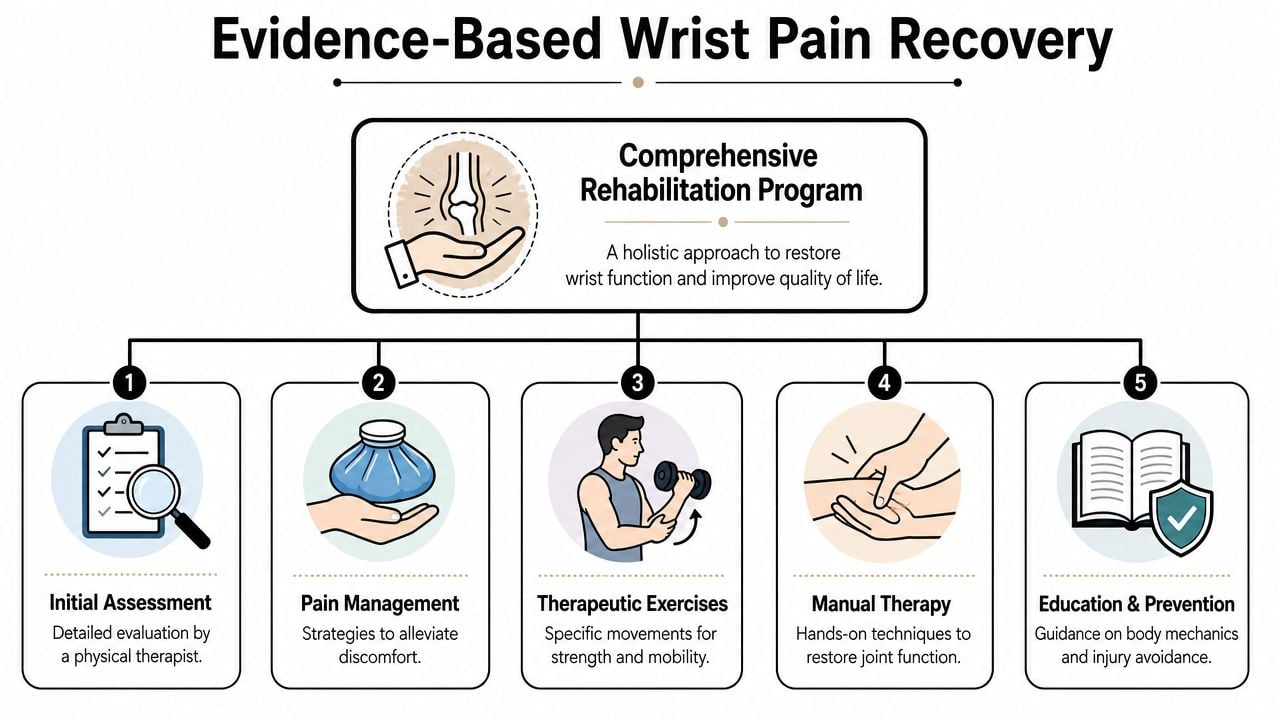
The best rehab plans don't rely on a single trick. Wrist pain usually responds to a combination of load management, therapeutic exercise, education, and hands-on treatment, with each piece doing a different job.
What works better than passive rest
If pain is irritable, we reduce aggravating load first. That doesn't mean total shutdown unless the injury demands it. More often, it means changing the angle, volume, depth, grip, or exercise selection so the wrist can settle down while you keep training around it.
Then we build capacity back up. That's where exercise matters most.
A clinical study on chronic wrist pain found that grip-strengthening plus wrist-stability training improved pain, wrist function, grip strength, and muscle strength. Clinically, that matches what we see. When the wrist handles force better and the segments around it coordinate better, symptoms usually become easier to control.
Useful treatment pillars often include:
- Education and load planning: Athletes need a clear answer on what to modify now, what they can keep doing, and how progression will happen.
- Mobility work: If joint or soft tissue restriction is part of the problem, restoring motion can reduce pinching and improve force distribution.
- Strength and stability training: Grip, forearm, wrist, and upper-quarter control help the joint tolerate real sport demands.
- Movement retraining: Sometimes the issue isn't tissue capacity alone. It's how you catch, bear weight, or transfer force.
Clinical insight: Pain reduction is important, but durable progress usually comes from improving tolerance to load.
Where hands-on care and recovery tools fit
Manual therapy can help when stiffness, guarding, or pain is limiting movement. That may include joint mobilization, soft tissue work, or assisted movement strategies. In the right case, those techniques make exercise easier to do well. They don't replace exercise.
Adjuncts can also have a role. Some athletes respond well to dry needling when forearm muscle tone or trigger point sensitivity is keeping symptoms active. Others ask about laser-based options for tissue irritability. If you're comparing recovery modalities, PTU has a plain-language overview of laser therapy for inflammation. People exploring light-based care in other settings also sometimes come across resources on low downtime aesthetic treatments, which can help clarify how low-level laser technology is discussed more broadly.
One note of caution. Modalities can be useful, but they're support tools. A wrist that hurts under load usually needs a loading solution. That means your program should eventually include graded strengthening, stability work, and sport-specific progression.
For athletes in Southeastern Massachusetts, this is also where clinic setup matters. A clinic that combines sports PT with strength and conditioning, dry needling, and return-to-sport progression can keep care connected from early rehab through later performance phases. Physical Therapy U provides that mix, alongside occupational therapy support for hand and wrist conditions.
Building Your Progressive Wrist Exercise Program
A solid wrist program starts below your current pain threshold and builds upward. The point isn't to chase fatigue for its own sake. The point is to restore motion, strength, and confidence in the exact directions your sport demands.
Clinical guidance notes that many people start noticing improvement in 4 to 6 weeks with consistent exercise, while tendon and soft-tissue conditions often improve over 6 to 12 weeks. The same guidance also notes that exercise-based rehab improves pain, grip strength, and function in many wrist and hand conditions, and an NHS protocol highlights drills like eccentric loading and dart-thrower's motion as part of graded loading strategies, as described in clinical guidance on wrist physical therapy.
Early phase goals
Early rehab is about calming symptoms without making the wrist more deconditioned.
You might start with:
- Pain-limited active motion: Gentle flexion, extension, and forearm rotation to reduce guarding and keep movement available.
- Isometric holds: Light, pain-limited holds for wrist extension, flexion, or grip. These are often well tolerated when dynamic loading still feels sharp.
- Positional tolerance drills: Modified quadruped, incline weight-bearing, or supported hand contact if floor loading is part of your sport.
In this phase, smooth movement matters more than intensity. If every rep looks guarded, you're probably loading too aggressively.
Strength phase progression
Once irritability drops, loading needs to become more specific. At this point, many athletes either improve steadily or stall because they jump straight back to hard training.
A typical progression may include:
- Eccentric wrist loading: Assisted lift up, controlled lowering down. This is especially useful when tendon symptoms linger.
- Dart-thrower's motion: A diagonal wrist pattern that often feels more functional than isolated straight-plane movements.
- Forearm pronation and supination: Controlled rotation drills to rebuild force transfer between the hand and elbow.
- Band or dumbbell strengthening: Wrist extension, flexion, radial and ulnar deviation, always progressed by tolerance rather than ego.
A simple way to think about this phase is that the wrist has to relearn how to accept force, not just move through space.
Smooth reps beat heroic reps. If you need to compensate through the shoulder, fingers, or trunk, the load is too high for that stage.
Functional loading for sport
Late-stage rehab should start to resemble the thing you're trying to return to.
That may include:
- Grip endurance work: Carries, timed holds, towel grips, or sport-specific grasp patterns for climbers, lifters, and field athletes.
- Closed-chain stability drills: Weight shifts, plank variations, hand-release progressions, or perturbation work for gymnasts and dancers.
- Impact preparation: Controlled catching, deceleration, or hand contact drills for volleyball, basketball, and field sports.
- Integrated upper-quarter strength: Shoulder and scapular work so the wrist isn't left absorbing force alone.
A staged approach usually works better than all-at-once programming. Here's a practical way to view it:
| Phase | Main target | Common mistake |
|---|---|---|
| Early | Calm pain and restore motion | Doing nothing and getting stiffer |
| Middle | Rebuild strength and tolerance | Jumping load too quickly |
| Late | Match sport demands | Stopping rehab once pain drops |
If you're a dancer, your program may need more repeated floor-contact exposure and end-range control. If you lift, we often build toward rack position tolerance, push-up loading, bar contact, and compressive demands. If you're returning after surgery, progression has to respect tissue healing while still moving toward performance.
Beyond Rehab Return to Sport and Performance
A wrist that feels better in the clinic isn't automatically ready for sport. That gap matters. Plenty of athletes can do daily tasks without pain but still can't tumble, catch, post, press, or absorb force at game speed.
Pain-free is not the same as game-ready
Return to sport should answer one question clearly. Can you handle the demands of your activity without compensation, hesitation, or symptom flare?
That usually means we test more than isolated strength. We look at movement quality, repeated-load tolerance, confidence, and the positions that matter in your sport. A gymnast may need progressive weight-bearing and impact acceptance. A baseball player may need grip endurance and force transfer through the chain. A volleyball athlete may need hand contact tolerance and landing strategies after dives.
In a sports setting, the finish line is performance readiness. That's why return-to-sport testing belongs in the plan, not as an afterthought.
How this looks for different athletes
For lifters, we often progress from simple loading to barbell-specific positions. Can you front rack without guarding? Can you press, catch, and stabilize under load? If not, pain relief alone hasn't solved the performance problem.
For dancers, the wrist is often part mobility problem, part control problem, and part exposure problem. Floor work, transitions, and repeated upper-extremity support need to be rebuilt gradually. Dance therapy is useful here because technique and artistic demands both matter.
For runners, the wrist issue may come from a fall, a recent lift cycle, or cross-training limitations. Running gait analysis doesn't directly treat the wrist, but it can still matter when return-to-run planning is part of the bigger recovery picture after an injury that affected overall training volume.
For post-surgical and higher-level athletes, the same principle applies. We don't stop at symptom reduction. We build objective capacity, then stress it in a controlled way. That's the difference between being cleared to move and being prepared to compete.
If you still don't trust your wrist when speed, fatigue, or contact increase, rehab isn't done yet.
Your Path to Recovery in Southeastern Massachusetts
If you have severe swelling, obvious deformity, loss of sensation, major weakness, or pain after a traumatic fall that won't let you use the hand normally, get medical evaluation promptly. Those signs can point to injuries that need imaging or physician review before rehab starts.
When to get medical attention quickly
You should also get checked sooner if symptoms keep worsening, pain wakes you consistently, or you can't grip, bear weight, or move the wrist without a strong pain response. Physical therapy is valuable, but it doesn't replace an in-person medical assessment when the presentation suggests fracture, significant ligament injury, or another serious condition.
For everyone else, the next best step is a focused evaluation with a licensed physical therapist who understands sport demands. That matters in wrist rehab because the right plan depends on your activity, your training load, and what “return” means for you. If you're comparing care models, some athletes also look into services like advanced physical and aquatic therapy to understand how different rehab environments support recovery.

Across Bridgewater, Buzzards Bay, and Middleborough, PTU serves active people from the South Shore Massachusetts region, including nearby communities like Plymouth, Taunton, East Bridgewater, West Bridgewater, and Raynham. Care is reviewed by licensed DPTs and shaped around your sport, your symptoms, and your next phase of training.
Common questions athletes ask
Q: How long does wrist rehab usually take?
A: It depends on the tissue involved, symptom irritability, and whether you're dealing with an acute injury or a longer-term overload problem. Many people notice meaningful change within weeks when the program is consistent, but your exact timeline should come from an in-person evaluation.
Q: Should I wear a brace?
A: Sometimes a brace helps calm symptoms or protect the wrist during a short phase of healing. The downside is that long-term reliance can reduce confidence and delay rebuilding load tolerance if it replaces active rehab.
Q: Can dry needling help wrist pain?
A: In the right case, yes. It can be useful when forearm muscle irritability or guarding is contributing to symptoms. It works best as part of a broader plan that includes strengthening, mobility, and sport-specific progression.
Q: Can I keep training?
A: Often yes, with modifications. A sports physical therapist can help you reduce aggravating loads while keeping the rest of your training moving forward safely.
If wrist pain is changing how you lift, practice, dance, or compete, don't wait for it to magically settle on its own. Get it assessed, get a plan, and build back with intention.
If you're ready to start, book an evaluation with Physical Therapy U. Our team works with athletes, dancers, runners, active adults, and post-surgical patients across Bridgewater, Buzzards Bay, and Middleborough to move from pain relief to full return-to-sport performance.
