
If you're an athlete in Bridgewater, Massachusetts, this is the moment where recovery gets frustrating. Your ankle sprain is no longer dramatic enough for crutches, but it still isn't stable enough for cutting, landing, or getting back to practice. Or you're a dancer from Plymouth doing class on a sore Achilles that keeps barking every time rehearsal volume climbs.
That gray zone is where sports physical therapy matters most. Ice, rest, and basic exercise still have a place, but they aren't the whole toolbox. A microcurrent stimulation device is one of the tools clinicians may use to support tissue healing when the goal isn't just to feel better, but to pass return-to-sport testing with confidence.
Most articles on microcurrent go in one of two bad directions. They either try to sell a gadget, or they bury the useful points under dense terminology. This guide gives you the practical version, the one injured runners, field athletes, dancers, and post-op patients in South Shore Massachusetts need.
Table of Contents
- Beyond Ice and Rest Advanced Recovery Tools for Athletes
- How Microcurrent Works to Heal Injured Tissue
- Microcurrent vs TENS and NMES An Athlete's Comparison
- The Clinical Evidence for Microcurrent Therapy
- How We Use Microcurrent at Our PTU Clinics
- What to Expect at Your First Microcurrent Session
- Frequently Asked Questions About Microcurrent
Beyond Ice and Rest Advanced Recovery Tools for Athletes
A high school soccer player from Taunton rolls an ankle, misses the first week, then tries to jog back too soon. The swelling hangs around, the joint feels stiff, and every change of direction feels a half-step late. A dancer from Plymouth has the opposite problem. No dramatic injury, just a tendon that never fully settles down because class, rehearsal, and performance keep stacking stress on tissue that isn't keeping up.
That's usually when people realize recovery isn't just about waiting.
In sports physical therapy, the job isn't to throw random modalities at an injury. The job is to match the tool to the problem. Sometimes that means loading a tendon better. Sometimes it means manual therapy, dry needling, running gait analysis, or dance-specific movement retraining. Sometimes it means using an electrical modality when the tissue is stuck in an irritated, slow-to-progress phase.
Athletes don't need more gadgets. They need a plan that connects symptom control to actual return-to-sport progress.
Microcurrent fits into that category. It isn't a miracle cure, and it isn't a shortcut around strength work, balance work, or impact progression. It's a clinical tool used to support healing when that matches the athlete's presentation.
If you're already building out your recovery habits outside the clinic, nutrition and sleep matter too. Runners looking for ways to accelerate runner recovery often do better when they stop thinking in one-tool solutions and start thinking in systems. Compression work can also help in the right situation, especially when paired with movement and tissue loading, which is why some athletes compare microcurrent with NormaTec compression boot recovery options.
When advanced recovery tools actually help
They tend to be useful when an athlete has one of these patterns:
- Stubborn swelling: The joint isn't acutely injured anymore, but fluid is still limiting motion and muscle activation.
- Pain that changes movement quality: You can technically train, but you can't move well enough to train productively.
- A tissue healing lag: The tendon, ligament, or post-op area isn't tolerating the next step as expected.
- A performance bottleneck: You're strong enough in the gym, but not reactive, stable, or efficient enough for sport.
That's the right lens for microcurrent. Not hype. Not passive care. A specific tool for a specific job.
How Microcurrent Works to Heal Injured Tissue
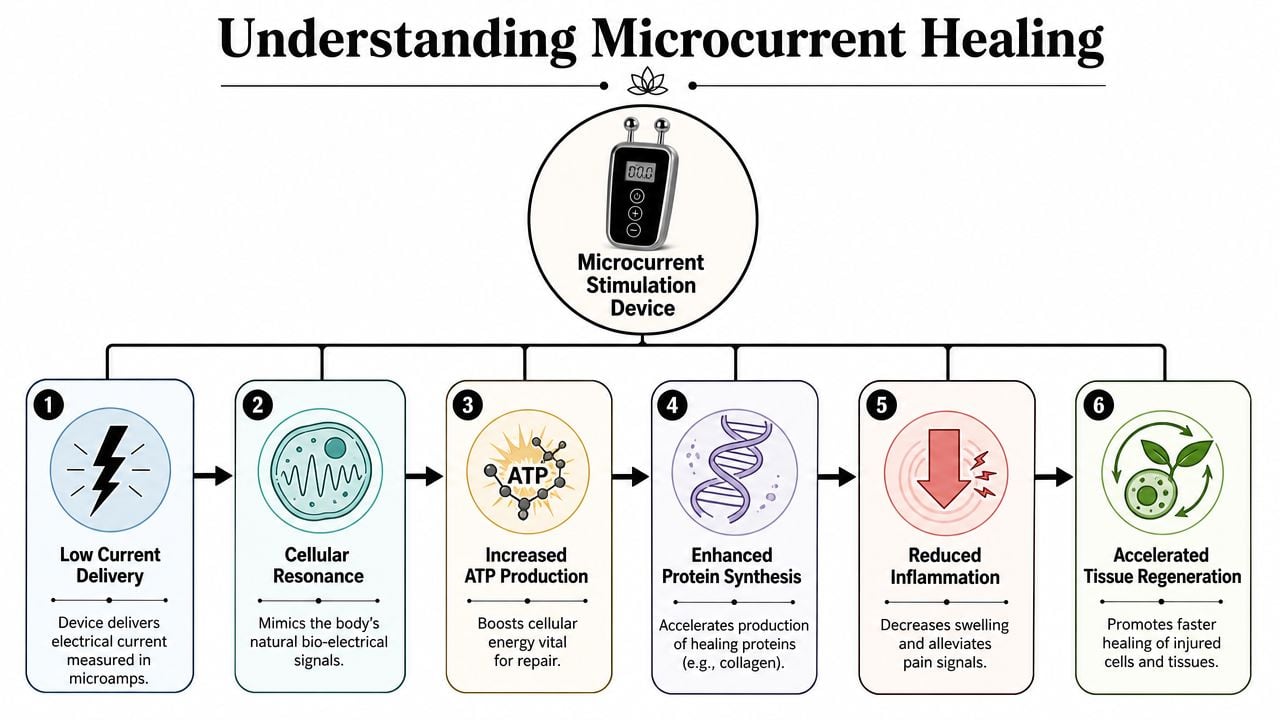
A microcurrent stimulation device sends an electrical current so small that it's measured in microamps, not milliamps. In plain English, that means the current is extremely low and designed to be sub-sensory, so it is typically not felt. The goal isn't to make a muscle visibly contract. The goal is to interact with tissue at a level below that.
The easiest analogy is a weak phone battery. The phone still turns on, but everything is sluggish, and it doesn't handle demand well. Injured tissue acts similarly. It can still function, but repair work is expensive, and the tissue may not have the same energy available for recovery.
Why you usually don't feel it
Athletes often get confused here. They expect electrical treatment to buzz, pulse, or make muscles jump. Microcurrent doesn't work like that. If TENS feels like turning up the radio and NMES feels like flipping on the engine, microcurrent is closer to charging the battery in the background.
That “nothing is happening” feeling is normal.
Practical rule: If your whole test for whether a modality works is “Did I feel something strong?”, microcurrent will seem underwhelming even when it's being used appropriately.
A lot of the interest in microcurrent centers on tissue healing, pain, and recovery support. If you want a simple visual overview of how body tissues move through repair phases, this guide on understanding wound recovery helps explain why timing and tissue state matter so much.
Why the history matters
Microcurrent is not a new wellness fad with a shiny rebrand. Devices have been in commercial use since the 1960s, when the Dermatron became the first commercial device to output micro-current stimulation, and non-invasive, externally generated sub-sensory microcurrent therapy developed further in the 1970s according to this historical background on microcurrent. That long timeline matters because it places the treatment inside the broader medical history of electrotherapy, including wound healing and orthopedic use.
For an athlete, that means two things.
First, the treatment category is established enough that clinicians aren't making up the concept on the fly. Second, history alone doesn't guarantee results. A tool can be legitimate and still need the right patient, the right timing, and the right setup.
What that means for your recovery
When a sports PT considers microcurrent, the question isn't, “Is electricity cool?” The question is whether the tissue problem in front of us might benefit from a sub-sensory healing-focused modality while we keep advancing the active parts of rehab.
In practice, that usually means microcurrent sits alongside things like:
- Progressive loading: Strengthening the injured area so tissue capacity improves.
- Movement retraining: Cleaning up mechanics in running, jumping, cutting, or dance patterns.
- Swelling management: Reducing barriers that block motion and muscle function.
- Return-to-sport testing: Making sure symptom improvement shows up in performance.
If a modality doesn't help you move toward that last point, it shouldn't stay in the plan for long.
Microcurrent vs TENS and NMES An Athlete's Comparison
Athletes often lump all electrical stimulation into one category. That's a mistake. A microcurrent stimulation device, a TENS unit, and an NMES unit may all involve pads on the skin, but they do different jobs.
Three tools with three different jobs
The simplest way to think about it is this:
- Microcurrent is generally used when the target is tissue healing support.
- TENS is typically used for pain modulation.
- NMES is used to create a muscle contraction.
If you mix those jobs up, you end up expecting the wrong result.
| Feature | Microcurrent | TENS | NMES |
|---|---|---|---|
| Primary purpose | Support tissue healing and recovery | Help modulate pain | Create muscle contraction |
| What you usually feel | Little to nothing | Tingling or buzzing | Stronger contraction sensation |
| Current style | Very low, sub-sensory current | Sensory-level stimulation | Stimulation strong enough to activate muscle |
| Best fit in sports rehab | Irritated tissue, swelling, recovery support | Short-term symptom relief | Weakness, poor activation, post-op muscle loss |
| What it is not best for | Building strength directly | Healing tissue directly | Quiet healing support |
That distinction matters after surgery and in overuse injuries.
A runner with plantar fascia pain might get TENS if pain is the main barrier to tolerating movement. A post-op knee patient who can't fire the quad well may need NMES because a visible contraction is the point. An athlete with persistent swelling and slow tissue response may be a better fit for microcurrent.
Don't judge the modality by the sound of the machine or the intensity of the sensation. Judge it by whether it matches the rehab problem.
When an ACL athlete might use all three
Take ACL rehab. Early on, several problems often show up at once. Pain limits confidence, swelling limits motion, and poor quad activation makes even basic tasks feel awkward.
That's where different electrical tools can earn their spot:
- For pain control: TENS may be used when symptoms are getting in the way of exercise tolerance.
- For quad activation: NMES may help produce a stronger contraction when the quad isn't doing its job.
- For healing support: Microcurrent may be considered when the tissue environment itself seems to need help calming down and progressing.
The important point is that these aren't interchangeable. If your knee is weak, microcurrent won't replace strength work or contraction-focused stimulation. If your pain is the main issue, healing-focused current may not be the first choice that day.
The athlete decision test
Ask one question before any modality goes on the table.
What exact problem are we trying to solve today?
If the answer is fuzzy, the treatment choice is probably fuzzy too. Good sports rehab is specific. That applies to return-to-sport testing, gait analysis, dance rehab, and electrical stimulation alike.
The Clinical Evidence for Microcurrent Therapy
Sports clinicians should be honest here. Microcurrent has some appealing features, especially for safety, but the evidence base isn't a blank check.
What the research supports
A 2023 review reported a strong safety profile for microcurrent therapy. In one study, only 1 dropout out of 251 participants, or 0.4%, was linked to a perceived tingling sensation after the first treatment session, and no serious adverse events requiring medical treatment were reported in the review's discussion of interventional studies. The same review also notes that microcurrent has been used in multiple studies without side effects in healthy adults, athletes, and older adults, which you can read in the PMC review on microcurrent safety and outcomes.
That matters in sports rehab because low-risk tools are useful when you're already asking a lot from an athlete's body through strengthening, plyometrics, cutting progressions, or post-op reloading.
Where clinicians need humility
Safety is not the same thing as proven benefit across every diagnosis.
That same review points out a major limitation. Even though more than 100 electrical stimulation devices have received FDA 510(k) clearance, there still aren't evidence-based clinical practice guidelines recommending microcurrent electrical neuromuscular stimulation devices, and there isn't enough research to show improved health outcomes for any condition broadly. That's the honest version of where the field stands.
A treatment can be low risk, commonly used, and still require careful clinical judgment because the evidence is condition-specific and incomplete.
For athletes and parents, that means you should be skeptical of anyone promising universal results. It also means a clinician shouldn't use microcurrent just because a machine is available in the clinic.
What that means in practice
In sports settings, microcurrent usually makes more sense as an adjunct than a centerpiece. It can be layered into a broader plan that still prioritizes movement, loading, strength, and objective progression. That's similar to how some clinicians think about other recovery tools aimed at symptom reduction, such as laser therapy for inflammation in physical therapy. The modality may help, but it doesn't replace the core work.
A reasonable clinical standard looks like this:
- Use it for a defined reason: Swelling, irritability, or tissue recovery support.
- Track whether it changes anything: Motion, pain response, exercise tolerance, or function.
- Drop it if it doesn't move the needle: Passive treatment shouldn't linger out of habit.
- Keep the athlete progressing: The long-term win is still return to sport, not repeated machine time.
That balanced approach tends to serve athletes better than either extreme. Microcurrent isn't useless. It also isn't magic.
How We Use Microcurrent at Our PTU Clinics
In a sports clinic, a microcurrent stimulation device only matters if it helps clear a bottleneck. We don't use it because it sounds advanced. We use it when an athlete has a specific barrier that isn't resolving fast enough with exercise and hands-on care alone.
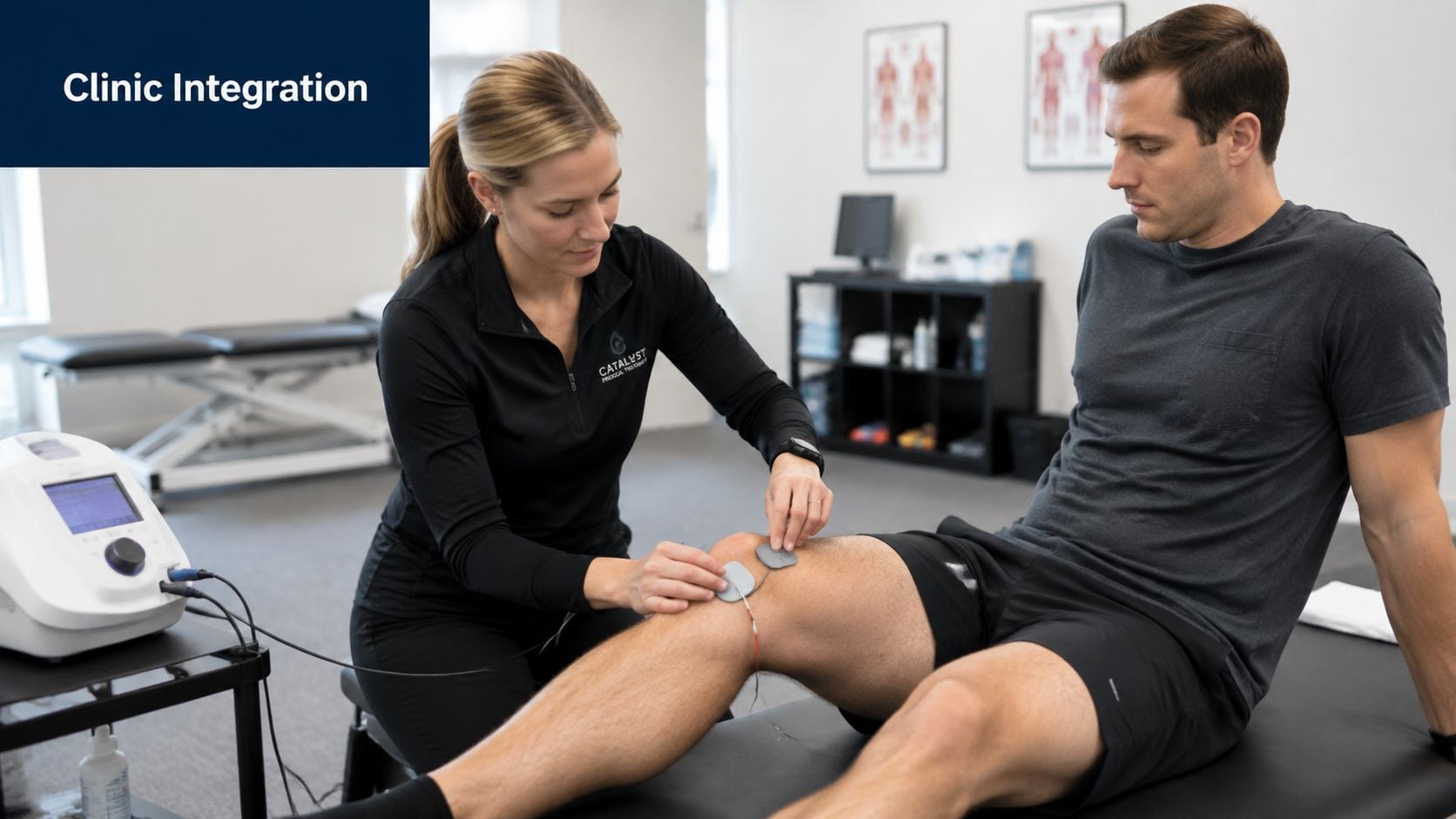
Post-op knee swelling that blocks progress
A common example is early ACL recovery. The athlete wants to strengthen hard, but the knee is still puffy, extension is sticky, and the quad won't fully wake up. In that case, microcurrent may be used to support the local tissue environment while the rest of the session stays focused on what restores function: extension work, quad activation, gait cleanup, progressive loading, and eventually return-to-sport testing.
The same logic applies to meniscus and other knee procedures. If swelling is the thing keeping the athlete from moving normally, then reducing that barrier can make the whole session more productive.
The device is never the treatment plan. The device is there to help the treatment plan work better.
Dancers and runners with stubborn overload injuries
South Shore dancers often present differently. They may have enough strength in general, but they keep flaring an Achilles, posterior tibialis, or forefoot issue because the artistic demand is high and the tissue never fully settles between exposures. In that setting, microcurrent may be paired with dance-specific therapy, calf and foot loading, landing mechanics, and schedule modification.
Runners from Raynham, East Bridgewater, or West Bridgewater often show up with a similar pattern in different clothes. Plantar fascia pain, Achilles irritation, or a lower-leg overuse problem keeps recurring because stretching alone isn't enough. Those athletes usually need a combination of gait analysis, strength work, training-load adjustment, and sometimes a healing-focused modality.
Clinical effectiveness often depends more on the protocol than the machine label. A clinical tutorial notes that waveform is the most critical aspect, and a 2023 review described studies showing benefit with 20–400 μA and application times often longer than 30 minutes to 3 hours, which is why clinician setup matters so much in this MedCentral tutorial on microcurrent protocols.
Here's a practical look at how that affects treatment decisions:
- Placement matters: Pad location changes what tissue you're targeting.
- Dose matters: Too little may do nothing. The wrong setup may also miss the intended effect.
- Timing matters: An irritable post-op knee isn't the same as a chronic tendon.
- Integration matters: Microcurrent works best when paired with the right exercise progression.
A broader recovery plan often includes more than one environment for healing and loading. For some athletes, that may also include advanced physical and aquatic therapy options when bodyweight tolerance or impact tolerance is still limited.
A quick video overview can help if you're trying to visualize how this fits into rehab sessions:
What doesn't work
What usually fails is the consumer mindset of “Which device should I buy?” without asking what parameters it can deliver or what clinical problem it's supposed to solve.
An athlete with patellar tendon pain doesn't improve because they own a machine. They improve because someone chose the right loading plan, the right progression, and, when useful, the right adjunctive modality. That's also why microcurrent isn't a replacement for dry needling, manual therapy, running retraining, dance rehab, or strength programming. It may support the plan. It doesn't become the plan.
What to Expect at Your First Microcurrent Session
Your first session should start with an evaluation by a licensed physical therapist, not a machine. The therapist needs to know what tissue is involved, what stage of healing you're in, what sport or dance demands you need to get back to, and what is limiting progress.
If microcurrent fits the case, small adhesive electrodes are placed on the skin around the target area. The device runs at a sub-sensory level, so users typically don't feel anything happening. That's normal, and it doesn't mean the treatment was set up incorrectly.
Questions worth asking your physical therapist
Bring these into the appointment:
- What's the goal today: Are we trying to calm irritation, reduce swelling, or support tissue healing?
- Why microcurrent instead of TENS or NMES: The answer should be specific to your problem.
- How will we know if it's helping: Good answers include changes in pain response, motion, swelling, exercise tolerance, or function.
- What active work goes with it: There should always be exercises, movement work, or loading progressions attached.
- When would you stop using it: A clinician should be able to tell you when the modality no longer earns a place in the plan.
You should also expect the therapist to connect that day's treatment to sport demands. For a basketball player, that may mean landing and cutting. For a runner, cadence, loading tolerance, and gait mechanics matter. For a dancer, turnout control, releve tolerance, and repetitive impact usually matter more than generic strengthening alone.
Frequently Asked Questions About Microcurrent
Is microcurrent therapy safe
Current evidence suggests microcurrent has a strong safety profile, and serious adverse events weren't reported in the review discussed earlier. That said, safety in general doesn't answer whether it's the right fit for your specific injury, so you should discuss it with a licensed physical therapist.
Does microcurrent hurt
Usually, no. Microcurrent is designed to be sub-sensory, so most athletes don't feel much, if anything, during treatment. If you were expecting the stronger sensation you may have felt with other electrical stimulation, this feels very different.
How many sessions will I need
There isn't one universal answer. Response depends on the injury, the tissue involved, the overall rehab plan, and whether the treatment is changing anything meaningful. A good clinician won't promise a fixed number before seeing how your body responds.
Is microcurrent covered by insurance
Coverage depends on your plan, how the visit is billed, and the specifics of your treatment program. The cleanest answer comes from checking benefits and asking the clinic what to expect before you start care.
If you're an athlete, runner, dancer, or post-op patient in Bridgewater, Buzzards Bay, Middleborough, or nearby towns like Plymouth, Taunton, Raynham, East Bridgewater, and West Bridgewater, Physical Therapy U can help you figure out whether microcurrent belongs in your rehab plan. Our licensed DPTs use athlete-centered evaluation, sport-specific training, dry needling, running gait analysis, dance therapy, and return-to-sport testing to build a plan that matches your actual goals. Book an evaluation and get a clear answer based on your injury, not generic advice online.
