
You notice it in places that used to feel automatic. Your first squat set feels shallow. Your calf stretch takes longer to bite. A warm-up jog around Plymouth or a weekend lift in Taunton leaves you feeling stiffer than you did ten years ago.
That change is real. In sports physical therapy, we see it all the time in adult runners, lifters, dancers, field athletes, and post-op patients who still train hard but can't ignore that their bodies need a different kind of prep than they used to.
Age affects flexibility, but not in a simple “you're getting old” way. Tissues change. Joints move differently. Recovery habits matter more. The upside is that flexibility loss is not fixed. With the right mix of mobility work, strength training, and sport-specific programming, individuals can improve how they move and how they feel.
Table of Contents
- Why Your Warm-Up Feels Harder Than It Used To
- How Aging Changes Your Muscles and Connective Tissues
- The Real Rate of Flexibility Loss and When It Starts
- Flexibility Demands for Athletes Dancers and Active Adults
- Assessing Your Flexibility A Clinical Approach
- Your Action Plan for Fighting Age-Related Stiffness
- Common Questions About Flexibility and Aging
Why Your Warm-Up Feels Harder Than It Used To
A lot of active adults first notice age-related stiffness in the warm-up, not during the workout itself. The body still performs, but it takes longer to get there. Hips feel blocked at the bottom of a squat. Ankles need extra reps before they loosen up. Shoulders don't glide overhead the same way.
That doesn't automatically mean you're injured. It usually means your tissues need more preparation, and your old routine no longer matches your current physiology. The athlete who could walk into the gym at 22 and jump right into sprint work often can't do that at 38 without paying for it later.
In sports PT, this matters because stiffness changes movement options. When one area loses motion, another area often cheats to make up for it. A runner may rotate more through the low back because the hips are tight. A tennis player may force shoulder motion without enough thoracic rotation. A dancer may hold turnout from the feet instead of the hips.
Practical rule: If your warm-up keeps getting longer, your body isn't being dramatic. It's asking for a different input.
The good news is that flexibility changes don't have to become a slow slide toward worse movement. Most athletes do better when they stop treating stretching as a random add-on and start treating mobility like training. That means matching the drill to the tissue, the sport, and the actual limitation.
A motivated athlete usually doesn't need more effort. They need better targeting. That's where understanding what is the impact of age on flexibility becomes useful, because once you know why the body feels stiffer, the plan gets much clearer.
How Aging Changes Your Muscles and Connective Tissues
Aging changes flexibility because the tissues that create movement don't stay the same. Muscles, tendons, ligaments, and joint structures all adapt over time. Some of that is normal biology. Some of it gets worse when activity levels drop or movement variety narrows.
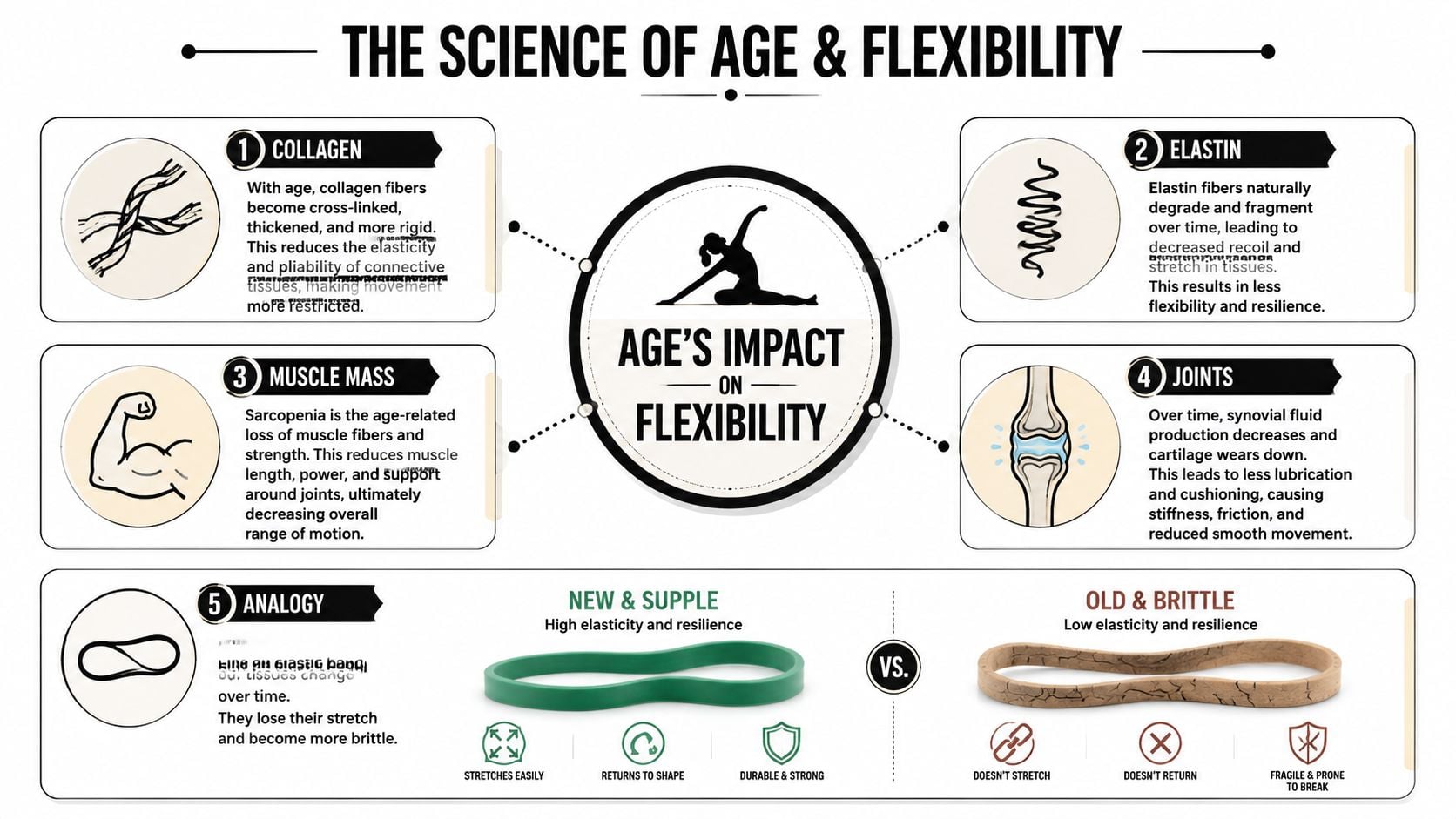
The easiest way to think about it is this. Young tissue behaves more like a fresh elastic band. Older tissue behaves more like one that's been sitting in a drawer for years. It can still stretch, but it doesn't rebound the same way, and it usually needs more gradual loading.
Why tissue quality changes over time
The main drivers of age-related flexibility loss are muscle-tendon stiffening, connective-tissue changes, and reduced joint lubrication and elasticity, with inactivity making that decline worse, as summarized in this overview of aging and flexibility. In plain terms, tissues don't glide or stretch as easily, and joints often feel less smooth at the start of movement.
That's why a stretch can feel different at different ages. The sensation isn't only “tight muscle.” It may involve tendon stiffness, capsular restriction around the joint, reduced elastic recoil, or poor motor control at end range. In clinic, that distinction matters because each problem responds to a different intervention.
A common mistake is assuming more aggressive stretching will solve all of it. It usually won't. If a hip is stiff because the surrounding muscles are guarding and the athlete lacks strength in the available range, cranking harder into the stretch can just create irritation.
Older tissues usually respond better to consistent loading than occasional forcing.
For athletes who want to support joint health more broadly, resources on movement-based cartilage care can be useful. A practical example is BionicGym for stronger joints, which highlights why regular motion matters for joint surfaces that don't love long stretches of inactivity.
What works better than random stretching
The most effective programs usually combine three things:
- Repeated movement exposure: Controlled, regular motion reminds the body that range is available and safe.
- Strength through range: Loading a joint at the edges of available motion helps the body keep that motion.
- Technique correction: If the athlete keeps compensating, the stiffness pattern often returns.
That's one reason posture-only fixes rarely hold. For example, someone working on pelvic control may need more than cueing. They may need hip mobility, trunk control, and strength pairing. If that sounds familiar, this guide on how to fix anterior pelvic tilt connects the mobility side to the strength side in a way athletes can apply.
The key point is simple. Age changes tissue behavior, but tissue still adapts. Flexibility is more trainable than commonly assumed, especially when the program addresses the underlying reason the movement is limited.
The Real Rate of Flexibility Loss and When It Starts
Many individuals want to know whether what they're feeling is normal. There is some solid research here, and it gives a useful benchmark without turning every stiff hip into a problem.
What the research actually found
A 2013 study of disability-free older adults aged 55 to 86 found that flexibility declined by about 6 degrees per decade in both the shoulder and hip joints. In hip flexion, the decline was about 7 degrees per decade for women and about 6 degrees per decade for men. The researchers also found that age and daily activity together explained only 9% of the variance in hip flexion in women and 10% in men, which suggests that the loss wasn't only a matter of moving less.
The same study found that significant declines in shoulder and hip flexibility became more apparent after age 70. In men, the decline accelerated at about 1.16 degrees per year beginning around age 71.
What those numbers mean in real life
Those numbers are population averages, not a verdict on your body. One athlete may hold onto motion well because they've trained through full range for years. Another may feel limited earlier because their sport uses repetitive patterns, they sit more for work, or they've had old injuries that changed how they move.
That's why “normal aging” can be a misleading label. Some loss is expected over time, but the day-to-day impact varies a lot. What matters clinically is whether the stiffness changes function. Are you cutting your stride short? Losing squat depth? Compensating through the low back? Struggling to hit positions you need for your sport?
Research gives you the average trend. Your movement exam tells you what's happening in your body.
The most important takeaway from the data is encouraging. Since age-related loss isn't explained away by activity alone, nobody should expect general exercise by itself to fully protect flexibility. If range of motion matters to your sport or recovery, you need direct flexibility and mobility work, not just more workouts.
Flexibility Demands for Athletes Dancers and Active Adults
Flexibility doesn't mean the same thing for every athlete. A runner doesn't need the same end-range control as a dancer. A baseball player doesn't need the same joint demands as someone recovering from ACL surgery. The question isn't “am I flexible?” It's “do I have enough motion, in the right places, for what I ask my body to do?”
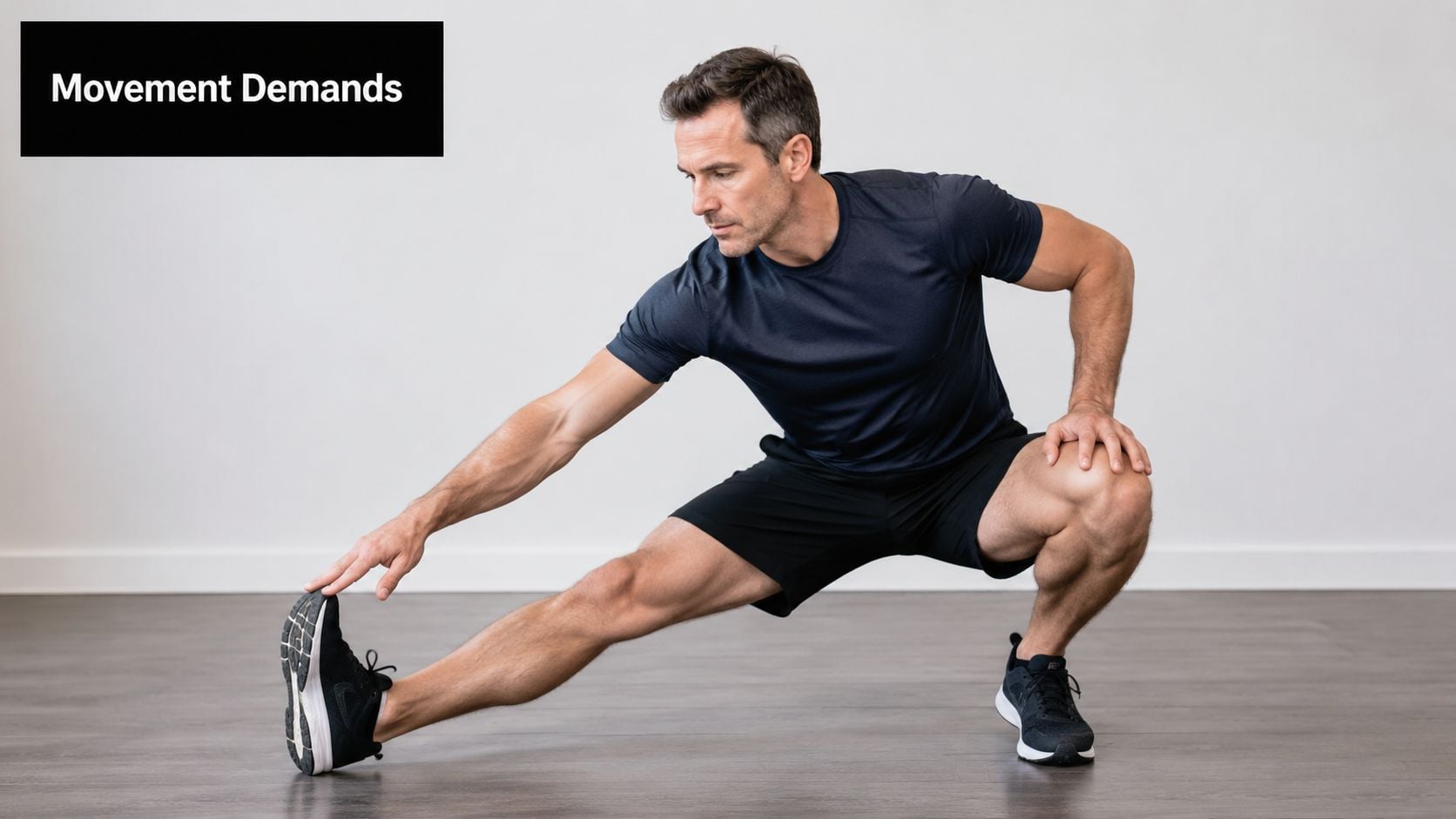
Adult runners
Runners usually notice stiffness in the hips, calves, and big toe before they call it a flexibility issue. They'll say their stride feels choppy, their leg swing feels restricted, or their pace falls off when they're not even that out of shape.
What often matters isn't extreme flexibility. It's enough motion to load and unload cleanly. If hip extension is limited, the body may borrow motion from the low back. If the ankle doesn't move well, the runner may rotate the foot out or overload the calf and Achilles.
A practical runner-focused screen looks at:
- Hip extension quality: Can you open the back leg without arching your low back?
- Ankle dorsiflexion in a squat or split stance: Do you have room to absorb force?
- Thoracic rotation: Can your trunk rotate smoothly, or do your shoulders and neck do too much?
Dancers
For dancers, age-related changes can feel personal because flexibility is tied directly to line, height, and precision. An arabesque that felt available in your twenties may now require more preparation and better strength support. A deep plié may feel pinchy if the hips and ankles don't share the work.
In this population, passive flexibility by itself isn't enough. Dancers need active control at end range. That's why turnout, extension, and back mobility work have to be paired with stability and technique. For dancers working on hip motion specifically, how to improve turnout is a useful next read because turnout problems are rarely just about stretching harder.
Dancers usually do best when they stop chasing maximum range and start building ownership of the range they already have.
Field and court athletes
Athletes in soccer, lacrosse, baseball, softball, tennis, and basketball often lose motion in the places they repeatedly load. The overhead athlete may get stiff through the thoracic spine or lats. The cutting athlete may lose hip rotation or ankle mobility. The weight room athlete may feel strong but still lack the movement quality needed for clean acceleration, deceleration, and rotation.
Flexibility becomes a performance issue, not just a comfort issue. If the body can't access the position, power leaks somewhere else.
Post-surgical athletes and ACL recovery
After surgery, flexibility takes on a different role. It's not optional. It's a milestone.
In ACL rehab especially, early restoration of knee motion matters because gait, quad activation, step-down control, and later return-to-sport testing all depend on it. The athlete who says “it's just stiff” may be dealing with a problem that changes every later stage of recovery. The same goes for hip, shoulder, and ankle surgeries. Motion sets the base for loading.
For post-op athletes, the trade-off is real. Push too little and stiffness hangs around. Push too hard and the joint gets angry. That's why guided progression matters so much.
Assessing Your Flexibility A Clinical Approach
Flexibility is often judged by feel. That's understandable, but it misses the important part. A tight feeling doesn't tell you whether the limitation comes from muscle, joint capsule, tendon, nerve sensitivity, swelling, pain guarding, or movement habit.
A clinical exam separates those pieces. That's how you stop guessing.
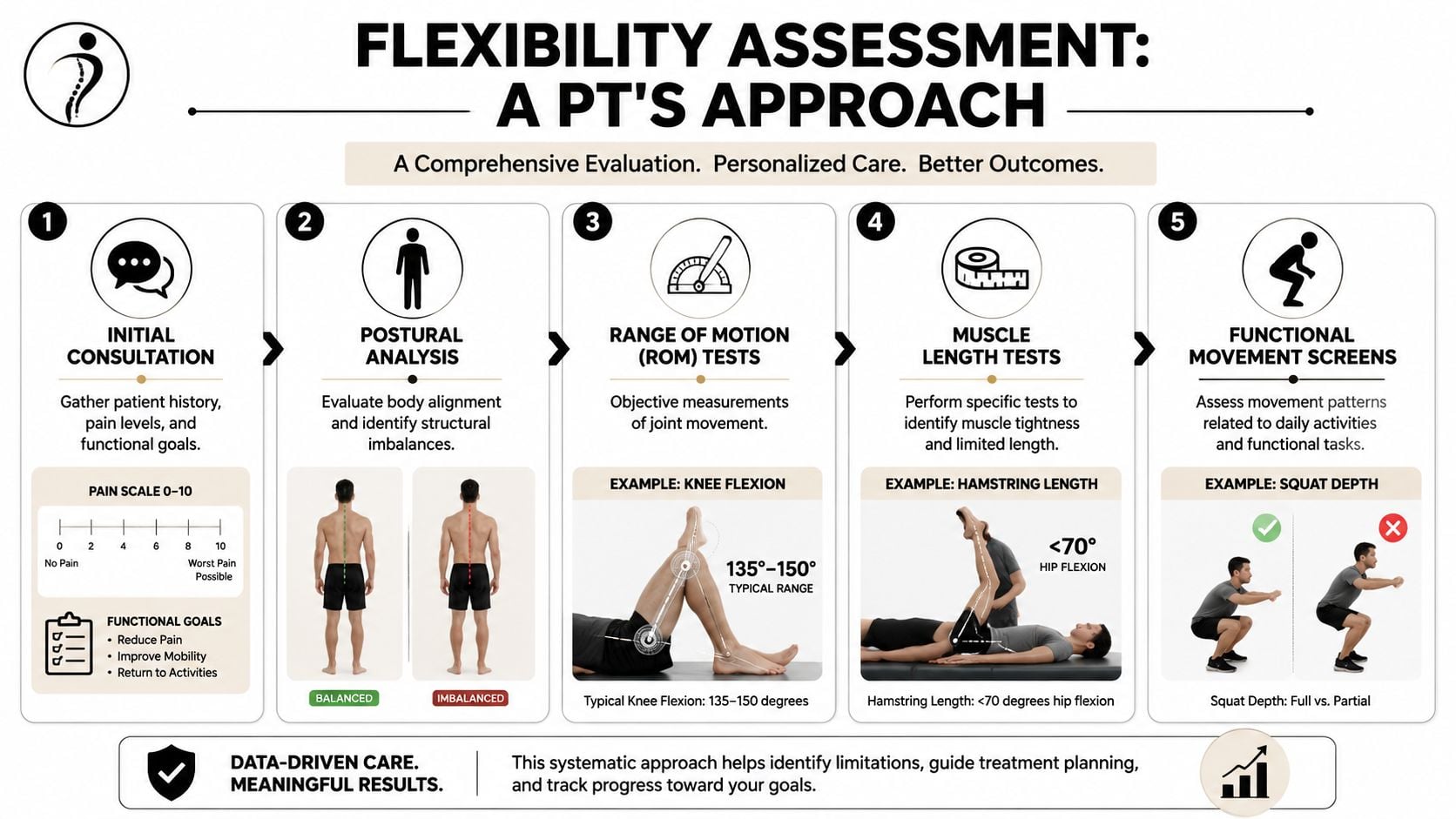
What a clinician is actually measuring
A sports physical therapist usually starts with the story behind the stiffness. When do you feel it? Warm-up only, or all day? Does it improve with movement, or worsen? Is the block muscular, pinching, unstable, or nerve-like?
Then comes measurement. That may include a goniometer for joint angles, muscle length tests, and movement screens like a squat, lunge, overhead reach, or single-leg pattern. In athletes, the exam also looks at sport demands. A pitcher needs a different shoulder picture than a powerlifter. A dancer needs different hip and foot findings than a runner.
Common parts of the exam include:
- Joint range of motion: Passive and active motion aren't always the same, and that difference matters.
- Muscle length testing: This helps identify whether a specific muscle group is limiting the movement.
- Movement quality: The body may technically reach the position, but only with obvious compensation.
- Side-to-side comparison: Useful, but only in context. A “better” side can still be limited.
What matters more than a single number
A single range-of-motion number doesn't tell the whole story. Two people can have the same hamstring length on paper and move very differently. One controls the position well. The other reaches it by rounding the spine or shifting weight.
The best flexibility assessment asks two questions at once. How far can you move, and how well can you use that range?
That's why treatment plans built from internet stretch lists often stall. They don't identify the actual limiter. If the ankle is stiff because the joint itself needs mobilization, calf stretching alone may do very little. If the hamstrings always feel tight because the pelvis is poorly controlled, the issue may be strength and position, not true shortness.
This is also why in-person assessment matters for athletes in Bridgewater, Massachusetts, and across the South Shore Massachusetts area, including Plymouth, Raynham, East Bridgewater, West Bridgewater, Buzzards Bay, and Middleborough. General advice can help. Individual testing is what makes the plan precise.
Your Action Plan for Fighting Age-Related Stiffness
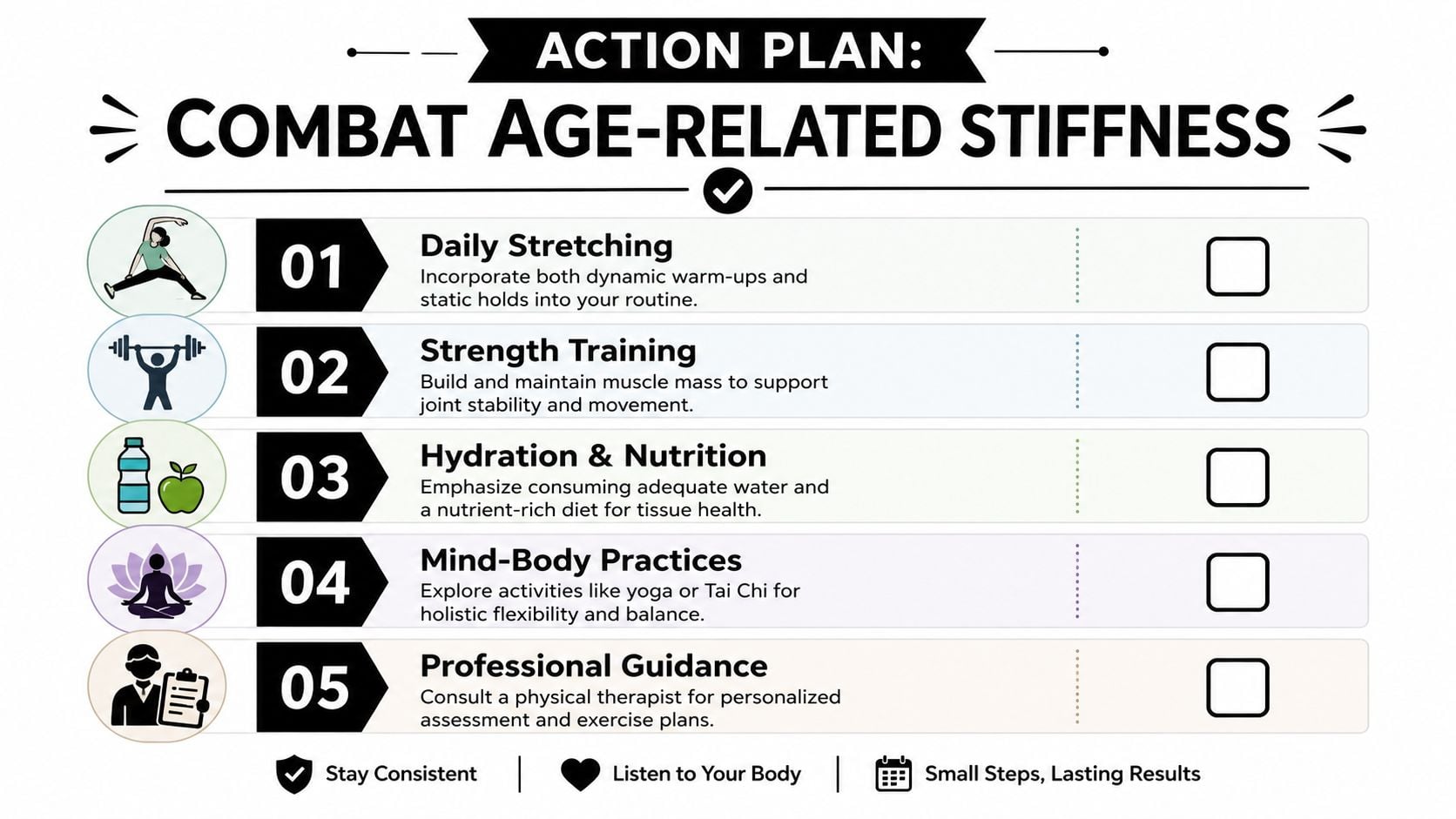
The best flexibility programs aren't built around one magic stretch. They combine prep work, tissue loading, and consistency. If you want your body to move better with age, train range of motion the same way you train strength. Repeatedly. Progressively. With intent.
Use dynamic work before training
Dynamic mobility works best before lifting, running, practice, or field sessions because it raises tissue temperature and rehearses positions you're about to use.
Try a short sequence like this:
- Leg swings: Hold a wall or rack. Swing front to back, then side to side, with control. Keep the trunk quiet.
- Walking lunges with reach: Step into the lunge, then add a gentle overhead or rotational reach to open the hip and trunk.
- World's greatest stretch: Move slowly. Don't rush the transitions.
- Ankle rocks in split stance: Drive the knee forward over the foot without lifting the heel.
If mornings are your toughest time, a simple routine can help you get moving before training or work. For a general home-based option, Family Caregiving Kit's morning stretches offer easy movement ideas that can be adapted for active adults who wake up stiff.
Here's a visual demonstration you can follow:
Use static stretching after training or on recovery days
Static stretching still has value. It's just often used at the wrong time. If your goal is recovery, downshifting, or gradually improving tolerance at end range, it finds better application.
A few reliable options:
- Calf stretch at wall: Keep the heel down and the foot straight. Don't let the arch collapse.
- Half-kneeling hip flexor stretch: Tuck the pelvis slightly before shifting forward. This is often felt more once they stop arching the low back.
- Supine hamstring stretch with strap: Keep the opposite leg bent if your pelvis wants to roll.
- Child's pose with side reach: Useful for lats and trunk if overhead work feels restricted.
Don't turn static stretching into a fight. If you're holding your breath and bracing your face, you're probably pushing too hard.
Train strength through full range
This is the piece people skip, and it's often the one that makes flexibility gains stick. If you only stretch into a range but never own it under load, the body has no reason to keep it.
Build that ownership with exercises like:
- Deep goblet squat to tolerance: Use a counterbalance if needed and pause where you can maintain position.
- Rear-foot raised split squat: Great for hip extension and front-leg ankle mobility when performed with control.
- Romanian deadlift: Helps load the posterior chain at longer muscle lengths.
- Cossack squat or lateral squat variation: Useful for adductors and frontal-plane hip mobility.
If lateral hip weakness keeps pulling you into poor positions, targeted strengthening matters. This guide on how to strengthen hip abductors pairs well with flexibility work because stronger hips usually improve control at the ranges you're trying to keep.
Flexibility that lasts usually comes from a combination of motion and strength, not stretching alone.
Add recovery tools when they fit
Manual therapy, myofascial work, dry needling, foam rolling, and massage guns can all help, but they're support tools. They don't replace the main program.
What they do well:
- Foam rolling: Helpful when tissues feel globally stiff before movement.
- Massage gun use: Can reduce the feeling of tightness in a small area before training.
- Dry needling and hands-on treatment: Often useful when a stubborn area keeps guarding and won't relax enough to train effectively.
- Running gait analysis or dance-specific movement review: Useful when technique keeps feeding the same restriction pattern.
What they don't do well is create lasting change by themselves. Use them to open the door, then follow with movement and strength while the body is ready to learn.
Common Questions About Flexibility and Aging
Is it too late to improve flexibility if I'm already feeling older and stiffer
No. Tissue changes with age, but it still adapts. Progress may be slower than it was earlier in life, and the body may need more recovery between hard sessions, but flexibility can still improve when mobility work is paired with strength and consistency.
Can foam rolling or a massage gun replace stretching
Not really. Those tools can make movement feel easier and may reduce the sensation of tightness, which is useful. But if you want lasting change, you still need position-specific mobility and strength work.
Is one yoga class a week enough
It can be a strong start, especially for general mobility and body awareness. But athletes often need more targeted work based on their sport, injury history, or surgery recovery. A runner, dancer, or post-ACL athlete usually benefits from a plan that matches the motions they need.
What is the impact of age on flexibility in the simplest terms
Age tends to make tissues stiffer and joints less easy to move, so positions that once felt natural may require more preparation and more focused training. The good news is that this is modifiable. If stiffness is limiting your running, dance, lifting, or return to sport, the smartest next step is an individual evaluation with a licensed physical therapist.
If you want a personalized plan instead of guessing which stretches to do, book an evaluation with Physical Therapy U. Our licensed DPTs work with runners, dancers, field and court athletes, and post-surgical patients across Bridgewater, Buzzards Bay, and Middleborough to improve mobility, restore strength, and help you return to sport with confidence.
