
You know the feeling. Your calf keeps grabbing at mile three. Your upper trap tightens every time you throw. Your hip feels like it has one spot that no amount of foam rolling, stretching, or massage can fully change.
For athletes around the South Shore Massachusetts area, that “knot” usually isn't just a nuisance. It changes mechanics, steals power, and makes training feel uneven. Runners shorten stride. Dancers stop trusting turnout. Lifters shift around a side that won't relax. Post-op athletes start guarding instead of moving cleanly.
Dry needling for muscle knots can help, but only when it's used for the right reason and at the right point in a rehab plan. In sports physical therapy, the goal isn't just to make a tight spot feel better for a day. The goal is to reduce the pain and guarding enough that you can move better, load better, and get back to sport with fewer compensations.
Table of Contents
- That Stubborn Knot That Just Won't Quit
- Decoding the Muscle Knot A Trigger Point Explainer
- How Dry Needling Releases Stubborn Muscle Knots
- The Evidence for Dry Needling What Athletes Should Know
- Dry Needling vs Acupuncture vs Trigger Point Injections
- Your Dry Needling Session at PTU From Start to Finish
- Is Dry Needling Right For You Next Steps at PTU
- Frequently Asked Questions About Dry Needling
That Stubborn Knot That Just Won't Quit
A high school runner from Bridgewater, Massachusetts finishes practice and spends twenty minutes on a foam roller. The calf still feels ropey. A baseball player from Taunton gets manual work every week, but the back-side shoulder tightness keeps coming back when throwing volume climbs. A dancer near Plymouth stretches constantly, yet the same deep hip spot still blocks clean movement.
That pattern matters. If the same area keeps tightening despite rest, stretching, and self-release, the problem usually isn't “you haven't worked hard enough on recovery.” It's often that the painful spot is only one piece of a larger movement problem.
In sports PT, that's where dry needling sometimes earns its place. It can calm down an irritable trigger point, reduce guarding, and create a short window where movement feels more normal again. That window is useful if you immediately follow it with the right loading, mobility work, or retraining.
Dry needling isn't a magic trick for athletes. It's a tool that can make the next part of rehab work better.
The athletes who do best with it are usually the ones who need a reset, not a passive fix. Think of the runner whose glute won't engage well because the hip flexor and adductor stay locked down. Or the ACL athlete who has the quad strength on paper but still guards around a stubborn band of tightness.
What doesn't work is treating the knot like the entire diagnosis. If a muscle keeps “re-knotting,” something is still driving it. Training load, landing mechanics, stride pattern, joint stiffness, post-surgical compensation, and recovery habits all matter.
That's why athlete-centered care in places like Bridgewater, Buzzards Bay, and Middleborough has to go beyond symptom chasing. Needling may help the knot. Performance rehab has to fix why it keeps showing up.
Decoding the Muscle Knot A Trigger Point Explainer
A muscle knot is the everyday label for a myofascial trigger point. In the clinic, that means a small, irritable spot within a tight band of muscle that is tender to pressure and can reproduce familiar pain. Athletes know the feeling right away. It is the spot you press and say, “That's it.”
What matters is that the knot is rarely the whole story. It is a local problem inside the muscle, but it often shows up because the larger system is under strain. A calf trigger point after a jump in sprint work means something different than a posterior shoulder trigger point in a pitcher late in a throwing cycle.
Why athletes get them
Trigger points tend to develop when a muscle is asked to do more work than it can recover from well, or when it keeps covering for something else.
Common patterns include:
- Repetitive loading: Runners often feel them in the calves, hip flexors, glutes, or hamstrings as mileage, hills, or speed work climb.
- High-skill repetition: Swimmers, throwers, and tennis players often develop them around the shoulder because the same motion is repeated under fatigue.
- Sustained positions: Cyclists, desk-bound athletes, and students can build up stiffness in the neck, upper traps, or hips from long hours in one posture.
- Movement compensation: After an ankle sprain, ACL surgery, or a back flare-up, nearby muscles often take on extra work to protect the area.
That last point gets missed all the time.
A “knot” can be painful on its own, but in athletes it often acts more like a warning light. The tissue is overloaded, guarding, or working around a mobility, strength, or control problem somewhere else.
Why location matters
The body region gives clues about the driver. A distance runner with a stubborn soleus trigger point may be dealing with load tolerance, ankle stiffness, or stride mechanics. An overhead athlete with trigger points around the posterior cuff and upper trap may be missing thoracic rotation, shoulder control, or force transfer from the trunk.
A few common sport patterns:
- Runners: calf, soleus, glute med, TFL, hip rotators
- Dancers: calves, foot intrinsics, hip flexors, adductors, deep rotators
- Lifters: upper traps, lats, pec minor, glutes, lumbar-adjacent tissue
- Overhead athletes: posterior cuff, upper trap, levator, pecs, forearm flexors
In sports physical therapy, the exam has to go beyond finding the tender spot. We look at what movement brings it on, what training load keeps it irritated, and which joints or muscle groups are not contributing enough.
For athletes who have already tried stretching, massage guns, and foam rolling, myofascial therapy options at PTU may help calm the tissue down. The bigger goal is to restore cleaner movement and better load sharing so the same knot does not keep showing up every training block.
How Dry Needling Releases Stubborn Muscle Knots
Dry needling works best when the problem is specific. An athlete points to one stubborn spot in the calf, posterior shoulder, hip, or forearm that keeps tightening back up, and the exam confirms a trigger point that reproduces the familiar pain pattern.
The treatment uses a thin filiform needle placed into that irritable band of muscle. The goal is not to chase a vague sense of tightness. The goal is to reach the tissue that is staying overactive and interfering with clean movement.
What the needle is targeting
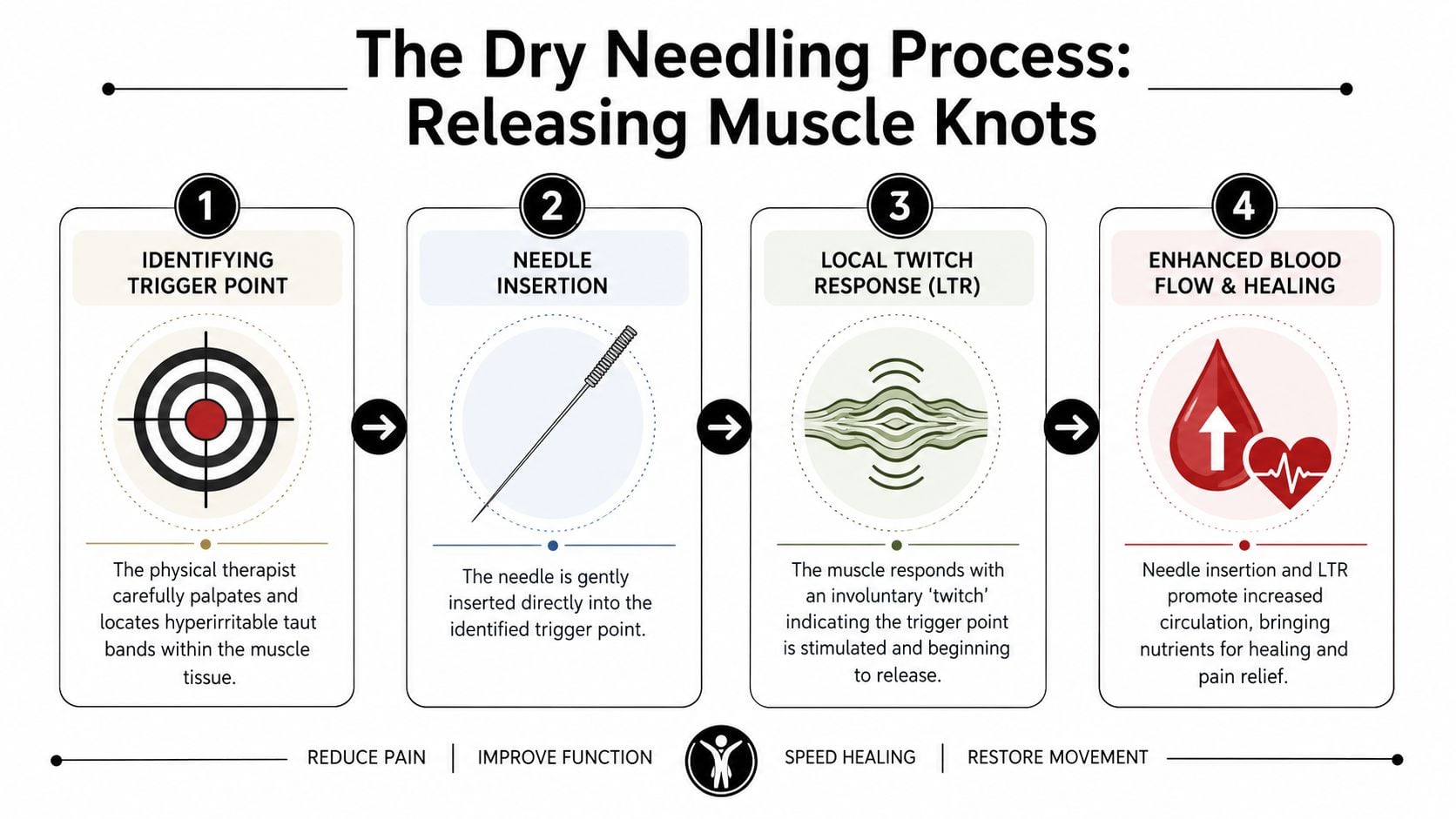
When the needle reaches the trigger point, the muscle may give a local twitch response. Athletes usually describe it as a quick grab, jump, or deep cramp-like sensation. It is brief.
That response matters because it tells us the needle contacted the irritated tissue, but the twitch itself is not the finish line. The more useful change is what happens right after. The area often becomes less guarded, pressure sensitivity drops, and motion can improve enough to train the pattern that was limited before.
A better way to frame dry needling is this: it gives the nervous system a precise input to a muscle that has been stuck in a protective loop. In the right patient, that can reduce irritability and create a short period where movement is easier to restore.
Why the response matters in sports rehab
Some insertions produce a clear twitch. Some do not. A strong response can be useful, but it is only one part of the session.
What I care about more is whether the athlete can use that change right away:
- Better motion: the ankle bends further, the shoulder clears overhead with less pinch, or the hip rotates with less resistance
- Less protective tension: the muscle stops bracing during basic movement or loading
- Cleaner strength work: the right muscle group starts carrying the work again instead of the pattern getting hijacked
- More accurate retesting: painful movement becomes easier to assess because guarding has dropped
Practical rule: If dry needling helps, the next twenty to thirty minutes matter. Use that time for mobility, strength, coordination, or sport-specific drills that reinforce the new motion.
For a high-performing athlete, that is an important value. Dry needling can open a window. During that window, we can reinforce better sprint mechanics, single-leg control, shoulder position, foot loading, dance-specific mobility, or post-op movement quality.
There is a trade-off here. Needling can calm an irritable area quickly, but the effect usually does not last if the underlying driver stays in place. If a calf trigger point comes from poor ankle mechanics and overstriding, the tissue may settle down for a bit, then tighten again on the next hard run. The same pattern shows up in dancers who keep forcing turnout and throwers who lack thoracic motion and ask the shoulder to make up the difference.
Precision matters. Timing matters. What the athlete does after the needle matters most.
The Evidence for Dry Needling What Athletes Should Know
The research on dry needling is useful, but only if you read it without overselling it.
A 2017 systematic review in the Journal of Orthopaedic & Sports Physical Therapy found very low- to moderate-quality evidence that dry needling helps musculoskeletal pain in the immediate to 12-week period. It reported a moderate effect size for pain reduction versus control or sham at short follow-up, with SMD −0.7 (95% CI −1.06 to −0.34), but when compared with other physical therapy treatments the effect was almost null at SMD −0.01 (95% CI −0.49 to 0.47) in the same review, which you can read in the JOSPT systematic review on dry needling.
What research supports
For athletes, the practical takeaway is straightforward. Dry needling can help reduce pain in the short term. It may also make motion easier during the period right after treatment and over the following weeks.
That's valuable in sports rehab because short-term relief is not trivial. If a runner can load the calf better, a pitcher can get through mobility work without guarding, or an ACL athlete can regain cleaner quad function, that can move rehab forward.
Where athletes get misled
The weak point is durability when needling gets treated like a standalone answer.
The same review found that dry needling didn't clearly outperform other active physical therapy approaches. That doesn't mean it doesn't work. It means it works best when used as an adjunct. In real practice, it helps create the conditions for better rehab. It does not replace strength work, running gait analysis, return-to-sport testing, dance-specific control, or sport-specific retraining.
If you want a treatment that makes a muscle feel different today, dry needling can fit. If you want the result to hold up under sprinting, cutting, jumping, lifting, or dancing, the exercise plan is what makes it stick.
Athletes should be selective. If someone offers dry needling for muscle knots with no discussion of mechanics, training load, or what happens afterward, that's incomplete care. The best use case is not “needle and leave.” It's “needle, then retrain.”
Dry Needling vs Acupuncture vs Trigger Point Injections
Athletes often lump these together because they all involve needles. Clinically, they're different tools with different goals.
A quick comparison
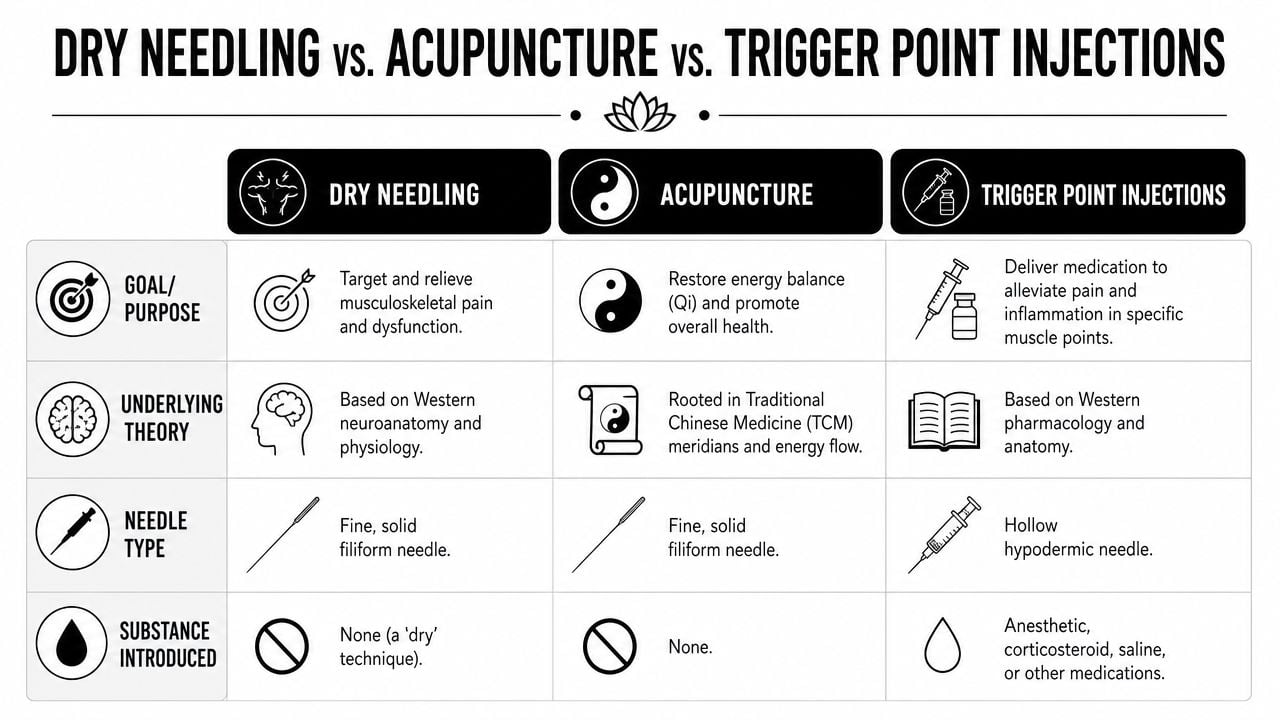
| Approach | Main goal | Framework | Needle type | Substance introduced | Typical provider |
|---|---|---|---|---|---|
| Dry needling | Relieve musculoskeletal pain and dysfunction tied to trigger points | Western anatomy and physiology | Fine solid filiform needle | None | PTs with appropriate training, depending on state rules |
| Acupuncture | Support symptom relief and whole-body balance | Traditional Chinese Medicine | Fine solid filiform needle | None | Licensed acupuncturists and other trained providers |
| Trigger point injections | Deliver medication into a painful point | Anatomy plus pharmacology | Hollow hypodermic needle | Medication or other solution | Medical providers |
Dry needling and acupuncture may use similar-looking needles, but they are not the same intervention. Dry needling targets a palpable trigger point in a muscle based on a musculoskeletal exam. Acupuncture follows a different diagnostic model and treatment philosophy.
That matters because the choice should match the problem. If the issue is a sport-specific mobility restriction and painful trigger point in a loaded muscle, dry needling may be appropriate. If someone is exploring broader wellness goals through Traditional Chinese Medicine, a resource on acupuncture benefits for reproductive health can help clarify what that model is trying to treat.
Why the distinction matters
Trigger point injections are different again because they involve introducing a substance through a hollow needle. That's not what happens in dry needling. “Dry” means nothing is injected.
For some athletes, the better comparison isn't dry needling versus acupuncture. It's dry needling versus other rehab tools. If your symptoms are more inflammatory and less trigger-point-driven, a different modality may fit better. For example, laser therapy for inflammation is another option some clinicians use for selected cases.
The big takeaway is simple. Similar tools don't mean similar treatment. The exam should decide the intervention.
Your Dry Needling Session at PTU From Start to Finish
The first part of the appointment isn't the needle. It's the exam.
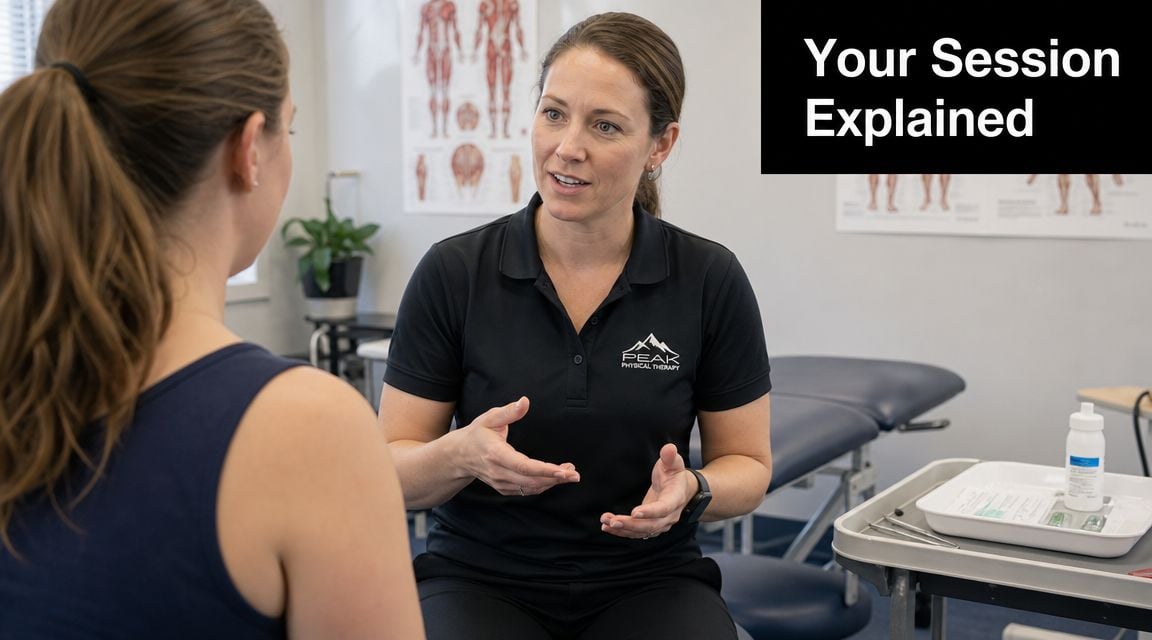
At our sports physical therapy clinics in Bridgewater, Buzzards Bay, and Middleborough, the session starts by identifying whether the painful spot is a trigger point and whether treating it will change something meaningful. We're looking for symptom reproduction, movement restriction, strength compensation, and sport-specific relevance.
What happens before the needle goes in
You'll talk through symptoms, injury history, training load, and any medical factors that matter for safety. Common adverse effects include post-needling soreness, bruising, stiffness, and fatigue, and clinicians screen for issues such as bleeding risk, pregnancy, immunocompromise, or other contraindications, as summarized in this clinical review of dry needling for muscle knots.
Then we decide whether dry needling belongs in the plan that day.
A typical session includes:
- Assessment first: Which movement is limited, painful, or compensating?
- Target selection: Which trigger point is most likely driving that movement problem?
- Consent and positioning: You should know what we're doing and what you may feel.
- Sterile technique: The area is prepared and the needle is placed with a clear anatomical purpose.
- Immediate retest: We recheck the movement that mattered before treatment.
What you may feel during and after
Most athletes describe one of three sensations. A mild pinch at the skin, a deep ache in the muscle, or a quick twitch when the trigger point is hit. None of those automatically means “good” or “bad.” They're just part of the tissue response.
Later that day, some soreness is common. It often feels like you trained a muscle hard or got deep manual work.
Here's a helpful walkthrough if you want to see treatment context before booking:
After treatment, we usually want you moving, not babying the area.
Common post-session guidance includes:
- Easy movement: Light walking or gentle mobility is often better than shutting things down.
- Hydration and normal recovery habits: Nothing fancy. Just solid basics.
- Follow-up exercise: The change is reinforced through follow-up exercise.
- Load adjustment if needed: Heavy lifting, sprinting, or intense practice may need to be modified that day depending on the area treated.
For athletes who are needle-averse but still want non-medication options for symptom control, approaches that address headaches without needles can be a useful parallel example of how treatment can be matched to tolerance.
Is Dry Needling Right For You Next Steps at PTU
Dry needling is usually worth considering when the painful spot is reproducible, clearly limiting movement, and tied to a sport or rehab task that matters. It tends to fit best when an athlete has already tried basic self-care and the tissue still won't let go.
Good candidates
Athletes who commonly benefit include:
- Runners with stubborn calf, glute, or hip tightness that alters stride or keeps returning during training
- Overhead athletes with shoulder or upper back trigger points that interfere with throwing, serving, or swimming
- Dancers with calf, foot, or deep hip restriction affecting turnout, extension, or landing control
- Lifters with recurring trap, lat, or hip tension that limits clean positions under load
- Post-surgical athletes who need less guarding so they can perform their mobility and strength work
Dry needling also makes more sense when it's part of a bigger sports rehab plan. That may include strength progressions, running gait analysis, dance therapy, return-to-sport testing, or home programming that changes the load on the irritated area.
When we pause or choose another option
It's not the right fit for everyone.
We may hold off or choose another route if you have:
- Strong needle anxiety that will make the treatment more stressful than useful
- Medical concerns identified during screening
- A problem that isn't trigger-point-driven and needs a different intervention
- An expectation that needling alone will solve a recurring performance issue
Sometimes athletes ask about recovery tools outside the clinic, from foam rollers to topicals to sprays. If you're curious about broader self-care ideas, this overview of ArtNaturals' wellness spray benefits can give context, but those tools don't replace a movement-based exam.
For some athletes, taping is also part of the bridge between treatment sessions. How to use kinesiology tape is one example of a support strategy that may help with selected movement tasks.

If you're in Bridgewater, Plymouth, Taunton, East Bridgewater, West Bridgewater, Raynham, Buzzards Bay, or Middleborough and you're dealing with a knot that keeps changing your training, the next step is an evaluation with a licensed PT. The exam should tell you whether the target is a true trigger point, what's driving it, and whether dry needling belongs in your plan.
Frequently Asked Questions About Dry Needling
Does dry needling hurt
Usually, it's tolerable. The skin insertion is often brief. The more noticeable sensation is the deep ache or twitch when the needle reaches the trigger point.
For athletes, the bigger issue is usually post-treatment soreness later that day. That's common and doesn't necessarily mean anything went wrong.
How many sessions will I need
There isn't one standard number that fits everybody. A runner with a simple calf trigger point and a clear loading problem is different from a post-op athlete with multiple compensations.
What matters most is whether each session changes a meaningful sign. Better range, less pain with a specific drill, improved recruitment, or cleaner mechanics. If the treatment doesn't change anything important, it shouldn't stay in the plan just because it's available.
How long does relief last
This is the question athletes should ask early. A 2022 systematic review found dry needling was superior to sham or no intervention for short-term pain relief, but there was insufficient evidence for long-term benefit, and it was often no better than other physical therapy treatments at follow-up, according to this summary of dry needling evidence in Physio-Pedia.
That lines up with what we see clinically. Relief often lasts longer when the session is tied to active rehab. If you needle a knot and then rebuild nothing around it, the body often falls back into the same pattern.
Is it covered by insurance
Coverage varies by plan and by how your physical therapy benefits are structured. The cleanest answer comes from checking your specific insurance details before the first visit.
A good clinic should help you understand what's covered, what counts as physical therapy care, and what your out-of-pocket responsibility may be.
Is dry needling safe
Current evidence supports it as a widely studied, minimally invasive technique when performed by trained clinicians. A 2023 NIH/PMC review synthesizing multiple meta-analyses reported that dry needling was superior to sham or no intervention and about equally effective to other interventions for short-term pain reduction, generally within the immediate to 12-week period, and safety data from 210 unique randomized controlled trials showed no major adverse events, while minor adverse effects were reported in 47% of trials, including small bruising, bleeding, and pain during or after treatment, as detailed in this NIH-hosted review of dry needling research.
That's reassuring, but it doesn't remove the need for screening, clean technique, and good clinical judgment. This is not a DIY treatment. It should be part of an individualized plan from a licensed PT.
If you're ready to figure out whether dry needling fits your rehab or performance plan, book an evaluation with Physical Therapy U. Our licensed DPTs work with runners, dancers, field and court athletes, and post-surgical patients across Bridgewater, Buzzards Bay, and Middleborough. The goal is simple: identify what's driving the knot, decide whether needling helps, and pair it with the right movement plan so you can get back to training with more confidence.
