
You felt the pop, or maybe it was more of a sharp catch along the inside or outside of the knee. Now the swelling is up, stairs are annoying, squatting feels sketchy, and you’re trying to figure out whether meniscus tear rehab without surgery is realistic or just wishful thinking.
For a lot of athletes, active adults, runners, and dancers, non-surgical rehab is absolutely a reasonable path. But it only works when the tear is the right kind, the loading is progressed correctly, and the return to sport phase is treated like training, not guesswork. Generic handouts don’t cover that well.
At our sports PT clinic in South Shore Massachusetts, we see this all the time. The athlete doesn’t just want less pain. They want to run, cut, land, pivot, lift, or dance without feeling like the knee is one awkward move away from flaring up again.
Table of Contents
- First, Is Conservative Care Right for You?
- The Acute Phase: Controlling Pain and Swelling
- The Loading Phase: Building Strength and Stability
- The Performance Phase: Sport-Specific Return-to-Play
- Advanced Rehab Tools and When to Consider Surgery
- Your Next Steps with Physical Therapy U
First, Is Conservative Care Right for You?
Wanting to avoid surgery makes sense. Surgery means downtime, post-op restrictions, and for many athletes, a longer runway back to training. But not every meniscus tear should be managed conservatively, and pretending otherwise can cost you time.
A meniscus is a shock-absorbing cartilage structure in the knee. Some tears have better healing potential than others, especially when they’re more stable and located in the outer, more vascular part of the meniscus. Clinical rehab guidance notes that nonoperative care is commonly used for stable tears in the red-red or red-white zones with good vascularity through a phased, criterion-based progression that starts with swelling control, range of motion, and strengthening (rehab protocol details).
What tends to respond well to rehab
The best candidates for meniscus tear rehab without surgery usually have a knee that’s irritated, but still moving. They can often bear some weight, gradually restore extension, and improve with a structured program instead of feeling mechanically blocked.
Good signs for a PT-first approach often include:
- A stable presentation where the knee isn’t fully locking
- Symptoms that calm down with load modification
- Steady improvement in swelling, walking tolerance, and range of motion
- A clear training goal so rehab can be customized to running, dance, lifting, or field sport demands
If you’re looking for home strategies to settle general knee irritation while you wait to be evaluated, these proven exercises for knee discomfort are a reasonable starting point as long as they don’t increase catching, locking, or swelling.
Red flags that need a medical consult
Some knees need physician input quickly. That doesn’t automatically mean surgery, but it does mean don’t try to self-rehab through it.
Get evaluated promptly if you have:
- A locked knee that won’t fully straighten
- Inability to bear weight
- A major twisting injury with immediate swelling
- Repeated buckling
- Sharp mechanical catching that’s getting worse
- Loss of motion that isn’t improving
Practical rule: If the knee feels blocked rather than just stiff, that’s different. Stiffness often improves with movement. A true block usually doesn’t.
For athletes and parents trying to sort out next steps, our sports rehab FAQ can help frame the right questions before your appointment. Still, an in-person exam matters most. A licensed PT or physician needs to test joint line tenderness, swelling, gait, range of motion, and whether your symptoms behave like an irritable but rehab-able knee or something more unstable.
The Acute Phase: Controlling Pain and Swelling
You twist on a cut, finish the session, and wake up the next morning with a knee that feels full, stiff, and unreliable. In that moment, the job is to settle the joint enough that you can walk cleanly, fully straighten the knee, and start loading it again without stirring everything up.
Early rehab works best when we treat irritability first. Swelling inhibits the quadriceps, pain changes gait, and athletes start borrowing motion from the hip, ankle, or opposite leg. That compensation is common in runners, dancers, and field sport athletes, and it usually makes the knee harder to calm down.
What matters in the first two weeks
Our priorities in the acute phase are straightforward. Reduce swelling, restore full extension, keep a tolerable amount of motion, and clean up your walking pattern.
For many athletes, that means a temporary pullback from the exact movements that irritated the knee in the first place:
- Pause cutting, pivoting, jumping, and deep squatting
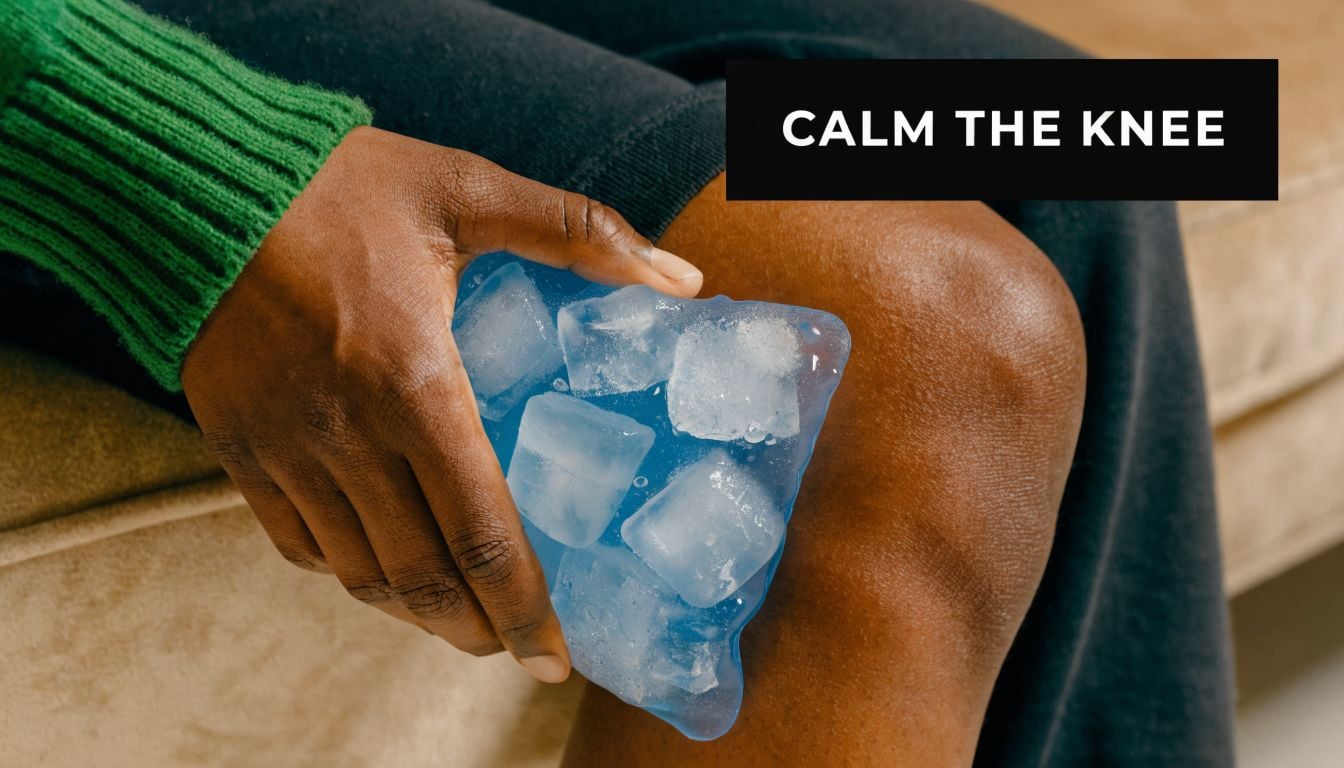
- Use ice or cold therapy after flare-ups if it helps your pain and swelling response
- Add compression and elevation to manage joint fullness
- Keep the knee moving gently instead of resting it completely still
- Use crutches if needed so you are not limping all day
Cold can help, but the method matters less than consistency. If you want a broader comparison of cold strategies for recovery, this guide on athletic recovery via ice baths gives useful context. For an irritable meniscus, we care more about whether the knee feels less swollen and moves better afterward than whether you used a bucket, sleeve, or ice pack.
A quieter knee responds better to exercise.
If pain stays high or swelling lingers, we sometimes add symptom-modulation tools early while keeping exercise at the center of the plan. Our page on laser therapy for orthopedic rehab explains how we use that option to support rehab, not replace it.
The early exercise menu
The acute phase should feel controlled. You should finish a session with the knee feeling the same or slightly better, not more puffy or more guarded two hours later.
A typical early menu includes:
- Quad sets to restore active knee extension and get the quadriceps firing again
- Heel slides to regain bend without forcing range
- Ankle pumps to keep circulation and low-level movement going
- Weight shifts or gait retraining if you are unloading the injured side or limping
We adjust those basics to the athlete in front of us. A runner may need earlier attention to stride symmetry and tolerance for repeated weight acceptance. A dancer often needs careful control of end-range positions and rotation demands. A soccer or basketball player usually needs stricter limits on twisting early because that is the movement that keeps re-irritating the joint.
These details matter. Generic online advice often stops at “rest and do a few exercises.” Our approach is phased and sport-specific from the start, even in the acute window, because the way a runner loads the knee is different from the way a dancer lands or a midfielder cuts.
A few choices tend to help:
| Early phase choice | Better option |
|---|---|
| Pushing through a limp | Use support until walking is cleaner |
| Forcing deep knee bend | Stay in a comfortable range and build gradually |
| Complete rest | Keep gentle daily motion |
| Passive treatment only | Pair symptom control with active quad work |
The acute phase ends when the knee is less reactive, you can straighten it fully, and daily walking looks more normal. That is the point where strengthening starts to stick instead of setting the joint off again.
The Loading Phase: Building Strength and Stability
You are out of the limp, walking better, and the swelling is calmer. This is the point where motivated athletes often rush. They start adding random gym work because the knee feels “pretty good.” That is usually where irritation comes back.
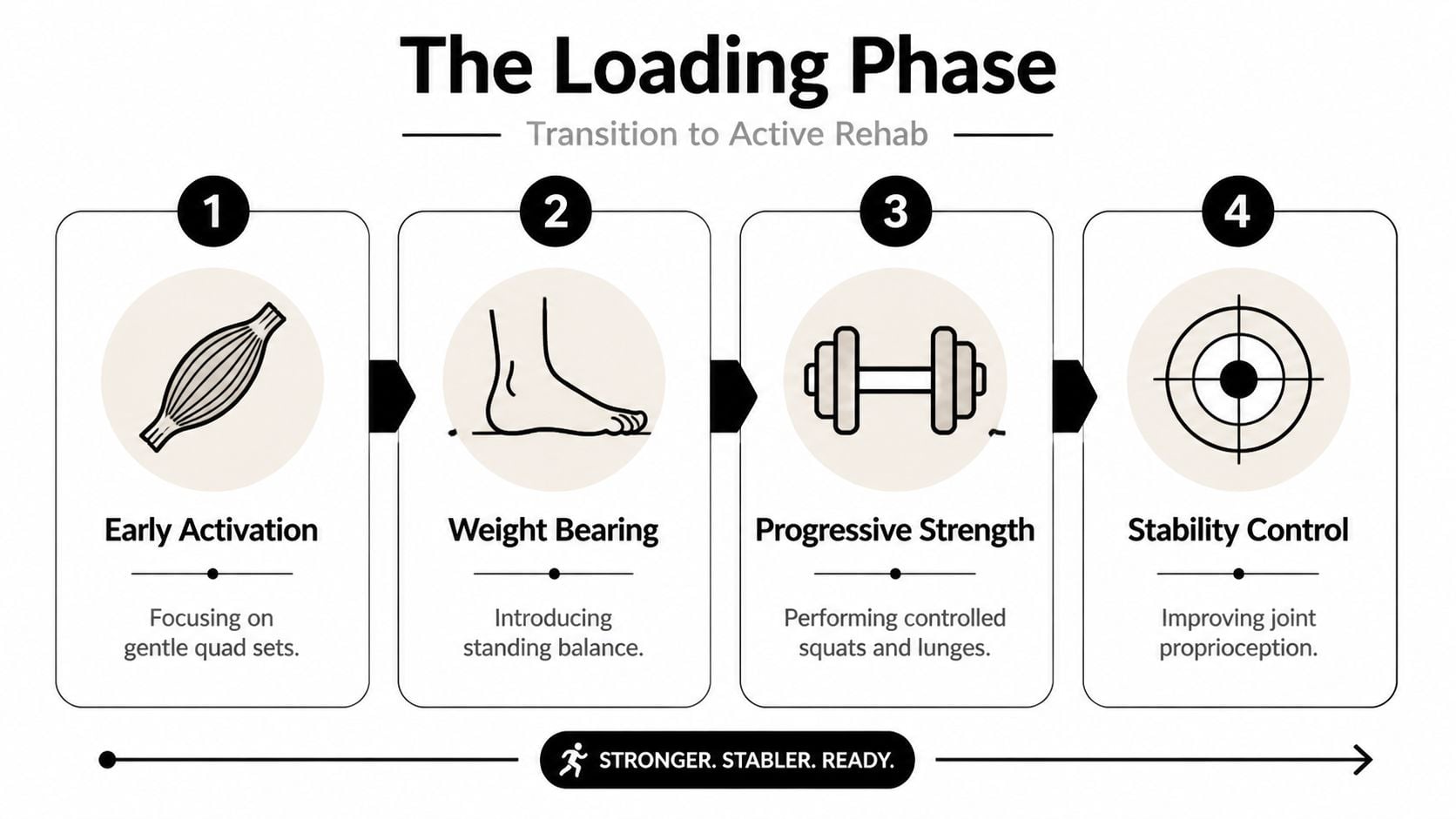
The loading phase is where we build a knee that can accept force repeatedly, not just tolerate a few exercises in the clinic. For a runner, that means better control with every step. For a dancer, it means handling single-leg positions and rotation without the knee drifting or pinching. For field and court athletes, it means restoring strength and deceleration mechanics before cutting ever enters the picture.
How we load the knee without irritating it
We build strength in layers. Early in this phase, closed-chain work and controlled volume usually beat aggressive loading. Research on exercise therapy for degenerative meniscal tears supports a progressive strengthening approach that targets the quadriceps, hips, and functional lower-body control rather than passive care alone (exercise therapy for meniscal tears).
A typical progression in our clinic includes:
- Straight leg raises only if you can keep the knee fully straight throughout the set
- Mini-squats in a comfortable range, often starting shallow and progressing as symptoms allow
- Heel raises to improve calf strength and lower-leg stiffness for walking, running, and landing
- Stationary biking with the seat height adjusted to avoid compressive irritation from too much knee bend
- Step-ups or step-downs with a height that lets you control the femur and pelvis, not just finish the rep
- Hip strengthening such as split-stance work, bridges, or lateral band work, because poor trunk and hip control often shows up as knee overload
Exercise selection matters, but dosage matters just as much.
Three sets of a good movement can calm a knee down. Three sets too many can make it swell later that day. We use symptom response, quality of movement, and next-day tolerance to decide whether to progress, hold, or back off.
What athletes usually get wrong here
The common error is chasing fatigue before earning control. A set can feel hard and still be the wrong stress.
Watch for these signs:
- the knee caves inward on squats or step-downs
- you shift weight off the involved side
- the trunk leans to avoid loading the leg
- pain is acceptable during the session but swelling or stiffness jumps the next morning
That last one matters. Meniscus rehab is often limited by joint irritability more than by pain during the exercise itself.
Benchmarks we use before adding more demand
We want to see clean movement, good tolerance to repeated loading, and clear strength gains before the next jump in difficulty. In practice, that usually means:
- full or near-full motion, especially extension
- good tolerance to biking, squatting, stairs, and single-leg loading drills
- no rebound swelling after strengthening sessions
- visible improvement in quadriceps strength and control compared with the uninvolved side
- better frontal-plane control at the hip and knee during single-leg tasks
For some athletes, this is also the phase where adjunct treatments help. Dry needling can reduce guarding in the quads, calves, or adductors when muscle tone is limiting good movement, but it does not replace loading. It helps you move better so the strengthening work actually sticks.
Athletes with a prior ACL injury often need even tighter criteria here because quad weakness, poor landing mechanics, and hesitation tend to overlap across both problems. If you are already tracking knee rehab between visits, our ACL rehab support app for structured strength and symptom tracking can help keep progressions consistent.
The trade-off in this phase is simple. Progress too slowly and strength lags. Progress too fast and the joint gets reactive again. We aim for steady loading that leaves the knee working, not angry.
The Performance Phase: Sport-Specific Return-to-Play
You finish a strength session feeling good, then the knee gets irritated the first time you cut, land, or string together a few harder efforts. That is the gap between being stronger and being ready for sport.
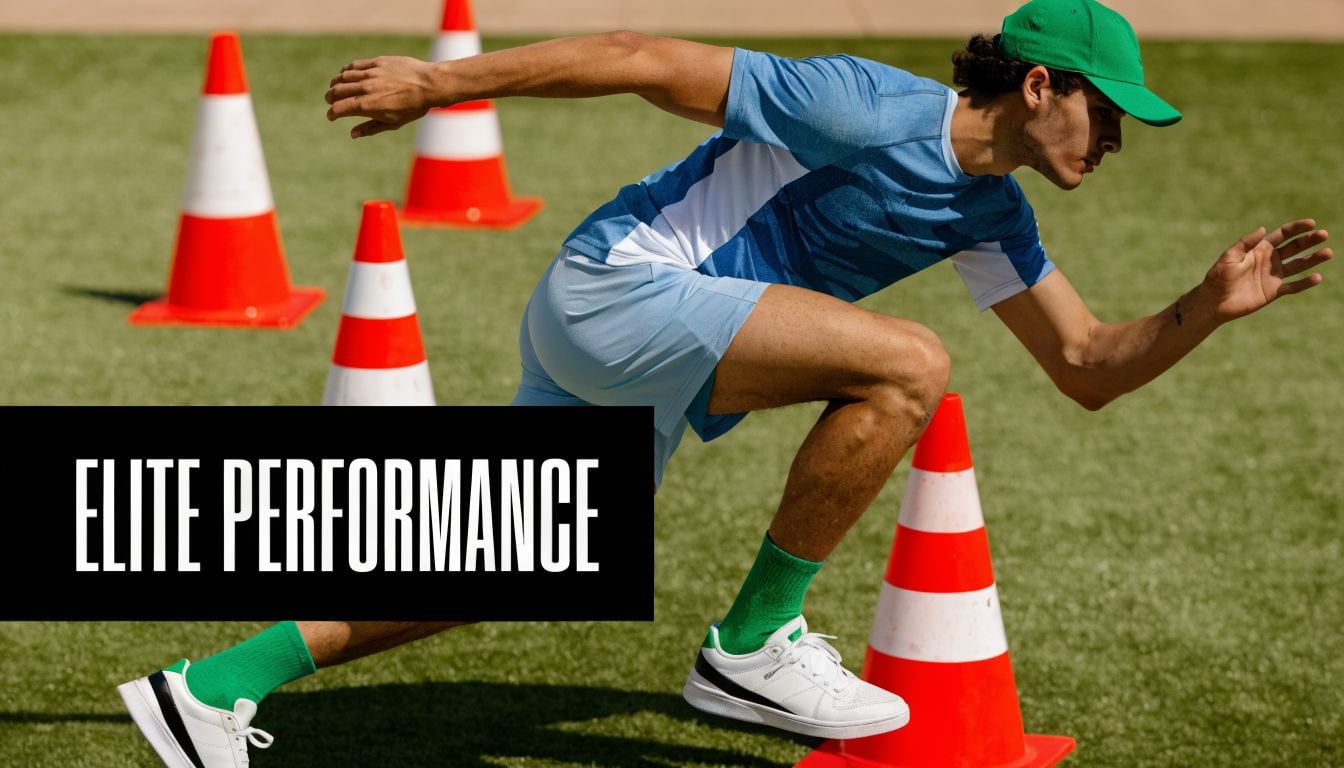
At PTU, we treat this phase as a progression back to your actual sport, not a generic finish line. A runner in East Bridgewater needs repeated impact tolerance and mileage planning. A dancer in Middleborough needs rotational control, end-range confidence, and technical precision under fatigue. A high school soccer player from Taunton needs to decelerate, cut, pivot, and react without the knee getting swollen later that day or the next morning.
That difference matters. Daily life, gym strength, and sport place very different demands on the meniscus and the rest of the kinetic chain.
What this looks like for runners dancers and field athletes
For runners, we build toward impact tolerance first, then volume, then speed. We look closely at cadence, stride mechanics, trunk and pelvic control, and how the knee responds to back-to-back loading exposures. A jog that feels fine during the run but leads to swelling later is still useful information. It tells us the joint is not fully tolerating the dose yet.
For dancers, the work becomes more specific. We focus on single-leg control, rotational stability, landing quality, and alignment in positions that challenge turnout, plié depth, and directional changes. Rehearsal volume matters as much as exercise selection. Many dancers can hit the position once. The essential test is whether they can repeat it cleanly when tired.
For field and court athletes, we progress from planned movement to reactive movement. Strength helps, but sport asks for timing, braking, repositioning, and trust in the knee at speed. We want athletes to own the position, not just survive it.
Our progression often includes:
- Lateral movement drills before unrestricted cutting
- Low-level plyometrics before repeated jumping and bounding
- Single-leg deceleration drills before aggressive change of direction
- Reaction-based drills once planned patterns stay clean under speed and fatigue
Here’s a practical example of movement quality work that often supports this phase:
Why generic rehab falls short
Generic online programs usually stop once the knee bends better, hurts less, and handles basic strengthening. That is not enough for athletes and dancers.
Return to sport should match the demands of the sport. Consensus guidance for meniscal injury management in athletes supports a criteria-based return, with sport-specific testing and gradual exposure to higher-demand tasks rather than a simple time-based clearance (2024 international consensus on meniscus rehabilitation and return to sport). That matches what we see in the clinic. A knee can look good in a controlled setting and still struggle with rotation, contact, fatigue, or repeated impact.
A knee can pass daily life before it’s ready for sport. Those are not the same finish line.
Good return-to-sport testing checks more than strength. We look at symmetry, movement quality, symptom response, confidence, and how your knee handles the specific demands you care about. For a soccer player, that may mean cutting, pivoting, and reacceleration. For a runner, it may mean graded mileage and downhill tolerance. For a dancer, it may mean technical control at end range late in rehearsal.
This phase also gives us room to use the right adjuncts for the right problem. If quad or adductor guarding is limiting clean mechanics, dry needling can help reduce that barrier so the movement session is more productive. Then we reinforce it with loading, footwork, and sport-specific repetition. That athlete-centered sequence is a big part of why our rehab does not stop at generic exercises.
Advanced Rehab Tools and When to Consider Surgery
Some athletes do well with a clean exercise plan and steady load progressions. Others hit a wall because pain stays high, the knee keeps swelling after sessions, or the surrounding muscles stay guarded enough to change mechanics.
In our clinic, we use adjunct treatments for a specific reason. They help the knee tolerate the work that drives recovery.
Where adjunct treatments can help
The right tool depends on the barrier in front of us.
If a runner has persistent irritation after impact progressions, low-level laser therapy may help settle symptoms enough to keep training on track. If a dancer cannot clean up single-leg control because the quad, adductors, or hamstrings keep tightening protectively, dry needling can reduce that guarding and make the movement session more productive. If a field sport athlete predictably swells after harder cutting or deceleration work, compression can help manage the post-session response.
Used well, these tools support the plan. They do not replace strength, loading, or sport-specific progression.
That distinction matters. An athlete who feels better for 24 hours but still cannot squat, land, rotate, or absorb force cleanly is not ready. We use symptom-relief strategies to create a better window for training, then we reinforce that window with exercise that matches the demands of running, dancing, or team sport.
The goal is not to collect treatments. The goal is to remove the barrier that is blocking good rehab.
When conservative care may not be enough
We are straightforward about this. Nonoperative rehab is a strong option for many meniscus injuries, but some knees keep showing signs that the problem is more mechanical than load-related.
An orthopedic consult makes sense when you have:
- Repeated locking episodes
- Ongoing loss of motion despite appropriate rehab
- Major limits with weight bearing that are not improving
- Sharp, consistent catching that does not change with treatment
- Frequent flare-ups even with careful progression
- Sport demands that keep exposing instability or loss of control
Pain alone does not automatically point to surgery. A knee can be painful and still respond well to load management, strength work, and time. A knee that repeatedly blocks motion, catches in the same range, or cannot handle basic progression despite a solid rehab plan deserves a closer surgical discussion.
That is the trade-off. Keep investing in rehab when the knee is trending in the right direction, even if progress is slower than you want. Reconsider the plan when the same mechanical symptoms keep showing up and the exam does not meaningfully change.
Your Next Steps with Physical Therapy U
The biggest mistake athletes make is treating meniscus rehab like a list of exercises instead of a progression. The right exercise at the wrong time can be just as unhelpful as the wrong exercise altogether.
If you’re in Bridgewater, Buzzards Bay, Middleborough, or nearby towns like Plymouth, Taunton, East Bridgewater, West Bridgewater, or Raynham, start with a sports-focused evaluation. That means looking beyond the MRI language and figuring out how your knee behaves with walking, squatting, single-leg control, impact, and the specific demands of your sport.
What to do this week
If the injury is fresh:
- Settle the knee down first with activity modification and swelling control
- Work on extension early rather than forcing deep flexion
- Start basic quad activation if it’s tolerated
- Stop testing the knee with random workouts to “see how it feels”
If you’re farther along but still not back:
- Check whether strength is symmetrical
- Look at movement quality, not just pain level
- Make sure someone has progressed you into sport-specific work
- Address running or dance mechanics if those are part of your goal
What good rehab should feel like
Good rehab is progressive, but not reckless. The knee should feel challenged, not threatened.
A strong plan should answer questions like:
| Question | What you should know |
|---|---|
| Why this exercise now | It matches your current tolerance and deficit |
| What earns the next step | Clear criteria like motion, swelling response, and control |
| How this connects to your sport | The drill should build toward your actual demands |
| When to change course | You should know the signs that warrant further medical review |
The best outcome isn’t just less pain. It’s a knee that holds up when practice gets faster, class gets longer, or mileage starts climbing again. That takes a plan built around performance, not just symptom relief.
If you want help from a sports physical therapy team that works with runners, dancers, youth athletes, active adults, and post-op knee cases across Southeastern Massachusetts, book an evaluation with Physical Therapy U in Bridgewater, Massachusetts, Buzzards Bay, or Middleborough. Our licensed DPTs use athlete-centered rehab, return-to-sport testing, running gait analysis, dry needling, laser therapy, and individualized strength progressions to help you get back with confidence.
Ready to stop guessing and start a real plan? Physical Therapy U serves athletes and active adults across Southeastern Massachusetts with sports physical therapy in Bridgewater, Buzzards Bay, and Middleborough. Book an evaluation to get a clear diagnosis, a phased rehab plan, and return-to-sport guidance that matches your actual goals.
FAQ
Q: Can a meniscus tear heal without surgery?
A: Some can. Stable tears with better healing potential are often managed with a criterion-based rehab program focused on swelling control, range of motion, strength, and gradual return to sport. An in-person evaluation is the best way to know if your presentation fits that path.
Q: What are the best early exercises for meniscus tear rehab without surgery?
A: Early rehab often includes quad sets, heel slides, ankle pumps, and gait work, depending on irritability. The priority is restoring extension and calming swelling before advancing load.
Q: When can I return to running or sports?
A: It depends on symptom behavior, motion, strength, control, and whether you’ve completed sport-specific progressions. Athletes shouldn’t base return only on pain being lower in daily life.
Q: Is dry needling or laser therapy worth it for a meniscus tear?
A: It can be useful in the right case, especially when pain, swelling, or muscle guarding are slowing progress. These tools work best as part of a full rehab plan, not as stand-alone treatment.
Q: When should I worry that rehab isn’t enough?
A: A locked knee, inability to restore motion, ongoing mechanical catching, or repeated failure with careful progression are good reasons to seek further medical evaluation. Always consult a licensed PT or physician for individualized advice.

