
You're training hard, showing up to practice, and still not separating from the pack. Maybe your first step feels heavy. Maybe your top speed never seems to show up in games. Maybe you're coming back from an ACL surgery, a hamstring strain, or months of running through stiffness and hoping it sorts itself out.
At PTU, we don't treat speed like a bag of drills. In our sports physical therapy clinics in Bridgewater, Massachusetts, Buzzards Bay, and Middleborough, speed training for athletes starts with the same question every time: what's holding you back right now? For one athlete, it's ankle mobility. For another, it's poor force production. For a runner, it may be a gait issue. For a dancer, it may be landing control. For a post-op athlete, it's often a gap between feeling “cleared” and moving fast with confidence.
That's the difference a sports PT lens brings. We build speed from the ground up so you can move faster, tolerate training, and stay available for your sport.
Table of Contents
- The Foundation of Speed Movement Screening and Mobility
- Building the Engine Strength and Power for Speed
- Honing Technique Sprint Mechanics and Drills
- Adding Explosiveness A Practical Guide to Plyometrics
- Your Weekly Speed Training Program
- FAQ Your Speed Training Questions Answered
The Foundation of Speed Movement Screening and Mobility
Fast athletes don't just produce force. They can also get into the positions that let force show up at the right time. If your hip is blocked, your ankle is stiff, or you can't control a single-leg position, speed work turns into compensation.
That's why our process in Bridgewater starts with movement quality. We want to know whether you're trying to sprint with a hidden parking brake on.
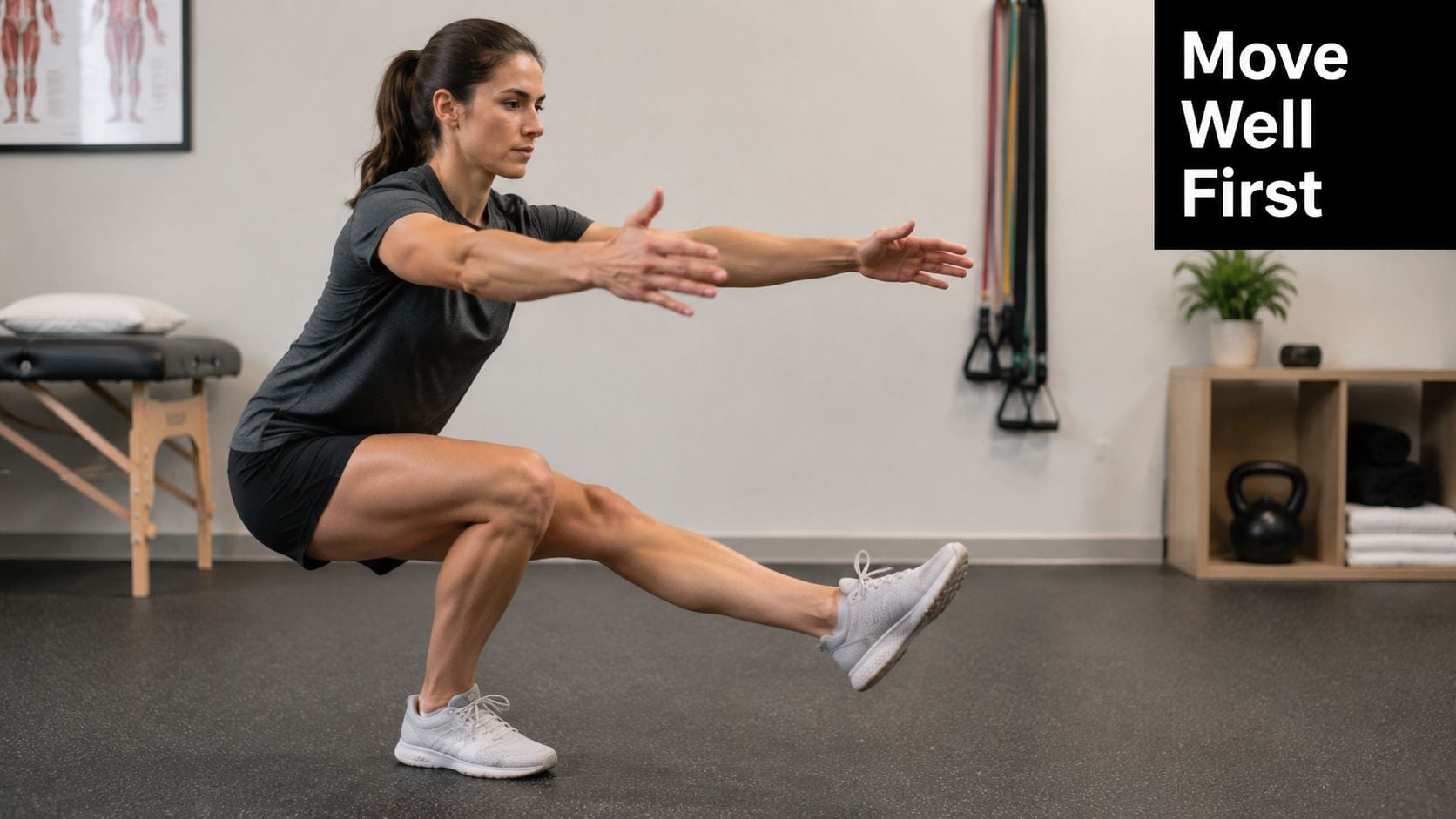
What we look at first
A fast first step depends on clean positions at the foot, ankle, knee, pelvis, and trunk. If one link can't do its job, another area takes over. That's where we start seeing hamstring irritation, anterior knee pain, Achilles overload, or a runner who feels smooth at easy pace but falls apart when they try to accelerate.
A 2024 evidence review found that SAQ training improves explosive traits tied to acceleration, including a 0.63 effect size for 5-meter sprint performance and 0.96 for lower-limb power in the pooled data from included studies (2024 SAQ evidence review). That matters clinically because the early part of a sprint is where movement restrictions show up fast.
Practical rule: If an athlete can't own the basic positions, adding more sprint volume usually exposes the problem instead of fixing it.
Three simple screens you can use today
These aren't a replacement for an in-person evaluation, but they're useful starting points.
- Deep squat check: Stand with feet about shoulder width apart and squat as low as you can while keeping your heels down. If you tip forward hard, heels pop up, or one side shifts, look at ankle mobility and hip control.
- Half-kneeling ankle test: In a half-kneeling position, drive your front knee forward over the toes without the heel lifting. If one side feels blocked or pinchy, sprint mechanics usually pay the price.
- Single-leg sit-to-stand or controlled pistol-to-box: If the knee collapses inward, the trunk wobbles, or you drop quickly instead of controlling the descent, you likely need single-leg strength and pelvic control before heavy speed work.
Here are the matching correctives we commonly start with:
- For limited ankles: Knee-to-wall ankle rocks, calf mobility, and controlled pogo holds.
- For stiff hips: 90/90 transitions, hip flexor mobility, and split-stance isometric holds.
- For poor single-leg control: Step-downs, supported split squats, and single-leg RDL reaches.
A runner who feels “tight all the time” often benefits from pairing this work with a more formal look at mechanics. PTU offers running gait analysis in Bridgewater, Massachusetts when the issue is less about effort and more about how force is moving through the body.
Why skipping this step stalls progress
The athlete who only wants ladder drills and sprints usually plateaus. The body finds a way to get through the session, but not a clean way to get faster.
In the clinic, the better pattern is simple. Restore motion where it's missing. Build control where it's weak. Then layer in speed. Athletes from East Bridgewater, West Bridgewater, Raynham, and Taunton usually notice the same thing first. They don't just feel looser. They feel like they can finally push.
Building the Engine Strength and Power for Speed
You can't fake force production. If you want better acceleration, cleaner deceleration, and more carryover to sport, you need a stronger base under your sprint work.
Many athletes commonly fall short in this aspect. They either sprint without enough strength behind it, or they lift hard without learning to apply that strength quickly.
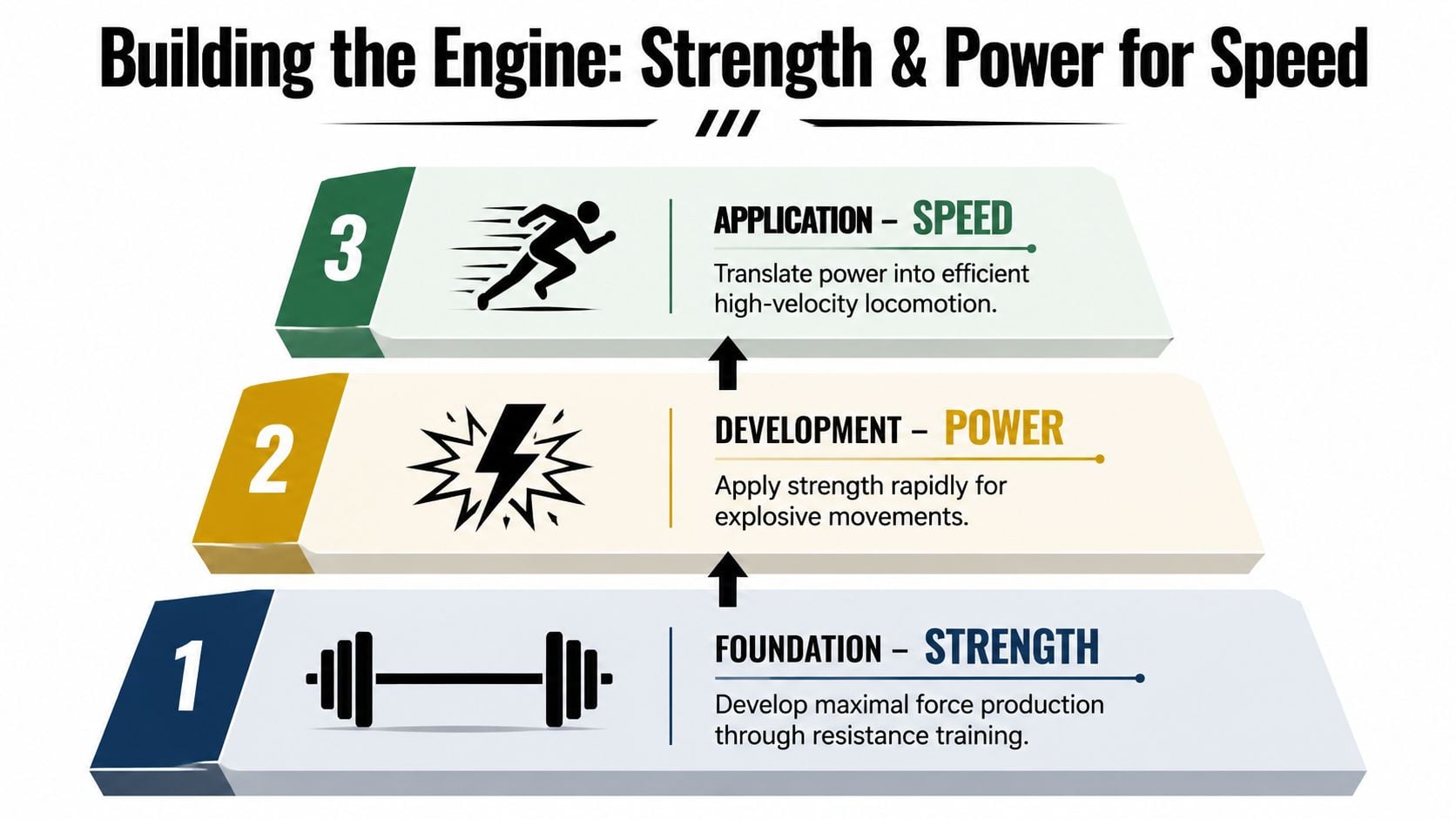
Strength first, then power
Strength is your ability to create force. Think squats, hinges, split squats, and pushes. Power is your ability to express that force quickly. Think jumps, throws, swings, and explosive step-ups.
That distinction matters because the weight room should support sprinting, not compete with it. An athlete who only chases heavy numbers can get stronger and still stay stuck if they never learn to move explosively. On the other side, an athlete who only does jumps without enough underlying strength often tops out early.
One training guide reports that athletes who combine speed work with strength work can improve maximum sprint speed by 8% to 15% more than speed work alone (sprint speed and strength integration guide). That fits what we see clinically. The strongest speed programs don't choose between lifting and sprinting. They organize both.
Athletes get faster when they can push harder into the ground and keep mechanics from breaking down under effort.
If you're a coach or athlete looking at broader programming ideas beyond rehab, resources on sport-specific strength training can help frame how force production should match the demands of the sport.
A practical exercise progression
Below is a simple progression we use often with athletes in Bridgewater and Middleborough. The goal isn't novelty. The goal is useful transfer.
| Training focus | Early progression | Mid progression | Advanced progression |
|---|---|---|---|
| Lower-body strength | Goblet squat | Front squat or trap bar pattern | Rear-foot elevated split squat under load |
| Posterior chain | Romanian deadlift | Single-leg RDL | More advanced hinge variations based on sport demands |
| Trunk and pelvic control | Dead bug and side plank | Loaded carry | Single-leg anti-rotation work |
| Force expression | Med ball chest pass | Kettlebell swing | Rotational med ball slam or scoop toss |
A few key lifts and why they matter:
- Goblet squat: Great for teaching depth, trunk position, and lower-body force without overloading an athlete who can't control the pattern yet.
- Romanian deadlift: Builds the hamstrings and glutes that support acceleration and protect against the athlete who sprints hard but can't tolerate the load.
- Split squat: Exposes side-to-side gaps that bilateral lifting can hide.
- Loaded carry: Underrated for trunk stiffness and posture. Both matter when athletes leak energy through the torso.
For power work, we keep the intent high and the dosage honest.
- Kettlebell swing: Useful for teaching hip snap and projection without turning the set into fatigue work.
- Medicine ball slam: Good for athletes who need aggressive intent and full-body sequencing.
- Jump squat or low-level jump variation: Best when the landing stays clean.
- Explosive step-up: Useful when we want transfer to sprint push-off and single-leg drive.
At PTU, one option for athletes who need this built into a structured plan is the clinic's strength and conditioning program for athletes, which includes sprint mechanics and acceleration-based progressions alongside strength work.
Honing Technique Sprint Mechanics and Drills
A stronger athlete still needs a usable pattern. Sprinting is technical, but most athletes don't need more complicated cues. They need a few clear ones they can feel.
The first thing we clean up is phase confusion. Acceleration and max velocity are not the same task.
Acceleration mechanics
Early acceleration is about projection. You're pushing, not popping straight up. The body angle is lower, the shin angle matters, and the first steps should move you forward with intent.
Drills we use often:
Wall drill holds and switches
- Feel the line: Keep your body in one straight line from head through heel.
- Punch down: Drive the foot into the ground under the hip, not out in front.
- Stay stiff through the trunk: Don't let the lower back take over.
Marches and skips for posture
- Drive, then strike: Lift with purpose and bring the foot back to the ground cleanly.
- Use the arms: Violent arm action can clean up lower-body rhythm.
- Own the start: If the march is messy, the sprint will usually be messier.
Short accelerations
- Push the ground away: Think projection, not spinning the feet.
- Keep the head neutral: Athletes often overreach with the chin and lose body angle.
- Stop before form slips: Good reps beat tired reps.
Max velocity mechanics
Once an athlete is upright, the job changes. Now we care more about rhythm, stiffness, and striking under the center of mass. Overstriding is the common speed killer here.
A few effective options:
A-skips
- Strike down, not out.
- Stay tall through the torso.
- Keep it rhythmic instead of forced.
High knees done well
- Fast contacts matter more than high thighs.
- Don't lean back.
- Let the arms match the cadence.
Flying sprint entries
- Build in smoothly.
- Hit tall posture before the fast zone.
- Relax the face, jaw, and hands. Tension slows people down.
A lot of athletes from Plymouth to Taunton think they need more effort at top speed. More often, they need less wasted motion.
Objective analysis helps. Video review can show whether the foot is landing too far in front, whether the trunk is rotating, or whether one side is spending longer on the ground. For runners and field athletes in our Bridgewater clinic, that level of detail often changes the plan faster than adding another random drill.
Adding Explosiveness A Practical Guide to Plyometrics
Plyometrics sit between strength and sprinting. They teach the body to accept force, reverse it quickly, and send it back into the ground. For speed training for athletes, that bridge matters.
If you're new to plyos, think spring quality. You're training your muscles and tendons to load and unload efficiently rather than sinking into every contact.
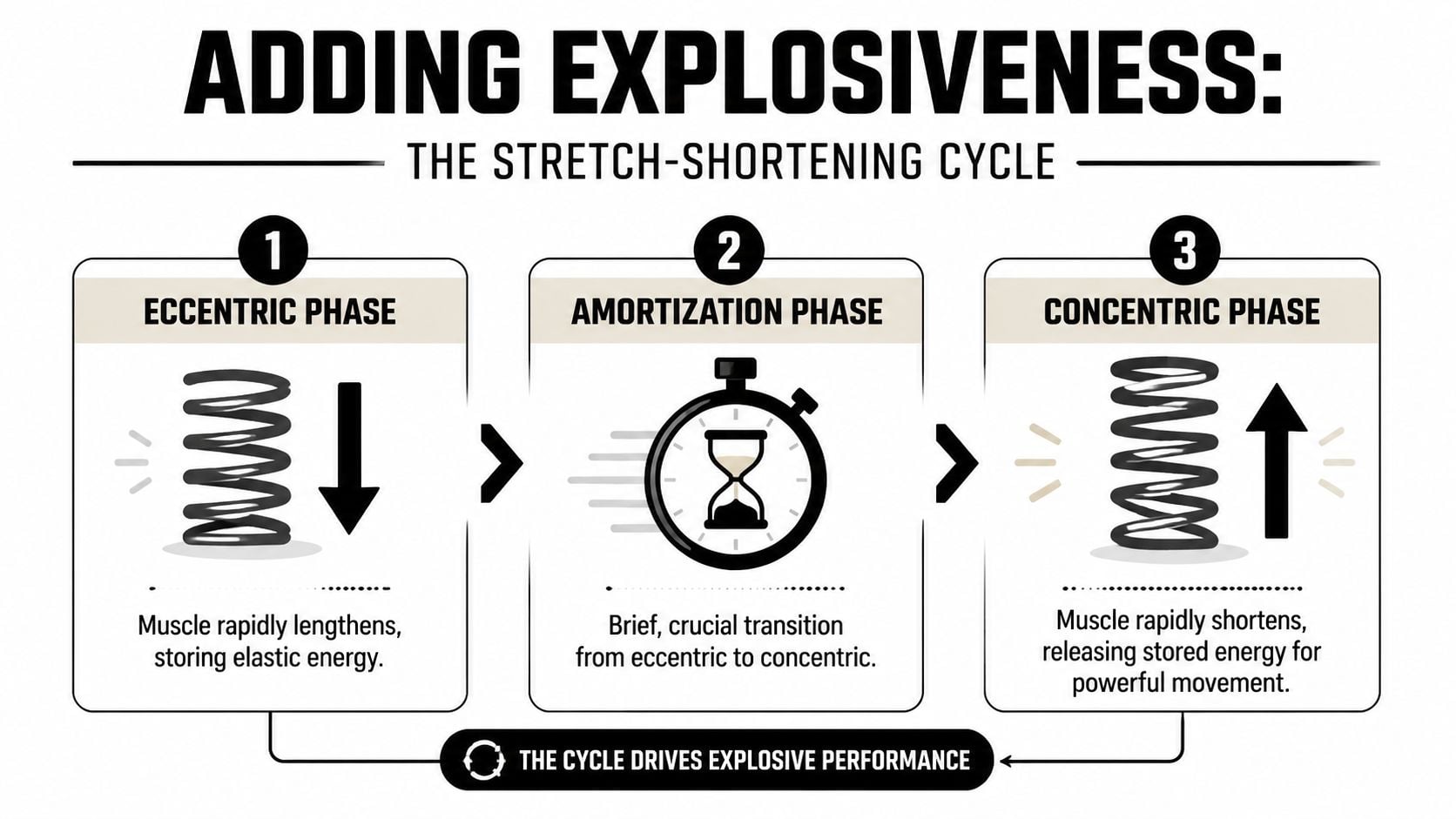
What plyometrics actually train
The plain-language version of the stretch-shortening cycle is simple. Your system stores energy on the way down, changes direction quickly, and releases that energy on the way up or forward.
That's why the landing matters so much. If an athlete collapses at the foot, knee, or trunk, they lose the spring and pile stress into the wrong places.
A good rep should look and sound clean:
- Land softly: Quiet contacts usually mean better control.
- Own the position: Knee tracks well, trunk stays organized, foot stays active.
- Finish balanced: If the landing is a scramble, the jump was too advanced.
Here's a short visual before moving into progressions:
A safe progression that makes sense
We don't give the same plyometric plan to a middle school soccer player, an adult runner, and a dancer coming back from ankle pain. The progression depends on tissue tolerance, coordination, and training history.
Low impact entry work
- Pogo hops: Great for ankle stiffness and rhythm.
- Snap downs: Teach the athlete to organize the trunk and hips before more dynamic work.
- Stick landings: Useful for youth athletes and post-rehab athletes who need positional control first.
Moderate impact power work
- Box jumps: Good for intent when the athlete lands in control and doesn't chase box height.
- Broad jumps: Helpful for horizontal projection.
- Skater bounds: Useful for field and court athletes who need frontal plane control.
Higher demand options
- Repeated bounds: Better for athletes who already own single-leg control.
- Depth jump progressions: Reserved for advanced athletes who can absorb and redirect force cleanly.
- Single-leg hurdle or reactive work: Appropriate only when previous stages are solid.
Clinical reminder: The best plyometric exercise is the hardest one the athlete can land well, not the flashiest one on video.
For basketball players and other jumping athletes, our guide on how to jump higher for basketball connects this same progression to vertical power and landing mechanics. The same principles also show up in dance therapy, where turnout control, calf capacity, and repeated landings often decide whether a dancer feels explosive or overloaded.
Your Weekly Speed Training Program
A smart week protects quality. That's what separates useful speed work from random hard sessions stacked on top of sport practice.
The NSCA's speed-training guidance recommends roughly 1,000 to 2,000 meters per week for acceleration and high-speed sprinting at around 95% to 100% effort, with sprint sessions no less than 48 hours apart and often 72 hours or more apart for recovery (NSCA speed-training guidelines). That supports what we tell athletes in South Shore Massachusetts every day. If you can't hit quality, you're not really training speed anymore.
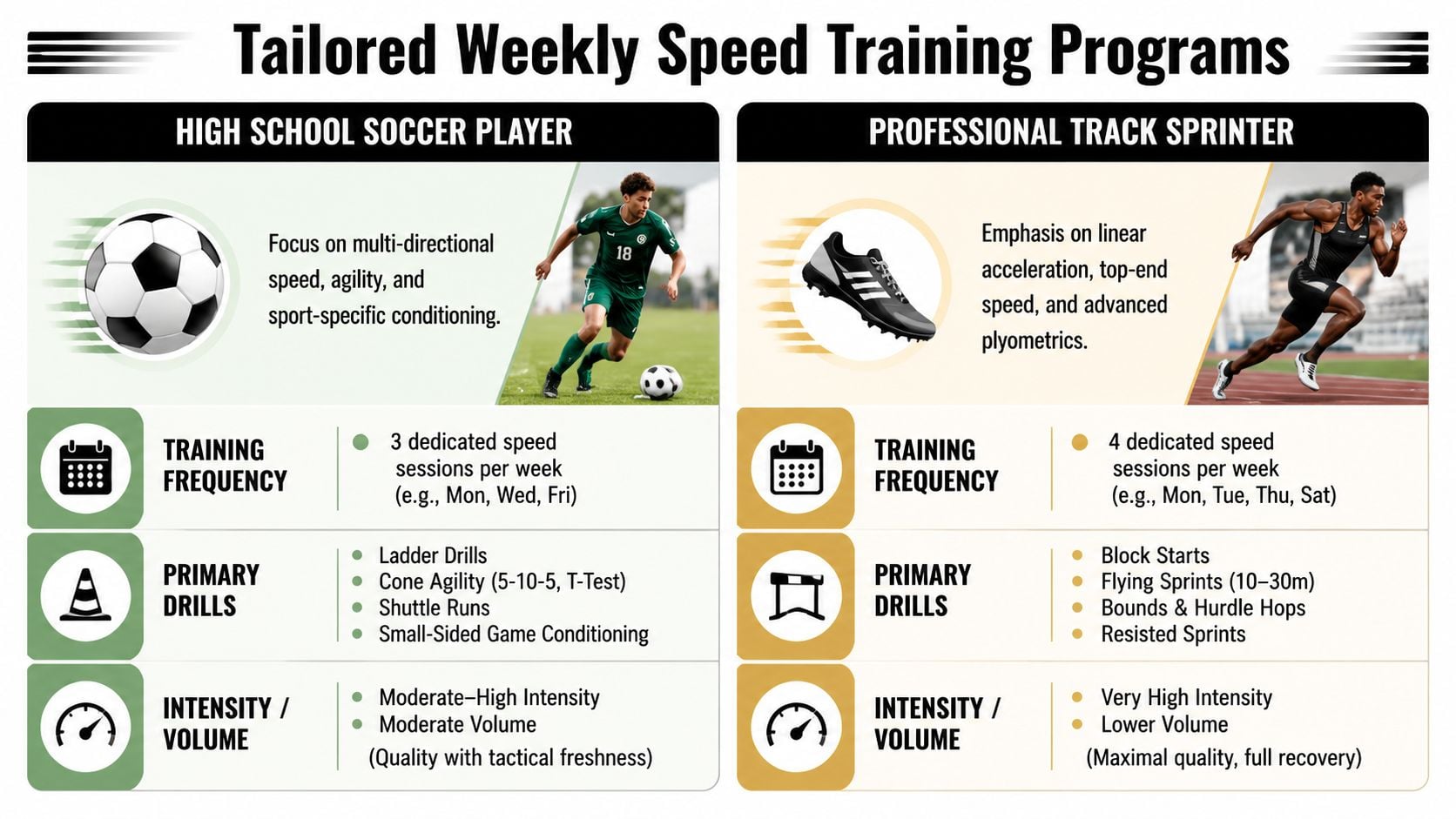
Template for a youth field or court athlete
This fits the high school athlete balancing team practices and games.
Day 1
- Prep: Mobility and activation
- Speed focus: Short accelerations and one or two mechanical drills
- Strength focus: Lower-body strength and trunk work
Day 2
- Recovery emphasis: Easy movement, tissue recovery, and light mobility
- Sport practice: Keep extra conditioning limited if practice load is already high
Day 3
- Plyometric focus: Low to moderate impact jumps
- Strength focus: Single-leg work and posterior chain
- Optional: Light ball skill work
Day 4
- Recovery or practice only: No additional hard sprint work
Day 5
- Speed focus: Flying sprint entries or short change-of-direction speed
- Accessory work: Calf, hamstring, and hip stability
Weekend
- Competition or rest: Adjust based on game schedule
Template for an adult runner
The adult runner usually needs enough speed exposure to improve mechanics without wrecking recovery for distance work.
| Day | Focus |
|---|---|
| Monday | Mobility, gait drills, short hill or flat accelerations |
| Tuesday | Easy run or cross-training |
| Wednesday | Strength training with posterior chain and single-leg emphasis |
| Thursday | Easy run and mobility |
| Friday | Speed session with controlled fast reps and full rest |
| Saturday | Longer aerobic run if tolerated |
| Sunday | Recovery |
If you want extra ideas from a running-focused perspective, Swift Running's guide to faster running is a useful companion read for runners sorting out pace, form, and training intent.
Template for a dancer
Dancers usually need explosive capacity without losing line, control, or landing quality.
Session A
- Mobility: Foot and ankle prep, hip mobility
- Power: Pogo variations, squat jumps, medicine ball throws
- Strength: Split squat, calf raises, trunk control
Session B
- Mechanics: Marching, skipping, short linear accelerations if relevant to performance goals
- Landing control: Stick landings and lateral hops
- Recovery: Mobility and tissue work
Session C
- Strength: Posterior chain and single-leg loading
- Plyometrics: Broad jump or controlled bound progression
- Optional: Dance-specific transition work under fatigue-free conditions
The trade-off is simple. More is not better if every hard day leaves you flat. Keep the true speed sessions spaced out, protect freshness, and let the rest of the week support them.
FAQ Your Speed Training Questions Answered
How should I measure progress if I'm not getting laser-timed every week
Use repeatable measures. Short sprint times, flying sprint segments, jump tests, and video of the same drill done under the same conditions all help. In rehab and return-to-sport work, we also look at asymmetry, landing quality, single-leg force expression, and whether the athlete can repeat efforts without losing mechanics.
In our clinics in Bridgewater, Buzzards Bay, and Middleborough, return-to-sport testing matters most when the athlete says, “I feel good,” but the movement still says something else.
What's the biggest mistake athletes make when trying to get faster
They turn speed training into conditioning. That usually looks like too many reps, not enough rest, or sprinting on tired legs because the session has to feel hard to feel productive.
The result is predictable. Mechanics get worse, contact quality drops, and athletes practice a slower version of sprinting. That's also when overuse issues start to build.
You don't earn speed by surviving sloppy reps. You earn it by repeating sharp ones.
Do agility ladders and cones actually help
They can help with rhythm, coordination, and organization. They do have a place, especially for younger athletes learning body control and for warm-ups.
But they are not the center of speed development. Ladders won't replace force production, sprint exposure, or single-leg control. Cones are useful when they organize a drill with a clear purpose. They're not useful when they create busy feet with no carryover.
How does speed training change after ACL surgery or another serious injury
The framework stays the same, but the entry point changes. Post-surgical athletes usually need objective strength, landing control, and deceleration capacity before true sprint work becomes appropriate. An athlete coming back from ACL reconstruction may be cleared for running and still not be ready for full acceleration, cutting, or repeated explosive contacts.
That's where sports physical therapy matters. We scale mobility, strength, mechanics, plyometrics, and return-to-sport testing to the tissue, the timeline, and the sport. Dry needling or hands-on care may help with symptom management in some cases, but they don't replace the work. The work is what restores speed.
If you're an athlete, runner, dancer, or parent looking for a clearer plan, book with Physical Therapy U. Our licensed DPTs in Bridgewater, Buzzards Bay, and Middleborough build speed the way it should be built: from movement quality to force production to sport-ready performance, with rehab and return-to-sport testing when needed.
