
You felt the pull. Maybe it was a sprint, a hard kick, a deadlift, or a grand battement. Now you're limping, testing every step, and wondering when you can run again without setting yourself back.
That's where most generic advice falls short. Lists of bridges, sliders, and stretches can help, but hamstring strain recovery exercises only work when they're sequenced the right way. In sports physical therapy, the primary job isn't just calming pain. It's rebuilding a muscle that can handle speed, length, and force again without becoming the same injury next month.
At PTU, our licensed DPTs treat athletes, runners, dancers, and post-op patients across Bridgewater, Buzzards Bay, and Middleborough with a criteria-based return-to-sport mindset. That means we don't guess. We progress load, restore mechanics, and use return-to-sport testing when it matters.
Table of Contents
- The First 72 Hours Acute Injury Management
- Phase 1 Restoring Mobility and Gentle Activation
- Phase 2 Progressive Strengthening for a Resilient Hamstring
- Phase 3 Neuromuscular Control and Running Preparation
- Phase 4 Sport-Specific Drills and Return to Play
- Your Hamstring Recovery Questions Answered
The First 72 Hours Acute Injury Management
The first few days are about protecting the tissue without shutting the whole leg down. A hamstring strain hates two extremes: doing nothing for too long, and trying to “test it out” every few hours. Both can drag recovery out.
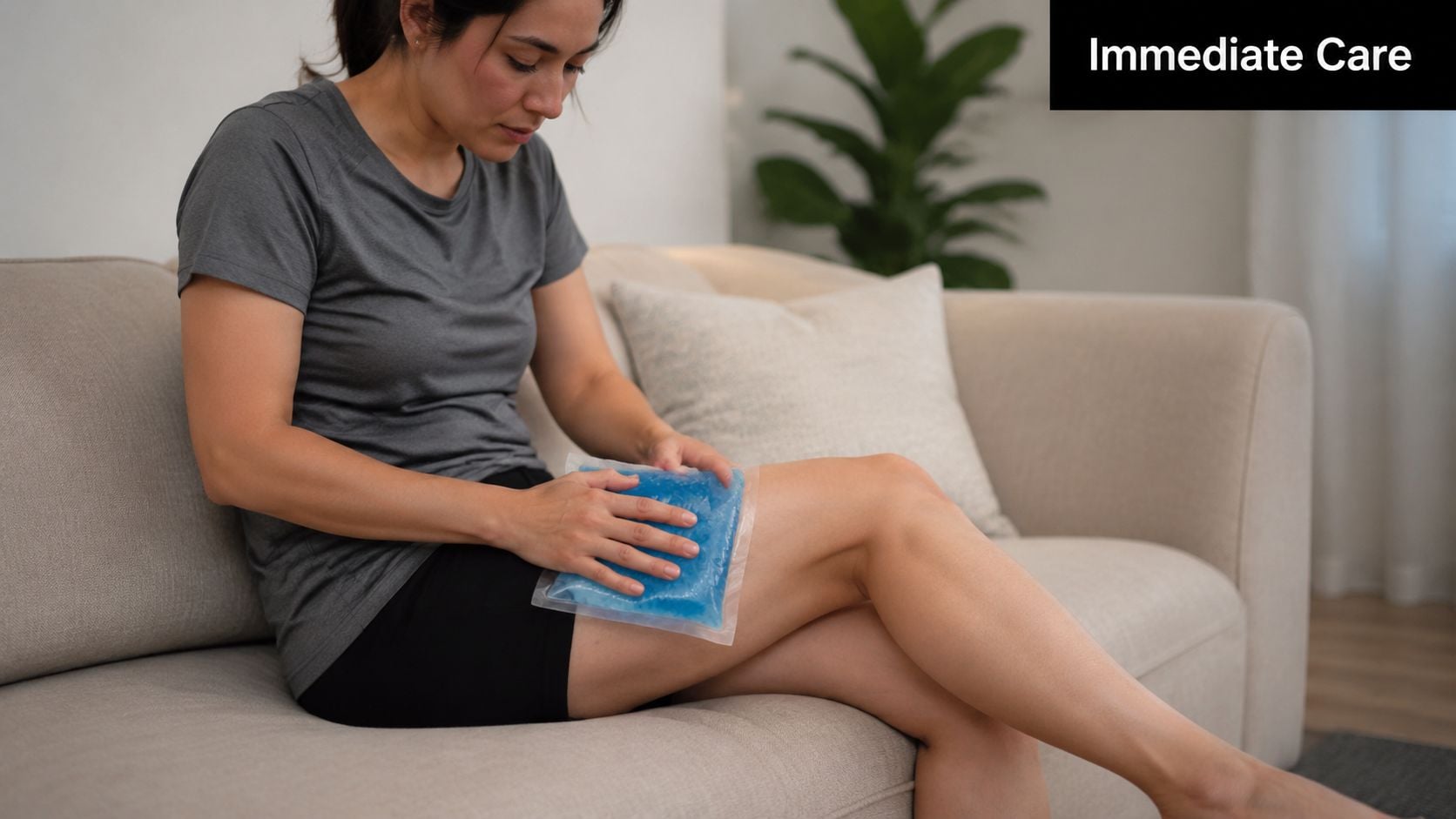
What to do right away
Use a calm, controlled approach:
- Reduce the load: If walking causes a limp, shorten your stride, slow down, and avoid sprinting, cutting, or deep bending.
- Manage irritation: Ice, compression, and relative rest can help settle pain in the short term.
- Skip painful stretching: Pulling aggressively on a freshly strained hamstring often makes the area angrier.
- Start gentle motion early: Pain-free ankle pumps, easy knee bends, and short bouts of comfortable walking usually beat full immobilization.
Practical rule: If a movement makes you more sore during the activity and clearly worse later that day or the next morning, it's too much for this phase.
The old “just rest it” approach is outdated. What works better is protecting the area while introducing pain-limited movement early. Picture fixing a damaged engine mount. You don't floor the gas pedal, but you also don't leave the car sitting for weeks and expect it to run smoothly.
What usually makes things worse
Athletes often lose time by making the same mistakes:
- Testing max speed too early: The muscle may tolerate walking and still fail badly when asked to sprint.
- Deep massage too soon: Freshly injured tissue often doesn't like aggressive hands-on work right away.
- Stretching into a sharp pull: A mild stretch sensation is one thing. Pain and guarding are another.
- Ignoring a limp: A limp changes loading up and down the chain, including the calf, hip, and low back.
Short-term symptom relief has a place, but it can't be the whole plan. Modalities are support tools. For athletes in South Shore Massachusetts dealing with swelling and pain early on, treatments like laser therapy for inflammation can complement the loading plan, not replace it.
What the first exercises often look like
In these first days, keep it simple:
- Heel digs into the floor or bed: Gentle hamstring activation without moving much.
- Bridge holds at a low height: Only if you can do them without a spike in pain.
- Easy walking: Enough to keep movement normal, not enough to create a limp or flare.
You're not trying to get stronger yet. You're teaching the area to tolerate light tension again. That small reset matters later when it's time to build strength, reintroduce running, and trust the leg again.
Phase 1 Restoring Mobility and Gentle Activation
Once the sharp irritation settles, the work shifts to restoring motion and waking the hamstring back up. During this stage, athletes often get impatient. They want “real exercises,” but skipping this phase usually leads to sloppy loading later.
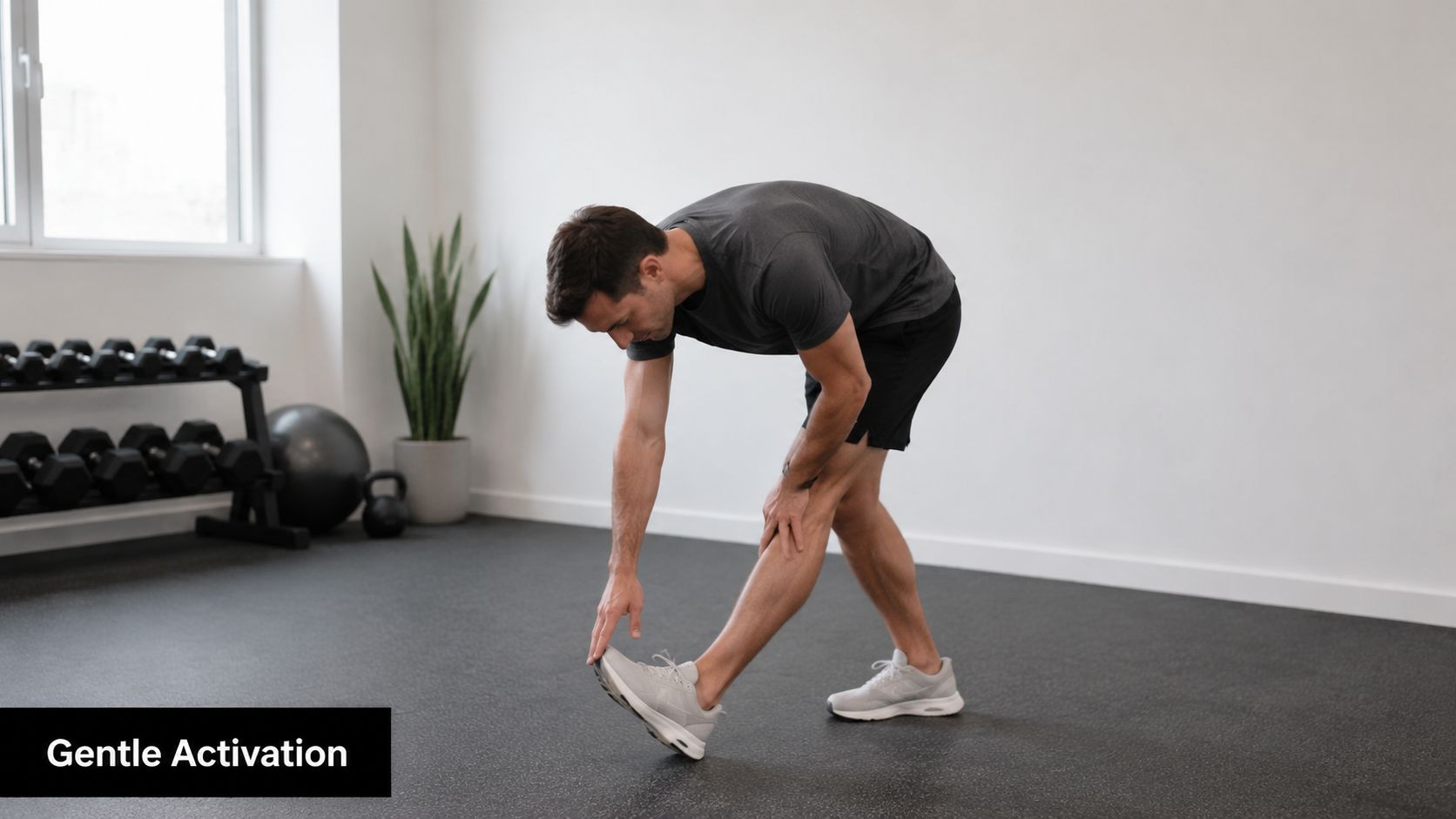
What to protect and what to keep moving
Early on, the hamstring usually tolerates isometrics better than big lengthening movements. That means you create muscle tension without asking the fibers to lengthen under load. It's one of the safest ways to reintroduce work.
At the same time, don't ignore the rest of the chain. Glutes, trunk control, and hip position all affect hamstring demand. If the glutes aren't helping, the hamstring often gets overloaded doing jobs it shouldn't handle alone.
A smart warm-up and cool-down habit also matters once you're moving again. Athletes looking to boost football performance often do better when recovery work becomes part of training, not an afterthought after symptoms show up.
Early exercises that usually make sense
Start with movements you can perform smoothly and without a symptom spike:
Hamstring heel digs
- Lie on your back with knees bent.
- Press the heel into the floor and tighten the back of the thigh.
- Hold, relax, and repeat.
Glute bridge holds
- Lift into a low bridge and keep the pelvis level.
- Don't chase height. Chase control.
Supine marching with trunk control
- Keep the pelvis steady while lifting one foot at a time.
- This adds core demand without overloading the hamstring.
Pain-free hip hinge patterning
- Practice the hinge with a dowel or bodyweight only.
- The goal is movement quality, not fatigue.
A good early session should leave the leg feeling a little more organized, not beaten up.
Here's a useful visual if you want a guided demo of basic early-stage mechanics and positioning:
How to judge whether you're ready to move forward
This phase is working when a few things improve together:
| Sign | What you want to see |
|---|---|
| Walking | Less guarding, smoother stride |
| Range of motion | Easier bending and straightening without a sharp pull |
| Activation | Better bridge and heel dig control |
| Next-day response | No clear flare after exercise |
If symptoms stay irritable, back the load down. That may mean shorter holds, smaller bridge height, or fewer reps. Progress in sports rehab should feel steady, not dramatic.
Phase 2 Progressive Strengthening for a Resilient Hamstring
This is the phase that changes a recovering hamstring into a durable one. A lot of athletes stop too early because daily life feels fine. That's a trap. Walking without pain doesn't prove the hamstring is ready for acceleration, deceleration, or a late-game sprint.
A major reason strengthening matters so much is recurrence. Nearly one third of hamstring strains recur within the first year after return to sport, and programs that emphasize eccentric strengthening are more effective for return to sport than programs with less eccentric focus, according to this review on hamstring strain rehabilitation.
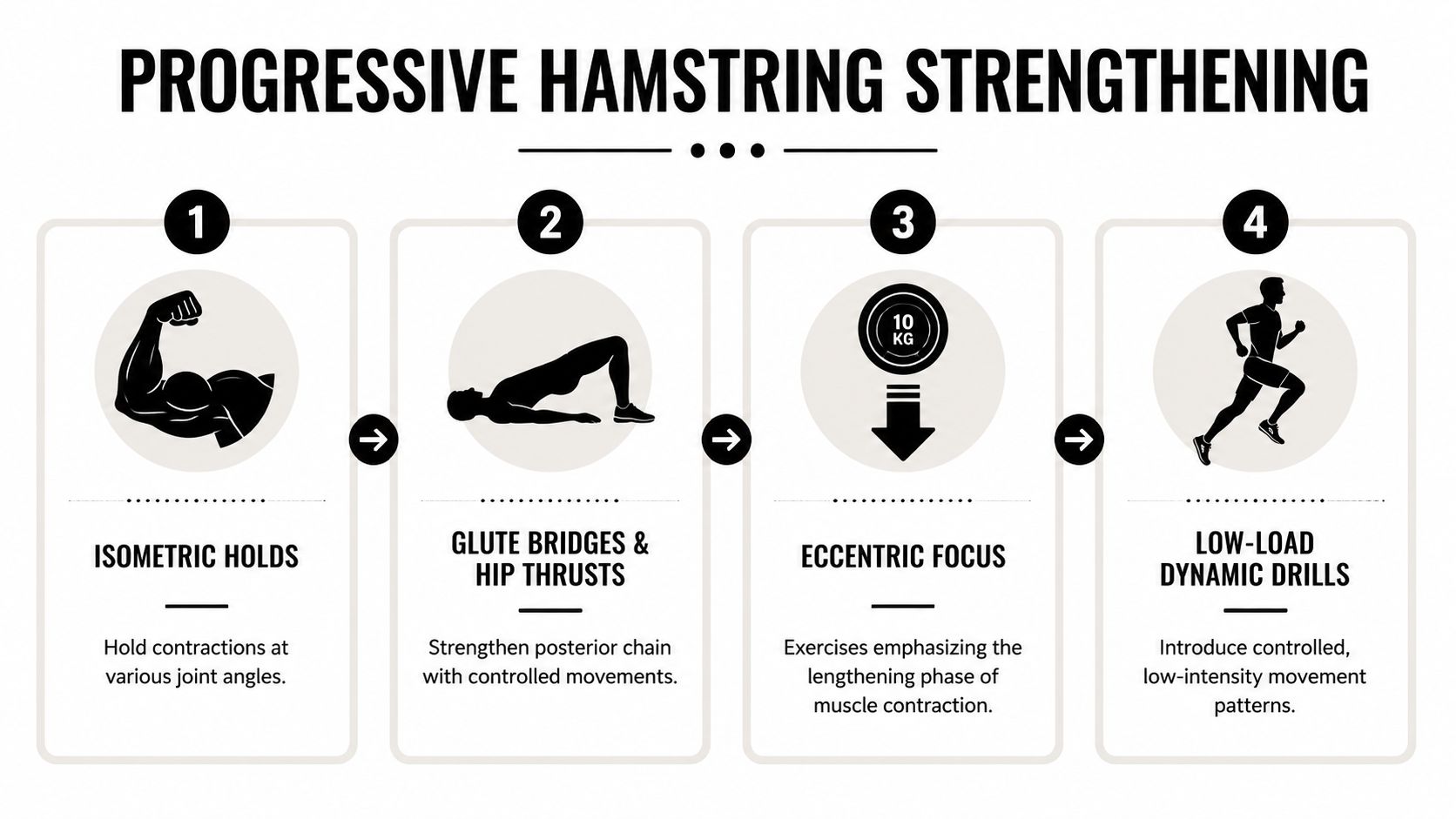
Why eccentric work matters
The hamstring doesn't just shorten to create force. In running and field sport, it also has to control lengthening under high tension. That's the job athletes often miss if rehab stops at bridges and band curls.
Eccentric work teaches the muscle-tendon unit to tolerate that braking demand. That's why exercises such as Nordic lowers, sliders, and long-length hinge variations show up in stronger rehab programs. The old model leaned hard on general stretching and basic strengthening. Modern sports rehab puts more value on targeted loading and neuromuscular control.
If your rehab never challenges the hamstring while it lengthens, don't be surprised if sprinting exposes the gap.
There's also an upstream piece here. Hip control changes hamstring demand. Poor frontal-plane control can push more stress into the posterior chain, which is one reason strengthening the glutes matters too. If that's a weak link for you, this guide on how to strengthen hip abductors fits naturally alongside hamstring rehab.
A practical strengthening progression
Don't jump straight to the hardest exercise. Build in layers.
Controlled isotonic strength
Start with exercises that move through a manageable range:
- Bridge reps
- Hamstring ball rollouts, double-leg
- Light machine or band hamstring curls
- Romanian deadlift pattern with light load
Single-leg control
Once double-leg work is clean, move toward asymmetrical loading:
- Single-leg bridge
- Single-leg ball rollout
- Split-stance RDL
- Step-down or lunge variations with good trunk control
Eccentric emphasis
This is the cornerstone:
- Hamstring sliders
- Nordic hamstring lowers
- Long-length RDL variations
- Slow lowering hamstring curl work
What good form looks like
A few coaching points matter more than extra volume:
- Keep the hinge honest: The load should come through the hips, not a rounded low back.
- Control the lowering phase: Rushing the eccentric portion defeats the point.
- Stay out of panic tension: Cramping, holding your breath, and shaking through every rep usually mean the drill is too advanced.
- Respect soreness location: Muscle fatigue is expected. Sharp pain near the original injury site isn't.
What doesn't work well
Three common dead ends show up in clinic all the time:
- Only stretching: A longer hamstring isn't automatically a stronger or safer one.
- Only massage and passive care: Helpful sometimes, but not enough to prepare for sport.
- Only machine curls: They can be useful, but they don't replace hinge mechanics, pelvic control, and long-length loading.
This phase should make the hamstring feel capable again. Not just less painful, but more trustworthy.
Phase 3 Neuromuscular Control and Running Preparation
A stronger hamstring still isn't automatically a sport-ready hamstring. The next layer is control. Can you hinge on one leg without drifting? Can the pelvis stay level? Can the trunk stay organized when the leg is doing real work?
That's the missing middle in a lot of online plans. They teach exercises in the gym but don't explain how the body earns the right to run again.
The bridge from strength to movement quality
Now the work becomes less about isolated force and more about coordination under load. The hamstring has to interact with the glutes, calf, trunk, and foot in a cleaner sequence.
Useful drills here often include:
- Single-leg RDLs: Great for hip hinge control, foot stability, and pelvic awareness.
- Walking lunges: They expose stride asymmetry and poor load transfer.
- Rear-foot-supported split squat patterns: Helpful if tolerated well and performed with strong trunk control.
- Marching and skipping drills at low intensity: Good for rhythm and timing before true running volume returns.
One review noted that stronger rehab programs don't stop at gym strengthening. They also emphasize progressive reloading at long muscle lengths and movement that better matches sprinting demands, including hip-extension work with the knee in a more flexed position. It also highlighted staged agility and plyometric exercises as part of return to activity in clinical protocols, which is why running preparation needs more than a list of isolated exercises in the weight room. That point is summarized in this review of hamstring injury prevention and rehabilitation.
Running is a skill. After a hamstring strain, you have to rebuild the skill, not just the muscle.
If stride mechanics are part of the problem, formal running gait analysis can help identify whether overstriding, trunk position, pelvic control, or asymmetrical push-off is keeping the hamstring overloaded.
Running readiness checks
Before running returns, athletes should be able to perform pain-free single-leg hinges and repeated single-leg bridges, and a key benchmark for returning to sport is hamstring strength that is at least 90% of the uninjured leg, as outlined in this clinical guide on hamstring recovery exercises and benchmarks.
Use these checks practically:
| Check | What you want |
|---|---|
| Single-leg hinge | No pain, no wobble, no trunk collapse |
| Single-leg bridges | Repeated reps without cramping or loss of form |
| Jogging trial | Smooth, no protective limp |
| Post-session response | Calm later that day and the next morning |
If one of those breaks down, you're not failing. You just need more preparation before adding speed.
Phase 4 Sport-Specific Drills and Return to Play
Rehabilitation should once again align with the demands of sport. A soccer player doesn't just need a strong hamstring. They need a hamstring that can tolerate acceleration, deceleration, kicking, curved runs, and late-reaction changes of direction. The same is true for sprinters, dancers, hockey players, and athletes coming back after ACL rehab who are layering sprint work back in.
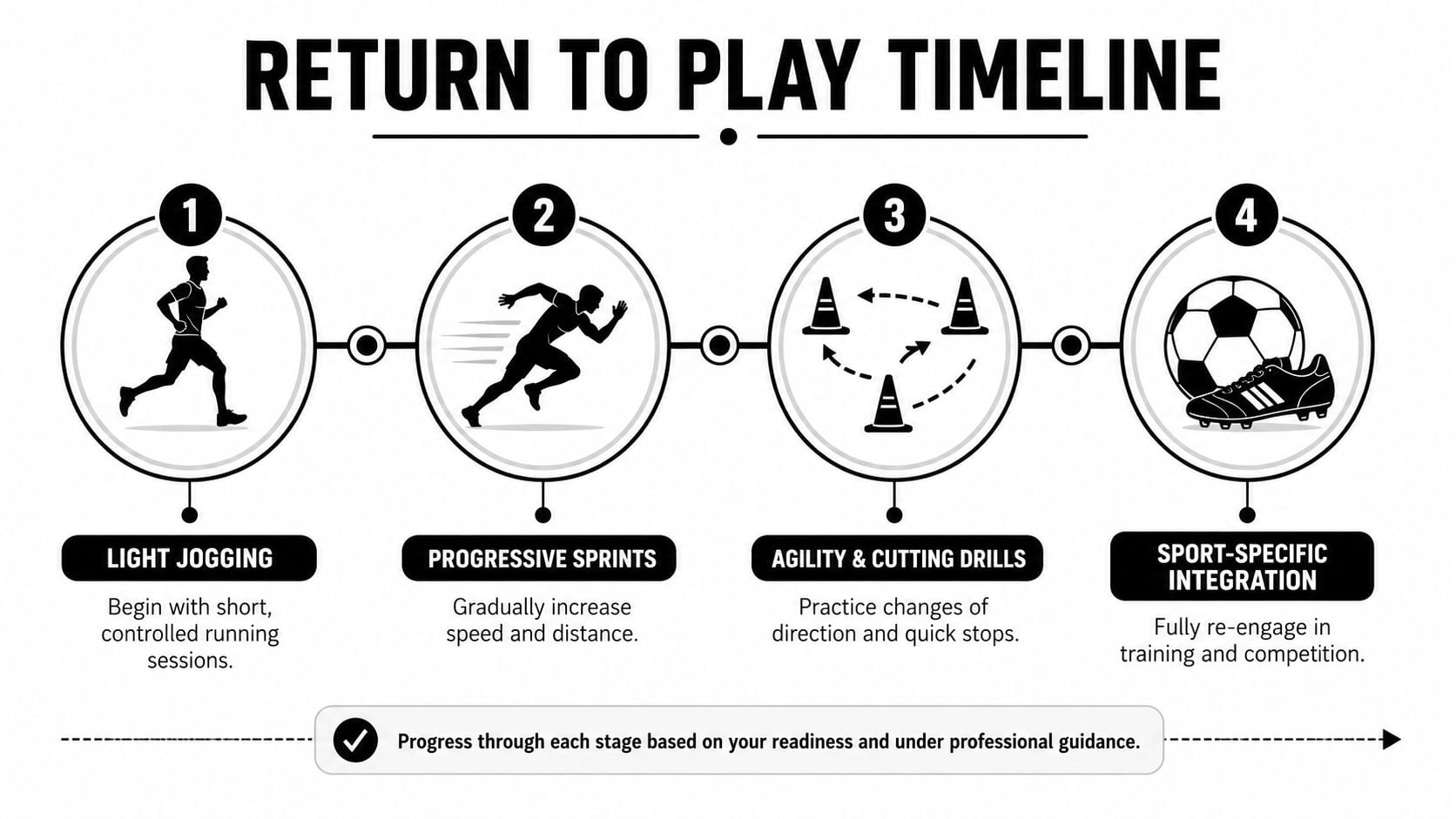
How sprinting comes back in stages
A clinically oriented sequence is to begin with pain-limited isometrics and bridge work, then progress to controlled lengthening work, then reintroduce running volume, and only after that add speed, acceleration, deceleration, and sport-specific drills. One published protocol also progresses from double-leg to single-leg ball rollouts and deadlifts before sprint progressions such as 10-yard to 40-yard runs at 90% effort, as described in this hamstring rehabilitation timeline and return-to-run plan.
That progression matters because many athletes feel “fine” at submaximal pace and then break down when the session finally includes speed. Sprinting is the final exam. It shouldn't be the first quiz.
A practical return-to-play ladder often looks like this:
- Rebuild running volume first: Easy jogging and controlled tempo efforts.
- Add stride mechanics: Drills like A-skips, B-skips, and wicket-style rhythm work if they're coached well.
- Introduce acceleration and deceleration: Build tolerance to starting and stopping.
- Layer in change of direction: Cutting, shuffling, crossover patterns, and reactive sport drills.
- Rehearse position-specific demands: Kicking, defending, rebounding, tumbling, jumping, or dance extensions depending on the athlete.
What clearance should actually include
The best modern rehab doesn't rely on calendar guesses. It uses criteria.
A recent review reported that studies using the Askling H-test as a return-to-play criterion found mean return-to-play times of 63 days with 3.6% reinjury and 36 days with 1.3% reinjury. The same review also summarized common performance benchmarks such as reducing strength deficits to less than 20% versus the uninjured limb, reaching eccentric and isometric hamstring force within 10% of the opposite side, and achieving a hamstring-to-quadriceps ratio of at least 65%. Those findings support a shift from time-based rehab to measurable testing in high-performance sports medicine, as outlined in this review of current hamstring prevention and rehab criteria.
The athlete who “waited a few weeks” and the athlete who passed objective testing are not the same athlete.
For dancers, the final phase needs one more filter. A dancer may pass a straight-line running progression and still struggle with turnout demands, explosive extension, or repeated end-range control. Sport-specific means your drills have to reflect your sport, not just generic fitness.
Your Hamstring Recovery Questions Answered
Should I stretch a hamstring strain right away
Usually not aggressively. Early hard stretching often irritates healing tissue more than it helps. Later on, mobility work has a place, but it should fit the phase of healing and the irritability of the injury.
One study found that passive stretching 4 times per day, starting 48 hours after injury, led to slightly faster recovery of active knee-extension range of motion than stretching once per day, but that doesn't mean more stretching is always the best answer. The same clinical discussion also notes that other mobility drills remain less clear in effectiveness, which is why loading and strength progression still carry more weight in practice.
When can I start running again
Not when the calendar says so. Start when your body meets the movement criteria covered earlier, especially clean single-leg control, calm symptom response, and enough strength symmetry to handle impact and push-off.
If jogging still looks guarded, the tissue may not be ready even if pain is low.
Why do hamstring strains keep coming back
Because a lot of rehab stops at “good enough.” Pain settles, walking returns, and training resumes before the hamstring can handle high-speed lengthening, pelvic control, or repeated sprint efforts.
That's why sports PT puts so much emphasis on eccentric strength, movement quality, and objective return-to-sport testing instead of waiting a few weeks.
Are bridges and curls enough
They're useful. They're not enough on their own.
You also need hinge mechanics, long-length loading, single-leg control, and a staged return to running and sport. For many athletes, the transition from gym work to field work is where effective rehab happens.
When should I get evaluated in person
Get evaluated if you have significant bruising, trouble walking normally, repeated strains, pain that doesn't settle, or you're trying to return to sprinting, dance, or cutting sports and don't know how to progress safely.
A licensed sports physical therapist can determine whether you're dealing with a mild strain, a more significant injury, or another issue that mimics hamstring pain. This article is educational and shouldn't replace an individual exam.
If you're dealing with a hamstring strain and want a sports-focused plan instead of guesswork, book with Physical Therapy U. Our licensed DPTs work with athletes, runners, dancers, and post-surgical patients across Bridgewater, Buzzards Bay, and Middleborough, using evidence-based rehab, return-to-sport testing, running gait analysis, dry needling, and sport-specific progression to help you get back with confidence.
