
That Pinch in Your Shoulder? Let's Fix It.
Every overhead athlete, from pitchers in Plymouth to swimmers in Taunton, knows the feeling. You lift your arm, reach back to throw, or settle into a press, and there's that sharp pinch in the front or side of the shoulder. That pattern often gets labeled shoulder impingement, and in sports PT we usually think of it as a movement and load-tolerance problem, not just a structure problem.
At Physical Therapy U, our sports physical therapists see this every week across Bridgewater, Buzzards Bay, and Middleborough. Baseball players lose arm speed. Swimmers cut training volume. Lifters stop pressing. Dancers start avoiding lines and positions they normally own without thinking. If you want a broader guide for related upper-quarter symptoms, this article on best exercises for neck and shoulder pain can also help.
The good news is that the right exercises usually work well when they match the actual problem. A recent systematic review found that exercise programs for rotator cuff-related shoulder pain, which closely overlaps with shoulder impingement, moderately alleviate symptoms, with programs under 2 months showing slightly better outcomes than longer ones in that review, and scapular stabilization, shoulder mobilization and stretching, and eccentric exercise each improved at least one clinically relevant outcome in roughly 2-month interventions according to the 2025 Frontiers review on exercise for rotator cuff-related shoulder pain. That's why the best exercises for shoulder impingement usually aren't random rotator cuff drills. They're targeted, progressive, and chosen for your sport.
Table of Contents
- 1. Sleeper Stretch
- 2. Scapular Plane Raises Prone I-Y-T Sequence
- 3. Half-Kneeling Single-Arm Landmine Press
- 4. Prone Shoulder External Rotation 90-90 Position
- 5. Quadruped Shoulder Tap and Stabilization Series
- 6. Banded Shoulder Internal and External Rotation Standing
- 7. Dead Bug Progression with Shoulder Flexion
- 7 Exercises Compared for Shoulder Impingement
- Your Next Move From Rehab to Peak Performance
1. Sleeper Stretch
The sleeper stretch is one of the few mobility drills I still like for irritated overhead shoulders, but only when it's done cleanly. If your posterior shoulder is stiff, your humeral head often doesn't glide well during elevation. That can leave the front or top of the shoulder feeling pinchy during throwing, serving, swimming, or pressing.
For baseball and softball athletes around the South Shore Massachusetts area, this matters a lot late in the season. Pitchers from Bridgewater, East Bridgewater, and Raynham often lose internal rotation gradually, then wonder why the shoulder starts barking on layback or follow-through.
Why it helps
This stretch targets the back side of the shoulder, not the neck, not the low back, and not your chest. That distinction matters because athletes tend to fake motion by rolling their trunk backward instead of properly stretching the posterior shoulder.
Practical rule: You should feel a mild stretch in the back of the shoulder. If you feel a sharp pinch in the front, stop and change the position.
A good setup is simple:
- Lie on your side: Use the involved shoulder down, with that arm positioned in front of you.
- Set the shoulder first: Keep the shoulder blade stacked and your trunk quiet.
- Guide the forearm down gently: Use the opposite hand to add light pressure only until you feel a stretch.
- Stay patient: Hold for 30 to 45 seconds, repeat 2 to 3 times, and keep discomfort mild.
How to do it without cheating the stretch
Warm tissue responds better than cold tissue, so this usually feels better after a warm-up, a shower, or light upper-body movement. I also pair it with scapular control work because stretching a stiff shoulder without improving mechanics rarely solves the whole problem.
This is also where symptom management matters. If an athlete is flared up after a tournament weekend, we may combine exercise with treatments that calm things down enough to restore better motion. PTU uses tools like laser therapy for inflammation when it fits the presentation, but the exercise piece still does the heavy lifting over time.
What doesn't work is cranking this stretch aggressively. Forcing range almost always irritates the shoulder more, especially in throwers and volleyball players who already have enough laxity in the wrong places.
2. Scapular Plane Raises Prone I-Y-T Sequence
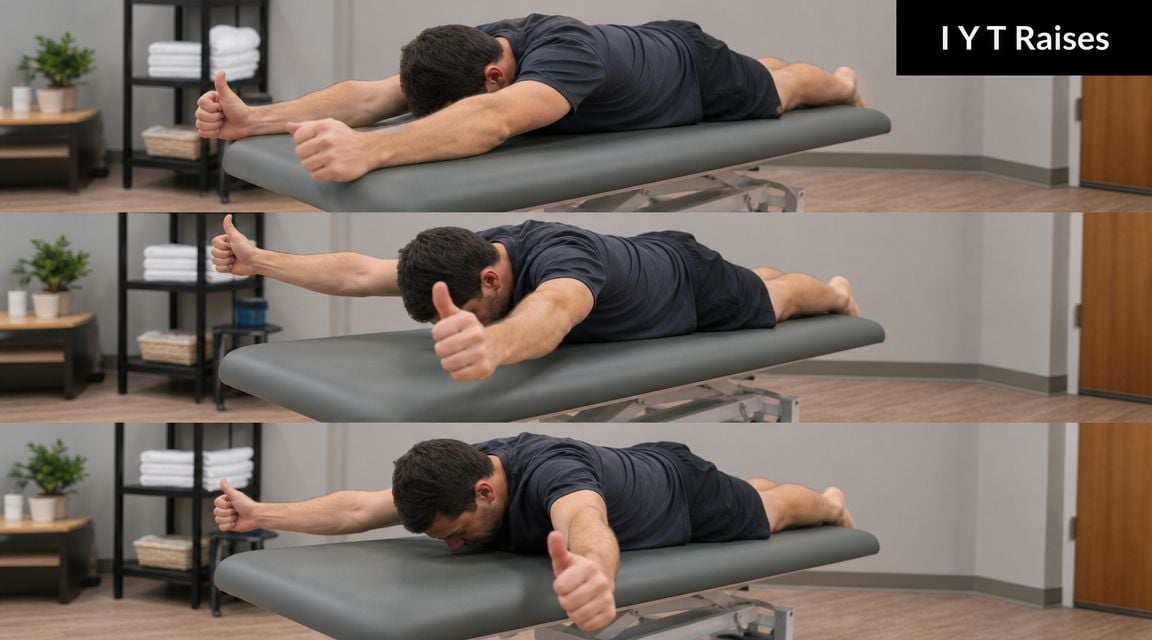
If the shoulder blade doesn't move well, the rotator cuff ends up working from a bad base. That's why prone I-Y-T work stays in my rotation for athletes with impingement symptoms. It builds lower trap, posterior shoulder strength, and control in positions that matter.
Here's the movement pattern in action:
What athletes get wrong
Most athletes turn this into a shrugging contest. They lift too high, jam the upper traps, and lose the exact scapular control the drill is supposed to train.
For swimmers in Taunton, volleyball players in Plymouth, and dancers in Buzzards Bay, that mistake matters because they already spend plenty of time in repetitive elevation. They don't need more neck tension. They need a shoulder blade that upwardly rotates and posteriorly tilts without a fight.
A practical dosage benchmark from clinical guidance is 2 to 3 sets of 10 to 15 reps performed 3 to 4 times per week, with scapular-focused choices like wall slides, prone Y-T-W variations, and banded external rotation. That framework is useful because it gives enough volume to improve control without turning every session into fatigue work.
How to program it
I usually start bodyweight only. If the athlete can't own the position without lifting the chin or shrugging, adding weight just makes the compensation stronger.
- I position: Arms closer to your sides. Good for lower trap and posterior chain control.
- Y position: Slightly overhead angle. Great for upward rotation and lower trap recruitment.
- T position: Arms out to the side. Helpful for posterior shoulder strength and scapular retraction.
- Tempo first: Raise, pause, lower with control before adding dumbbells.
For athletes who need a visual, this demo is a solid reference:
What works is smooth motion and clean scapular mechanics. What doesn't work is chasing burn, range, or weight.
3. Half-Kneeling Single-Arm Landmine Press
Some shoulders hate strict overhead pressing early in rehab. That doesn't mean pressing is off the table. It means you need a smarter entry point.
The half-kneeling single-arm landmine press gives you pressing exposure with a friendlier arc. The angled path usually feels better than a vertical press, and the half-kneeling setup forces the trunk, rib cage, pelvis, and shoulder to work together. For lifters, baseball players, and field athletes in Bridgewater, Massachusetts, that combination is useful because shoulder pain rarely lives in the shoulder alone.
Why landmine pressing works better than forcing overhead work
I like this drill when an athlete needs strength but still gets pinchy at end-range elevation. The bar path stays in front of the body, which often reduces irritation while still training serratus, cuff, and scapular upward rotation under load.
Don't confuse “pain-free enough to train” with “ready for max effort overhead lifting.”
That trade-off matters. A landmine press is often an intermediate step, not the finish line. For a volleyball hitter or baseball player, we still need a path back to higher-speed, higher-angle overhead demands. But this is a much better bridge than skipping from bands straight to heavy dumbbell presses.
Good reps only
I coach this with a tall posture, quiet ribs, and no twisting to fake range. If the trunk rotates hard, the shoulder loses the training effect.
- Start light: The first sessions should feel technical, not grindy.
- Use the half-kneeling side correctly: Opposite knee forward usually gives a better anti-rotation challenge.
- Press up and slightly forward: Follow the bar angle instead of trying to force a vertical line.
- Stop before compensation: A clean set of 8 is better than a sloppy set of 12.
This fits well inside a bigger strength and conditioning program for athletes, especially when you're rebuilding pressing tolerance without aggravating symptoms.
4. Prone Shoulder External Rotation 90-90 Position
If you work with throwers, swimmers, or tennis athletes long enough, you stop treating external rotation like a generic band exercise. Position matters. The 90-90 prone version loads the cuff in a way that's much closer to sport.
This drill puts the shoulder in abduction with the elbow bent, then asks the external rotators to move and stabilize without help from the trunk. For pitchers from Middleborough or catchers from West Bridgewater, that's valuable because a lot of shoulder pain shows up when they can't control the ball in that abducted, externally rotated window.
Why this one matters for throwers and swimmers
A randomized trial on motor control retraining in young adults with shoulder impingement signs found that a 10-week motor-control rehabilitation program improved function and reduced pain immediately post-treatment. That supports using exercises that train movement quality and scapular-shoulder coordination, not just brute strength.
This is one of those exercises. It forces the athlete to center the humeral head, own the scapular position, and avoid the classic compensation of rolling the shoulder forward.
If the shoulder blade tips forward or the elbow drifts, the cuff isn't getting the clean stimulus you think it is.
How to feel the right muscles
Small load. Slow motion. No drama. That's the formula.
- Use a very light dumbbell: Many athletes need less load than they expect.
- Keep the elbow at 90 degrees: Don't let the arm wander.
- Rotate, don't yank: The movement should be smooth through the available range.
- Own the lowering phase: Eccentric control matters for overhead athletes.
This isn't a flashy exercise, and that's part of why it works. It asks for precision. Athletes who rush it usually miss the point entirely.
5. Quadruped Shoulder Tap and Stabilization Series
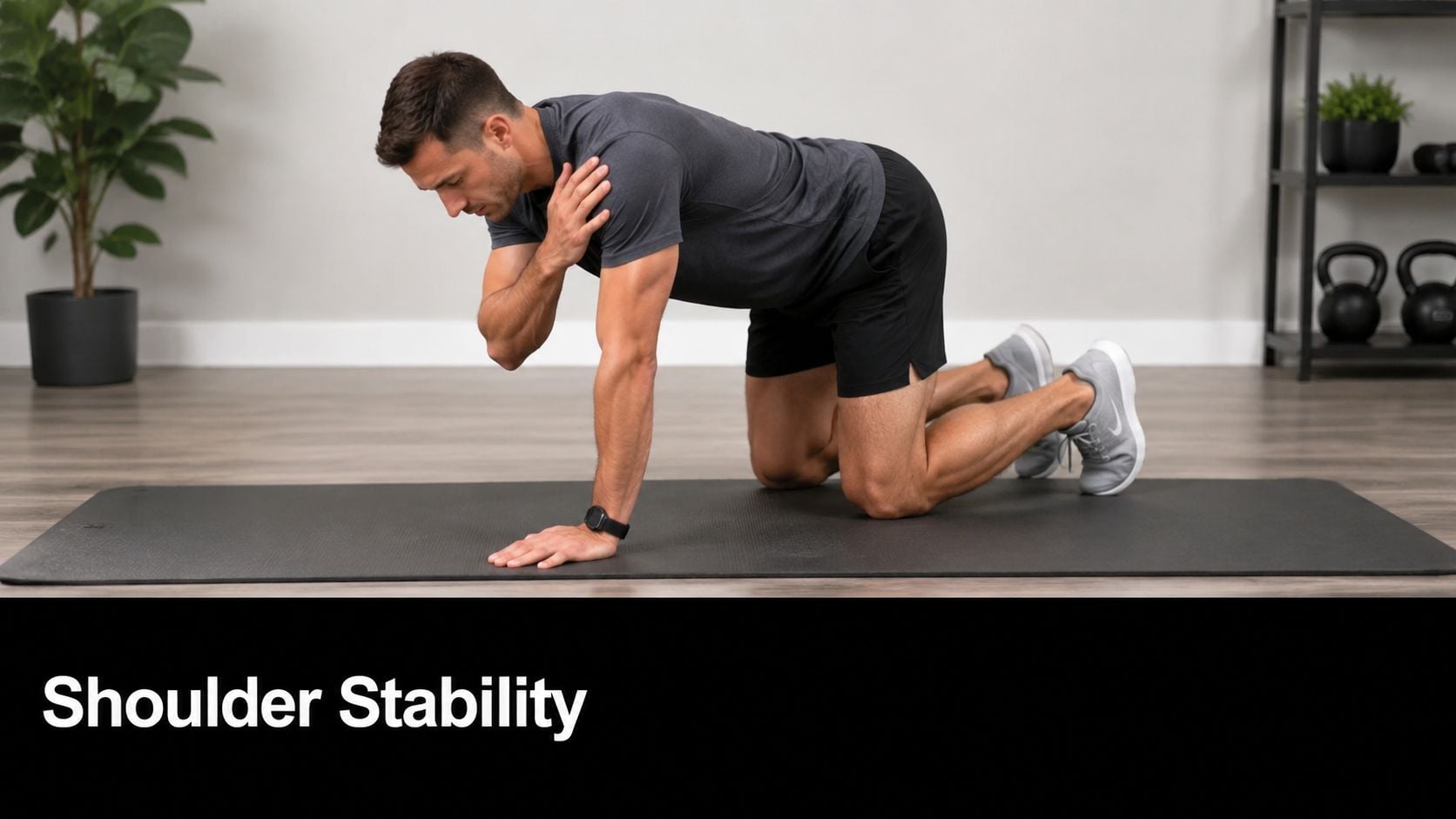
Closed-chain shoulder work is often a better entry point than open-chain loading when the joint is irritable. Quadruped shoulder taps are a great example. They train serratus, cuff co-contraction, trunk control, and anti-rotation without demanding a ton of overhead range.
For dancers and field-sport athletes, this has another advantage. It teaches the shoulder to hold position while the rest of the body moves, which is a much more athletic task than isolated arm lifting.
Why closed-chain work is useful early
A lot of athletes with shoulder impingement don't need more stretching. They need a shoulder blade that stays anchored on the rib cage while load shifts side to side. Quadruped gives you exactly that.
At PTU, we use this often with post-surgical athletes too, once they're cleared for that stage. It's a nice bridge from protected rehab into more dynamic control work because the floor gives feedback and limits the urge to cheat.
Progressions that make sense
This drill should get harder because of control demands, not because you found a creative way to make it unstable too soon.
- Start with simple taps: Shift weight, lift one hand briefly, tap the opposite shoulder.
- Pause before returning: Short holds expose loss of control quickly.
- Advance to reaches: Longer lever work raises the demand on serratus and trunk.
- Use bird dog later: Arm and leg movement together adds another layer of control.
What doesn't work is racing through the reps. If your hips are rocking or your supporting shoulder is collapsing, you're just practicing compensation.
6. Banded Shoulder Internal and External Rotation Standing
Bands are useful. They're also overprescribed and often undercoached.
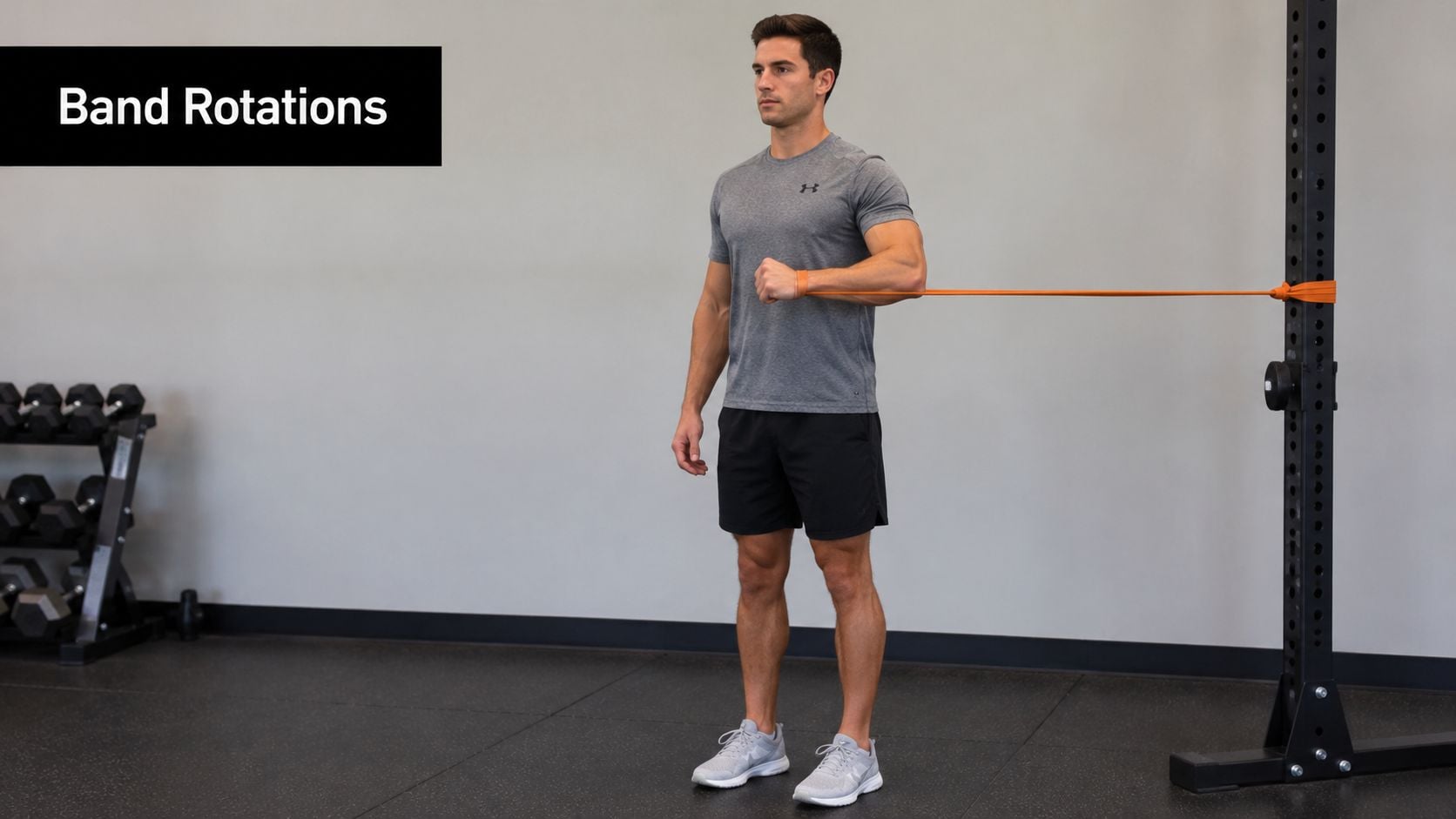
Standing internal and external rotation work can be a very practical part of a home program, especially when athletes need simple equipment and repeatable dosage. But the setup matters. If the shoulder blade is shrugged up, the ribs are flared, or the athlete is twisting through the trunk, the cuff isn't doing what you want.
Use the right dose
Harvard-affiliated HSS guidance notes that isometric internal and external rotation, side-lying shoulder abduction, and shoulder scaption can help improve shoulder pain in a few weeks, with isometric holds done for 10 seconds for 10 reps and side-lying abduction and scaption progressing from 3 sets of 10 up to 30 reps as tolerated. That lines up well with what we see clinically. Low-load, higher-repetition cuff work done consistently usually beats random heavy band sessions.
For many athletes, standing band rotations become the home-base exercise between visits. They're portable, easy to dose, and easy to tweak by tension, position, or tempo.
When bands help and when they don't
Bands help when the athlete needs tolerance, repetition, and motor control. They don't solve everything.
- Good use case: A swimmer rebuilding cuff endurance without provoking symptoms.
- Less helpful use case: A thrower trying to return to max-velocity sport demands with bands alone.
- Best setup: Elbow supported or position controlled so the cuff does the work.
- Common mistake: Turning every rep into a torso rotation.
Some athletes also like extra symptom support around training. If that's part of the plan, PTU may layer in tools like kinesiology tape for shoulder support, but the tape is an assistant, not the main treatment.
7. Dead Bug Progression with Shoulder Flexion
This is the exercise that surprises athletes. They come in expecting another shoulder isolation drill, and instead we put them on their back teaching rib control, core position, and overhead arm motion. Then the shoulder starts moving better.
That's not a gimmick. A lot of shoulder impingement symptoms show up when the trunk and rib cage stop giving the scapula a stable platform. If you can't control overhead motion without arching your back, you'll often borrow motion from places that irritate the shoulder.
Why core and shoulder work belong together
This is especially useful for runners, dancers, and athletes returning from a layoff. They may have enough raw shoulder strength, but poor proximal control means the arm still moves on top of a shaky base.
The dead bug variation also works well for athletes who aren't ready for a lot of loaded overhead exercise yet. It gives them a way to train shoulder flexion, cuff timing, and trunk control in a low-threat position.
A shoulder that only works in isolation usually won't hold up in sport.
Simple progression
Keep this drill strict. If the low back peels off the floor every rep, you've lost the point.
- Level 1: Basic dead bug with alternating arm and leg movement.
- Level 2: Add controlled shoulder flexion overhead on the moving arm.
- Level 3: Reach both arms overhead while alternating the legs.
- Level 4: Slow the tempo and increase the pause where control is hardest.
This is one of my favorite bridge exercises before athletes return to more demanding pressing, serving, throwing, or dance-based overhead patterns. It teaches the body to organize itself again, which is often what painful shoulders are missing.
7 Exercises Compared for Shoulder Impingement
| Exercise | 🔄 Implementation Complexity | ⚡ Resource Requirements | 📊 Expected Outcomes | ⭐ Ideal Use Cases | 💡 Key Advantages / Tips |
|---|---|---|---|---|---|
| Sleeper Stretch | Low, simple side‑lying technique but position‑dependent | Minimal, none or towel | Gradual increase in posterior capsule mobility and internal rotation | Early rehab, acute posterior tightness, daily warm‑up/cool‑down | Safe daily use; hold 30–45s ×2–3; pair with scapular stabilization |
| Scapular Plane Raises (Prone I‑Y‑T) | Moderate, prone positioning and movement precision required | Low–Moderate, treatment table, light weights/bands | Improved posterior chain strength and dynamic scapular control | Mid‑rehab, overhead athletes needing posterior strength and motor control | Emphasize form over load; 2–3 sets of 12–15; progress with light weights/bands |
| Half‑Kneeling Single‑Arm Landmine Press | High, anti‑rotation and positioning demands; technical learning curve | High, landmine/barbell and gym space required | Functional unilateral strength, core anti‑rotation, sport transfer | Advanced rehab, return‑to‑sport strength phases, performance training | Start light (5–15 lb), cue tall posture and braced core; progress load gradually |
| Prone Shoulder External Rotation (90/90) | Moderate, precise 90/90 positioning and control needed | Minimal, light dumbbell or cable, treatment table | Targeted external rotator strengthening and humeral head centering | Rotator cuff rehab for throwers/overhead athletes, mid‑rehab strengthening | Begin very light (0.5–2 lb), slow controlled reps 15–20; maintain elbow at 90° |
| Quadruped Shoulder Tap & Stabilization | Low–Moderate, demands scapular control and anti‑rotation | Minimal, mat; optional unstable surface for progression | Enhanced scapular stability, proprioception, and neuromuscular control | Early‑phase rehab, home programs, core‑shoulder integration | High compliance; progress holds/tempo; avoid trunk rotation and scapular winging |
| Banded Shoulder Internal/External Rotation (Standing) | Low, simple setup but requires consistent form | Low, resistance bands and stable anchor | Rotator cuff endurance and balanced rotational strength | Home maintenance, early‑mid rehab, group conditioning | Portable and progressive; anchor at elbow height; advance bands when >15 reps |
| Dead Bug Progression with Shoulder Flexion | Moderate, coordination and core control critical | Minimal, mat; no special equipment | Integrated core‑shoulder stability and safe overhead patterning | Early‑mid rehab for proximal stability before standing overhead work | Maintain neutral spine, move slowly; 2–3 sets of 10–12; progress complexity gradually |
Your Next Move From Rehab to Peak Performance
These seven movements are a strong starting point, but they aren't a universal recipe. That's the biggest mistake people make with the best exercises for shoulder impingement. They grab a list online, do all of it at once, and assume more work means better results. It usually doesn't.
The question isn't just which exercise is best. It's which exercise fits your current stage, your irritability level, and your sport. A recent clinical discussion around shoulder pain guidance points to a major gap in most online content. People get lists of doorway stretches, pendulums, wall slides, and band drills, but they don't get enough help deciding which exercises are appropriate, how much pain is acceptable, or when they need an assessment instead of more home work, as outlined in this discussion of the common exercise-list gap in shoulder impingement content.
That's where sports physical therapy changes the process. At PTU, we don't just hand you exercises. We look at how your shoulder behaves under load, how your scapula moves, how your thoracic spine contributes, and what your sport demands. A swimmer doesn't need the same progression as a baseball pitcher. A dancer doesn't need the same path as a powerlifter. A post-op athlete doesn't need the same volume as someone managing an overuse flare.
Return-to-sport planning matters too. Another common gap in shoulder impingement advice is load management and sequencing back into training. Athletes are left wondering whether to train through pain, when to add overhead pressing, and how to progress for throwing, swimming, volleyball, or dance, which is exactly the progression problem described in this overview of the return-to-sport gap in shoulder impingement exercise advice. That's a sports rehab problem, not just a home exercise problem.
At Physical Therapy U, our licensed DPTs build that progression with you. Depending on what you need, that may include dry needling, laser therapy, running gait analysis, dance therapy, strength work, or formal return-to-sport testing. We treat athletes from Bridgewater, Buzzards Bay, Middleborough, and nearby communities including Taunton, Plymouth, East Bridgewater, West Bridgewater, and Raynham.
If your shoulder keeps pinching, don't guess. Get it assessed, get a plan, and rebuild it the right way. Recovery is only half the goal. The other half is returning with a shoulder that's ready for your sport. If recovery work is part of your routine, you may also like this perspective on improving performance through massage.
If shoulder pain is limiting your lifting, throwing, swimming, dancing, or return to full training, book an evaluation with Physical Therapy U. Our sports PT team serves Southeastern Massachusetts from Bridgewater, Buzzards Bay, and Middleborough, and we'll build a plan that matches your sport, your symptoms, and your return-to-performance goals.
