
Maximize Your Recovery: Your First PT Visit Starts Here
Walking into your first physical therapy appointment can feel overwhelming. You know the goal. Get back to your sport, move with confidence, and stop wondering whether every step, cut, jump, or lift is making things better or worse.
At Physical Therapy U, we work with athletes across Southeastern Massachusetts who are asking the same thing. What should I ask my PT so I know I'm in the right place? That matters whether you're a high school soccer player in Bridgewater, Massachusetts, a runner from Plymouth, a dancer in the South Shore Massachusetts area, or a post-op ACL athlete trying to make a safe return.
The right questions change the whole relationship. They help you find out whether your therapist understands your sport, has a clear progression plan, and knows how to measure recovery instead of guessing. That's a core part of patient-centered care in practice.
This guide is written from a sports physical therapy perspective and reviewed by licensed DPTs at PTU. It's built for athletes who want more than generic rehab. You'll find the most important questions to ask a physical therapist, why each one matters, what a strong clinical answer sounds like, and which follow-up questions make sense for runners, dancers, and post-surgical athletes.
Table of Contents
- 1. What is your experience treating my specific injury or condition?
- 2. What is your approach to return-to-sport progression and clearance?
- 3. How do you incorporate sport-specific or activity-specific training into my rehab?
- 4. What supplemental treatments or modalities would benefit my recovery?
- 5. How will you measure my progress and adjust treatment if I'm not improving?
- 6. What can I do at home to support my recovery and accelerate healing?
- 7. What is your approach to managing pain, and when would you recommend advanced interventions?
- 8. What is your experience with my specific age group or population (youth athletes, older adults, dancers, etc.)?
- 9. What is your treatment plan timeline and when can I expect to return to my sport or activity?
- 10. How do you incorporate education and self-management into my recovery?
- 10 Key Questions to Compare Physical Therapists
- Ready to Start Your Comeback Story?
1. What is your experience treating my specific injury or condition?
This is the first filter. A therapist can be excellent and still not be the right fit for your problem if they don't regularly treat your injury, your sport, or your stage of recovery.
An ACL reconstruction, a runner's bone stress issue, a throwing shoulder, and a dance overuse injury don't follow the same rehab logic. Athletes do better when their PT understands the actual demands of the activity they're trying to return to, not just the body part that hurts.

What a good answer sounds like
A strong answer is specific. Your PT should be able to describe how they've handled your type of case, what common setbacks look like, and how they adapt rehab to your sport.
For example, a runner should ask whether the clinic performs running gait analysis. A dancer should ask whether the therapist understands turnout demands, pointe progression, and technique-related overload. A post-op ACL athlete should ask whether return decisions involve more than time since surgery.
Practical rule: If the answer stays vague, stays generic, or sounds the same for every injury, keep asking.
Useful follow-ups include:
- ACL athletes: “How do you handle strength deficits, cutting progressions, and return-to-sport testing?”
- Runners: “Do you evaluate cadence, loading patterns, training errors, and shoe history?”
- Dancers: “How do you modify rehab around class, rehearsal, flexibility demands, and balance work?”
- Parents of youth athletes: “How do you communicate with families, coaches, and surgeons when needed?”
One more point matters. Many athletes only ask about credentials, but they should also ask how the clinic tracks outcomes. In PT practice management, benchmarks like net collection rate, vacancy rate, and conversion rate are standard ways clinics measure operational performance, and a net collection rate of at least 95% is a commonly cited goal in PT practice operations. You don't need to become an administrator, but asking how a clinic monitors performance tells you a lot about whether it runs with discipline.
2. What is your approach to return-to-sport progression and clearance?
For athletes, this question matters more than “How long until I'm better?” Pain relief is only one checkpoint. Return to sport is a separate decision, and it should be based on function, not hope.
A lot of consumer advice about questions to ask a physical therapist stays too general. It covers experience, frequency, and insurance, but often skips the key issue for active people. How will you know I'm ready to run, jump, cut, land, or compete? That gap is especially important for athletes, dancers, and post-surgical patients because pain reduction isn't the same as readiness, as discussed in this guide on smart questions before choosing a physical therapist.
What athletes should listen for
A good sports PT should describe a progression. Early stage rehab restores motion, controls swelling or irritability, and rebuilds baseline strength. Later stages should challenge movement quality, force production, deceleration, impact tolerance, and sport-specific confidence.
If you're recovering from ACL surgery, ask whether the clinic uses a formal testing process before clearance. At PTU, that conversation often includes hop testing, strength work, movement analysis, and staged return to practice. Our clinicians also walk athletes through what to expect in an ACL recovery timeline for athletes.
You want a therapist who can tell you why you're moving forward, and why you're not ready yet if you're not ready.
Good follow-up questions:
- For field and court athletes: “How do you test cutting, deceleration, and change of direction?”
- For overhead athletes: “When do you begin an interval throwing or serving progression?”
- For runners: “What needs to happen before I go from jogging to full training?”
- For dancers: “How do you decide I'm ready for jumps, turns, and full choreography?”
3. How do you incorporate sport-specific or activity-specific training into my rehab?
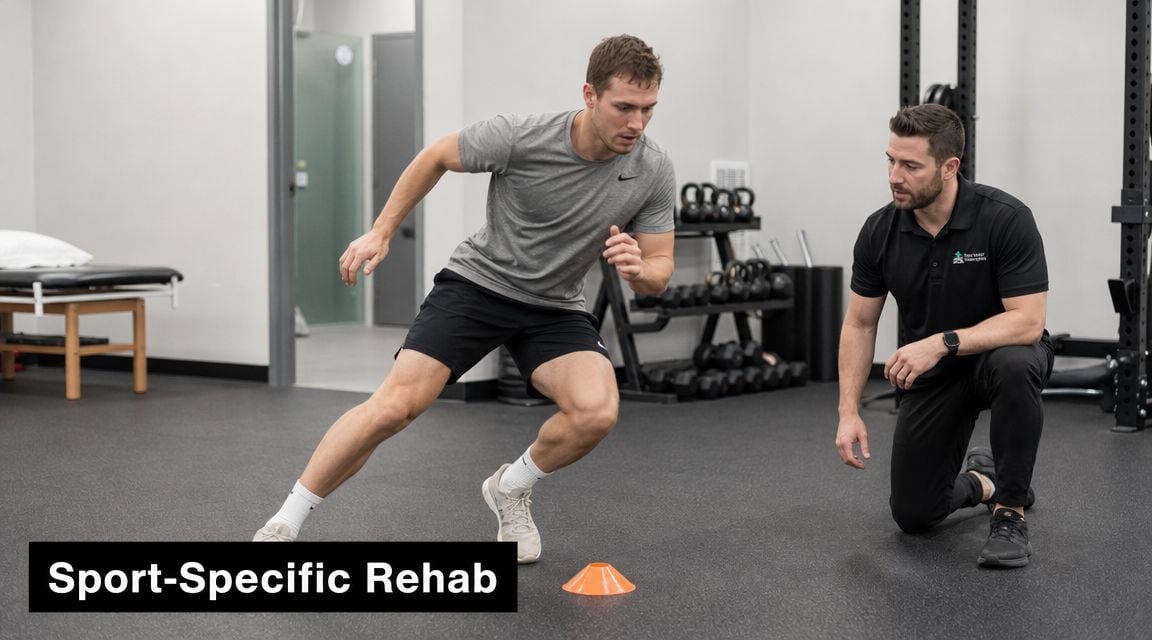
Generic rehab has a ceiling. Squats, bridges, band walks, and balance drills matter, but if your final goal is a sprint start, a volleyball block landing, a pirouette, or distance running, your plan has to bridge into that world.
At PTU, we treat that transition as part of rehab, not something you figure out later on your own. Athletes in Bridgewater, Buzzards Bay, and Middleborough usually don't need more random exercises. They need the right progression from basic capacity to sport demand.
Ask when rehab starts to look like your sport
A strong answer should include examples. A soccer athlete might move from bilateral loading to single-leg control, then lateral movement, then deceleration, then reactive change of direction. A baseball player might progress from cuff strength and scapular control into an interval throwing program. A dancer might rebuild foot and ankle capacity before progressing to relevé, turns, and choreography-specific endurance.
Runners should ask whether the therapist looks beyond pain location. Training load, cadence, stride habits, hip control, calf capacity, and return-to-run structure all matter. PTU offers running gait analysis for athletes and active adults because small movement errors can keep symptoms going even when strength is improving.
Ask follow-up questions like these:
- Timing: “When do we start drills that resemble my sport?”
- Specificity: “Will you build rehab around my position, event, or training style?”
- Load management: “How do I restart team practice, class, or mileage without a setback?”
- Transfer: “How will we know the gym work is carrying over to performance?”
Rehab shouldn't stop at “stronger.” It should end at “ready for the demands you actually face.”
4. What supplemental treatments or modalities would benefit my recovery?
Athletes ask about dry needling, laser therapy, compression boots, cupping, manual therapy, and hands-on recovery work all the time. That's fair. These tools can help, but they shouldn't be the whole plan.
A good therapist won't sell you passive treatment as the main event. They'll explain where a modality fits, what problem it's targeting, and when it should fade into the background as you regain function.
What works and what doesn't
Supplemental treatments are most useful when they support active rehab. Dry needling may help reduce tone or irritability so you can move better. Manual therapy may help restore motion so exercise becomes more productive. Compression and recovery sessions may help an athlete tolerate training blocks or reduce post-session heaviness. Laser therapy may be discussed when a clinician is trying to calm an irritated tissue as part of a broader plan.
At PTU, we use tools like dry needling, myofascial release, and recovery services when they match the athlete's presentation. We also talk through expectations so nobody mistakes short-term relief for full recovery. If you're curious about one modality in particular, our clinicians outline where it may fit in laser therapy for inflammation and recovery.
Ask these follow-ups before you agree to a modality:
- Reasoning: “What problem is this treatment supposed to solve?”
- Timing: “How long do you expect to use it?”
- Skill: “Do you have training or certification for this technique?”
- Exit plan: “What tells us I no longer need it?”
The wrong answer sounds like this: every visit looks the same, you feel temporary relief, and there's no progression in strength, tolerance, or sport movement. For athletes, passive care without active progression usually stalls out.
5. How will you measure my progress and adjust treatment if I'm not improving?
If your rehab plan doesn't measure anything, it's built on impressions. That's not enough for an athlete trying to get back to high-demand activity.
You should know what your PT is tracking from the beginning. That may include pain behavior, range of motion, strength, jump or hop quality, balance, running tolerance, movement patterns, or sport-specific tasks. The exact mix depends on the injury, but there should be a system.
Progress should be visible
For a knee injury, that might mean repeated strength checks, single-leg control tasks, and functional movement testing over time. For a shoulder, it may involve range, force generation, tolerance to overhead loading, and mechanics. For a runner, symptom response to mileage and changes in gait may matter as much as isolated strength numbers.
A useful patient-facing question is whether the clinic gathers structured feedback on the experience itself. PT satisfaction surveys commonly include prompts about booking ease, waiting-room time, whether questions were answered, and likelihood to recommend the clinic. Broader market research guidance also notes the value of customer satisfaction studies and automated NPS-style surveys for identifying service gaps and improving the patient experience, as outlined in this physical therapy patient satisfaction survey guide.
Clinical reality: If you're not improving, your PT shouldn't just repeat the same visit and hope.
Ask direct follow-ups:
- Measurement cadence: “How often will you re-test me?”
- Decision-making: “If I plateau, what will you change first?”
- Transparency: “Can you show me the trend, not just tell me I'm doing better?”
- Readiness: “Which test matters most for the next stage of rehab?”
The best sports rehab feels collaborative. You should understand what you're working on, what has improved, and what still needs to change before you move forward.
6. What can I do at home to support my recovery and accelerate healing?
Most of your recovery doesn't happen in the clinic. It happens between visits, in the choices you make when nobody is supervising you.
That doesn't mean you need a complicated home program. In fact, athletes usually do better with a focused plan they will commit to. A few well-chosen exercises done consistently beat a giant handout that never leaves the kitchen counter.

Ask for the minimum effective plan
Your PT should be able to tell you which exercises matter most, how often to do them, what form errors to avoid, and how to progress. If they can't simplify it, the plan probably isn't clear enough.
For example, an ACL athlete may need a short list centered on motion, quad activation, and swelling control early on. A runner might focus on calf loading, hip stability, and return-to-run structure. A dancer may need foot intrinsic work, ankle control, and strength through end range.
Helpful questions include:
- Priority: “What are the top two or three things I need to do at home?”
- Dose: “How many days per week matters most here?”
- Progression: “What tells me it's time to level this up?”
- Compliance: “How do we make this realistic with school, work, or practice?”
Home work also includes recovery basics. Sleep, training load, daily movement, and fueling affect how well you adapt. Athletes often ask about how to boost energy and endurance naturally, but in rehab the more useful question is whether your daily habits are supporting the program you're already doing.
This short video gives a simple example of how home exercise education can look in practice.
A good home program should evolve. What helped in week one usually shouldn't be the same plan you're doing a month later.
7. What is your approach to managing pain, and when would you recommend advanced interventions?
Athletes often worry that pain means damage, or that zero pain is required before any progression. Neither assumption is reliable.
A strong PT will help you understand the difference between acceptable rehab discomfort and warning-sign pain. That matters after surgery, during tendon rehab, and in overuse injuries where complete rest often isn't the answer.
Pain management should be active, not fear-based
Good pain management includes education, load adjustment, exercise modification, and hands-on treatment when appropriate. It may also include talking through what a flare-up means and what it doesn't mean. The point is to keep you progressing without ignoring signs that need medical attention.
This is also where clinical judgment matters. If pain is worsening, swelling isn't settling, or your function is moving backward, your PT should know when to coordinate with your surgeon, sports medicine physician, or primary care provider. Sometimes that means discussing imaging. Sometimes it means medication questions need to go back to the prescribing physician. Sometimes it means the plan needs to be dialed down before it can move forward again.
Ask questions like these:
- Boundaries: “What amount of pain during exercise is acceptable?”
- Red flags: “What symptoms mean I should call my doctor?”
- Medication context: “How should pain meds affect how I judge my response to exercise?”
- Escalation: “When would you consider imaging, injection discussion, or specialist referral?”
Pain is information. It's not always a stop sign, and it's not something to ignore.
For post-op ACL athletes, one practical example is persistent swelling. If the knee keeps ballooning after appropriate loading, that changes the conversation. For runners, pain that ramps with each run despite sensible modification may suggest the return plan needs reworking. For dancers, repeated pain in turnout positions may point to a technique or load issue, not just weakness.
8. What is your experience with my specific age group or population (youth athletes, older adults, dancers, etc.)?
The right rehab plan for a varsity soccer player isn't the same as the right plan for a masters runner, and neither looks like rehab for a pre-professional dancer. Population matters.
Youth athletes may need closer communication with parents and coaches. Older active adults may need smarter load progression around work, recovery, or prior injuries. Dancers often need a therapist who understands movement quality, flexibility demands, and the reality that “return to class” is not the same as “return to full performance.”
Population experience changes the details
At PTU, this comes up constantly. A middle school athlete may need confidence-building and simple instructions. A college athlete may need a plan that fits travel, lifts, and practice demands. A dancer may need dance therapy that respects artistry and technical requirements rather than forcing everything into a standard gym model.
Ask the therapist whether they see people like you. Then ask how that changes care.
Useful follow-ups:
- Youth athletes: “How do you balance growth, sport pressure, and safe progression?”
- Parents: “How much of communication happens with me versus my child?”
- Dancers: “Do you understand turnout, pointe demands, jumps, and rehearsal load?”
- Older athletes: “How do you adjust training if I'm managing stiffness, past injuries, or slower recovery?”
A strong answer includes context, not just reassurance. You want to hear that the therapist understands your training environment, your motivations, and the barriers that are likely to affect adherence.
9. What is your treatment plan timeline and when can I expect to return to my sport or activity?
This is one of the most common questions to ask a physical therapist, and it's also one of the easiest to answer badly. The wrong answer is a fast, confident prediction with no explanation.
A better answer gives you phases, milestones, and the variables that can move the timeline up or down. It also separates pain reduction from true sport readiness. Those are not the same endpoint.
Ask for phases, not just a date
Athletes do best when they know what each stage is supposed to accomplish. Early rehab may focus on calming the problem, restoring range, and building baseline strength. Mid-stage rehab usually increases tissue capacity and movement control. Late-stage rehab should prepare you for speed, force, impact, and sport-specific demand.
Access issues matter here too. Many articles mention insurance but don't fully answer the practical questions athletes and families care about. Visit frequency, therapist continuity, expected plan-of-care length, co-pays, and what happens if scheduling delays slow progress are all part of the recovery picture, especially for insured patients and busy families, as highlighted in this overview of common patient questions before a first PT appointment.
Ask for specifics like these:
- Milestones: “What should I be able to do before the next phase?”
- Meaning: “Does return mean practice, modified practice, or full competition?”
- Scheduling: “How often do I really need to be seen early versus later?”
- Continuity: “Will I see the same clinician consistently?”
If you live near Taunton, Raynham, East Bridgewater, West Bridgewater, Plymouth, or Buzzards Bay, these practical access questions matter just as much as clinical skill. The best plan in the world won't help much if you can't follow it consistently.
10. How do you incorporate education and self-management into my recovery?
The best physical therapists don't create dependence. They build athletes who understand their body, know how to manage setbacks, and can stay healthy after discharge.
That means your PT should teach as they treat. You should leave visits understanding why you're doing an exercise, what response is expected, and how your choices affect recovery.
What long-term success sounds like
If you're a runner, education may focus on training errors, recovery, and gait-related loading. If you're post-op, it may center on stage-appropriate expectations and what signs require a call to your surgeon. If you're a dancer, it may involve technique modifications, rehearsal load, and self-monitoring during return.
Ask whether the therapist plans to make you more independent over time. Good rehab should gradually shift from guided care to self-management, with periodic check-ins instead of indefinite treatment.
Questions worth asking:
- Understanding: “Can you explain why this exercise or progression matters?”
- Prevention: “What can I keep doing after discharge to lower re-injury risk?”
- Ownership: “What signs tell me I'm handling training well, or not well?”
- Off-ramp: “How do we transition from regular visits to independent work?”
A strong rehab plan doesn't end when pain settles. It leaves you with a system you can use the rest of your season.
That's especially important for athletes with recurring injuries. If you've had the same hamstring, ankle, shoulder, or knee problem more than once, education isn't optional. It's part of the treatment.
10 Key Questions to Compare Physical Therapists
| Item | Implementation Complexity 🔄 | Resource Requirements ⚡ | Expected Outcomes 📊⭐ | Ideal Use Cases 💡 | Key Advantages ⭐ |
|---|---|---|---|---|---|
| What is your experience treating my specific injury or condition? | Low, simple inquiry 🔄 | Low, credential review ⚡ | High alignment with evidence 📊 ⭐⭐⭐⭐ | Athletes with specific injuries (ACL, rotator cuff, dancers) 💡 | Ensures specialized, evidence‑based care ⭐ |
| What is your approach to return-to-sport progression and clearance? | Moderate, structured protocols 🔄 | Moderate, objective testing equipment/time ⚡ | Strong reduction in re‑injury risk 📊 ⭐⭐⭐⭐ | High‑risk injuries; competitive athletes nearing return 💡 | Objective milestones and measurable clearance ⭐ |
| How do you incorporate sport-specific or activity-specific training into my rehab? | High, tailored progressions 🔄 | High, space, equipment, clinician expertise ⚡ | High transfer to sport performance 📊 ⭐⭐⭐⭐ | Sport/position specific rehab, dancers, pitchers 💡 | Maximizes real-world performance and confidence ⭐ |
| What supplemental treatments or modalities would benefit my recovery? | Moderate, modality selection 🔄 | Moderate–High, devices, certifications, cost ⚡ | Variable; can accelerate pain/ROM gains 📊 ⭐⭐⭐ | Post‑op swelling, chronic pain adjuncts, soft‑tissue issues 💡 | Multi‑mechanism symptom relief; complements exercise ⭐ |
| How will you measure my progress and adjust treatment if I'm not improving? | Moderate, scheduled testing/decision points 🔄 | Moderate, outcome tools and documentation ⚡ | High clarity and timely adjustments 📊 ⭐⭐⭐⭐ | Plateauing patients; insurance justification; complex cases 💡 | Data‑driven care, early identification of barriers ⭐ |
| What can I do at home to support my recovery and accelerate healing? | Low, deliverable HEPs 🔄 | Low, minimal equipment, patient time ⚡ | High when adhered to; reduces visits 📊 ⭐⭐⭐⭐ | All patients; limited clinic access; cost‑sensitive cases 💡 | Empowers patients; cost‑effective and scalable ⭐ |
| What is your approach to managing pain, and when would you recommend advanced interventions? | Moderate, multimodal strategy 🔄 | Moderate, education, modalities, physician collaboration ⚡ | High with proper application; reduces unnecessary procedures 📊 ⭐⭐⭐⭐ | Chronic pain, persistent post‑op pain, complex presentations 💡 | Multimodal management; clear escalation thresholds ⭐ |
| What is your experience with my specific age group or population (youth athletes, older adults, dancers, etc.)? | Low, caseload inquiry 🔄 | Low, communication and examples ⚡ | Improved appropriateness and safety 📊 ⭐⭐⭐ | Population‑specific care (youth, geriatric, dance) 💡 | Age/population‑tailored expectations and strategies ⭐ |
| What is your treatment plan timeline and when can I expect to return to my sport or activity? | Moderate, phase‑based planning 🔄 | Low–Moderate, assessment and individualized plan ⚡ | Better planning and motivation; variable timelines 📊 ⭐⭐⭐ | Surgical planning, season scheduling, life planning 💡 | Realistic milestones and expectation management ⭐ |
| How do you incorporate education and self-management into my recovery? | Low, educational emphasis 🔄 | Low, materials/time for teaching ⚡ | High long‑term outcomes and independence 📊 ⭐⭐⭐⭐ | Chronic conditions, prevention, long‑term maintenance 💡 | Builds self‑management, reduces dependence, prevents re‑injury ⭐ |
Ready to Start Your Comeback Story?
You're the most important member of your recovery team. Asking better questions doesn't make you difficult. It makes you engaged, informed, and more likely to get a plan that fits your sport, your injury, and your goals.
That's the point of this list. Not every physical therapy experience is built the same. Some clinics are good at reducing pain but never fully bridge athletes back to performance. Some are convenient but don't provide continuity. Some rely too heavily on passive treatment. Others understand exactly how to move an athlete from the early rehab stage into strength, sport-specific training, and return-to-sport testing.
At PTU, we believe athletes deserve that full picture. If you're dealing with an ACL recovery, a running injury, dance-related pain, a shoulder issue, or a setback that's keeping you from training the way you want, you should know how your therapist thinks. You should know how progress will be measured. You should know what milestones matter, what happens if you plateau, and how the plan connects to the field, court, track, studio, or gym you're trying to get back to.
For athletes in Southeastern Massachusetts, that often means looking beyond the most obvious questions. Yes, ask about experience. Yes, ask about insurance. But also ask whether you'll see the same clinician, how return-to-sport decisions are made, whether the clinic offers sport-specific progression, and how home programming fits your actual life. Those answers tell you whether the plan is practical, not just impressive on paper.
If you're near Bridgewater, Massachusetts, or coming from Plymouth, Taunton, East Bridgewater, West Bridgewater, Raynham, Buzzards Bay, or Middleborough, our team is here to help you sort through those questions with you. PTU provides athlete-centered sports physical therapy with one-on-one clinical care, return-to-sport testing, running gait analysis, dance therapy, dry needling, and performance-minded rehab for youth athletes through adults.
No article can replace an in-person evaluation, especially after surgery or with persistent pain. A licensed physical therapist needs to assess your movement, symptoms, training demands, and medical history before giving individualized advice. But showing up prepared changes the conversation immediately.
Bring these questions to your first visit. Ask the follow-ups that matter for your sport. Expect clear answers. Then build a plan that gets you back with confidence, not guesswork.
If you're ready to work with an athlete-centered team, book an evaluation with Physical Therapy U. We serve Southeastern Massachusetts from our Bridgewater, Buzzards Bay, and Middleborough locations, and we'll help you build a rehab plan around your sport, your schedule, and your return-to-play goals.
