
You felt it on the last rebound. You got there on time, loaded up, and still watched someone else meet the ball first. For a lot of basketball players, that moment turns into the wrong plan fast: more random jumps, more pickup games, more fatigue.
A better answer starts with sports physical therapy, not just motivation. At PTU, our clinicians work with basketball athletes, runners, dancers, and post-surgical patients across Bridgewater, Massachusetts, Buzzards Bay, and Middleborough. When we look at how to jump higher for basketball, we don't treat it like a pure “bounce” problem. We treat it like a blend of force production, movement quality, tendon loading, technique, and recovery.
That matters if you're a middle school athlete in Plymouth, a varsity player in Taunton, an adult league hooper on the South Shore, or someone rebuilding after ACL surgery. A higher vertical is trainable, but it has to be trained in a way your body can tolerate.
Table of Contents
- Why You Are Not Jumping as High as You Could Be
- Establish Your Baseline with Jump Testing
- Build Your Foundation with Strength Training
- Add Explosiveness with Plyometric Drills
- Master Your Jumping and Landing Technique
- Protect Your Gains with Smart Recovery and Mobility
- Frequently Asked Questions About Jump Training
Why You Are Not Jumping as High as You Could Be
Most players don't have a jumping problem. They have a force expression problem.
USA Basketball explains vertical leap as a physics issue: improve your power-to-body-weight ratio, because more power at a given body weight raises takeoff velocity and jump height in basketball movements (USA Basketball on the science behind vertical leap). That's why “just jump harder” usually doesn't work. If your legs can't produce enough force, if you take too long to apply it, or if your approach mechanics leak energy, your jump stalls.
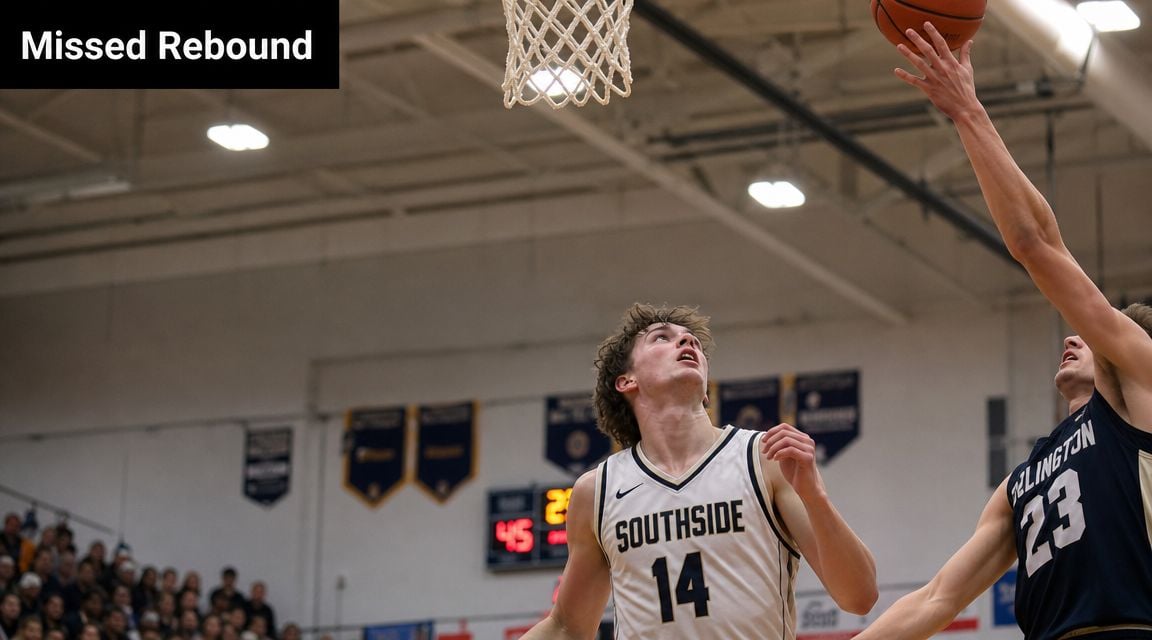
Genetics matter, but they're not the full story. Basketball-specific research has shown that jump measures can improve over the course of a season when training and adaptation are monitored, which tells us vertical jump is not fixed talent. It responds to structured work.
What usually holds players back
A few patterns show up over and over:
- You skip strength work: Plyometrics without force capacity often turn into noisy reps with limited carryover.
- You train tired all the time: Pickup, practices, games, and extra jump work pile up fast.
- Your approach is inefficient: A rushed penultimate step, poor arm swing, or too much knee bend can waste good power.
- Your ankles and hips don't move well: Stiff joints change loading strategy and blunt takeoff.
- You land poorly: If every landing is loud and rigid, your body stops tolerating the volume needed to improve.
Practical rule: If your jump training makes you more beat up than springy, your program is off.
For athletes in South Shore Massachusetts, the best plan usually isn't more effort. It's better sequencing. Test first. Build strength. Add explosive work. Clean up your technique. Then recover hard enough to repeat the process.
Establish Your Baseline with Jump Testing
If you want a real answer to how to jump higher for basketball, start by measuring it the same way every time.
Basketball research commonly uses squat jump (SJ), countermovement jump (CMJ), and free-arm-swing countermovement jump (CMJ Free) to assess jump performance, and a study of professional players found all three improved significantly across a season with structured training and monitoring (professional basketball jump testing research). For an athlete, that does two things. It gives you a baseline, and it shows whether your program is working.
Use the same tests every time
You don't need a lab to get useful data. You do need consistency.
Here's a practical setup:
- Squat jump: Start from a still quarter-squat position. Pause briefly. Jump without a dip.
- Countermovement jump: Start tall, dip quickly, then jump straight up.
- Free-arm-swing countermovement jump: Same as the CMJ, but use your natural arm swing.
Each test tells you something slightly different. The squat jump removes the quick dip and gives you a cleaner look at force from a static position. The countermovement versions are more game-like and show how well you use timing, coordination, and elastic recoil.
A simple testing setup that works
Pick one method and stick with it:
- Wall and chalk method: Mark standing reach, then mark highest touch.
- Vertec if your gym has one: Good option for team settings.
- Video from the side and front: Useful for mechanics, not just height.
Keep the setup stable:
- Use the same shoes
- Test after the same warm-up
- Jump on the same surface
- Record your best efforts after multiple attempts
- Write down how the jumps felt, not just the result
A player who tests after a hard leg day, then compares that to a rested test a week later, isn't tracking progress. They're tracking fatigue.
Test on a day when you're fresh enough to show your actual output, not the leftovers from practice.
If you're a high school athlete training this offseason, pairing jump testing with organized strength work helps a lot more than guessing. PTU's high school strength and conditioning summer program is a good example of the kind of structured environment where athletes can measure, train, and re-test with purpose.
Build Your Foundation with Strength Training
Players love box jumps because they look athletic. Squats, hinges, and split-leg work are less flashy. They're also where a lot of vertical jump progress starts.
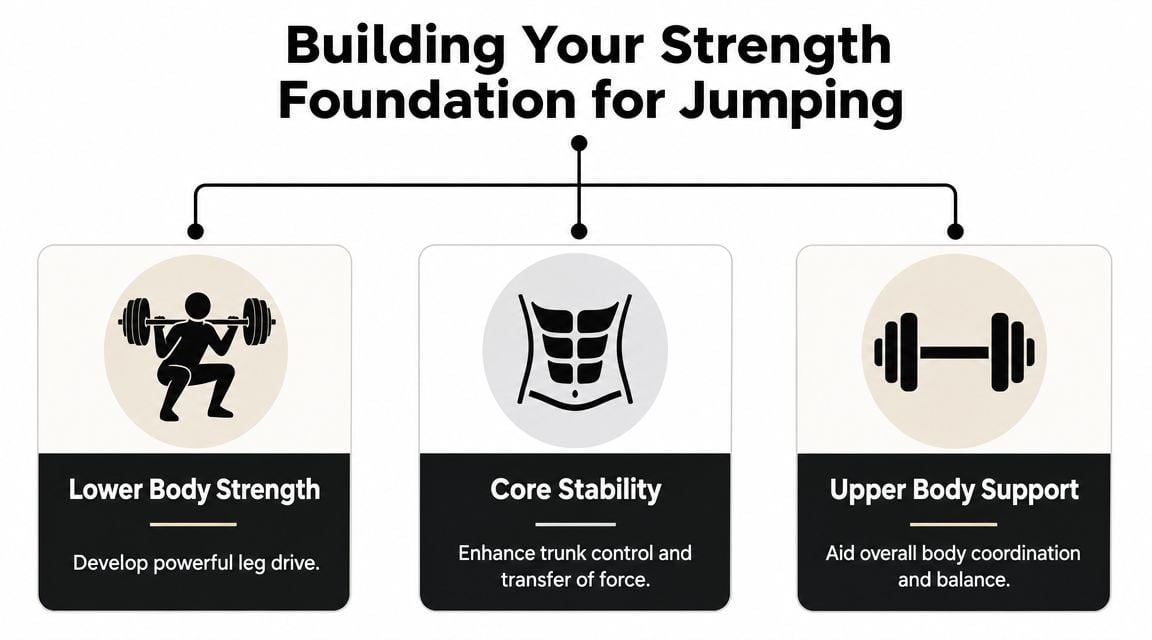
Mass General Brigham notes that plyometric training combined with specific strength exercises can improve vertical jumping, and squat-based strength work matters because higher force output supports a better rate of force development (Mass General Brigham on improving vertical jump). In plain terms, stronger legs give you more raw material to turn into lift.
Why strength comes first
A lot of jump plateaus come from a simple mismatch. The athlete wants more explosion, but their body doesn't have enough force capacity yet.
That shows up as:
- limited first-jump pop
- poor second-jump quality
- slow transition off the floor
- soreness that lingers because every jump is already near the athlete's ceiling
Strength work also gives tissue a better foundation. Tendons, muscles, and joints usually handle jumping volume better when the athlete has spent time under controlled loading.
The lifts that carry over best
You don't need a huge menu. You need a few movements done well and progressed over time.
- Back squat or front squat: Builds lower-body force through the quads and glutes. Stay controlled on the way down, own the bottom, and drive up without folding through the trunk.
- Deadlift or trap bar deadlift: Trains hip extension and posterior-chain strength. Think “push the floor away” rather than yanking the bar.
- Romanian deadlift: Useful for hamstrings and glute loading. Keep the ribs stacked, hinge at the hips, and don't turn it into a squat.
- Split squat or reverse lunge: Basketball is rarely perfectly symmetrical. Single-leg patterns expose side-to-side gaps.
- Calf raise variations: The ankle is a major force-transfer site. If the lower leg is weak, the top end of your jump often suffers.
- Trunk work: Carries, anti-rotation presses, and controlled core drills help transfer force instead of leaking it.
A simple training week often works better than a complicated one. Two lower-body strength sessions done consistently beat a scattered routine of random max-effort jumps.
Stronger athletes usually don't just jump higher. They tend to look quieter and more organized leaving the floor.
If you want extra exercise ideas beyond the basics, this comprehensive guide to lower body hypertrophy is a useful reference for compound lower-body training options that can support an offseason strength phase.
For athletes who need coaching, accountability, or a better progression than “lift hard and hope,” PTU's strength and conditioning program for athletes is built around sport-specific development rather than generic gym work.
Add Explosiveness with Plyometric Drills
Once you've built force, you have to learn to use it fast.
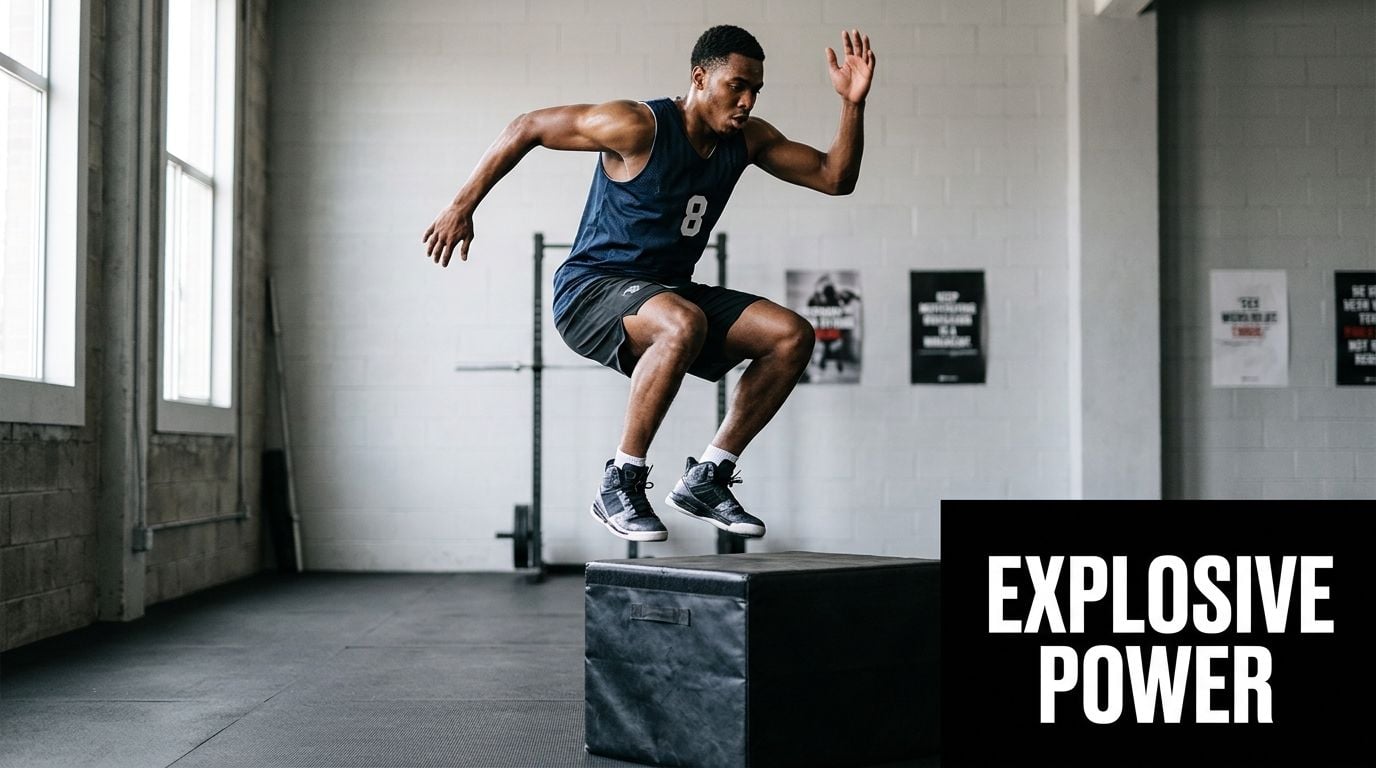
Plyometrics train the quick transition from loading to takeoff. That's the spring-like quality players feel when they're fresh and bouncy. It isn't just about jumping high one time. It's about teaching your body to absorb force, reverse it quickly, and do that again without falling apart.
Teach your body to use the spring it already has
A good plyometric progression moves from simple contacts to more demanding ones. Most athletes do better when they earn the advanced drills instead of starting there.
A practical sequence looks like this:
- Low pogo hops: Good for ankle stiffness and rhythm. Keep contacts short and quiet.
- Snap downs to stick: Teaches organized landing before repeated jumping.
- Two-foot line hops: Builds quick contacts without a huge landing demand.
- Box jumps: Useful when done for intent and clean mechanics, not for chasing the tallest box in the gym.
- Bounding or approach jumps: Adds horizontal speed and coordination.
- Depth jump variations: Higher demand. Better for advanced athletes who already show good landing control.
Not every player needs the same menu. A youth athlete in-season might stay with lower-impact options. A healthy college player in the offseason can tolerate more aggressive elastic work.
One other point comes up often in the clinic and weight room: supplements. Some athletes use creatine during training blocks, and if you're sorting through that decision, this review of creatine health and side effects is a reasonable starting read. It doesn't replace individualized guidance, but it can help you ask better questions.
A practical six-week jump block
This works well as a simple framework when you're training two days per week with a jump emphasis.
| Week | Day 1 Strength Focus | Day 2 Plyometric Focus |
|---|---|---|
| 1 | Squat pattern, hinge, split squat, calf work | Pogo hops, snap downs, low box jumps |
| 2 | Squat pattern, hinge, split squat, trunk control | Line hops, pogo hops, low approach jumps |
| 3 | Squat pattern, posterior chain, single-leg work | Box jumps, bounds, controlled repeated jumps |
| 4 | Squat pattern, hinge, unilateral loading | Box jumps, approach jumps, stick landings |
| 5 | Heavy lower-body strength with reduced accessory volume | Bounds, depth jump intro, approach jump practice |
| 6 | Strength maintenance and crisp reps | Low-volume high-quality jumps, re-test week |
The main rule is quality. Stop the set when contacts get slow, noisy, or sloppy. Plyometrics done under fatigue often become conditioning disguised as jump training.
A short demonstration can help athletes understand how to organize a jump session and keep quality high:
A few mistakes to avoid:
- Too much volume too soon: More contacts aren't always better.
- No rest between efforts: Jump training needs intent, not exhaustion.
- Advanced drills before basic control: Depth jumps are not a beginner drill.
- Ignoring soreness at the front of the knee or Achilles: That's often a load-management warning, not a toughness test.
Master Your Jumping and Landing Technique
Good jumpers don't just produce force. They direct it well.
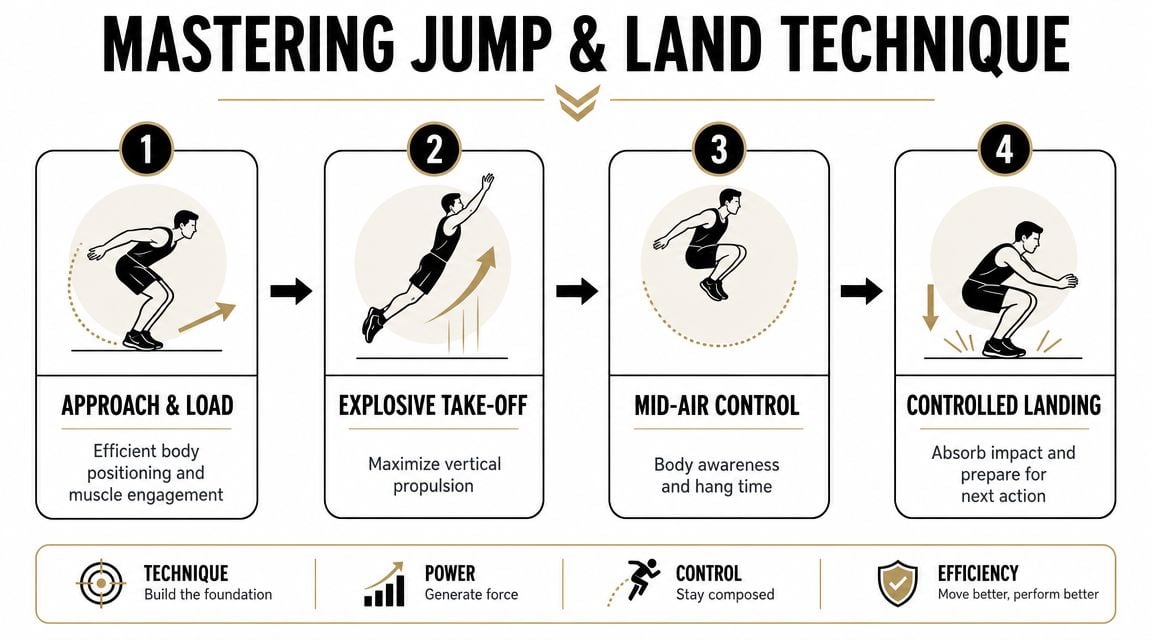
Applied basketball coaching consistently points toward a sequence that works: build lower-body strength, then add plyometrics and technique. Technical cues matter. Athletes tend to jump better by staying low, moving fast, and using an efficient penultimate step and arm swing to turn approach speed into vertical force (jump technique guidance for basketball).
Two-foot jumps are a skill
A lot of players make the same mistake on two-foot takeoffs. They over-dip, get stuck in the floor, and lose the speed that was supposed to help them.
The fix usually isn't “bend more.” It's cleaner timing.
For a two-foot jump:
- Carry useful speed into the plant
- Use a penultimate step that lets the hips lower without collapsing
- Keep the torso organized
- Drive the arms with intent
For a one-foot jump, the rhythm changes. The athlete usually needs more elastic stiffness and better control through the final plant. That's one reason dunk-style one-foot takeoffs and crowded-paint two-foot jumps can feel so different. They are different.
Fast approaches only help if you can convert speed into force. If you can't brake and organize the plant, more speed just creates a mess.
Landing is part of performance
Players usually think about takeoff. Clinicians spend just as much time watching the return to the floor.
A clean landing has a few recognizable traits:
- Quiet contact: The floor shouldn't sound like a crash.
- Shared load: Ankles, knees, hips, and trunk all contribute.
- Aligned knees: Not perfectly rigid, but not diving inward.
- Control after contact: You should be able to stick it, shuffle, or jump again.
If your landing is stiff, your jump training volume often gets limited by pain long before it's limited by effort. That's especially relevant for athletes managing patellar tendon irritation, ankle history, or return-to-sport after surgery.
A simple coaching checklist works well:
- Land softly.
- Let the hips help absorb force.
- Keep the chest from folding.
- Own the position before the next rep.
Protect Your Gains with Smart Recovery and Mobility
Players who never recover eventually stop adapting. Then they start compensating.
One of the biggest gaps in mainstream jump advice is the lack of attention to injury risk and load management. High-intensity jumping places real stress on tendons and joints, especially in youth athletes, and a physical therapy perspective looks at more than output. It looks at whether the body can safely absorb and reproduce force through the full kinetic chain (physical therapy perspective on jump load and injury risk).
Mobility restrictions can hide your real vertical
Some athletes aren't underpowered. They're blocked.
The common trouble spots are:
- Ankle dorsiflexion: If the ankle can't move, the knee and hip often have to solve the problem poorly.
- Hip flexion and extension: Limited hip motion changes the loading strategy and can make the athlete feel jammed up.
- Trunk stiffness in the wrong places: You want control, not rigidity.
Mobility work doesn't need to be dramatic to help. It needs to be targeted.
Useful options include:
- Knee-to-wall ankle mobility drills
- Loaded calf mobility
- Hip flexor mobility with glute engagement
- Adductor rock-backs
- Thoracic mobility paired with breathing
If hip pinching shows up during loading or squatting, don't just stretch harder and hope. Some athletes need a more specific screen. This article on hip impingement exercises to avoid is a good example of why the wrong mobility drill can make the wrong athlete feel worse.
Recovery is training when you want to keep improving
Recovery habits don't need to be fancy, but they do need to be consistent.
Good baseline habits include:
- Spacing hard jump days away from heavy game load when possible
- Using lighter skill or shooting sessions instead of stacking every day as max effort
- Monitoring pain during and after sessions
- Adjusting volume when tendons start to feel irritable
- Sleeping enough to adapt
Some athletes also benefit from hands-on care, dry needling for stubborn muscle tone, or recovery sessions when training volume is high. That's not a substitute for programming. It supports programming.
For athletes who want a broader view, these recovery strategies for serious athletes can be a helpful companion read.
Soreness is common. Sharp pain, swelling, or a jump quality drop that keeps trending down is a signal to get assessed.
That's especially true for in-season basketball players around Plymouth, Raynham, East Bridgewater, and West Bridgewater who are balancing practice, games, lifting, and school. Your body doesn't care that the schedule is crowded. It still responds to total load.
Frequently Asked Questions About Jump Training
How should a youth basketball player train for vertical jump
Youth athletes usually need better fundamentals, not aggressive plyometric volume. Start with body control, landing mechanics, split-leg strength, ankle stiffness, and basic jump rhythm. Keep contacts crisp, stop before technique falls apart, and make sure practices and games count as part of the total weekly load.
How do I return to jump training after ACL reconstruction
Don't jump back into max-effort jumping just because the knee feels “pretty good.” Athletes coming back from ACL surgery need progressive strength, single-leg control, landing tolerance, and objective return-to-sport testing before high-level elastic work makes sense. That often includes watching how the athlete decelerates, lands, and re-accelerates, not just whether they can complete a jump.
When should I see a physical therapist about my jump
Get assessed if you notice pain with takeoff or landing, repeated ankle rolls, front-of-knee soreness, one leg clearly doing more work, or a jump plateau that isn't changing despite training. It's also smart to get checked if you're coming off surgery, returning after a long layoff, or dealing with hip or Achilles symptoms.
Can mobility work alone make me jump higher
Sometimes it helps, especially if a clear ankle or hip restriction is blocking mechanics. But mobility by itself usually isn't enough. Most athletes need the combination of adequate movement, strength, coordinated technique, and well-dosed jump exposure.
Is more jump practice always better
No. More is only better when your tissues can handle it and your reps stay sharp. Once contacts get slow and landings get loud, you're usually practicing fatigue and compensation rather than explosiveness.
If you want a personalized plan for how to jump higher for basketball, book an evaluation with Physical Therapy U. Our licensed DPTs work with athletes across Bridgewater, Massachusetts, Buzzards Bay, and Middleborough, including youth basketball players, adult athletes, runners, dancers, and post-surgical patients returning to sport. If you need sport-specific rehab, dry needling, return-to-sport testing, running gait analysis, or a safer path back after ACL recovery, PTU can help you build a program that improves performance without ignoring the body that has to produce it.
