That Pinch in Your Hip? It’s Not Just Tightness.
If a sharp, pinching feeling in the front of your hip during squats, lunges, or even sitting has become your unwanted training partner, you’re in the right place. That pattern often fits femoroacetabular impingement, or FAI, a common problem in active people where the ball and socket don’t have enough space to move cleanly. In sports PT, we see it all the time in runners, dancers, field sport athletes, and lifters who keep trying to “stretch through it” and only make the hip angrier.
At Physical Therapy U, our licensed DPTs in Bridgewater, Buzzards Bay, and Middleborough treat this daily for athletes across South Shore Massachusetts. We work with youth athletes, adult runners, dancers, and post-surgical patients who need more than generic rest advice. This guide gets straight to the point. These are the hip impingement exercises to avoid most often, why they flare symptoms from a biomechanical standpoint, and what we usually swap in so you can keep training.
If your symptoms feel more like front-of-hip strain than joint pinching, this overview on MEDISTIK for hip flexor discomfort may help you sort out the difference.
Table of Contents
- 1. Deep Back Squats Below Parallel
- 2. Leg Press with Deep Hip Flexion
- 3. Stationary and Walking Lunges
- 4. Sumo Squats Wide-Stance Deep Squats
- 5. Seated Butterfly 90/90 Stretch
- 6. Hip Adductor Abductor Machine Heavy Load
- 7. Pigeon Pose Yoga
- Comparison of 7 Exercises to Avoid for Hip Impingement
- Your Next Move Get Assessed by a Pro in South Shore, MA
1. Deep Back Squats Below Parallel
An athlete drops into a heavy back squat, reaches the bottom, and feels a sharp pinch in the front of the hip. It shows up at the same depth every set. That pattern is common in femoroacetabular impingement, and it usually points to position, not just load tolerance.
Below-parallel back squats push the hip into substantial flexion under compression. Add a little inward collapse at the knee or pelvic tuck at the bottom, and the femoral neck can run out of room against the acetabular rim sooner than the athlete expects. Cadaver and imaging work on femoroacetabular impingement has shown that hip flexion combined with internal rotation brings the femur and acetabular rim into earlier contact, which helps explain why deep squatting is such a reliable symptom trigger in this group, as described in this review from the American Academy of Orthopaedic Surgeons.
Why this one flares FAI fast
In our Massachusetts sports PT clinic, the issue is rarely the squat pattern itself. The issue is chasing depth your current hip anatomy and control do not tolerate. Athletes in CrossFit, powerlifting, and field sports often keep forcing the same bottom position because the rep looks good on video, even though the joint keeps giving the same warning sign.
A back squat also gives the athlete fewer easy ways to self-organize than many front-loaded variations. The bar position can drive more forward trunk angle, and that can make it harder to stay stacked through the pelvis and rib cage as depth increases. Once the pelvis rolls under, the available space at the front of the hip often gets smaller.
Practical rule: If the same front-of-hip pinch appears at the same point in every rep, stop making the range the goal. Clean up the position and reduce depth first.
Here’s the movement demo many athletes compare themselves against:
What we use instead
We usually keep the squat in the program, but we change the version, the range, and the coaching target. That trade-off matters. An athlete may lose some depth for a few weeks, but gains the ability to train legs hard without feeding joint irritation.
- Box squat to a symptom-free depth: Start at parallel or slightly above and earn depth back.
- Control pelvic position: Keep the bottom range where the pelvis stays quiet instead of tucking under.
- Watch the knees: Track them over the feet. If they drift inward, reduce load or range.
- Trial front-loaded squats carefully: Goblet squats help some athletes keep a better torso position, but we stop if they recreate the same pinch.
- Use tempo before load: A slower descent often shows whether the problem is depth, control, or both.
Athletes who are unsure whether they are dealing with training soreness, joint irritation, or something that needs formal rehab should read this guide on when one visit to a physical therapist makes more sense than guessing. The right call is not always to stop squatting. Sometimes it is to change the setup, calm the hip down, then build back with a clear progression.
If the hip also feels unstable or weak with single-leg work, we often pair squat modification with lateral hip strengthening and pelvic control drills. This science-backed plan for hip stability is a useful companion resource.
2. Leg Press with Deep Hip Flexion
A common clinic scenario looks like this. An athlete cuts back on squats because the front of the hip pinches, switches to the leg press because it feels more supported, and the same symptoms show up by the second or third set.
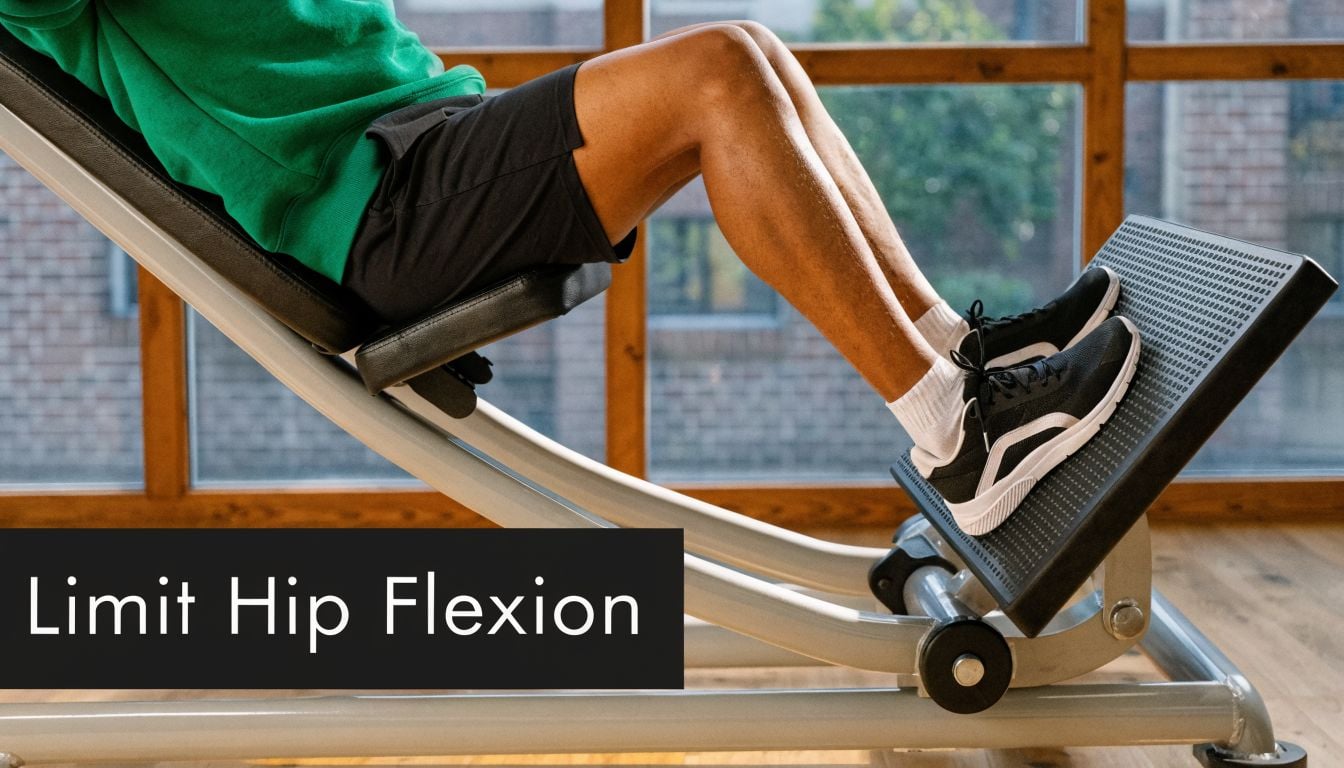
The reason is mechanical. The leg press guides the load, but it also guides your body into a fixed path. If the hip gets irritated as the femur closes into the socket, the sled does not give you many options to adjust trunk angle, pelvic position, or stance the way you can in free-weight work.
Why deep leg press often irritates the hip
At the bottom of a deep leg press, the hip is flexed hard and the pelvis often rolls backward against the backrest. That combination reduces available space at the front of the joint. For athletes with femoroacetabular impingement, or athletes who do not tolerate loaded end-range flexion well, that is often the exact position that brings on the familiar front-of-hip pinch.
Daily posture can add to the problem. Research published in the Journal of Hip Preservation Surgery found that common seated positions can reduce anterior hip clearance during flexion, which helps explain why knees-high sitting and deep machine positions can both feel crowded at the front of the hip when load is added. The leg press recreates that closed angle, then asks the joint to produce force there.
How we modify it in the clinic
At our Massachusetts sports PT clinic, we rarely need to scrap leg training altogether. We change the setup first, then test whether the hip can handle the pattern without that sharp closing sensation.
- Move the seat back or limit sled depth: The goal is to stop short of the range where the pelvis tucks and symptoms start.
- Adjust foot placement slightly higher on the platform: Many athletes report less anterior hip pressure and better glute loading with this change.
- Use a controlled tempo: A slower lowering phase shows whether the problem is pure depth, loss of pelvic control, or both.
- Keep the load honest: If heavy reps force the hips into a range you cannot control, the machine is driving the exercise instead of you.
- Swap to step-ups, sled pushes, or a controlled split squat variation: These options often let the pelvis and trunk move more naturally while still training the legs hard.
There is a trade-off here. You may give up the ego boost of piling plates on the sled for a few weeks. In return, you usually get a lower-body strength option the hip can tolerate, which is what keeps training moving.
A machine is not automatically joint-friendly. If the hip keeps barking during leg press despite setup changes, it is worth getting a trained set of eyes on it. Our recommendation is simple: stop guessing and get assessed. This article explains why one visit with a physical therapist can make more sense than trying random braces, gadgets, and quick fixes.
Sometimes the right modification is not a better cue. It is choosing a lower-body pattern that gives the hip more room.
3. Stationary and Walking Lunges
A common scene in our Massachusetts sports PT clinics looks like this: an athlete can jog, lift, and even squat without much trouble, then a set of walking lunges brings on that sharp front-of-hip pinch by rep six. The movement seems simple. The mechanics are not.
Lunges ask the front hip to control flexion, rotation, and pelvic position on one leg. That is exactly why they are useful, and exactly why they can irritate a hip with femoroacetabular impingement when technique slips. Walking lunges add another layer because the athlete has to decelerate, accept load, and keep the femur centered as the body moves forward.
Why lunges can flare the front of the hip
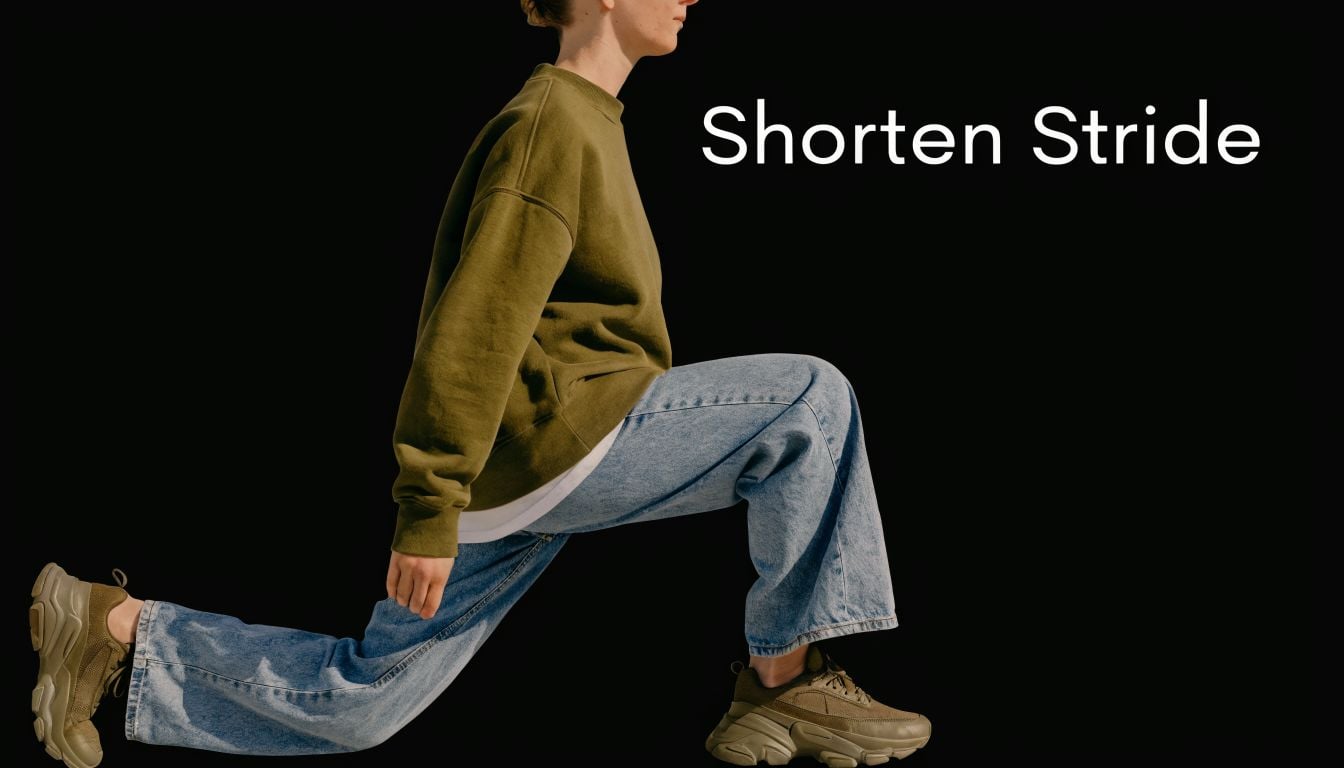
The problem usually is not the lunge itself. It is the combination of too much stride length, a trunk that falls forward, and a knee that drifts inward as fatigue builds. That pattern tends to push the hip into more adduction and internal rotation on the loaded side, which is a common symptom position in athletes with anterior hip impingement.
We see this a lot in runners, soccer players, and golfers who have enough strength to do the exercise but not enough single-leg control to keep the pelvis and femur organized under load. A lunge can look athletic while the hip is still getting compressed.
How we clean it up in return-to-sport rehab
We rarely ban lunges outright. We change the version until the athlete can own the position.
- Shorten the stride a bit: This usually reduces the demand on the front hip and helps keep the rib cage stacked over the pelvis.
- Start with reverse lunges instead of walking lunges: Stepping back often gives the athlete more control and less front-of-hip irritation.
- Use light hand support: A TRX, dowel, or rack upright can improve balance enough to let the hip work without fighting for stability.
- Keep the front knee tracking over the middle of the foot: That cue often limits the inward collapse that crowds the joint.
- Pause at the bottom for 1 to 2 seconds: If symptoms rise during the pause, the issue is usually positional control, not just load tolerance.
For rotational athletes, we also match the progression to the sport. A golfer may need frontal plane and rotary control before high-volume walking lunges make sense, especially if the lead hip already gets irritated during the swing. Our clinicians often pair split-stance strength work with golf-specific strength and mobility progressions before returning to more dynamic lunge patterns.
The trade-off is straightforward. Pulling back from long, loaded walking lunges for a few weeks may feel like a step down in training intensity. In practice, it usually keeps the athlete training consistently instead of chasing symptoms after every leg day.
4. Sumo Squats Wide-Stance Deep Squats
A lot of people assume a wide stance automatically opens the hips and solves pinching. Sometimes it does. Sometimes it’s exactly what keeps the symptoms going.
The issue is that a sumo squat isn’t just a regular squat with the feet spread out. It changes the rotational demand at the hip, and if you also chase depth, the joint can still run out of room.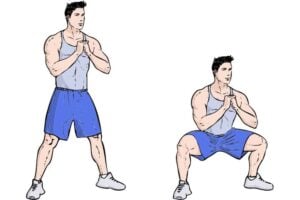
Wide stance is not always more hip friendly
For some athletes, especially dancers and lifters who already have a lot of available motion, the wide stance creates a false sense of safety. They feel “open” in the groin, but the front of the hip still gets compressed at the bottom.
This is common in kettlebell classes and body sculpting workouts where the cue is to push the knees way out and sit low. If the athlete is already symptomatic, forcing a deep sumo position can be more irritating than a shallower squat with cleaner alignment.
“If the squat only feels good because you’ve stopped paying attention to the pinch, it’s not actually going well.”
Safer lower-body options
The best substitute depends on the sport. A hockey player, golfer, and dancer won’t all need the same progression. That’s where sports PT matters more than generic exercise lists.
- Use a partial-range goblet squat: The front load often helps posture without forcing deep depth.
- Keep toe turnout modest: Extreme turnout can create a position your hip can’t control well under load.
- Try a landmine squat: Many athletes tolerate the angle and counterbalance better.
- Train lateral strength separately: Don’t rely on sumo squats to solve every groin and glute problem.
For rotational athletes, we also look at how the hip handles force transfer through the trunk and pelvis. PTU’s golf strength resource is a good example of how sport-specific loading changes exercise choices.
When a sumo squat hurts, don’t interpret that as “I need more mobility.” In many cases, you need a better position, less depth, and stronger control of the range you already have.
5. Seated Butterfly 90/90 Stretch
A common scene in our Massachusetts sports PT clinic is the athlete who drops into butterfly before training, then feels the same sharp pinch in the front of the hip they have been trying to calm down for weeks. The stretch looks harmless. For an irritated hip, it often is not.
Butterfly and seated 90/90 positions get prescribed as general “hip openers,” especially in dance, yoga, martial arts, and field sports where athletes chase turnout or rotational range. The problem is mechanical. If the hip is sensitive to flexion and rotation, sitting in that position and pushing farther into it can increase compression at the front of the joint instead of improving usable mobility.
Why this stretch can flare symptoms
Femoroacetabular impingement is common enough that many active people have the bony shape without knowing it. Symptoms usually show up when training volume, joint position, and tissue irritability start to stack up. Butterfly can be one of those positions because it combines hip flexion, abduction, and external rotation, then holds you there passively.
That matters because passive range is not the same as tolerated range under a pelvis you can control. If the pelvis rolls back and the low back slumps, the hip can lose space quickly. Athletes describe it as a pinch, block, or deep groin ache. Once that sensation starts, pushing the knees down harder rarely fixes the problem.
I see this a lot in dancers and skaters. They assume the hip feels stiff, so the answer must be more stretching. In many cases, the better answer is to stop forcing end range and build control in a range the joint accepts.
Better ways to work mobility without provoking the hip
At our clinic, we usually swap butterfly for drills that let the athlete adjust angle, pelvic position, and effort level.
- Use a supported supine hip rotation drill: Lying on your back reduces the demand on the hip and makes symptoms easier to read.
- Try quadruped rock-back variations: You can limit the depth and find a hip position that feels clear instead of pinchy.
- Train active rotation instead of hanging on passive tissue: Controlled lift-offs or band-assisted rotation work often give athletes better carryover.
- Keep the pelvis organized: A small change in ribcage and pelvic position often changes the stretch from joint irritation to muscular work.
The trade-off is simple. Aggressive stretching may create the feeling that you are doing more, but symptom-guided active mobility usually gives better results for return to sport. If butterfly always reproduces the same front-of-hip pinch, stop chasing it. Use positions your hip can control, then earn more range gradually.
6. Hip Adductor Abductor Machine Heavy Load
An athlete sits down on the adductor or abductor machine because it feels safer than squats, lunges, or cutting drills. Then the front or side of the hip starts talking halfway through the set. I see that pattern often in clinic.
These machines are not automatically bad. The problem is the combination of fixed positioning, large-range movement, and heavy load in a seated posture that does not ask much from the trunk or pelvis. For an irritated hip, that can turn “targeted strengthening” into repeated joint compression or a pinch at the front of the hip.
Why isolated machine work can backfire
With the machine, the pads drive the legs in or out while the rest of the system stays quiet. That sounds efficient, but sport does not use the hip that way. Running, skating, and change of direction all depend on the hip managing force with help from the trunk, pelvis, and foot.
For athletes with femoroacetabular impingement symptoms, that distinction matters. If the femoral head is already struggling to move cleanly in the socket, loading adduction or abduction hard in a fixed seat can irritate the joint instead of building useful strength. The machine can also hide compensations. An athlete may finish the set, but still lack the frontal-plane control needed for landing, cutting, or decelerating.
A sports medicine review in the Clinics in Sports Medicine literature describes FAI as a motion-related disorder, where symptom provocation is closely tied to position, bony shape, and repetitive loading patterns rather than simple weakness alone (PubMed overview of femoroacetabular impingement in athletes). That matches what we see in return-to-sport rehab. Load has to match mechanics.
What we use instead in sports PT
At our Massachusetts clinic, we usually move athletes toward exercises that train the hip in coordination with the rest of the chain.
- Side-lying hip abduction or clamshell variations: Useful early when symptoms are irritable and you need a low-threat way to build lateral hip strength.
- Lateral band walks: Better for teaching pelvic control in standing, especially for runners and field sport athletes.
- Supported Copenhagen progressions: A good option for adductors when started at the right level and kept out of symptom-provoking angles.
- Single-leg stance with reach or wall support: This exposes whether the hip can control the femur and pelvis together.
The trade-off is straightforward. The machine may let you use more weight and feel a stronger burn. These alternatives usually transfer better to sport and give cleaner feedback about whether the hip is tolerating the work.
If an adductor or abductor machine is pain-free, it may still have a place later in rehab as accessory work. It just should not be the main plan for an athlete trying to get back to sprinting, cutting, skating, or lifting without that familiar hip pinch.
7. Pigeon Pose Yoga
A runner finishes class feeling looser, then gets that familiar pinch getting into the car. We hear that story often with pigeon pose.
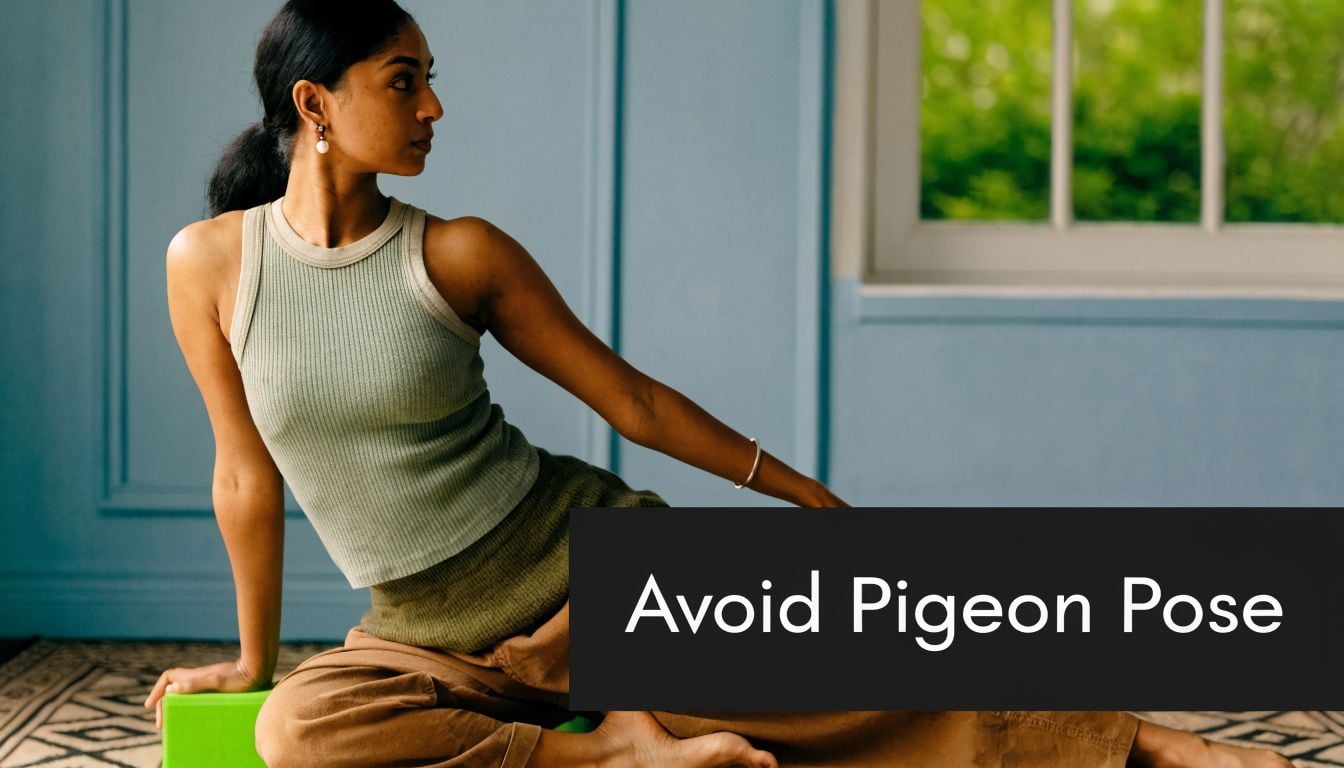
Pigeon asks the front hip to sit in flexion and external rotation while body weight presses down into the joint. For an athlete with femoroacetabular impingement, that combination can close down space at the front of the hip instead of giving a useful stretch. If a labrum is already irritated, the result is often a sharp groin pinch, deep joint pressure, or soreness that shows up later that day.
Why pigeon can backfire
In sports PT, we do not judge this pose by how intense it feels. We judge it by symptom response during the pose, after the session, and the next morning.
That matters because people with FAI commonly report pain with positions that combine hip flexion and rotation, including sitting cross-legged and similar postures, as described in the Warwick Agreement overview of femoroacetabular impingement syndrome published in the British Journal of Sports Medicine. Pigeon is a more loaded version of that same general hip shape.
The trade-off is real. Some athletes feel a strong stretch through the glutes and mistake that for a productive mobility drill. If the front of the hip feels blocked, pinchy, or sore afterward, the capsule and labrum may be taking more stress than the muscles you are trying to target.
What we use instead in clinic
At our Massachusetts clinic, we usually start with positions that calm symptoms while still working on posterior hip mobility.
- Supported supine figure-4: This gives the athlete control over depth and lets the pelvis stay grounded.
- Rocking hip external rotation stretches: Gentle motion often works better than a long hold in an aggressive position.
- 90/90 modifications with hands supported behind the body: Useful only if the front hip stays free of pinching.
- Yoga props with strict depth control: A block or bolster under the front hip can reduce joint compression if someone wants to stay in class.
We also coach athletes to watch the response after practice, not just during it. A pose that feels acceptable for 30 seconds but leaves the hip aching for hours is still too aggressive.
Pigeon is not banned forever. For some athletes, we reintroduce parts of that pattern later, once hip control improves and the joint tolerates flexion and rotation with less irritation. The goal is not to force a classic yoga shape. The goal is to restore the amount of motion your sport needs, with symptoms staying quiet.
Comparison of 7 Exercises to Avoid for Hip Impingement
| Exercise | Complexity 🔄 | Resources ⚡ | Expected Outcomes 📊 | Ideal Use Cases ⭐ | Key Advantages / Tips 💡 |
|---|---|---|---|---|---|
| Deep Back Squats (Below Parallel) | High, advanced technique, high hip mobility/control required | Barbell, squat rack, plates, spotter/coaching | Strong quad/glute/core development but increased anterior hip joint stress | Powerlifting and advanced strength programs when hip clearance is adequate | Develops maximal lower-body strength; tip: limit depth to parallel, maintain neutral rotation, or use box squats |
| Leg Press with Deep Hip Flexion | Low–Moderate, machine-guided but deep ROM increases risk | Leg press machine, weight stack; minimal balance needed | Quadriceps hypertrophy with low core demand; deep flexion may aggravate FAI | Bodybuilding hypertrophy work; early rehab with strict ROM control | Isolates quads for size; tip: set seat back, place feet higher, keep hip flexion <90° |
| Stationary and Walking Lunges | Moderate, requires balance and unilateral hip stability | Bodyweight or dumbbells/kettlebells; minimal equipment | Improves unilateral strength and balance but forward hip translation can irritate FAI | Sport-specific training and functional single-leg strength work | Enhances single-leg control and function; tip: shorten stride, keep upright, prefer reverse lunges if painful |
| Sumo Squats (Wide‑Stance Deep Squats) | Moderate–High, demands hip mobility and pelvic control | Kettlebell, dumbbell, or barbell; stable platform | Emphasizes adductors and inner thigh; deep stance + adduction heightens impingement risk | Variation for adductor focus or conditioning in trained individuals | Targets inner thigh/adductors; tip: limit depth above 90°, use goblet hold and keep toes mildly outward or neutral |
| Seated Butterfly (90/90) Stretch | Low, passive stretch but can load end-range structures | None (mat optional) | Increases perceived external rotation/mobility yet may load anterior hip in FAI | Yoga, dance, or mobility routines for those without anterior hip pain | Simple hip opener accessible to all; tip: prefer standing external-rotation drills or supine figure‑4 if painful |
| Hip Adductor/Abductor Machine (Heavy Load) | Low, machine-guided but arbitrary ROM may misalign joint | Specialized adductor/abductor machine; weight stack | Isolated medial/lateral hip strengthening; heavy loads increase joint compression | Bodybuilding isolation, controlled rehab with light loads | Easy progressive loading for isolation; tip: limit ROM to pain-free zone, use light resistance or replace with clamshells/band walks |
| Pigeon Pose (Yoga) | Low–Moderate, flexibility and pelvic control needed to be safe | Mat, optional blocks/bolster | Deep glute/external-rotator stretch; front hip flexion can pinch anterior-superior hip in FAI | Yoga and mobility work for flexible individuals without anterior hip pain | Effective glute stretch accessible in classes; tip: use supine figure‑4, props, or avoid deep holds if it causes pinching |
Your Next Move Get Assessed by a Pro in South Shore, MA
Avoiding painful movements is a good start, but it is not the whole plan. A complete solution involves figuring out why your hip gets pinchy in one athlete but not another, and what your sport demands before you return to full training.
That’s where sports physical therapy makes a difference. A generic list of hip impingement exercises to avoid can help you stop poking the bear, but it can’t tell you whether your main issue is depth tolerance, pelvic control, rotational weakness, running mechanics, post-op stiffness, or a workload spike. Those are very different problems, even if they all produce front-of-hip pain.
At Physical Therapy U, we evaluate athletes the way athletes move. That may include squat and lunge mechanics, running gait analysis, dance-specific movement review, strength testing, mobility screening, and return-to-sport testing. For some patients, hands-on treatment and dry needling help calm the area enough to train better. For others, the breakthrough comes from changing loading strategy, not adding more treatment.
This matters for youth athletes, adult lifters, dancers, and runners across Bridgewater, Massachusetts, Buzzards Bay, Middleborough, Plymouth, Taunton, East Bridgewater, West Bridgewater, and Raynham. It also matters for post-surgical patients, especially those coming off ACL rehab who are rebuilding lower-body strength and need to avoid compensations that keep shifting stress into the hip.
What tends to work is straightforward, even if it isn’t always easy. Calm the irritated positions. Keep training what the hip tolerates. Build glute, trunk, and pelvic control. Reintroduce compression-heavy movements only when the joint handles them well, not because a program says you should be there by now.
Licensed DPTs review and deliver care at PTU, but online guidance can’t replace an in-person assessment. If your hip pinches with squats, lunges, sitting, sprinting, dance class, or after workouts, get it checked before it becomes a longer layoff.
Book an appointment at Physical Therapy U in Bridgewater, Buzzards Bay, or Middleborough and get a plan that matches your sport, your anatomy, and your return-to-play goals.
If you’re dealing with front-of-hip pinching, groin pain, or training setbacks that won’t settle down, Physical Therapy U can help. Our sports PT team serves athletes across Southeastern Massachusetts with individualized rehab, dry needling, running gait analysis, dance therapy, and return-to-sport testing from our clinics in Bridgewater, Buzzards Bay, and Middleborough. Book your evaluation and get a clear plan for what to avoid, what to strengthen, and how to train forward without guessing.