
You finished rehab, got cleared, and technically you're “fine.” But your cut still feels late. Your stride still feels noisy. Your landings still don't look or feel the way they did before. Or maybe you're not injured at all. You're just stuck. Same race times, same jump, same fatigue point, same nagging tightness that keeps showing up when training gets serious.
That gap matters. Being out of pain isn't the same as being ready to compete well.
For athletes across South Shore Massachusetts, from Plymouth to Taunton and from East Bridgewater to Buzzards Bay, sports performance physical therapy is applicable. It sits between standard rehab and generic training. It asks a different question. Not just “How do we get this body part calm?” but “How do we help this athlete move cleaner, tolerate more, and perform with fewer setbacks?”
Table of Contents
- When Good Enough Is No Longer an Option
- Beyond Rehab The Core Principles of Performance PT
- Who Benefits from Sports Performance Physical Therapy
- A Look Inside a PTU Performance Program
- The Proof Is in the Performance Measuring What Matters
- Proactive Injury Prevention Strategies for Every Athlete
- Frequently Asked Questions About Sports Performance PT
When Good Enough Is No Longer an Option
A high school soccer player in Bridgewater, Massachusetts finishes ankle rehab and returns to practice. She can run straight. She can pass. But when the game speeds up, she hesitates on hard cuts and loses confidence in traffic.
A runner from Plymouth gets over calf pain, starts training again, and realizes the bigger problem never left. He's not breaking down anymore, but he's also not getting faster. The same effort still produces the same pace.
A dancer near Middleborough can get through class, but repeated jumps, turnout demands, and long rehearsal blocks still expose the same weak links. Pain improved. Performance didn't.
Good rehab restores function. Good performance care asks whether your function is strong enough for the actual demands of your sport.
That's the line many athletes miss. Standard physical therapy often focuses on pain, swelling, range of motion, and basic strength so you can return to normal activity. Sports performance physical therapy goes further. It looks at the movement errors, force deficits, mobility restrictions, and load problems that keep athletes at “good enough.”
The athlete who feels healthy but stalled
You don't need to be injured to benefit from this kind of care. Plateaus often show up before an injury does.
Common signs include:
- You keep hitting the same ceiling: Race times, jump mechanics, sprint speed, or lifting numbers stop moving despite consistent work.
- One area always tightens first: Calf, hip flexor, adductor, Achilles, low back, or shoulder symptoms keep returning when training volume rises.
- Your technique breaks down under fatigue: Early reps look clean, late reps don't.
- You've been cleared, but not restored: You can participate, but you don't trust your body at full speed.
For athletes on the South Shore, that gap shows up every day. Youth athletes want to build safely. Adult runners want a clearer reason for recurring inefficiency. Dancers need technique-aware care, not generic exercise sheets. Post-operative athletes, especially after ACL reconstruction, want more than a checkbox return.
Sports performance physical therapy is for the athlete who doesn't just want less pain. It's for the athlete who wants better output.
Beyond Rehab The Core Principles of Performance PT
A flat tire and an underpowered engine are different problems. One keeps the car from moving at all. The other keeps it from performing the way it should.
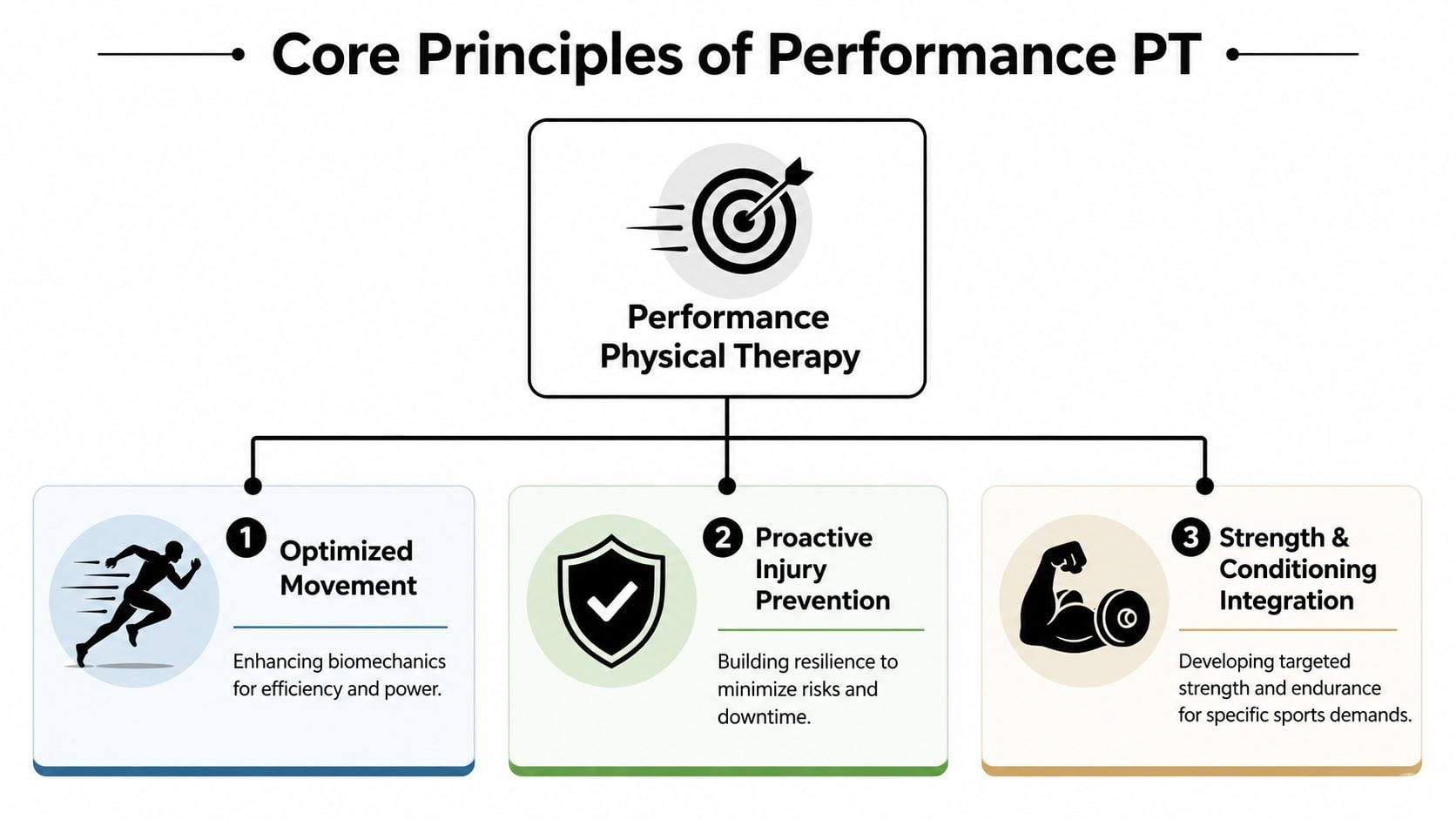
That's the difference between rehab-only care and performance-focused care. Sports physical therapy includes both recovery and optimization across the continuum of care, and a 2021 NIH-indexed review on sports physical therapy describes performance-focused treatment as raising the body's capacity rather than restoring baseline function. That's the mindset shift that matters for athletes who want durability, not just symptom relief.
Capacity instead of baseline
Baseline means you can do the task. Capacity means you can do it well, repeatedly, under fatigue, and under sport stress.
That changes treatment priorities. Instead of stopping once pain settles and motion returns, performance care keeps building the pieces that support output:
- Movement quality: cleaner mechanics for sprinting, landing, cutting, turning, or striking
- Joint-specific control: hip, foot, trunk, scapular, and rotational control where the sport demands it
- Strength that transfers: not just stronger in a clinic exercise, but stronger in patterns that matter to your sport
- Load tolerance: the ability to handle practice, games, rehearsal, mileage, or lifting volume without a steady drop in quality
A lot of athletes also benefit from coordinated work between therapy and training. If you're interested in the broader training side of optimizing athletic performance, strength development still matters. The key is matching it to the athlete's mechanics and current tolerance instead of layering generic work on top of a faulty pattern.
The assessment drives the program
The biggest mistake in performance care is guessing.
A useful program starts with a real assessment of how the athlete moves, where they compensate, and what the sport asks of them. For a runner, that may include cadence, foot strike behavior, trunk control, hip stability, and workload history. For a dancer, it may be turnout strategy, balance, landing control, pointe readiness, or hypermobility management. For a field athlete, it may be deceleration, single-leg control, and force transfer from trunk to lower body.
Practical rule: If the program doesn't connect directly to the demands of your sport, it's probably too generic to change performance.
That's also where strength and conditioning should integrate with therapy instead of sitting in a separate silo. A good performance plan blends corrective work, tissue capacity, power development, and sport-specific progressions. This is the same reason athletes often do well with a more structured strength and conditioning program for athletes once the movement foundation is clear.
The trade-off is simple. Performance physical therapy takes more precision than a sheet of standard exercises. But that precision is what gives athletes a better chance of moving ahead instead of circling the same problem.
Who Benefits from Sports Performance Physical Therapy
Not every athlete needs the same plan. The pitcher, the marathoner, the dancer, and the post-op soccer player can all look “fine” in daily life and still have completely different barriers to performance.
What they share is this. Their goals are sport-specific, and the bottlenecks usually are too.
Youth athletes building a base
Young athletes often arrive with busy schedules, rapid growth, inconsistent strength work, and one or two patterns that keep showing up under load. The issue isn't always a true injury. Sometimes it's poor landing mechanics, loss of trunk control during cutting, or a shoulder that can't handle throwing volume well.
For this group, sports performance physical therapy helps build foundations:
- Learning movement early: squat, hinge, land, decelerate, rotate, and change direction well
- Cleaning up overload patterns: especially when one season rolls right into the next
- Creating age-appropriate strength habits: enough to support sport demands without chasing advanced work too soon
Parents often think performance care is only for elite players. It isn't. It's often most useful before the athlete becomes dependent on compensation.
Adult runners chasing efficiency
Runners rarely ask for “more glute strength” or “better pelvic control.” They ask why one side always tightens, why their pace falls apart late, or why they can't stack healthy training weeks.
The runner who benefits most usually fits one of these profiles:
| Runner profile | Common frustration | What performance PT addresses |
|---|---|---|
| Returning from injury | Pain is better, pace isn't | Rebuilds mechanics, tolerance, and confidence |
| Plateaued but healthy | Training feels repetitive, results don't change | Identifies efficiency leaks and load issues |
| Frequent minor flare-ups | Calf, knee, hip, or Achilles symptoms recur | Improves tissue capacity and movement strategy |
The value isn't in hearing “stretch more.” It's in finding the pattern that keeps wasting energy or overloading the same tissue.
Dancers balancing technique and durability
Dancers need a different lens. Turnout, pointe demands, hypermobility, repetitive impact, and long rehearsal schedules create a profile that generic rehab often misses.
Performance-focused dance therapy looks at questions dancers care about. Are you getting turnout from the right place? Can you control end ranges without hanging on passive mobility? Do your landings stay quiet and aligned when fatigue builds? Can your foot and ankle complex tolerate repeated class and performance volume?
Dancers don't need less athletic care. They need more specific athletic care.
Post-surgical athletes who want more than clearance
This group is often the most motivated and the most vulnerable to doing “enough” and stopping there.
An athlete after ACL reconstruction may regain motion and basic strength, yet still show clear side-to-side differences, poor deceleration control, or hesitation on cutting and jumping. A performance program helps bridge the last gap between medical recovery and sport readiness.
That's the benefit across all four groups. Sports performance physical therapy meets athletes where generic rehab and generic training usually stop.
A Look Inside a PTU Performance Program
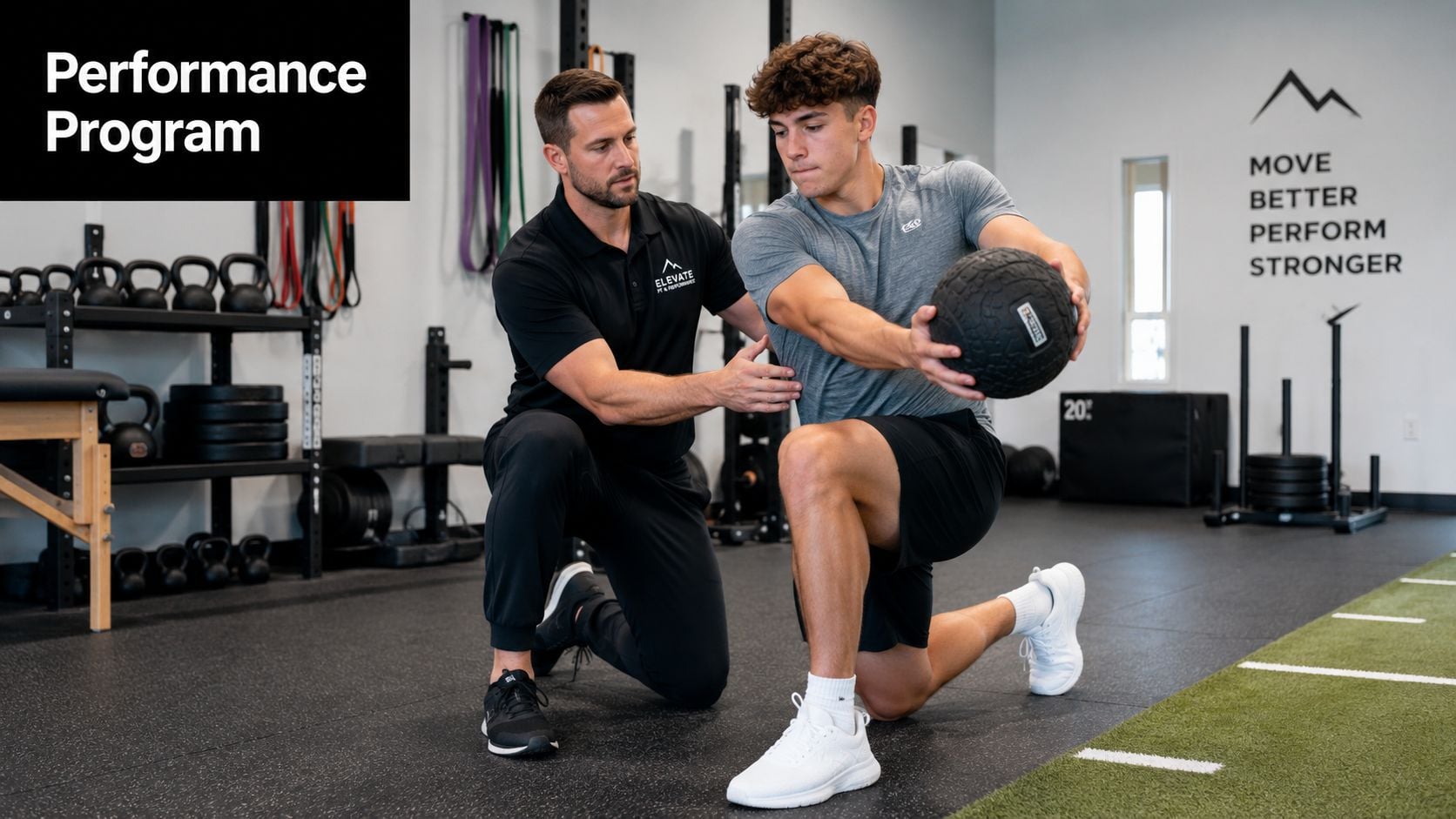
The difference between a vague performance promise and a useful one is what happens in the room. Athletes need to know what gets assessed, what gets trained, and how decisions are made from week to week.
At PTU, that work is sport-specific. A runner isn't treated like a basketball player. A dancer isn't treated like a post-op field athlete. The plan starts with the demands of the sport and the athlete standing in front of us.
Running gait analysis
A runner may come in saying the issue is knee pain, calf tightness, or a pace plateau. But the limiting factor often shows up in video and movement review. Cadence drift, overstriding, trunk position, arm carriage, pelvic control, and foot placement can all change how much energy each stride costs.
A performance therapy source notes that targeted gait analysis and retraining can improve running economy by 4 to 6% in some cases, which is why this is one of the clearest examples of measurable performance carryover in sports performance PT, especially for endurance athletes (running economy and gait retraining).
A typical running-focused session may include:
- Video review: treadmill or overground analysis to identify stride mechanics worth changing
- Strength testing: especially around calf, hip, trunk, and single-leg control
- Cue selection: one or two high-value changes instead of ten competing thoughts
- Progressive drills: carry the new pattern from controlled work into real running
For athletes who want a deeper look at that process, PTU also breaks it down in this guide to running gait analysis.
ACL return-to-sport progression
Performance care requires strictness. Feeling good isn't enough. Jogging in a straight line isn't enough. Team drills aren't enough if the athlete still unloads one side, avoids deceleration, or loses knee and trunk position under speed.
A solid ACL progression usually includes staged work such as:
- Rebuilding force production: single-leg strength, landing strategy, and rate of force development
- Reintroducing elastic tasks: hopping, bounding, and repeated contacts with good alignment
- Adding chaos gradually: reaction, change of direction, acceleration, and deceleration
- Testing before full return: not just participation, but quality under game-like demands
The hard truth is that many athletes get medically cleared before they're athletically ready. That's where criteria-based return-to-sport testing matters.
Dance therapy
Dance athletes need care that respects technique instead of fighting it.
A dance-focused visit often looks at turnout mechanics, foot intrinsic strength, calf and ankle capacity, trunk control, balance, jump and landing form, and whether pain is coming from the demands themselves or from how the dancer is meeting them. Pointe readiness and rehearsal tolerance are especially important because dancers often keep performing through low-grade warning signs until those signs become limiting.
The right cue for a dancer isn't always “more turnout.” Sometimes it's better control of the turnout they already own.
Dry needling as a tool not a shortcut
Dry needling can help when trigger points or protective muscle tone are blocking clean movement. It can reduce a local barrier enough for the athlete to use the strength, mobility, or gait changes they're training.
But it only works well in context. Needling a calf, hip, or shoulder without changing the load, mechanics, or surrounding strength usually gives temporary relief and not much else. The better use is to pair it with active retraining right away.
The Proof Is in the Performance Measuring What Matters
Athletes are right to be skeptical of broad promises. “Move better.” “Reach your full potential.” “Optimize performance.” Those phrases sound nice, but they don't answer the essential question. What changed?
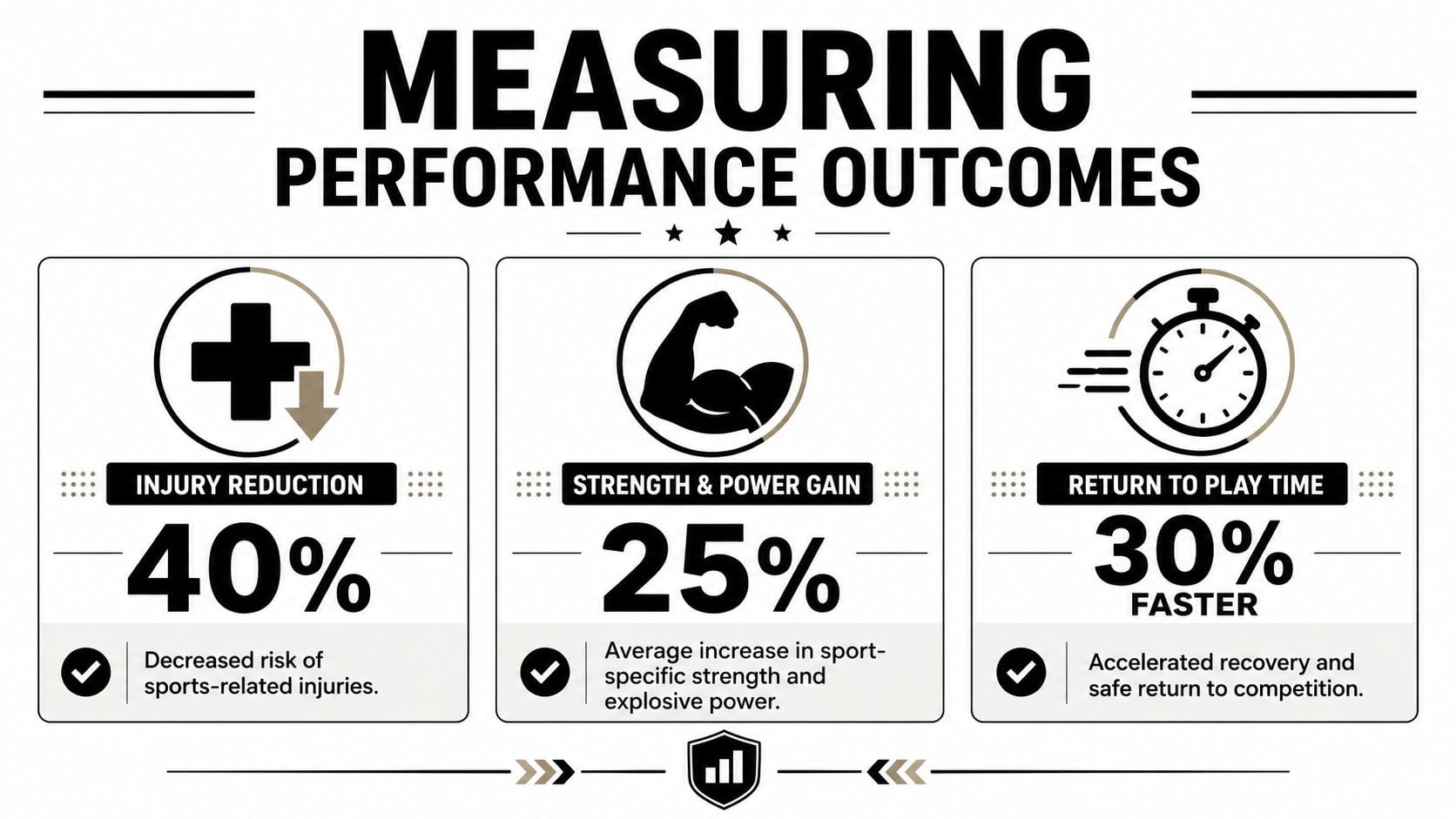
That skepticism is justified. A recent review in sports physical therapy points out that public-facing performance content often makes generic claims while athletes want measurable answers on outcomes like speed, jump performance, workload tolerance, recurrence, and return to sport. It also notes that value depends on whether load management, strength, and movement quality are indeed measured over time (measurable outcomes in sports physical therapy).
What should actually be measured
A serious performance program tracks outputs that matter for the athlete's sport. That doesn't mean chasing every gadget in the clinic. It means picking the right metrics and repeating them under similar conditions.
Useful measures often include:
- Strength by side and by pattern: with tools such as handheld dynamometers or structured loading tests
- Power and landing quality: often through jump testing, force plate work, or repeated hop tasks
- Speed and agility: timed efforts, deceleration drills, and directional work
- Movement quality: video review of cutting, running, squatting, jumping, or dance-specific tasks
- Workload tolerance: how the athlete responds to training volume over days and weeks, not just one session
For a runner, the win may be smoother form and better tolerance at target training pace. For a dancer, it may be cleaner single-leg control and less breakdown late in rehearsal. For a post-op athlete, it may be restoring confidence and output in high-speed change of direction.
What doesn't count as proof
Feeling looser after treatment can matter. So can having less pain. But neither one proves athletic readiness on its own.
A few red flags:
| Weak signal | Why it falls short |
|---|---|
| “It feels better today” | Short-term symptom change may not reflect true capacity |
| “I can do the exercises” | Clinic tasks may be easier than sport demands |
| “I was cleared” | Medical clearance and competitive readiness aren't always the same |
| “I'm back at practice” | Participation doesn't tell you how well the body is tolerating the load |
If you can't show what improved, you're mostly guessing that it improved.
That doesn't mean every athlete needs a lab-style setup. It means the program should have objective checkpoints, honest interpretation, and adjustments based on results instead of habit.
Proactive Injury Prevention Strategies for Every Athlete
Most injuries don't come out of nowhere. Athletes usually get warning signs first. A calf that tightens earlier each week. A shoulder that needs longer to loosen up. A knee that gets sore only after hard sessions, then starts speaking up sooner.
Prevention works best when athletes stop waiting for pain to become the deciding factor.
The non-negotiables
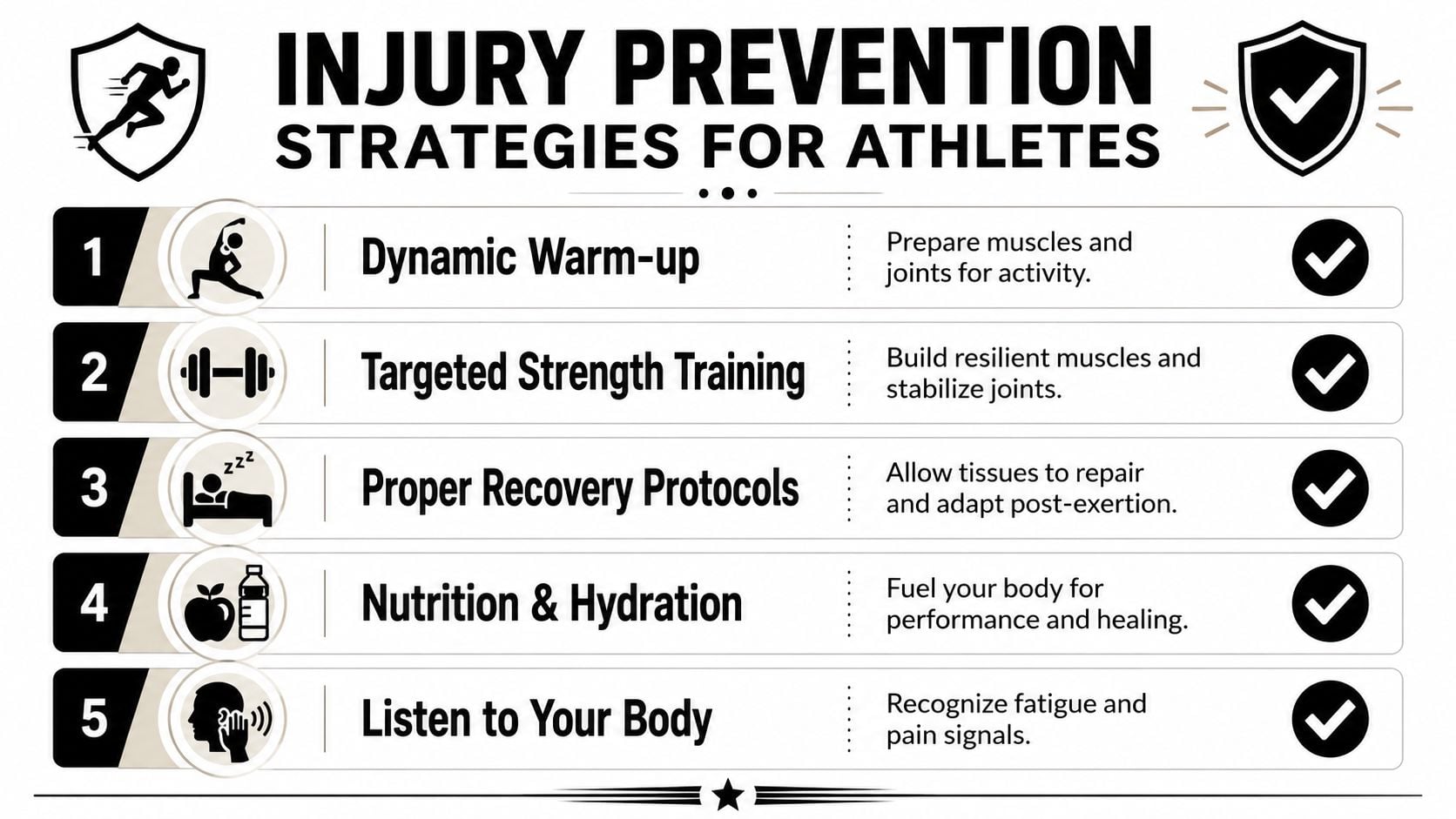
A few habits consistently make athletes more resilient across sports:
- Use a dynamic warm-up: Pick movements that raise temperature and prepare the actual joints and patterns you're about to use. Think skips, marching, lunges, ankle prep, hip openers, and short accelerations instead of static stretching alone.
- Build strength where your sport asks for control: Runners need calf, hip, and trunk strength. Court and field athletes need deceleration strength and single-leg control. Dancers need foot, ankle, hip, and trunk stability at end range.
- Respect recovery: Hard training only helps if tissues have time to adapt. Sleep, nutrition, hydration, and spacing high-intensity work matter more than most athletes want to admit.
- Manage load: Sudden spikes in mileage, practice intensity, rehearsal time, or lifting volume are where many problems begin. The exact increase that's tolerable varies by athlete, so don't rely on a one-size-fits-all rule.
- Treat repeated “niggles” as data: If the same area talks every week, something in the system isn't handling the demand well.
A short runner-focused routine can help bridge the gap between rehab and training. PTU outlines several useful options in these physical therapy exercises for runners.
This video gives a practical look at movement prep and injury reduction habits athletes can use before training.
When to get checked before it turns into time loss
Get evaluated if a pattern keeps returning, if your mechanics visibly change under fatigue, or if one side consistently feels weaker, stiffer, or less trustworthy. That's especially true for athletes in Raynham, Middleborough, and nearby towns heading into a new season or a higher training block.
Small problems become big layoffs when athletes keep training around them instead of through them with a plan.
This isn't a substitute for an in-person evaluation. A licensed physical therapist can identify whether the issue is training load, movement strategy, strength deficit, recovery problem, or a mix of all four.
Frequently Asked Questions About Sports Performance PT
How is sports performance physical therapy different from personal training
Personal training can be excellent for general fitness and strength development. Sports performance physical therapy starts from a medical and biomechanical lens. It looks for pain drivers, asymmetries, tissue irritability, post-surgical considerations, return-to-sport criteria, and movement faults that may limit performance or increase risk. The best programs often blend both, but they're not interchangeable.
Is sports performance PT covered by insurance
Coverage depends on your plan, your diagnosis, and whether the service falls under covered physical therapy benefits. Some parts of care may be insurance-based, while some performance-focused services may be self-pay. The most useful step is to verify benefits before starting so you understand what's covered and what isn't.
Do I need a doctor's referral to start
Often, no. In Massachusetts, many patients can start physical therapy through direct access, though insurance rules can still vary. If you're post-surgical, have a complex medical history, or aren't sure where to start, it's smart to check with the clinic and your insurer first.
If you're an athlete, runner, dancer, or post-op patient asking better questions than “Does it hurt less?”, that's usually the right time to get evaluated. The goal isn't just to feel better. It's to know what's holding you back and what to train next.
If you're ready for a data-driven plan built around your sport, book an evaluation with Physical Therapy U. PTU serves athletes across Southeastern Massachusetts at clinics in Bridgewater, Buzzards Bay, and Middleborough, with care designed for runners, dancers, youth athletes, and post-surgical return-to-sport patients.
