
You're a few weeks into the season. At first it was just a small ache in the shin or top of the foot near the end of practice. Then it started earlier. Now it hangs around after the workout, and you notice it walking to class or going down the stairs.
That's the moment a lot of runners, dancers, and field athletes in South Shore Massachusetts try to bargain with it. New socks. More stretching. Ice. Maybe a day off. Sometimes that works for simple soreness. Sometimes it doesn't, because the problem is that the bone has been asked to handle more impact than it can repair between sessions.
At PTU, our sports physical therapists see this pattern all the time with high school athletes from Bridgewater, Plymouth, Taunton, Raynham, East Bridgewater, West Bridgewater, Buzzards Bay, and Middleborough. The good news is that learning how to prevent stress fractures usually comes down to a few controllable things: training load, recovery, fueling, biomechanics, and knowing when a “normal ache” isn't normal anymore.
Table of Contents
- The Ache That Won't Quit Understanding Stress Fractures
- Are You at Risk Key Factors and Self-Screening
- Mastering Load Management to Protect Your Bones
- Building a Fracture-Resistant Body With Strength and Mobility
- Fueling for Resilience The Critical Role of Nutrition
- Your Gear and Ground Choosing Footwear and Surfaces
- Your Questions Answered and When to See a PT at PTU
The Ache That Won't Quit Understanding Stress Fractures
A stress fracture usually doesn't start with one dramatic moment. It builds gradually. One hard practice isn't usually the issue. The bigger problem is repeated loading on the same bone, over and over, without enough recovery for the bone to keep up.
In plain language, a stress fracture is a tiny crack in bone caused by cumulative stress. It's less like snapping a branch and more like bending a paperclip again and again until the metal gives way. That's why athletes often describe a very specific, localized ache instead of the diffuse soreness they feel after a tough workout.
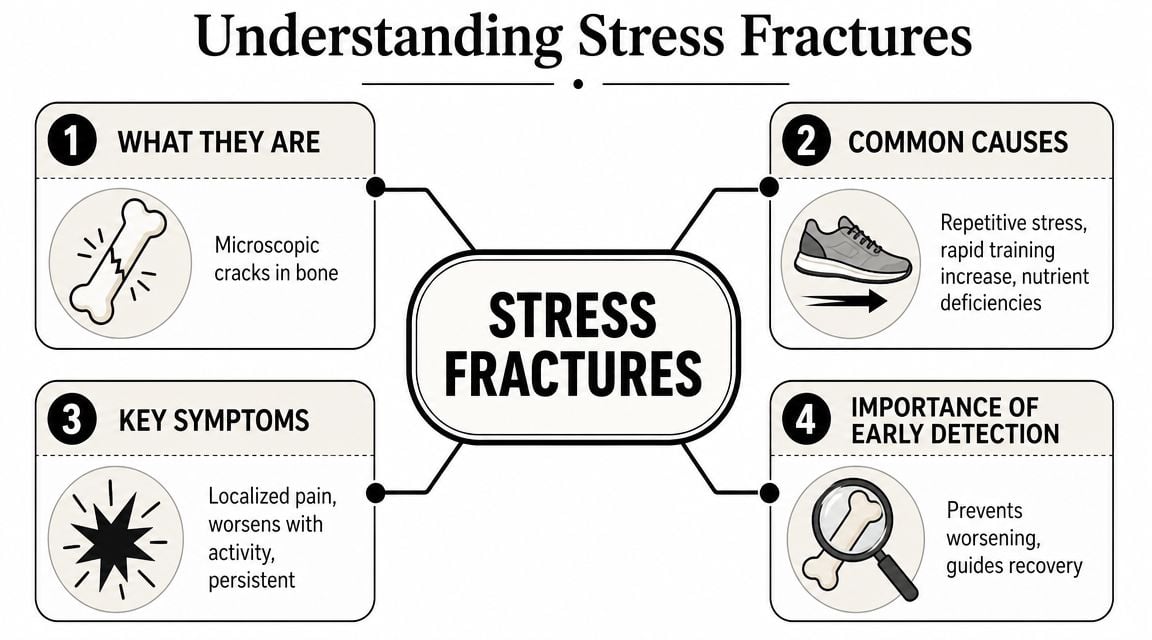
A review in PMC notes that stress fractures represent 10%–20% of all injuries in sports medicine and points to prevention steps that are practical, not mysterious: gradual training increases, proper footwear, enough calcium and vitamin D, and avoiding low energy availability through under-fueling (peer-reviewed review on stress fractures in sports medicine).
What athletes usually notice first
The pattern matters more than any single symptom.
- Pain that starts with impact activity: It often shows up while running, jumping, dancing, or marching.
- A very specific sore spot: Athletes can often point to one small area with a finger.
- Pain that lingers longer each week: At first it warms up and fades. Later it stays.
- Less tolerance for normal training: Sessions that were fine two weeks ago suddenly aren't.
Stress fractures usually aren't a toughness problem. They're a load management problem.
Parents often ask if this is just shin splints. Sometimes it is. But if the pain is increasingly focal and keeps returning with activity, it deserves more respect. If you're looking at ways to calm early lower-leg irritation while sorting that out, this piece on cold water therapy for shin splints is a reasonable adjunct. It just shouldn't be used as a substitute for evaluating bone stress when the pain pattern is concerning.
Are You at Risk Key Factors and Self-Screening
Some athletes get hurt because the training plan is off. Others get hurt even though the plan looks reasonable on paper. That's usually where individual risk factors come in.
The risk factors you inherit and the ones you create
Some factors are harder to change, but they still matter because they tell you how carefully you need to manage training.
Intrinsic factors are the things your body brings to the equation:
- Previous stress injury: If you've had one before, your threshold for overload may be lower unless the original driver was fully addressed.
- Foot structure and mechanics: Flat feet, high arches, stiffness through the foot and ankle, or excessive foot pronation can shift where force gets absorbed.
- Bone health concerns: Delayed growth, menstrual irregularity, or a history that suggests low bone density changes the conversation.
- Movement strategy: Some athletes land loudly, overstride, collapse through the hip, or rotate poorly through the trunk. Bone feels those mechanics.
Extrinsic factors are what your schedule, gear, and habits add on top:
- Rapid increases in running, jumping, or practice density
- Back-to-back hard sessions with too little recovery
- A sudden change in sport season, position, surface, or footwear
- Under-fueling, skipped meals, or trying to train hard while eating too little
A simple self-screen before you change your plan
Ask yourself these questions truthfully:
| Question | Why it matters |
|---|---|
| Has my pain become more pinpoint over time? | Localized pain raises concern for bone stress. |
| Did training change recently? | New volume, speed work, or more competitions can outpace adaptation. |
| Am I doing impact work on tired legs day after day? | Fatigue changes mechanics and load tolerance. |
| Have I changed shoes or kept the same pair too long? | Footwear can change how force is distributed. |
| Am I eating enough to support growth, school, and training? | Bone repair needs energy, not just willpower. |
| For female athletes, have periods become irregular or stopped? | Menstrual changes can be a key warning sign of low energy availability. |
A high school runner might say, “My mileage didn't change much, but I added hills, started racing every weekend, and switched from grass loops to pavement.” That's not one change. That's several loading changes stacked together.
Practical rule: Don't judge risk by mileage alone. Count impact, intensity, fatigue, and how many hard days touch the same tissues.
If you're a dancer, gymnast, or distance runner who feels like you're “doing everything right” but still getting hurt, that's usually a clue that the problem isn't effort. It's often hidden in biomechanics, fueling, recovery, or an old movement pattern that keeps pushing load to the same spot.
Mastering Load Management to Protect Your Bones
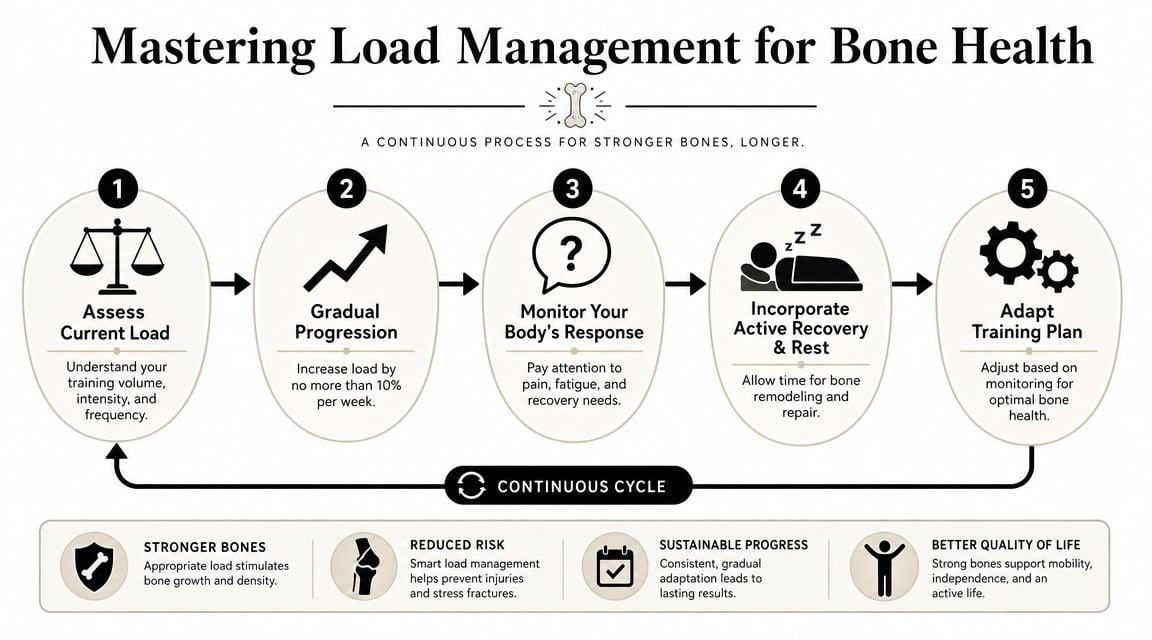
If there's one concept athletes and parents should understand, it's this: bone is living tissue. It responds to stress. But it only gets stronger when the training dose and the recovery window match.
Why bone needs stress and recovery
Bone remodeling is your body's maintenance system. Training creates stress. Recovery lets the body rebuild. If the stress arrives faster than the rebuild, the bone starts losing that tug-of-war.
That's why complete rest forever isn't the answer, but grinding through pain isn't either. Bone likes measured exposure. It does poorly with chaotic spikes.
A practical starting point comes from guidance summarized by Mayo Clinic and HPRC: keep weekly load increases to about 10%, especially for athletes training regularly, and use cross-training to reduce cumulative bone loading while maintaining fitness (Mayo Clinic stress fracture guidance).
Why the 10 percent rule helps but doesn't solve everything
The 10 percent rule is useful because it keeps athletes from making obvious mistakes. It is not a guarantee.
Military training data make that clear. In a review of lower-extremity stress fractures, Marine recruit data across 12 weeks of basic training showed reported stress fracture incidence of 0.8%–4.0% in males and 1.6%–12.0% in females, and the review emphasized gradual progression plus planned recovery periods as core prevention strategies (review of military stress fracture risk and prevention).
That matters because “load” isn't just distance. A week with the same mileage can be much harder if it includes more hills, more sprinting, more jumping, more concrete, less sleep, and no easy day after competition.
What smart load management looks like in real life
Here's what I'd want a high school runner to do before adding more work:
- Spread impact through the week: Don't pile speed, long run, and extra team conditioning into consecutive days if you're already flirting with pain.
- Use low-impact fitness on purpose: Bike, pool running, elliptical, and other options can maintain conditioning while reducing repetitive bone loading. PTU also has a useful resource on best cross-training for runners.
- Track intensity, not just minutes: Two hard workouts and a race can load bone more than a “high mileage” easy week.
- Build recovery into the plan: Easy days are where adaptation happens.
- Pay attention to technique under fatigue: A runner who lands well for the first mile may look very different at the end of practice.
For field and court athletes, this matters after other injuries too. Someone coming back from an ACL issue or a knee sprain may clear pain but still move differently, shifting force down the chain into the tibia or foot. If that's part of your story, this guide on recovery from football knee injuries gives a useful overview of how knee problems can affect return to sport.
If you keep getting bone stress symptoms despite “reasonable” mileage, the next thing to inspect is how you create force, not just how much you do.
That's where individual assessment matters. A running gait analysis can show whether overstriding, pelvic drop, stiff landings, or asymmetry are increasing bone strain on one side. For some athletes, changing the loading pattern is more important than cutting training volume again.
Building a Fracture-Resistant Body With Strength and Mobility
Strong bones don't work alone. They depend on muscles to absorb force and joints to let that force move where it should.
If the hip is weak, the trunk is unstable, or the ankle is stiff, impact tends to concentrate instead of being shared. That's why a prevention plan can't stop at “run less.”
Strength that reduces bone stress
For runners, dancers, and cutting-sport athletes, I'd prioritize control on one leg before chasing heavier numbers in the weight room.
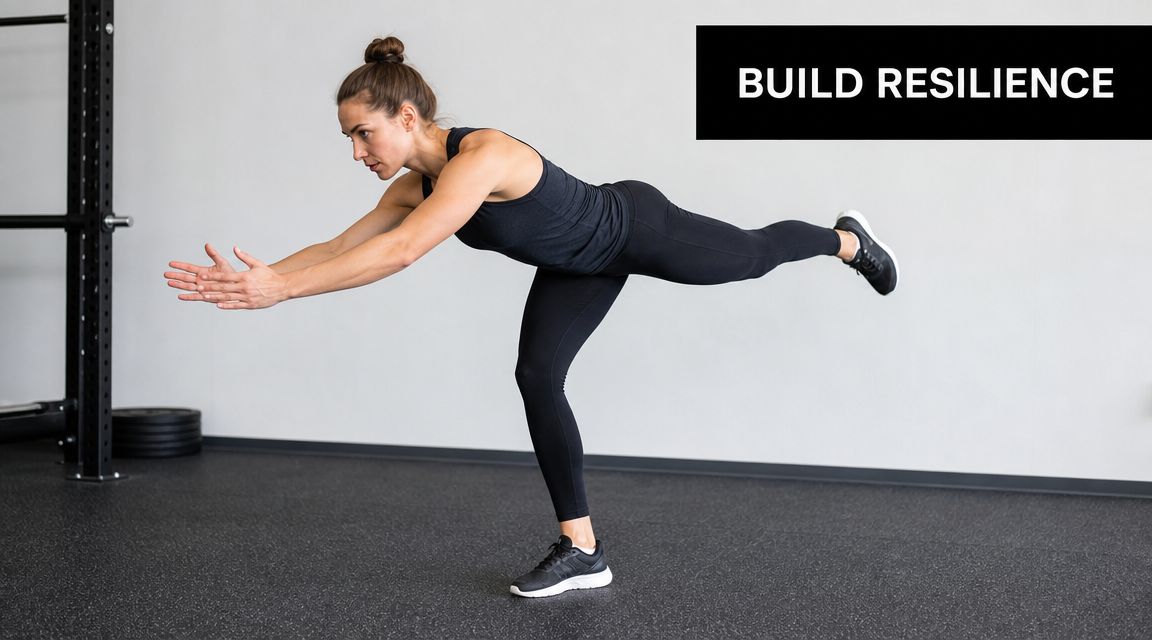
- Single-leg Romanian deadlift: Builds hip control, hamstring strength, and balance. If you wobble all over the place, that's useful information. Your body may be struggling to control force cleanly on one limb.
- Glute bridge and single-leg bridge: Helps the posterior chain contribute to shock absorption instead of dumping load into the lower leg.
- Lateral band walks: Trains the glute medius, which helps control pelvic drop and femoral position during stance.
- Calf raises: The calf complex helps manage landing forces and forward progression. Weak calves leave the lower leg doing more work with less support.
- Planks and side planks: A stable trunk gives the legs a better base. Without it, mechanics get messy fast.
A home program doesn't need to be fancy. It needs to be consistent, technically clean, and appropriate to the athlete's sport. If you want a broader starting point, PTU has a practical guide to physical therapy exercises for runners.
Mobility and control that keep force moving well
Mobility isn't about being loose everywhere. It's about having motion where you need it.
Common problem spots include the ankle, big toe, and thoracic spine. If the ankle doesn't bend well, the body often finds a workaround by twisting through the foot, collapsing the arch, or shortening stride mechanics in ways that can irritate bone over time.
A simple mobility and control sequence might include:
- Ankle dorsiflexion drills: Helps the shin move over the foot during stance.
- Big toe mobility work: Important for push-off mechanics in runners and dancers.
- Split squat holds: Builds strength at useful joint angles while exposing asymmetry.
- Landing drills with coaching: Teaches quieter, more controlled impact.
Later in a progression, clinicians may add hopping, deceleration work, or sport-specific drills to see whether your body can handle repeated impact without loss of form.
This movement demo is a good example of single-leg control work that carries over well to bone stress prevention:
For dancers, the same principle applies with a different flavor. Turnout strategy, foot intrinsic strength, and repeated forefoot loading often matter more than generic gym strength. For post-surgical athletes, especially after ACL rehab, return-to-sport testing can help identify asymmetry that still changes how force travels through the leg.
Fueling for Resilience The Critical Role of Nutrition
A lot of athletes hear “eat healthy” and assume that's enough. It isn't always. A salad and a protein shake can still leave an athlete under-fueled if training demand is high.
Why eating healthy isn't specific enough
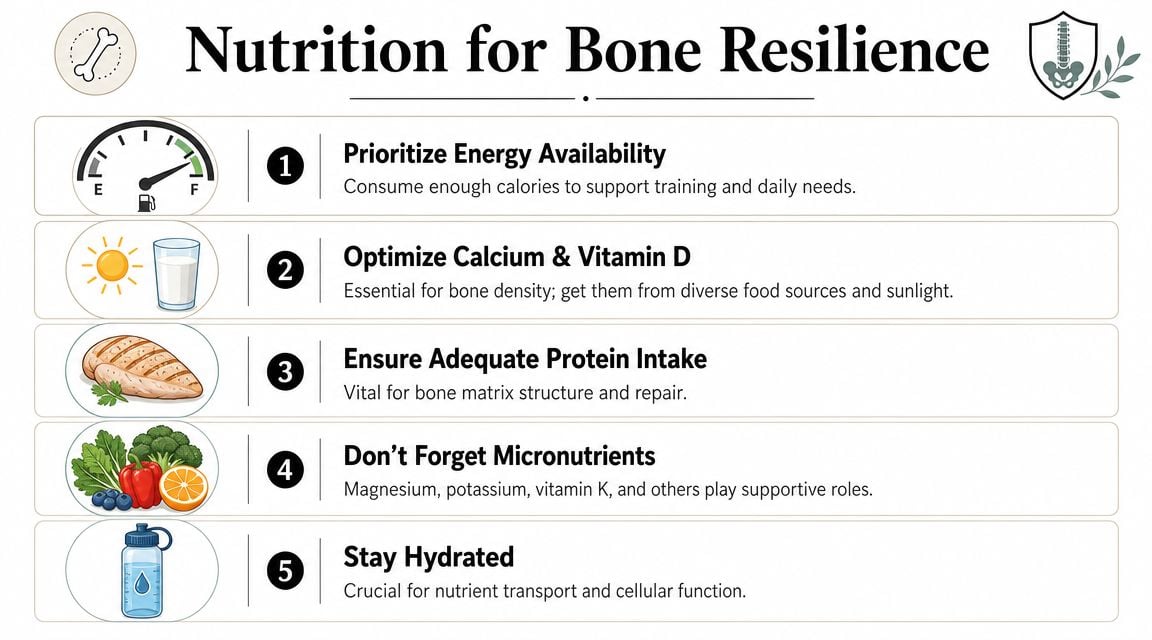
Bone repair requires raw materials, but it also requires enough total energy. If your body doesn't have enough energy available after covering daily life and training, it starts conserving resources. Bone health can pay the price.
The International Olympic Committee has directly linked low energy availability to impaired bone health and increased injury risk in its consensus on Relative Energy Deficiency in Sport (RED-S) (IOC consensus on RED-S and health consequences). That's one of the biggest missed pieces in stress fracture prevention, especially in endurance sports, dance, and aesthetic sports.
This doesn't only apply to athletes who are intentionally dieting. It also shows up in busy high school athletes who leave the house early, practice after school, do homework late, and never catch up on fuel.
A body that's under-fueled often looks disciplined from the outside and overstressed on the inside.
What parents and athletes should watch closely
For female athletes, menstrual regularity matters. For all athletes, so do appetite changes, repeated fatigue, declining recovery, and a pattern of recurring overuse injuries.
Watch for:
- Skipped meals around practice: Training after a light lunch and then not eating until late evening is a common setup for trouble.
- Fear of normal weight changes during training: Growth, muscle gain, and seasonal shifts are part of sport.
- Recurring bone or tendon symptoms: If the same athlete keeps getting “overuse” problems, don't assume bad luck.
- Menstrual changes: A missed or irregular cycle can be an important health signal, not something to ignore.
- Heavy training with low intake variety: Bone health depends on more than one supplement or one “healthy” meal.
Calcium and vitamin D still matter. So does overall energy intake. The military review cited earlier also noted that higher calcium intake of 2 g/day was associated with lower incidence of stress fractures in soldiers, which reinforces that bone nutrition and load management belong in the same conversation. The bigger point, though, is that supplements can't rescue an athlete who chronically under-eats.
If your family needs ideas for structuring meals and snacks around training, a simple runner's nutrition guide can help spark practical planning. It's not a substitute for individualized care, but it can make the “what should I eat?” question less vague.
For athletes with red flags for RED-S, a full team approach may be needed. That can include a physician, sports dietitian, and licensed physical therapist. In that setting, prevention shifts from “train smarter” to “fuel enough, monitor health markers, and rebuild tolerance without digging the hole deeper.”
Your Gear and Ground Choosing Footwear and Surfaces
Shoes and surfaces won't solve every problem. They still matter because they shape the amount of impact your body has to manage.
When shoes stop helping
Running shoes don't fail all at once. They fade. Cushioning compresses, support changes, and the shoe stops doing the quiet work it used to do.
Guidance summarized in sports medicine sources notes that running shoes should generally be replaced after 300 to 350 miles because worn shoes lose shock absorption, which can increase repetitive bone loading (guidance on footwear replacement and softer surfaces).
That doesn't mean every athlete needs the same shoe. It means the shoe should match the athlete and the task. A light racing shoe may feel fast, but it may not be the right answer for every easy day, every growing athlete, or every runner already flirting with bone stress.
How to use surfaces strategically
If you run every mile on asphalt or concrete, your bones feel that consistency. Mixing surfaces can spread stress more intelligently.
Try this approach:
- Use flatter, softer surfaces for easier runs: Dirt paths, grass loops, and some trails can reduce cumulative impact.
- Keep the hard sessions predictable: Track work is fine if it fits the plan and your body tolerates it.
- Don't combine a surface change with multiple other changes: New shoes, faster workouts, and harder ground in the same week is a poor experiment.
- Respect camber and uneven terrain: Some athletes do worse on side-sloped roads or technical trails than on a flat path.
For runners in Bridgewater, Massachusetts, and the surrounding South Shore, route choice is part of injury prevention. If your training week has been all pavement, changing one or two easier sessions to a softer route can be useful.
If you're not sure whether footwear is the issue or your mechanics are the issue, a running gait analysis can help separate those variables. Orthotics can help some athletes, but they're a tool, not a universal fix. They make the most sense after a movement and load assessment, not as an impulse buy for pain.
Your Questions Answered and When to See a PT at PTU
Athletes usually wait too long with bone stress symptoms because the pain often starts small. The better move is to get clear on what's normal soreness, what's adaptation, and what deserves evaluation.
FAQ
What's the difference between shin splints and a stress fracture?
Shin splints tend to feel more diffuse along a broader area of the shin. A stress fracture is more likely to feel sharply localized in one spot. If pressing one fingertip over a small area reproduces the pain clearly, that raises concern.
Can I cross-train if I think I have a stress fracture?
Sometimes, yes. But it depends on the location, symptom irritability, and whether the activity is low impact for you. Pool work, cycling, or other modified conditioning may be appropriate, but don't guess if walking already hurts.
If I followed the 10 percent rule, why did I still get hurt?
Because bones respond to more than mileage. Practice density, speed, jumps, hills, fatigue, sleep, fueling, old injury patterns, and biomechanics all affect load tolerance. A “reasonable” plan can still be unreasonable for your body at that moment.
Do orthotics prevent stress fractures?
Not automatically. They may help in the right athlete if they change loading in a useful way. They can also be irrelevant if the underlying problem is under-fueling, poor progression, or movement mechanics upstream.
Should dancers worry about stress fractures too?
Absolutely. Repeated forefoot loading, technique demands, schedule density, and low energy availability can all contribute. Dance therapy and sport-specific assessment matter because the loading pattern is different from running.
Signs you shouldn't try to push through
These are the patterns that should move you toward an in-person evaluation:
- Pinpoint tenderness on a bone
- Pain that returns quickly with impact
- Pain that starts showing up with daily walking
- Night pain or pain that feels more constant
- A recurring ache in the same location despite “resting it a bit”
- A history that suggests RED-S, menstrual dysfunction, or repeated overuse injuries
At that stage, guessing costs time. A licensed sports physical therapist can help sort out whether the issue is likely bone stress, another overuse problem, or a movement fault that keeps putting you back in the same cycle. Depending on the athlete, that process may include sport-specific training review, running analysis, dance-specific assessment, dry needling for adjacent muscle overload, or staged return-to-sport testing once healing allows.
If you're in Bridgewater, Buzzards Bay, Middleborough, Plymouth, Taunton, Raynham, East Bridgewater, or West Bridgewater, don't wait for a small ache to become a lost season. Book an evaluation with a licensed DPT who works with athletes and can tailor the plan to your sport, training calendar, and recovery needs.
If you're dealing with a persistent bone-level ache, repeated shin or foot pain, or you want a smarter prevention plan before the season gets away from you, book with Physical Therapy U. Our licensed sports PT team works with runners, dancers, field athletes, and post-surgical athletes across Bridgewater, Buzzards Bay, and Middleborough, with individualized rehab, gait analysis, return-to-sport testing, and athlete-specific programming that fits the way you train.
