
Hitting a performance plateau or battling the same nagging injury? The problem might not be your running. It might be what you do when you're not running.
At Physical Therapy U, we look at cross-training through a sports PT lens, not a generic fitness lens. Runners across South Shore Massachusetts often come in thinking cross-training means “any cardio that isn't running.” That's too broad to be useful. The best cross training for runners depends on why you need it, what tissue you're trying to unload, and whether you're chasing performance, durability, or a safe return after injury.
The evidence points in a clear direction. Strength work should support your running, not replace it, and the strongest carryover comes from structured strength that complements race pace demands and training phase. Mainstream coaching guidance also lines up around a practical weekly model: limited, regular cross-training paired with strength, rather than random extra workouts [systematic review on strength training and running economy].
This guide is reviewed by our licensed DPTs and built for real runners, from high school athletes in Raynham and East Bridgewater to adult runners in Plymouth, Taunton, Buzzards Bay, and Bridgewater, Massachusetts.
Table of Contents
- 1. Swimming and Pool Running
- 2. Cycling and Stationary Biking
- 3. Strength and Resistance Training
- 4. Elliptical Training
- 5. Yoga and Flexibility Training
- 6. Rowing and Rowing Machine Training
- 7. Running Gait Analysis and Technique-Focused Training
- 8. Injury-Specific Rehabilitation and Physical Therapy Integration
- 8-Way Cross-Training Comparison for Runners
- Design Your Runner-Specific Plan with a PTU Expert
1. Swimming and Pool Running
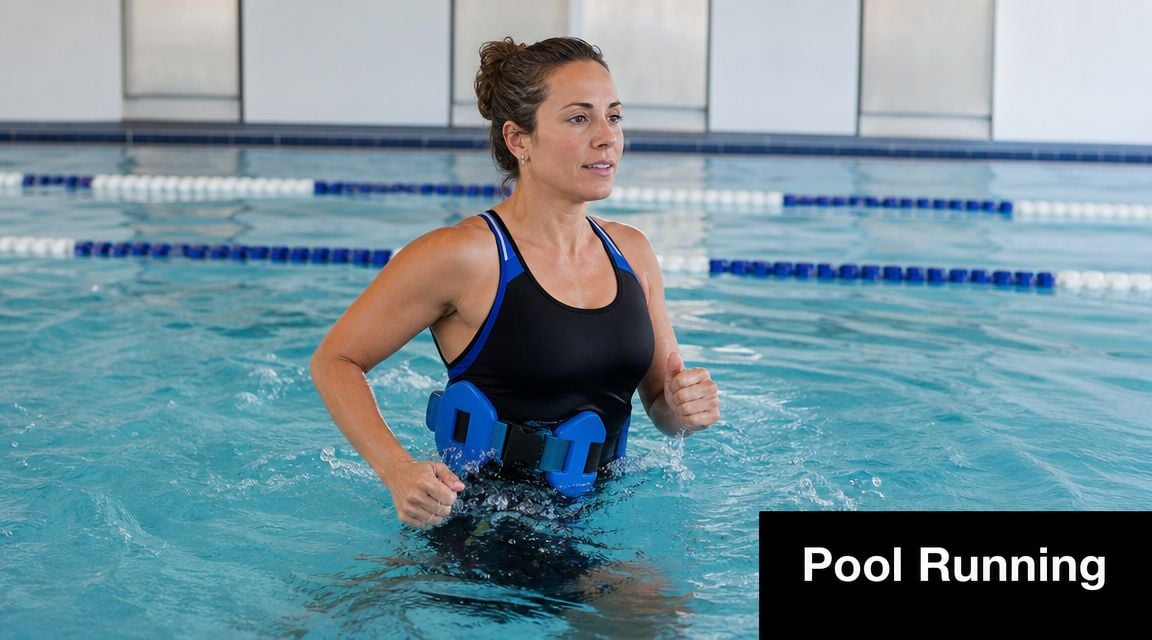
Swimming and pool running both reduce impact. They are not equally useful for a runner trying to preserve running-specific fitness.
Swimming is solid general conditioning. It can help on recovery-focused weeks, especially if your legs are beat up and you want movement without pounding. But the mechanics don't look much like running, so the carryover is more general than specific.
Why pool running stands out
Deep-water running is different. It lets you rehearse upright posture, hip flexion, arm swing, and cadence with almost no ground impact. For injured runners, that matters more than people realize.
A running-specific rehab source reports that deep-water running done 3 to 5 days per week at 60 to 75% of maximum heart rate for 20 to 60 minutes can maintain VO2max. That's one of the strongest practical reasons pool running stays high on my list.
Practical rule: If you're trying to preserve running fitness, choose the pool workout that looks and feels more like running. That's pool running, not lap swimming.
When we use it in the clinic
At PTU, we often like pool running for runners who can't tolerate ground impact yet but still need structure. That includes some post-op athletes, some runners with irritated knees, and some athletes in early return phases after an overload flare.
A few form points make a big difference:
- Stay tall: Keep your trunk upright instead of leaning back into the belt.
- Drive the knee naturally: Don't turn it into a bicycle motion.
- Match effort to training intent: Easy day means easy day, even in the water.
- Use the belt well: A flotation belt should support position, not encourage lazy mechanics.
Swimming still has value. For runners who need a mental break, upper-body work, or gentle aerobic movement, it can be a smart option. It's just not my first pick when the question is which option best preserves running mechanics.
2. Cycling and Stationary Biking
Cycling is one of the most practical cross-training options because it's accessible, scalable, and easy to control. Outdoor riding works. So does a stationary bike in a gym or clinic.
For many runners, biking is a good choice when impact needs to come down but training routine needs to stay intact. We use it often in sports PT because you can dose time, resistance, and cadence without asking a sore tendon, bone, or joint to absorb repeated landing forces.
Where cycling helps and where it falls short
Cycling works well for aerobic maintenance and leg endurance. It can also fit nicely into a deload week, a post-race reset, or a rehab block where running volume has to drop.
Its limitation is specificity. The seated position changes the demand pattern, and some runners overdo heavy resistance work because it feels productive. That can irritate knees or hips, especially when the bike setup is poor.
A bike can keep an athlete training. It doesn't automatically keep them run-ready.
This matters for runners recovering from certain injuries. If sitting and repeated hip flexion aggravate symptoms, biking may not be the right first choice. In those cases, elliptical or pool running may fit better.
How runners should use it
The best cycling sessions for runners are usually boring in a good way. Smooth cadence. Controlled effort. Enough load to challenge the system, not enough to turn the ride into a strength event.
Useful guardrails include:
- Prioritize fit: Seat height and fore-aft position affect knee and hip comfort.
- Think aerobic first: Most sessions should support your running, not compete with it.
- Watch resistance: High-force grinding can create problems if your knees are already touchy.
- Pair with strength: Mainstream running guidance consistently groups cross-training with strength work, and bikes are one of the common non-impact options used in that model [Peloton running guidance on cross-training structure].
If you want a broader cycling perspective, Rider 18's guide to NZ cycling covers bike-focused considerations. For runners, though, the key question stays the same. Does the bike support your running, or is it just extra fatigue?
3. Strength and Resistance Training
Why do so many runners skip the one cross-training option that can improve performance and make the body more tolerant of mileage?
Strength work fills gaps that running alone does not cover. Distance running builds repetition. It does not reliably build the force production, single-leg control, and tissue capacity that help runners handle hills, speed work, and race-specific volume. In clinic, this is often the missing piece for athletes who keep cycling through the same calf, knee, or hamstring issue.
Research in middle- and long-distance runners has found that high-load strength training, often at 80% of one-repetition maximum or higher, can improve running economy. That review also noted a useful nuance for programming. Heavier strength work showed stronger effects at faster running speeds, plyometrics may help more at slower speeds, and combining methods can outperform using only one approach.
Running economy matters because it changes how expensive each mile feels. A runner who uses less energy at a given pace usually has more room for workouts, racing, or getting through a training block without feeling flat all the time.
PTU treats lifting as part of run training, not an optional add-on. That matters even more for runners coming back from injury. A post-ACL athlete may need to rebuild quad strength and landing mechanics before speed returns. A runner with patellofemoral pain may need better hip and trunk control before mileage feels comfortable. In those cases, generic gym advice is usually not enough.
Mayo Clinic Health System's guidance for runners also recommends strength exercises such as hex bar deadlifts, squats, and leg press alongside low-impact cardio. That matches what we see clinically. The best plan is rarely random circuits. It is targeted work that supports the mechanics of running.
What good runner strength work looks like
Good programming starts with the runner in front of you. A high school cross-country athlete, a masters marathoner, and a runner rehabbing after surgery should not be on the same template.
Useful building blocks include:
- Single-leg strength: Split squats, step-downs, and single-leg Romanian deadlifts help expose side-to-side deficits that often show up during stance phase.
- Hip and pelvic control: Lateral lunges, carries, and frontal-plane loading can improve control that matters for knee tracking and load transfer.
- Heavy bilateral lifts: Squats, trap bar deadlifts, and leg press help build force capacity that running alone tends to undertrain.
- Elastic work: Pogos, hops, skips, and bounds fit later in the plan, once base strength and landing tolerance are in place.
The trade-off is straightforward. Heavy lifting can help a runner. Poor timing can also leave the legs dead for key workouts. Most runners do better with two focused sessions per week, scheduled away from the hardest run days or adjusted around race season. During rehab, exercise choice matters even more than exercise effort.
For runners who want a more structured progression, PTU offers a strength and conditioning program for athletes. If your goals include return-to-run after ACL surgery, recurring bone stress issues, or persistent asymmetry, that is also the point where a gait analysis at our Bridgewater, Buzzards Bay, or Middleborough clinics can help connect gym work to actual running mechanics.
If your interest leans more toward barbell sport, this roadmap for aspiring powerlifters gives a strength-specific perspective. Runners still need a different target. The goal is not to lift the most weight possible. The goal is to get strong enough, and coordinated enough, that your running improves.
4. Elliptical Training
Elliptical is underrated because it looks generic. In practice, it's often one of the better cardio choices for injured runners.
The reason is specificity. It's still not running, but it's more running-like than many “low-impact” alternatives. You stay upright, cycle through a stride pattern, and load the legs in a way that feels more familiar than swimming or rowing.
Why elliptical often beats generic cardio
One underserved point in most consumer advice is that not all low-impact cardio preserves running fitness equally well. Run-specific guidance has argued that aqua jogging and elliptical are closer to running than swimming for maintaining run-like mechanics and fitness, while swimming stays more general [discussion of specificity in low-impact options].
That lines up with what we see clinically. If someone needs a bridge between no running and some running, elliptical often fits that middle ground better than a random cardio machine.
Best use cases
Elliptical tends to work well in these situations:
- Impact intolerance: The athlete can't tolerate pounding but can tolerate repetitive leg motion.
- Return-to-run transition: The runner needs something between full rest and outdoor mileage.
- Mileage management: The athlete wants aerobic work without another pavement session.
- Post-surgical progression: Some post-op runners need motion and conditioning before full run loading is appropriate.
Keep the setup honest. Stand tall. Don't hang on the rails. Match resistance and stride effort to the purpose of the day.
If you're injured, the right machine depends less on what feels hard and more on what your tissue can tolerate right now.
That's where a sports PT evaluation helps. A machine that's perfect in late rehab may be the wrong choice early on.
5. Yoga and Flexibility Training
Yoga can help runners. It just gets oversold.
The good version of yoga for runners builds awareness, breathing control, balance, and movement options they don't get from straight-ahead mileage. It can also be useful on recovery days, especially for runners who feel stiff through the calves, hips, or thoracic spine after heavy training.
What yoga is good for
I like yoga most when it fills a gap, not when it becomes a substitute for strength or load management. Many runners benefit from slower sessions that improve control in positions they normally rush through.
Helpful areas to target include:
- Hips: Pigeon, lizard, and controlled split-stance mobility can expose asymmetry.
- Calves and feet: Gentle loading and mobility work can feel better than aggressive stretching.
- Thoracic rotation: Useful for runners who move stiffly through the trunk and arms.
- Balance and body awareness: Good for athletes who need better single-leg control.
At PTU, our clinicians also work with dancers and movement-based athletes, so we're careful about one common mistake. More flexibility is not always better. A runner with poor control can feel loose and still move poorly.
What it does not fix on its own
Yoga doesn't replace heavy strength, impact preparation, or a gait assessment. If a runner has recurring Achilles pain, patellofemoral pain, or post-ACL deficits, a mobility-only plan usually misses the underlying problem.
That's why I place yoga lower than strength, pool running, and elliptical when we're talking about the best cross training for runners. It's useful support work. It usually isn't the centerpiece.
If you enjoy it, keep it in the week. Just make sure it supports the plan instead of distracting from the work that matters more.
6. Rowing and Rowing Machine Training
Rowing is a strong conditioning tool. It's just not a very running-specific one.
That doesn't make it bad. In fact, for some runners, especially those who need variety or want more total-body work, a rowing machine can be a smart addition. It trains the legs, trunk, and upper body together, and it gives athletes who live in a lower-body-dominant sport a different challenge.
The upside for runners
Rowing can work well for runners who:
- Need a break from impact: It's low impact and easy to scale.
- Want more trunk and back demand: Useful for athletes who get posture-related fatigue.
- Prefer indoor structure: Erg workouts are simple to control.
- Need non-running conditioning in bad weather: It's practical and efficient.
The machine also rewards rhythm and pacing. That appeals to endurance athletes.
The trade-offs
Technique matters a lot. Poor rowing form can overload the low back, and many runners overpull with the arms instead of driving through the legs and trunk.
It's also less specific than pool running or elliptical. The movement pattern doesn't resemble running closely enough to make it my first recommendation for a runner trying to preserve run mechanics during a layoff.
Still, it has a place. If a runner can't tolerate other machines, enjoys rowing, and uses it as one piece of a broader plan, it can absolutely work. I just wouldn't mistake “hard workout” for “best carryover.”
7. Running Gait Analysis and Technique-Focused Training
A gait analysis isn't cardio. It still belongs on this list because it tells you which cross-training options are worth your time.
At PTU, gait analysis is one of the most useful services we provide for runners in Bridgewater, Buzzards Bay, and Middleborough. It helps us connect symptoms to mechanics, loading habits, and strength deficits instead of guessing from a generic injury label.
Before reading further, this short video gives a quick look at the idea behind a gait-focused approach.
Why assessment comes before more training
A runner with hip drop and poor single-leg control may need heavy strength and frontal-plane work. A runner who overstrides and can't tolerate impact after ACL rehab may need different return-to-run progressions, cadence work, and staged plyometrics.
Without that assessment, cross-training becomes random. You do more biking because it feels productive, more yoga because you feel tight, and more swimming because it's available. None of that guarantees you're addressing the limiter.
We also often end up discussing adjacent issues. For example, some runners with front-of-hip symptoms need to understand which hip impingement exercises to avoid before they pile more mobility work onto an already irritated joint.
Who should get a gait analysis
A running gait analysis is especially useful for:
- Runners with repeat injuries: Same pain pattern, different season.
- Post-surgical athletes: Especially ACL runners building back toward full sport.
- Youth runners: Good for building cleaner habits early.
- Performance-focused runners: When training is consistent but results have stalled.
If you're exploring different run-specific tools, parachute training for fitness professionals shows a very different performance angle. Most runners, though, need assessment before gadgets.
8. Injury-Specific Rehabilitation and Physical Therapy Integration
When a runner is injured, generic cross-training advice stops being enough. You need sequencing.
One of the most missed ideas in public running content is that cross-training choice should change by injury stage, not just by fitness goal. Neutral rehab guidance recommends using activities that are very different from running and pain-free early on, then shifting later toward more running-like options such as aqua jogging, elliptical, or Alter-G-style support as return-to-run gets closer [McMillan guidance on choosing cross-training by injury stage].
Cross-training changes by injury stage
Early rehab is about calming things down without losing all routine. Later rehab is about restoring the specific demands of running.
That means the same athlete might use different tools over time:
- Early phase: Pain-free options that unload the irritated area.
- Middle phase: Strength progression, controlled cardio, and tissue capacity work.
- Late phase: More running-specific conditioning and impact preparation.
- Return-to-sport phase: Testing, symptom monitoring, and graded exposure to speed and volume.
The best cross-training plan after injury is the one that matches the stage you're in, not the one your friend used.
What integrated sports PT looks like
At Physical Therapy U, we combine rehab and performance because runners usually need both. That may include strength progressions, running gait analysis, dry needling when appropriate, manual therapy, return-to-sport testing, and sport-specific training.
This is especially important for post-surgical athletes and runners who want more than “rest until it feels better.” A true sports PT plan should answer three questions clearly: what tissue is irritated, what capacity is missing, and what objective signs say you're ready to progress.
For runners looking for a practical starting point, PTU's guide to physical therapy exercises for runners is a useful companion to in-person care.
8-Way Cross-Training Comparison for Runners
| Modality | 🔄 Implementation Complexity | Resource Requirements | 📊 Expected Outcomes | ⭐ Key Advantages | 💡 Practical Tip |
|---|---|---|---|---|---|
| Swimming & Pool Running | Moderate, swim skills helpful; pool-running simple | Pool access, flotation belt, lane time; occasional coach | Maintains ~90–95% aerobic fitness; low joint load; upper-body endurance | Zero-impact cardio; ideal for rehab and breathing work | Start 20–30 min, monitor HR, use flotation belt; combine strokes |
| Cycling & Stationary Biking | Low–Moderate, technique simple but proper bike fit required | Bike or trainer, helmet (outdoor), professional bike fit recommended | Maintains cardio, builds quad/hip strength and endurance | Low impact, highly adjustable intensity, outdoor variety ⚡ | Get a bike fit; target 90–100 RPM cadence; balance with hip/glute work |
| Strength & Resistance Training | Moderate–High, requires programming and technical coaching | Minimal (bands/bodyweight) to gym equipment; PT/coach recommended | Reduces injury risk substantially; improves power, economy, bone density | Most evidence-backed for injury prevention and power gains ⭐ | 2–3 sessions/week; prioritize hip/glute single-leg and eccentric work |
| Elliptical Training | Low, machine use is straightforward | Elliptical machine (gym or home) | Preserves running-specific cardio with near-zero impact | Closest low-impact mimic of running motion; safe for early rehab | Use 3–5% incline; perform intervals; start 15–20 min progressions |
| Yoga & Flexibility Training | Low–Moderate, quality varies by instructor | Mat, classes or apps; instructor familiar with runners preferred | Improved mobility, proprioception, recovery; limited cardio | Enhances mobility, balance, and mental recovery; minimal equipment | Do on easy/rest days; emphasize hip openers and runner-specific poses |
| Rowing & Ergometer Training | Moderate, needs technique to protect the back | Rowing machine or club access; coaching advised | Full-body aerobic fitness; posterior chain and core strength | Whole-body engagement with measurable output; scalable intensity | Learn proper stroke (leg drive → core → arms); start 15–20 min steady |
| Running Gait Analysis & Technique Training | High, specialist assessment and time to retrain | PT or coach, video/motion capture, force plates optional | Identifies root biomechanical causes; improves economy and reduces injury | Personalized diagnostics linking strength work to running form ⭐ | Get multi-view video, focus on 1–2 cues, practice changes at easy paces |
| Injury-Specific Rehabilitation & PT Integration | High, individualized protocols and close monitoring | Sports PT (DPT/SCS), clinic modalities, time commitment | Safe, evidence-based return to sport; reduced re-injury risk; clear milestones | Addresses root cause with progressive loading and return-to-run criteria ⭐ | Choose a credentialed sports PT, adhere to home program, follow RTP tests |
Design Your Runner-Specific Plan with a PTU Expert
The best cross training for runners isn't a fixed list you copy from the internet. It's a system. The right choice depends on whether you're healthy and trying to get faster, overloaded and trying to stay durable, or injured and trying to return without another setback.
If your goal is performance, strength should sit near the center of the plan. That's where the clearest evidence points. For runners who need lower-impact cardio, the next question is specificity. Pool running and elliptical usually carry over better to running than more generic options because they better preserve run-like positions and rhythm. Cycling is highly practical and often very useful, but it can become junk fatigue if it isn't fitted and dosed well. Swimming, yoga, and rowing all have a place, but they work best when you understand what they do well and what they don't.
That's the part many runners miss. Cross-training isn't just about finding something hard enough to make you sweat. It's about choosing the stress that helps your running while avoiding the stress that keeps feeding the same issue.
A sports physical therapy clinic provides greater benefit than a generic exercise template. At PTU, our licensed DPTs work with runners, field athletes, dancers, and post-surgical patients across Bridgewater, Buzzards Bay, and Middleborough. For runners in South Shore Massachusetts, that often means pairing a running gait analysis with strength testing, mobility assessment, and a return-to-run plan that matches the athlete's training history and goals.
For some athletes, the next step is simple. Clean up the weekly structure, keep cross-training limited and regular, and add the strength work you've been skipping. For others, especially those dealing with recurring shin pain, knee pain, Achilles issues, or post-ACL deficits, the better move is a full sports PT evaluation so you stop guessing.
If you're in Plymouth, Taunton, East Bridgewater, West Bridgewater, Raynham, Buzzards Bay, Middleborough, or Bridgewater, Massachusetts, PTU can help you build a runner-specific plan that fits your current phase. That may include sport-specific training, dry needling, clinician-led strength progressions, gait analysis, or return-to-sport testing when indicated.
No article can replace an in-person evaluation. But the takeaway is straightforward. Run to improve your running. Cross-train to support it. And if you keep hitting the same wall, get assessed before adding more work.
If you want a runner-specific plan built around your goals, injury history, and mechanics, book with Physical Therapy U. Our sports PT team in Bridgewater, Buzzards Bay, and Middleborough works with runners of all levels, from youth athletes to adult distance runners and post-surgical return-to-sport patients.
