
You've probably had this run. Your breathing feels fine, but your stride gets noisy, your knees start talking back, or your pace stalls even though you're training consistently. A lot of runners assume the fix is new shoes, more mileage, or more grit. In a sports physical therapy clinic, we see a different pattern.
At Physical Therapy U, our DPTs work with runners, field sport athletes, dancers, and post-surgical patients across Bridgewater, Buzzards Bay, and Middleborough. When someone wants to know how to improve running form, the answer usually isn't a dramatic overhaul. It's a smarter process: assess what's happening, pick the right change, dose it gradually, and support it with strength and mobility that hold up when fatigue hits.
That matters whether you're training for your first 5K, returning after shin splints, rebuilding after ACL rehab, or trying to stop the same ache from showing up on every longer run. Good mechanics aren't about looking pretty. They're about moving efficiently enough that your body can tolerate training.
Table of Contents
- Why Your Running Form Matters More Than Your Shoes
- How to Self-Assess Your Running Form with Video Analysis
- The Three Pillars of Efficient and Injury-Free Running
- Actionable Running Drills to Rebuild Your Mechanics
- Essential Strength and Mobility for Runners
- Putting It All Together and When to See a Physical Therapist
- Frequently Asked Questions About Running Form
Why Your Running Form Matters More Than Your Shoes
Shoes matter. Surface matters. Training load matters. But if your mechanics are inefficient, those factors won't rescue a stride that keeps reaching too far out front, collapsing through the hips, or turning each mile into more work than it needs to be.
That's why form often sits behind the problems runners describe in plain language. “My shin keeps tightening after a few miles.” “My knee hurts on downhills.” “I can hold my cardio, but I can't hold my pace.” Those complaints usually point to movement strategy, not effort.
In a sports PT setting, the job isn't to chase a perfect-looking stride. It's to help your body handle running with less wasted motion and less unnecessary stress. For a youth athlete in South Shore Massachusetts, that might mean cleaning up mechanics before club soccer or lacrosse season. For an adult runner in Bridgewater, Massachusetts, it may mean figuring out why half marathon training keeps stirring up the same calf or hip issue.
What shoes can help with, and what they can't
Shoes can change comfort and feel. They can influence how a runner experiences impact. They can even make it easier to tolerate certain sessions.
They can't create stable hips, coordinated arm swing, or a better landing pattern by themselves.
A runner with poor trunk control can still overreach in expensive shoes. A runner with weak calf and glute support can still lose form late in a workout. If the movement pattern is the problem, gear alone won't solve it.
Practical rule: If your pain or plateau keeps showing up across different shoes, look at mechanics and loading before you buy another pair.
What actually changes performance and resilience
The runners who improve most usually do a few things well:
- They measure before they guess. They use video, cadence checks, or a gait analysis instead of relying on feel alone.
- They make one change at a time. They don't try to fix posture, arm swing, foot strike, and breathing on the same run.
- They build the body under the pattern. Better form sticks when the hips, core, calves, and feet can support it.
- They respect progression. A cleaner stride has to work on easy runs first, then during hills, workouts, and race pace.
That's the lens we use at PTU with runners from Plymouth, Taunton, East Bridgewater, West Bridgewater, Raynham, Buzzards Bay, and Middleborough. If you want to know how to improve running form, start by treating it like a skill you can assess and train.
How to Self-Assess Your Running Form with Video Analysis
Most runners are surprised by what they see on video. What feels smooth often looks rushed, stiff, or asymmetrical. That's normal. Your first job isn't to judge your stride. It's to get objective footage and identify one pattern worth addressing.
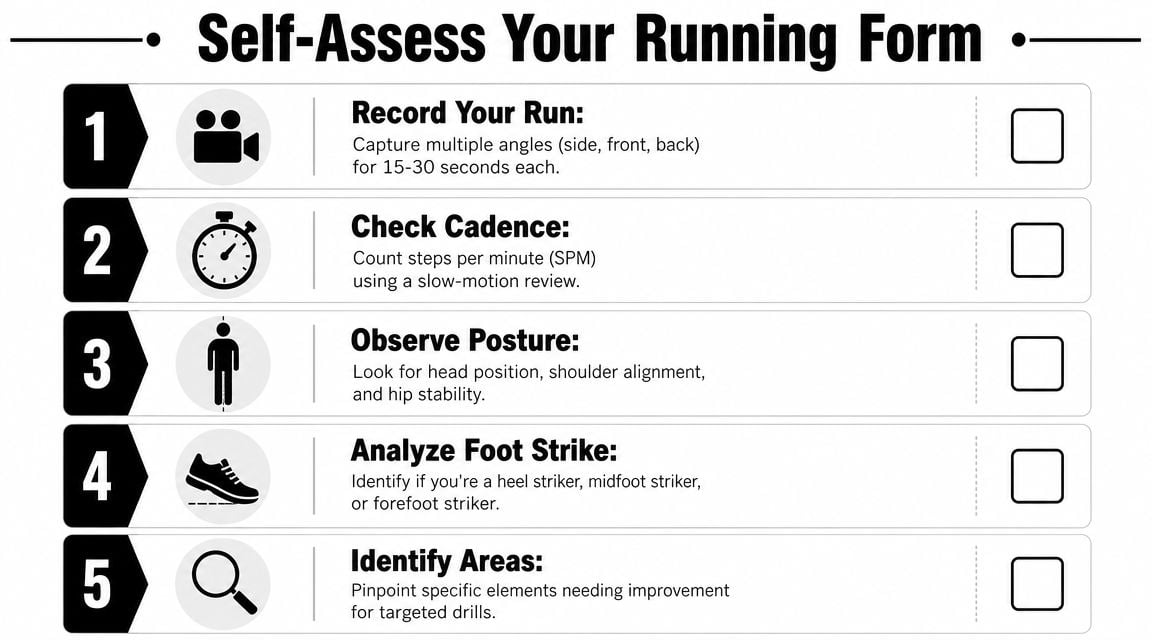
Set up your phone like a clinician would
Use your smartphone in slow-motion mode if available. Film during an easy run, not an all-out effort, because you want a picture of your default mechanics.
Capture three views:
- Side view: Record from your left and right side for a short stretch while you run naturally.
- Front view: Record while moving toward the camera so you can watch knee tracking, trunk position, and arm path.
- Rear view: Record from behind to check hip drop, pelvic control, and whether one side works differently than the other.
A few setup details matter:
- Keep the camera steady. A friend helps, but you can also prop the phone if you're on a treadmill.
- Use normal training pace. Don't change your stride because you know you're being filmed.
- Wear fitted clothing if possible. It's easier to see pelvis, knee, and arm movement.
If you want a more structured benchmark than a DIY setup, PTs use a similar starting process during a running gait analysis appointment.
What to watch in slow motion
Start from the ground and work upward. Don't try to fix everything you notice.
Use this checklist:
- Foot placement: Does your foot land well in front of your body, or closer underneath you?
- Cadence rhythm: Does your stride look quick and quiet, or slow and reaching?
- Knee path: Does the knee track fairly straight, or does it collapse inward?
- Hip stability: Does one side of the pelvis drop as you land on the opposite leg?
- Trunk position: Are you running tall, or folding forward through the waist?
- Arm swing: Do the arms move mostly forward and back, or cross excessively across the body?
- Vertical motion: Are you bouncing upward more than moving forward?
Modern coaching has moved away from rigid one-size-fits-all form cues. Guidance now favors slow, evidence-informed changes, often one adjustment at a time over a week or two, with common targets that include upright posture, slight forward lean from the ankles, relaxed arm carriage, and rhythmic diaphragmatic breathing, as described in Polar's running form guidance.
Don't use video to self-diagnose an injury. Use it to spot repeatable movement patterns.
What usually stands out first
In self-assessment, a few issues show up again and again:
| Pattern | What it tends to look like | Why it matters |
|---|---|---|
| Overstriding | Foot lands too far ahead of the body | Often increases braking and makes the stride feel heavy |
| Hip drop | Pelvis dips on one side in single-leg stance | Often reflects reduced lateral hip control |
| Excessive trunk fold | Lean comes from the waist instead of the ankles | Can make it harder to stay stacked and efficient |
| Cross-body arm swing | Hands travel across the torso | Often shows up with trunk rotation or wasted motion |
If you spot more than one problem, pick the one that looks most obvious and most repeatable. That's the pattern to test first.
The Three Pillars of Efficient and Injury-Free Running
Running form gets overcomplicated fast. For most runners, the most useful lens is simpler: cadence, posture, and foot strike location. Those three pieces shape how you absorb load and move forward.

Cadence
A lot of runners try to get faster by reaching farther. That usually backfires. A better route is to reduce overstriding and let pace come from cleaner turnover.
A common target is about 170 to 180 steps per minute for many runners, and one review of competitive runners found that shorter ground contact time was associated with better performance, with correlations ranging from r = −0.351 to −0.367 for ground contact time and r = −0.212 to −0.276 for duty factor, as summarized in this running form review from Peloton. In practical terms, quicker, lighter steps usually help more than forcing a longer stride.
If you want a plain-language companion resource on this topic, this guide offers practical running cadence advice that runners often find helpful alongside clinical feedback.
Posture
“Run tall” is common advice. It's also incomplete.
Tall doesn't mean stiff. Good posture usually looks like a stacked trunk, relaxed shoulders, eyes forward, and a slight lean from the ankles instead of a hinge from the waist. When runners fold at the middle, they often lose hip extension and start shuffling. When they overcorrect and get rigid, they create tension that doesn't carry well under fatigue.
The useful cue is this: keep your ribs and pelvis organized enough that your legs can cycle underneath you.
A good running posture feels springy and calm, not forced.
Foot strike
Foot strike gets argued about more than it deserves. The better question isn't whether you're a heel striker or midfoot striker. It's where your foot lands relative to your center of mass.
Landing far out front tends to create more braking. Landing closer under the hips tends to support smoother mechanics. Some runners will contact more through the heel, some through the midfoot, some more toward the ball of the foot depending on pace, terrain, and anatomy. The key is avoiding a reaching pattern.
A useful way to support these mechanics off the run is targeted strength work. For athletes who need that bridge between movement quality and performance, this overview of strength and conditioning for athletes fits well with form-focused work.
Here's a quick visual on efficient mechanics and stride rhythm:
Actionable Running Drills to Rebuild Your Mechanics
You won't think your way into a new stride. Form changes stick when your nervous system rehearses a cleaner pattern often enough, in small enough doses, that it stops feeling foreign.
That's where drills help. They exaggerate one part of running so your body can feel it, then carry that sensation back into normal pace.
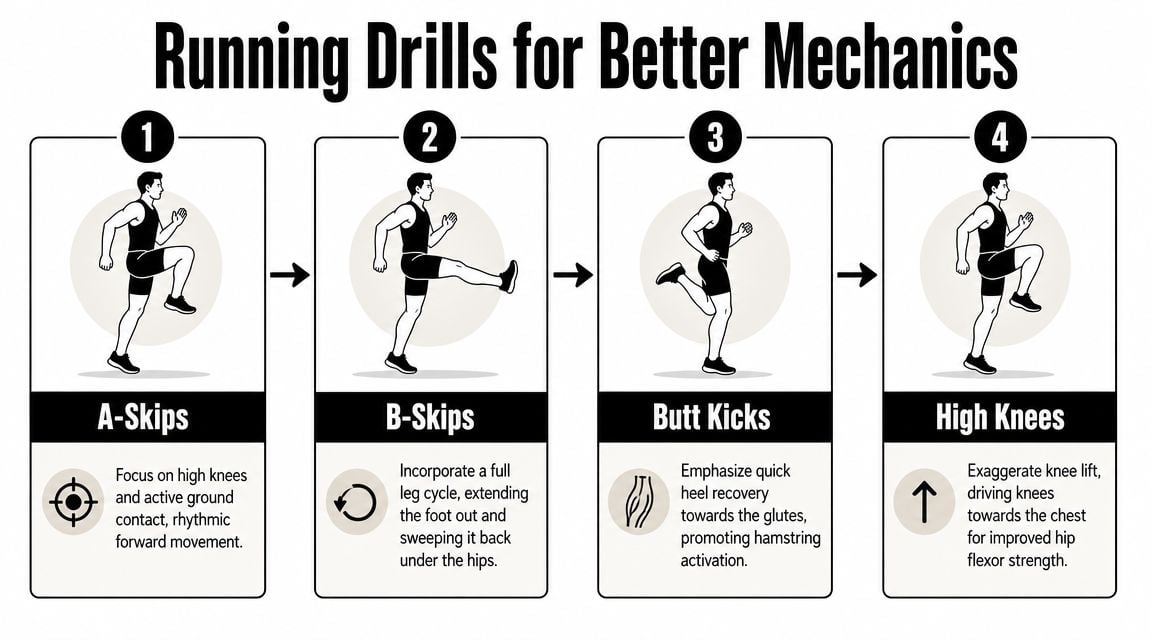
Four drills that carry over
Use these on a flat surface after an easy warm-up. Keep the volume low enough that quality stays high.
A-skips
Drive one knee up, keep posture tall, and strike the ground actively under your body. This drill teaches rhythm, front-side mechanics, and cleaner foot placement.B-skips
Lift the knee, extend the lower leg forward briefly, then sweep the foot back under the hips. This can help runners who need better awareness of the full leg cycle without reaching out in front.Butt kicks
Think quick heel recovery rather than flinging the heel high behind you. Done well, this reinforces a compact backside pattern and a snappier turnover.High knees
Use these in short doses. They can improve coordination and reinforce active knee drive, but they shouldn't turn into a leaning, flailing sprint drill.
How to plug drills into a real week
The biggest mistake is doing too much too soon. A better method is to build one new movement pattern gradually inside easy running.
A practical coaching protocol is to confirm the form issue on video, test one cue for 3 to 4 weeks, then re-film and adjust. One progression uses 6 × 30-second intervals of the new movement pattern with 60 to 90 seconds of normal running between reps, performed 2 to 3 times per week, then increasing the form-focused portion by 10 to 15 seconds each week until the runner can hold the pattern for about 10 to 15 total minutes. It often takes 6 to 8 weeks for the change to feel normal, based on the coaching progression described in this video discussion of gait retraining.
That approach works because it respects how motor learning happens. You're not rewriting your gait in one session. You're layering in repetition without creating excessive tension.
Clinical reminder: Change one variable at a time. If you're working on cadence, don't also force a new arm swing and a new foot strike on the same day.
A simple drill sequence might look like this:
- Warm up easily: Jog, brisk walk, or dynamic warm-up until you feel loose.
- Pick one drill: Stay with the drill that best matches your main fault.
- Run with one cue: Use a short carryover run after the drill, such as “quick feet” or “land under hips.”
- Stop while it's still clean: If the pattern gets sloppy, end the set.
Essential Strength and Mobility for Runners
A runner can know every cue in the book and still lose form if the body can't support the position. That's why mechanics work almost always goes better when it's paired with strength and mobility.
In clinic, the pattern is familiar. The runner says the knee caves in late in a run. Video shows hip drop. Testing shows the lateral hip fatigues quickly and the trunk can't stay organized on one leg. The problem looks like “running form,” but the driver is often capacity.
Strength that supports better mechanics
These exercises build the tissues that keep your stride stable when fatigue shows up.
Single-leg glute bridge
Lie on your back, one foot planted, the other leg lifted. Drive through the planted foot and lift the hips without twisting. This supports hip extension strength and single-leg control.Single-leg deadlift
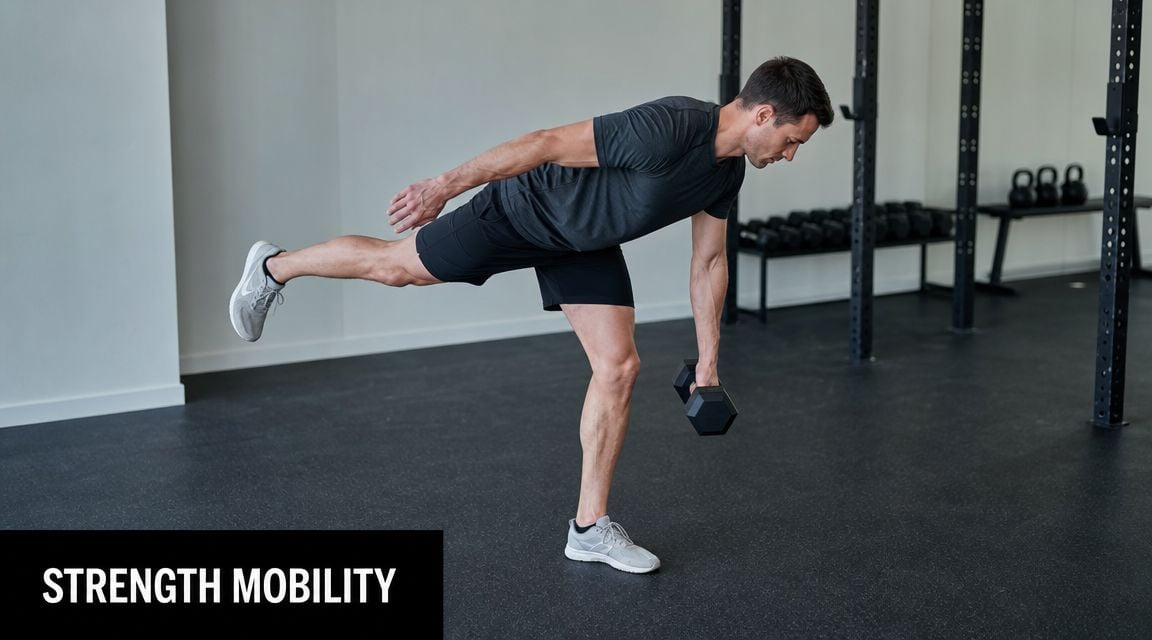
Hinge at the hip while keeping the pelvis level and the stance knee softly bent. This trains balance, posterior chain strength, and the body control runners need during stance phase.Side plank or side plank variation
This builds lateral trunk and hip stability. That matters for runners whose pelvis drops or whose torso wobbles side to side.Calf raises
Use controlled reps and full range. Your calf complex handles a lot of repetitive load in running, and weak lower legs often show up as a noisy, inefficient stride.Step-downs
Stand on a low step and lower with control. This is one of the most useful ways to train knee tracking, hip control, and eccentric strength that carries over to downhills.
For runners who want a broader home program, these physical therapy exercises for runners pair well with the mechanics work in this article.
Mobility that keeps you from compensating
Mobility doesn't mean chasing extreme flexibility. It means having enough motion in the right places so you don't steal it from somewhere else.
Focus on:
Ankle mobility
If the ankle is stiff, runners often rotate the foot out, shorten stride mechanics behind them, or compensate up the chain.Hip extension mobility
Limited motion here can make it harder to finish the stride and can push runners into overusing the low back.Hip rotation mobility
When the hip can't rotate well, the knee and foot often take on motion they weren't built to own repeatedly.
A practical mobility circuit can include:
- Knee-to-wall ankle mobilization
- Half-kneeling hip flexor stretch
- World's greatest stretch
- Quadruped rock-back for hips
- Thoracic rotation drill
What works and what doesn't
Here's the trade-off runners need to understand:
| Approach | Likely result |
|---|---|
| Only thinking about cues while running | Short-term awareness, limited carryover if capacity is lacking |
| Only doing strength work with no gait attention | Better fitness, but the same form fault may persist |
| Combining targeted strength, mobility, and one movement cue | Better chance of durable change |
Sports PT differs from generic exercise advice. We're not just handing out clamshells. We're matching the right exercise to the pattern on video, the athlete's history, and the demands of training. For some runners, that also includes dry needling, recovery work, or return-to-sport testing if they're coming back from injury and need objective benchmarks before resuming full speed.
Putting It All Together and When to See a Physical Therapist
The best form plan is the one you can keep doing while you still train. Runners often fail here because they treat mechanics like a separate project instead of building it into the week.
A practical weekly rhythm
A workable pattern looks like this:
- Easy run day: Add one form cue and a short drill block before or during the run.
- Strength day: Hit single-leg strength, core control, and calf work.
- Workout or hill day: Keep your technical focus narrow. Don't coach yourself on five things at once.
- Recovery day: Use mobility and easy walking or jogging to keep tissues moving.
Fatigue is where form usually unravels, and that's exactly where your cue needs to hold up. Trail Runner Magazine notes that form often deteriorates when runners tire and recommends maintaining a quick, relaxed motion with higher cadence during harder efforts, intervals, and hills. It also highlights a simple cue: consciously bending the knee as the foot leaves the ground can reinforce efficient mechanics during both running and walking practice, as outlined in Trail Runner's discussion of form under fatigue.
That cue is useful because it's simple enough to remember when you're working. On hill reps, tempo efforts, or the late stages of a race, simple wins.
Supporting recovery matters too. If you're training consistently and want better day-to-day fueling habits, this guide can help you discover healthy runner nutrition without overcomplicating it.
When self-correction isn't enough
Some runners can clean up a mild issue on their own. Others need an outside set of eyes.
It's time to get evaluated if:
- Pain keeps returning despite changing shoes, terrain, or mileage
- You can see a form fault on video but can't change it without feeling awkward or worse
- One side looks different from the other
- You're returning from injury or surgery and need a safe progression back to speed
- Your stride falls apart under effort even when easy running looks fine
That's especially relevant for athletes around Bridgewater, Massachusetts, and the South Shore, including Plymouth, Taunton, Raynham, East Bridgewater, West Bridgewater, Buzzards Bay, and Middleborough. A sports PT can connect mechanics, tissue capacity, training load, and injury history in a way a generic checklist can't.
Frequently Asked Questions About Running Form
How long does it take to change running form
Longer than most runners want, and shorter than most fear if they stay consistent. A new pattern often starts to feel more natural over 6 to 8 weeks when it's practiced in short, regular doses rather than forced all at once. If you're trying to improve running form, patience isn't optional. Rushed changes usually create tension and confusion.
Do I need special shoes to run with good form
No. Shoes can improve comfort and may influence how a run feels, but they don't replace mechanics, strength, or load management. If a runner lands too far out front or loses pelvic control under fatigue, the shoe may change symptoms without fixing the driver.
Is soreness normal when I change my mechanics
Some mild soreness in different areas can happen when tissues take on a new workload. What shouldn't be ignored is sharp pain, increasing pain during runs, limping, or symptoms that linger and worsen. That's where an in-person evaluation matters, especially if you've had prior injuries.
Can I improve my form on a treadmill
Yes. A treadmill can make video analysis easier because the camera stays fixed and the pace stays controlled. It's a useful place to practice one cue at a time. Just remember that treadmill running won't fully replicate hills, turns, wind, or road variability, so you'll still need carryover into outdoor running.
If you're in Bridgewater, Buzzards Bay, Middleborough, or nearby South Shore Massachusetts towns and want a clearer answer than generic online tips, book with Physical Therapy U. Our licensed sports physical therapists work with runners, athletes, dancers, and post-surgical patients using gait analysis, targeted rehab, strength programming, and return-to-sport testing to build a plan that fits your body and your training.
