
You’ve probably seen this version of soccer training before. A player gets stronger in the gym, adds weight to squats, works hard all winter, then steps onto the field in Bridgewater, Plymouth, Taunton, or Raynham and still feels late to loose balls, awkward cutting off either leg, or tight in the hamstrings after hard sessions.
That gap matters. Strength and conditioning for soccer players isn’t just about lifting more. It’s about building force you can use when you sprint, decelerate, cut, jump, land, and repeat those efforts late in a match without your movement breaking down.
From a sports physical therapy perspective, the plan has to do two things at once. It has to improve performance, and it has to reduce the injury risk that climbs when a high school athlete gets stronger in the wrong pattern, piles fatigue on top of poor mechanics, or returns from a prior ankle, hamstring, or ACL issue without enough testing. That’s why a smart soccer program starts with movement quality, then layers strength, then power, then match-specific conditioning, with a yearly plan that fits the season.
Table of Contents
- The Soccer Player’s Paradox Strength Without Speed
- Building Your Bulletproof Movement Foundation
- Unleashing Explosive Soccer Power
- Game-Ready Conditioning for the 90th Minute
- Your Annual Plan Periodization for Peak Performance
- Staying on the Field Targeted Injury Prevention
- Your Next Step Answering Your Questions
The Soccer Player’s Paradox Strength Without Speed
A lot of athletes assume general gym strength will automatically transfer to the field. It helps, but it doesn’t solve everything. Soccer asks you to produce force quickly, in awkward positions, often off one leg, and under fatigue.
Why stronger doesn’t always mean faster
A bilateral lift can improve total force production, but soccer rarely happens in a neat, symmetrical stance. You plant, rotate, absorb contact, open your hips, or cut off an angle while your trunk and pelvis try to stay organized. If your training only builds weight room strength, you can still look strong and play slow.
That’s the paradox. A player can improve a squat and still struggle to accelerate, because they can’t direct force well into the ground. Another player can be “fit” but lose every reactive first step because deceleration control, trunk position, and ankle stiffness are poor.
Strong legs don’t help much if the knee caves in when you cut, the trunk tips when you plant, or you need an extra step to regain balance.
This is also why two athletes from the same club team may need very different programs. A center back with a history of ankle sprains usually needs a different emphasis than a winger with recurrent hamstring tightness. One player needs more frontal plane control. The other may need more posterior chain eccentric work and sprint exposure.
What a sports PT looks for first
Before loading a program, a sports physical therapist looks at how the athlete moves. That starts with movement quality, not bar weight.
Key screens often include:
- Single-leg control: Can the athlete hold pelvis and knee position during split squat, landing, or step-down patterns?
- Hip and trunk coordination: Can they rotate and resist rotation without losing alignment?
- Deceleration mechanics: Do they stop with control, or collapse into the hip, knee, or foot?
- Asymmetry after prior injury: Does one side absorb force differently?
- Running and cutting pattern: Does foot strike, trunk angle, or stride strategy suggest overload risk?
For soccer athletes, those details matter more than chasing random maxes. A player from East Bridgewater who controls a rear-foot split squat cleanly is usually building more usable field strength than a player who keeps stacking plates onto a machine without owning position.
General strength still has value. It just needs to sit inside a soccer-specific plan. When strength is paired with single-leg stability, rotational control, acceleration work, and fatigue management, it starts to look like performance instead of just gym progress.
Building Your Bulletproof Movement Foundation
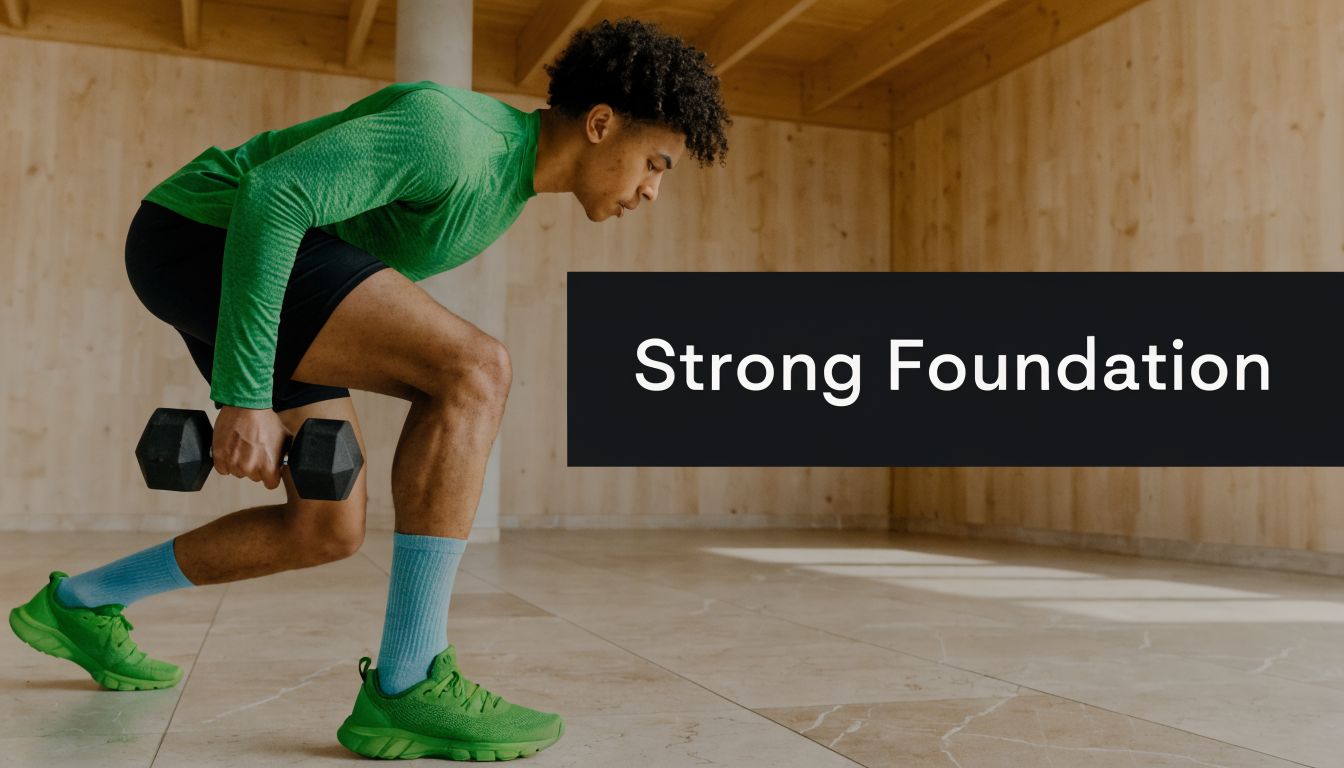
Before a player worries about sprint times or vertical jump, they need movement that holds up under contact, fatigue, and repeated practices. Soccer rewards athletes who can control their body on one leg, rotate with power, and decelerate without leaking force.
The movement patterns that matter most
The base of a good program isn’t flashy. It’s repeatable, clean movement in patterns that show up every match.
Those patterns include:
- Single-leg strength: planting, cutting, and shooting all depend on force through one leg
- Eccentric control: the ability to slow down your body before changing direction
- Rotational trunk strength: passing, crossing, and striking all need force transfer from the ground through the core
- Adductor capacity: groin and inner-thigh strength matter for lateral movement and kicking
- Foot and ankle stiffness: stable contact with the ground improves both force transfer and control
For many high school players, the first improvement comes from removing junk volume and cleaning up these basics. Better positions often create better outputs.
Foundational exercises worth doing well
A soccer strength plan doesn’t need dozens of lifts. It needs a small group of movements done with intent.
- Rear-foot raised split squat: Builds unilateral strength for acceleration and contact tolerance. Keep the front foot flat, ribs stacked over pelvis, and drive through the whole foot.
- Single-leg RDL: Teaches hip hinge control and hamstring loading while challenging balance. Keep the hips square and avoid opening the stance leg outward.
- Copenhagen plank: Targets adductors and trunk control. Start with a short lever if groin strength is limited.
- Lateral lunge: Builds frontal plane strength that most young athletes lack. Sit into the hip, keep the foot grounded, and don’t let the knee collapse inward.
- Step-down or controlled drop landing: Improves eccentric knee and hip control. The goal is quiet, organized control, not speed.
- Pallof press or cable anti-rotation hold: Trains trunk stiffness that carries into cutting, shielding, and kicking.
- Calf raise variations: Useful for lower-leg stiffness and repeated sprint support. Pause at the top and control the lowering phase.
- Hamstring bridge or slider curl: A good entry point before more aggressive hamstring loading.
Practical rule: If a player can’t control a movement at bodyweight or light load, adding more weight usually builds compensation, not performance.
For runners and field athletes who also notice recurring lower-leg or hip issues, a formal running gait analysis for movement efficiency and injury prevention can add useful detail about stride strategy and loading patterns.
How to warm up before strength work
The warm-up should prepare the exact patterns you plan to train. It shouldn’t be random stretching and it shouldn’t leave the athlete tired before the main lifts.
A simple sequence works well:
- Mobility prep: ankle rocks, hip openers, adductor rock-backs
- Activation: glute bridge, mini-band lateral walk, dead bug
- Pattern rehearsal: bodyweight split squat, hinge reach, pogo hops
- Ramp-up sets: the first exercise of the day begins light and builds
If you want a simple reference for pre-lift movement prep, this MEDISTIK guide on pre-workout preparation gives practical warm-up ideas that fit well before strength sessions.
A strong foundation doesn’t look dramatic on social media. It looks like an athlete who lands with control, cuts cleanly, and finishes a week of training without their body feeling unstable or overworked.
Unleashing Explosive Soccer Power
Strength matters, but soccer rewards the player who can express it fast. First-step acceleration, jumping for a header, reacting to a deflection, and striking through the ball all rely on power.

Power is strength expressed fast
Power training sits between the gym and the field. It teaches the athlete to use the force they’ve built, quickly and efficiently. If strength is your engine, power is how fast you can access it.
That doesn’t mean every soccer player needs maximal jump volume. It means they need the right dose of explosive work, with mechanics that stay clean. Poor plyometrics done under fatigue often teach sloppy landing and cutting strategies.
A good progression starts with low-complexity drills and earns the right to advance.
A safe plyometric progression
Start with drills that teach landing and stiffness before adding height, distance, or unpredictability.
- Snap-down to stick: teaches organized landing from a tall position
- Pogo jumps: builds ankle stiffness and rhythm
- Countermovement jump with stick landing: adds vertical force with control
- Broad jump with hold: teaches horizontal power and stable landing
- Skater bound: introduces lateral force and single-leg acceptance
- Box jump: useful for intent and concentric power, as long as the landing is clean
- Reactive hop or bound: later-stage option when base mechanics are consistent
What separates a good plyometric session from a bad one is intent and quality. Reps should look sharp. Once landings get noisy or valgus shows up at the knee, the session quality is dropping.
Choosing the right power drill for the job
Different drills train different expressions of power.
| Drill type | Best use in soccer | Main coaching focus |
|---|---|---|
| Vertical jump | Headers, aerial duels | Fast takeoff, quiet landing |
| Broad jump | Early acceleration | Push back into the ground |
| Lateral bound | Cutting and recovery steps | Hip control on landing |
| Rotational med ball slam | Shooting and passing power transfer | Hips initiate, trunk follows |
| Sprint start | First-step explosiveness | Sharp shin angle and projection |
Medicine ball work is especially useful because it lets athletes train speed and rotation without heavy joint stress. Rotational scoop tosses, shot-put throws, and slams can bridge trunk power into sport movement.
A simple visual demonstration helps many athletes clean this up before they overcomplicate it:
The biggest mistake here is doing advanced drills too early. If a player can’t control a broad jump landing, depth jumps and chaotic reactive hops aren’t the answer. The fastest path to real explosiveness is usually better mechanics, crisp intent, and enough recovery to keep outputs high.
Game-Ready Conditioning for the 90th Minute
By minute 72, a lot of high school players are still trying hard but no longer moving well. The first step gets shorter. The deceleration is late. The knee caves in on a cut they handled cleanly in the first half. From a sports physical therapy standpoint, that is not just a conditioning issue. It is a performance problem and an injury risk problem at the same time.
Why distance running misses the point
Soccer rewards repeat sprint ability, recovery between efforts, and the skill to change speed without losing mechanics. A few easy runs can still have a place for recovery or general aerobic work, especially in an off-season block or early return from injury. They just cannot be the main conditioning strategy for a field sport built on accelerations, decelerations, and rapid transitions.
Analysts at TeamBuildr note in their soccer conditioning and testing overview that higher-level players separate themselves with more high-intensity running and sprint exposure, along with stronger Yo-Yo Intermittent Recovery Test performance. That lines up with what we see in clinic. Players who can recover between hard efforts keep better footwork, make cleaner decisions, and hold their sprint mechanics later in matches.
For younger athletes, there is a trade-off here. More conditioning is not always better. If the session adds volume but strips away posture, trunk control, or braking quality, the athlete is practicing fatigue compensation.
Conditioning that actually transfers to matches
The best conditioning sessions look like soccer in the ways that matter. Work bouts are short to moderate. Recovery is incomplete. Direction changes are planned well enough to protect the athlete, but specific enough to train the demands they face in games.
For many high school and club players, these formats work well:
- Tempo intervals: Controlled efforts that build aerobic support without beating up the legs.
- Repeated sprint sets: Short sprints with limited rest to train recover-and-go capacity.
- Shuttle runs with coached deceleration: Conditioning plus braking mechanics and cutting control.
- Small-sided games: Soccer-specific conditioning that adds perception, decision-making, and competitiveness.
Small-sided games are useful, but they are not automatically safe or well-dosed. Field size, player count, and work-to-rest ratio all change the stress. In clinic, I often see athletes who are doing plenty of hard work but are missing the movement-quality side. They can grind. They cannot hold position on the plant leg once fatigue sets in.
Good soccer conditioning keeps the athlete fast enough to matter and organized enough to stay healthy.
How we dose it from a physical therapy perspective
A generic conditioning plan asks, "How tired can we make the player?" A sports PT plan asks better questions. Can the athlete keep shin angle, trunk position, and knee alignment under fatigue? Can they decelerate on the involved leg after a prior ankle sprain? Have they earned higher-speed repeat work based on testing, or are they still rebuilding capacity?
That is where return-to-sport testing and angle-specific strength profiling change the program. A winger coming back from a hamstring strain may tolerate straight-line tempo runs before repeated max sprint work. A midfielder with patellofemoral pain often needs conditioning choices that limit unnecessary joint irritation while we build quad and hip capacity. A defender with recurrent ankle sprains may need more deceleration and lateral repeat-effort work before full chaotic game conditioning.
If you want a structured way to build that base before the season starts, our off-season sports training plan for local athletes lays out how we progress capacity without losing movement quality.
Simple field sessions for high school players
These sessions fit a school field and do not require fancy equipment. The key is matching the session to the athlete’s training age, injury history, and weekly soccer load.
| Session type | Field setup | Main goal |
|---|---|---|
| Tempo intervals | Straight-line efforts across a field segment | Aerobic support with lower mechanical stress |
| Repeated sprints | Short sprint lanes with timed rest | Repeat sprint ability and recovery between bursts |
| Shuttle runs | Cones set for planned changes of direction | Conditioning with braking and re-acceleration practice |
| Small-sided play | Reduced space, limited numbers | Soccer-specific work capacity and decision-making |
Here is the practical rule I give families. If the athlete finishes a conditioning session exhausted but cannot hold clean mechanics, the dose was too high or the progression was too aggressive. The 90th minute belongs to players who can still sprint, cut, and recover with control.
Your Annual Plan Periodization for Peak Performance
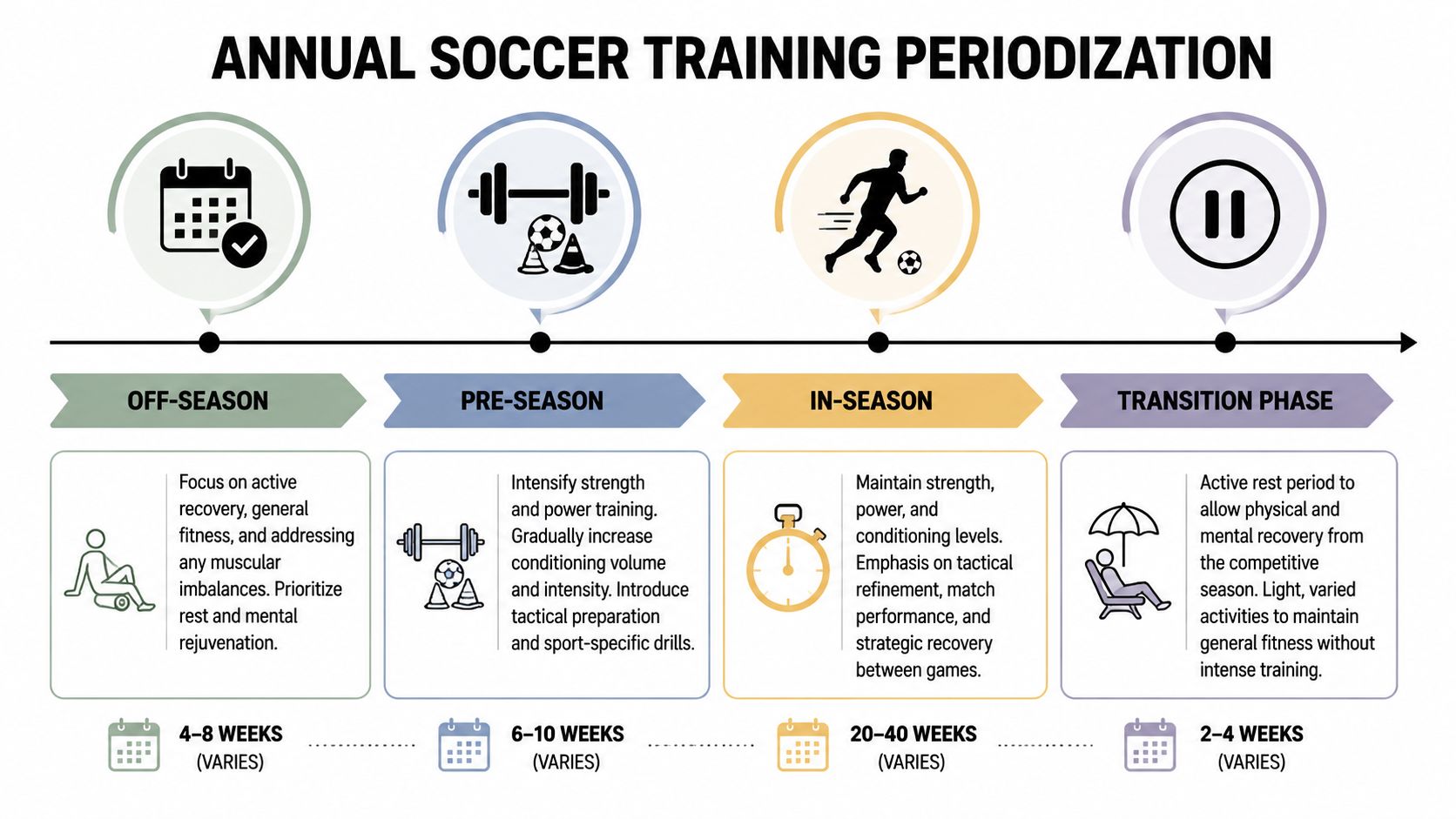
The best training plan isn’t the hardest one. It’s the one that changes across the year so the athlete builds capacity when there’s room for it, sharpens before competition, and maintains gains without digging a fatigue hole during the season.
What changes across the soccer year
In professional soccer, 98% of strength and conditioning programs use periodization, and in-season maintenance commonly uses 1 to 2 sessions per week with 2 to 3 sets of 4 to 6 reps at 80 to 90% 1RM, which has been shown to preserve strength and power for over 12 weeks with no significant detraining, based on this review of strength and conditioning practices in professional soccer.
For a high school athlete, the exact loads depend on training age and supervision, but the principle is the same:
- Off-season: build strength, tissue capacity, and movement quality
- Pre-season: shift toward speed, power, and match-like conditioning
- In-season: maintain performance and manage fatigue
- Transition phase: reduce intensity, recover, and address nagging issues
This is also where off-season planning becomes valuable. A structured off-season sport training plan for athletes helps athletes organize that window instead of wasting it.
Sample Weekly Training Schedule In-Season vs. Off-Season
| Day | Off-Season Focus (Example) | In-Season Focus (Example) |
|---|---|---|
| Monday | Lower-body strength and trunk work | Recovery, mobility, light tissue work |
| Tuesday | Field speed and power session | Team training |
| Wednesday | Upper-body and single-leg strength | Brief maintenance lift |
| Thursday | Conditioning intervals or small-sided work | Team training with set-piece or tactical emphasis |
| Friday | Power and landing mechanics | Primer session, short and crisp |
| Saturday | Skill play or scrimmage | Match day |
| Sunday | Recovery or full rest | Recovery or full rest |
Why autoregulation matters
A schedule on paper is useful, but athletes don’t live on paper. Sleep, school stress, contact load, growth spurts, and prior injury all change readiness.
That’s why daily adjustment matters. Some days the athlete should push. Some days the athlete should reduce volume, lower load, or stick to cleaner movement quality work. In higher-level environments, coaches may use tools like velocity tracking or RPE to guide that decision. In a younger athlete, the same concept can be applied with simpler coaching. If movement quality and intent are poor, that’s not the day to force volume.
A strong annual plan protects the athlete from two common mistakes. Doing too much in-season and doing too little with purpose in the off-season.
Staying on the Field Targeted Injury Prevention
Most soccer athletes don’t miss time because they lacked motivation. They miss time because the body found a weak link under speed, fatigue, or contact. For high school players, the hamstrings, groin, ankle, and knee deserve special attention, especially after growth spurts or previous injury.
Hamstrings and ACL risk need specific attention
Employing a sports PT lens changes the plan. Standard strength testing can miss the exact deficits that matter.
Research on youth soccer players shows that traditional strength tests can miss age-related eccentric knee flexor weakness at specific joint angles, while angle-specific torque testing can identify those deficits and guide targeted interventions for hamstring injury prevention, as described in this Mass General Brigham overview of soccer strength testing in youth athletes.
That point is important for parents. A player can “test strong” in a general sense and still have a vulnerable hamstring pattern when sprinting or decelerating. If the assessment misses the weak point, the program may miss it too.
For athletes and families wanting a broader primer, these tips for staying on the pitch are a useful complement to a more individualized prevention plan.
What targeted prevention looks like
Good prevention isn’t random band work at the end of practice. It’s specific loading and specific movement coaching.
Common pieces include:
- Nordic hamstring progression: builds eccentric hamstring capacity
- Single-leg landing drills: improves knee and hip control under load
- Deceleration drills: teaches the athlete to stop and redirect without collapsing
- Adductor strength work: helps with cutting and kicking tolerance
- Foot and ankle control: useful after sprains and for overall stability
- Trunk control under rotation: improves force transfer and reduces energy leaks
Athletes with prior ACL injury or real concern about knee risk should also understand the bigger picture of return-to-sport decision-making. This ACL education podcast episode with Dr. Eric Rightmire is a helpful resource for athletes and parents trying to think beyond “the knee feels okay.”
The practical trade-off is this. Generic team warm-ups are better than nothing, but they can’t replace individualized prevention when an athlete has asymmetry, recurring pain, or a prior surgery. Injury prevention works best when it’s treated like training, not like an optional add-on.
Your Next Step Answering Your Questions
Saturday match, late in the second half. Your athlete is working hard, but the first step is gone, the landings are getting sloppy, and the knee or groin starts to bother them again. That usually is not a motivation problem. It is a planning problem.
The right soccer strength and conditioning plan matches the athlete in front of you. Age, position, training age, injury history, growth spurts, and weekly schedule all change what the body can handle. From a sports physical therapy standpoint, the goal is not just to get stronger in the weight room. The goal is to build a body that can sprint, cut, decelerate, and recover without breaking down.
FAQ
Q. Is strength training safe for middle school and high school soccer players?
Yes, if it is coached well and progressed appropriately. For younger athletes, I want clean squat patterns, single-leg control, trunk stability, and good landing mechanics before chasing heavier loads. Strength work is one of the best tools we have to improve resilience, but only when technique and dosage come first.
Q. What if lifting makes my athlete sore and slower at practice?
That usually means training load is not matched to the week. Hard lower-body lifting the day before speed work or a match often creates problems. In season, many soccer players do better with shorter maintenance sessions that preserve strength and power without adding unnecessary fatigue.
Q. Should soccer players run long distances for conditioning?
Not as the main strategy. Soccer asks for repeated accelerations, decelerations, changes of direction, and short recovery periods. Some aerobic work can support recovery and general fitness, but conditioning should still look like the sport.
Q. What is a good warm-up before practice or a match?
Use a dynamic warm-up that raises body temperature and prepares the movements the athlete needs. Good options include skips, hip mobility, lunges, acceleration buildups, lateral movement, and landing prep. Structured neuromuscular warm-ups can improve readiness and help lower injury risk. Passive stretching alone does not cover those demands.
Q. What should we do if there is pain during training?
Pain that changes mechanics, causes limping, lingers after sessions, or keeps returning deserves attention. Do not train through it blindly. Reduce the aggravating load, note what movements trigger symptoms, and get examined by a licensed physical therapist or physician.
Q. How is this different for an athlete coming back from ACL reconstruction or another injury?
Return from injury needs more than a generic team workout. The athlete should show adequate strength, power, hop performance, change-of-direction tolerance, and confidence before full return to play. At our Bridgewater clinic, that often includes return-to-sport testing and angle-specific strength profiling so we can see where force production still drops off, especially in positions that matter for sprinting, cutting, and deceleration.
Q. Does every athlete need the same program?
No. A center back with recurrent hamstring strains, a midfielder dealing with patellar tendon pain, and a forward returning from ankle sprains should not train the same way. The weekly framework can be similar, but exercise selection, loading, and progression need to fit the athlete.
Parents usually ask a fair question. How do we know if the plan is working? We look for better movement quality, fewer symptom flare-ups, stronger single-leg control, more consistent speed late in sessions, and objective testing results that trend in the right direction. Gym numbers matter, but they are only part of the picture.
For athletes and parents across the South Shore, the next step is straightforward. If there is pain, repeated injury, obvious asymmetry, or a return-to-play decision to make, get the athlete assessed one on one.
If you want a personalized soccer strength and conditioning plan built by licensed sports physical therapists, Physical Therapy U can help. Our athlete-centered team works with soccer players in Bridgewater, Massachusetts, Buzzards Bay, and Middleborough on sport-specific training, injury rehab, ACL return-to-sport testing, running gait analysis, dry needling, and performance programming that fits the actual demands of the season.
