
You're training hard, but one area still feels stuck. Your calf tightens halfway through a run. Your hip pinches at the bottom of a squat. Your shoulder keeps talking back after practice, even though you've stretched, foam rolled, and taken a few days off.
That pattern is common in sports physical therapy. Athletes, runners, dancers, and post-op patients often assume the problem is just a “tight muscle,” when the underlying issue is that the tissue around it isn't gliding well. That's where myofascial release, or MFR, can help.
In a sports rehab setting, MFR isn't a spa treatment and it isn't random massage. It's a hands-on physical therapy technique used to reduce pain, improve motion, and help you move with less compensation. At an athlete-centered clinic, the point isn't just to make you feel looser for an hour. The point is to help you run, cut, land, lift, and recover better.
If you're also comparing conservative care options for ongoing pain, it can help to look at broader Chicago Ridge non-surgical options so you understand where hands-on treatment fits within a full rehab plan.
Table of Contents
- Your Introduction to Myofascial Release
- Understanding Fascia The Body's Performance Web
- The Core Benefits of Myofascial Release Therapy
- Who Can Benefit Most From Myofascial Release
- What to Expect During Your MFR Session
- Is Myofascial Release Safe for Everyone
- How MFR Fits into Your Full Recovery Plan at PTU
- Frequently Asked Questions About Myofascial Release
Your Introduction to Myofascial Release
Myofascial release is a manual therapy technique that uses sustained pressure to target restrictions in fascia, the connective tissue that surrounds and links muscles, bones, nerves, and other structures. In plain terms, it helps tissue that feels stuck start moving more normally again.
For an athlete, that can matter more than it sounds. If fascia around the hip, calf, quad, or shoulder isn't gliding well, your body often works around it. You may still get through practice, but you'll do it with altered mechanics, extra tension, and more stress on the next link in the chain.
A balanced research review published in Archives of Physical Medicine and Rehabilitation looked at 9 included studies and found that the evidence for MFR was still mixed in quality and results, but the overall signal was encouraging, especially in more recent randomized controlled trials. The review concluded that MFR showed potential for reducing pain and improving function, while also noting that stronger trials were still needed across conditions such as low back pain, neck pain, and fibromyalgia (PubMed review).
Clinical takeaway: MFR makes the most sense when it solves a specific movement problem. It's less useful when it's applied as a generic “recovery add-on” with no clear goal.
That's the practical way sports physical therapists use it. If your ankle can't dorsiflex, your trunk won't rotate, or scar tissue is changing how you land, MFR can create a window for better movement. Then that window has to be reinforced with strength, control, and sport-specific work.
Understanding Fascia The Body's Performance Web
Fascia is easiest to understand if you stop thinking about the body as isolated muscles. Think of it as a three-dimensional web or a layer of shrink wrap that runs through the whole system. It supports structures, connects them, and helps force move from one area to another.
When that web is healthy, movement feels efficient. When it gets irritated, stiff, or restricted after overuse, surgery, repetitive loading, or a period of inactivity, it can contribute to pain and a sense that your body just won't move cleanly.
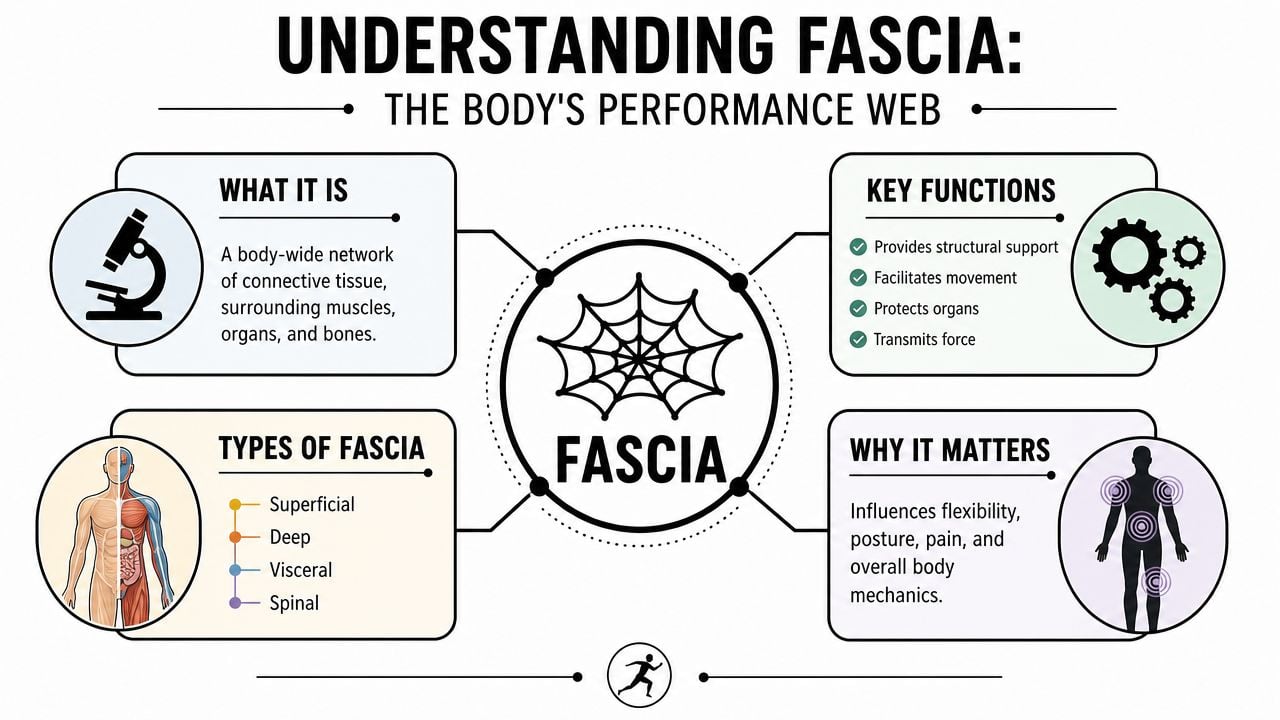
Why fascia matters in sport
Athletes feel fascial problems in ways that don't always match a textbook muscle strain. A runner may describe “constant hamstring tightness” that returns no matter how much they stretch. A baseball player may say the shoulder feels bound up during follow-through. A dancer may feel pulling through the front of the hip that changes turnout and landing quality.
That happens because fascia helps tissues glide, transmit force, and tolerate load. If glide is limited, the body starts borrowing motion somewhere else. The knee twists a bit more. The low back extends a bit earlier. The neck and upper trap pick up work the mid-back should be handling.
Why stretching alone sometimes falls short
Stretching can help, but it doesn't always solve a true restriction. If the issue is only muscle tone after a hard session, a stretch may be enough. If the issue is deeper tissue irritability or a loss of normal fascial mobility, the stretch often feels temporary.
Here's one way to see it:
| What you feel | What may be going on | Common result |
|---|---|---|
| General post-workout tightness | Short-term muscle tension | Often improves with movement and recovery |
| Same “tight spot” every week | Repeated overload or poor mechanics | Keeps coming back |
| Pulling, stiffness, or stuck movement | Fascial restriction or tissue glide issue | Stretching helps briefly, then symptoms return |
Fascia doesn't just affect flexibility. It affects how force travels through the body when you sprint, jump, rotate, and absorb load.
That's why hands-on assessment matters. A trained sports PT isn't just asking, “Where does it hurt?” They're asking, “What tissue is restricted, what movement is being altered, and what sport demand is exposing it?”
The Core Benefits of Myofascial Release Therapy
An athlete usually notices the benefit of MFR in a simple moment. The squat stops pinching at the front of the hip. The warm-up run feels less tuggy through the calf. The shoulder reaches overhead without that familiar protective tension.
The benefits of myofascial release are real when they connect to a specific goal. In the clinic, we use MFR to change a movement problem, reduce irritability in overloaded tissue, and create a window for better exercise. That matters for return to sport, because temporary relief without better loading mechanics rarely holds.
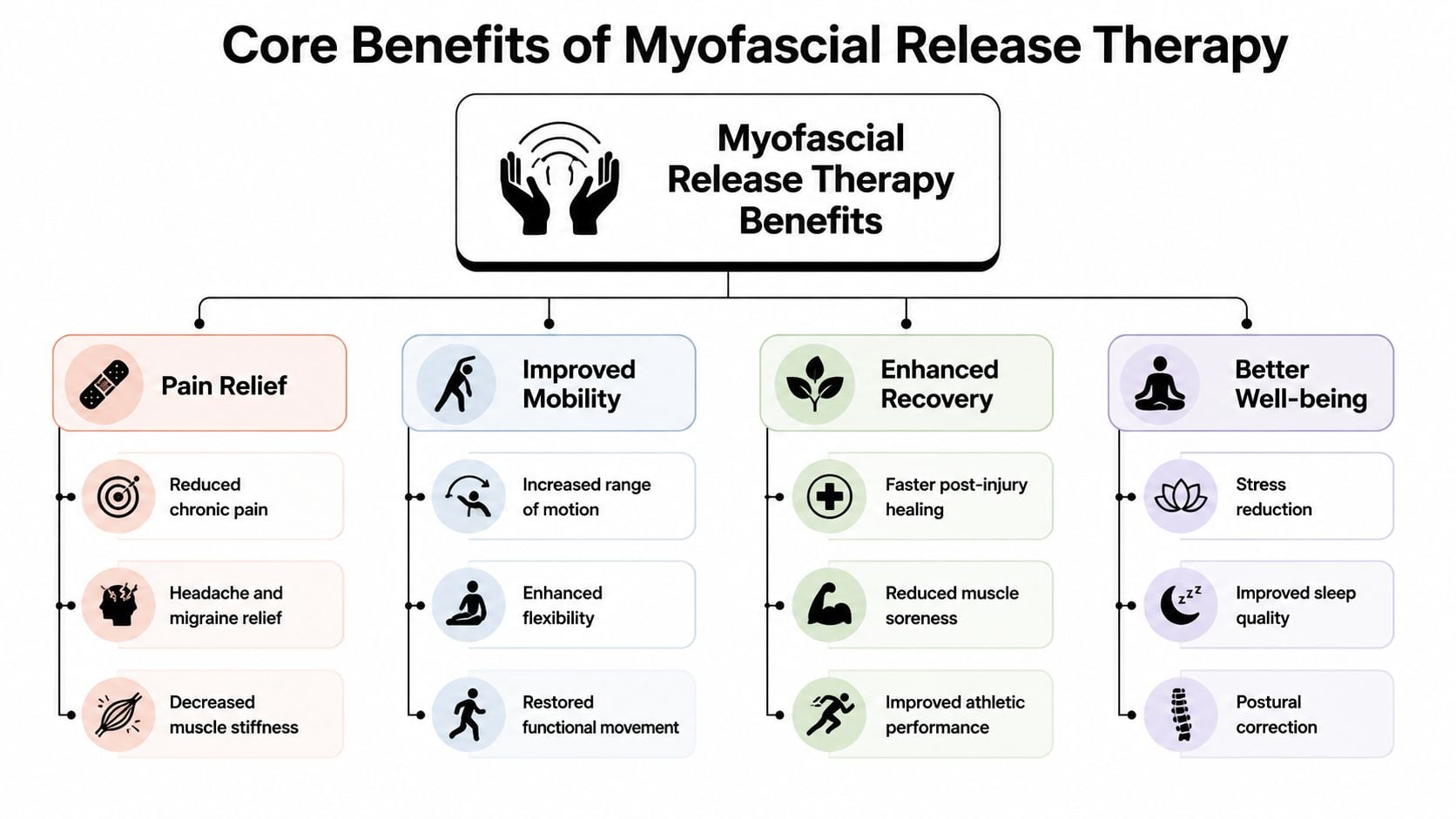
Pain relief that improves function
Pain relief is often the first change people feel, but the clinical question is whether that relief improves movement quality. If the tissue calms down and you can load the leg, rotate through the trunk, or reach overhead with less guarding, treatment is doing its job. If pain drops for an hour and the same faulty pattern shows up in your next session, the plan needs more than hands-on work.
In sports rehab, that distinction matters.
- Running: Less pulling through the arch, calf, or lateral hip can improve push-off and make stride mechanics feel cleaner.
- Lifting: Reduced tissue sensitivity can help you get into position without shifting away from one side.
- Throwing and overhead work: Better tissue mobility can decrease protective tension through the chest, neck, and shoulder so the arm does not have to force motion.
Athletes with heel or arch pain often compare several recovery tools at once. If that is part of your picture, this article on how red light helps plantar fasciitis is a useful companion read.
More usable range of motion
MFR can improve motion, but the goal is not passive flexibility for its own sake. The goal is motion you can use in a squat, sprint, cut, landing, or lift.
A recent clinical review describes myofascial release as a manual therapy approach used to reduce pain and improve mobility across musculoskeletal conditions, including sports-related overuse problems (clinical review on PMC). That matches what we see in practice. The biggest win is often not a dramatic increase in range. It is getting enough motion back in the right place so the rest of the body stops compensating.
A few common examples:
- Ankle and foot stiffness: Better soft tissue mobility can improve how the shin moves over the foot during running, squatting, and change of direction.
- Hip restriction: Improving tissue mobility around the front or side of the hip often helps single-leg control look and feel cleaner.
- Thoracic stiffness: Better motion through the rib cage and upper back can reduce stress on the neck and shoulder during pressing or overhead sport.
For runners, that carryover matters more than the treatment itself. Hands-on work may help restore motion, but the next step is retraining stride, load tolerance, and calf-foot strength. These physical therapy exercises for runners are a good example of what should follow tissue work.
Better circulation, less guarding, and a calmer system
Patients often describe a treated area as feeling looser, warmer, or less stuck after MFR. Part of that response is mechanical. Part of it is neurologic. When tissue irritation drops and the nervous system stops guarding so hard, movement usually becomes easier and less effortful.
That can help during heavy training blocks, especially in athletes who keep hitting the same overloaded area. The calf that never settles down after speed work. The adductor that stays on after lateral cutting. The shoulder that remains tense after repeated contact or overhead volume.
MFR can support recovery in those cases, but there is a trade-off. It does not replace strength work, conditioning, sleep, nutrition, or smart programming. It works best as one part of a complete sports physical therapy plan, especially when hands-on treatment is immediately followed by the exercise that teaches the body how to keep the new motion.
Practical rule: If MFR gives you relief but your strength, mechanics, or training tolerance do not improve, the treatment helped the symptom, not the full problem.
Who Can Benefit Most From Myofascial Release
The people who benefit most from MFR usually have one thing in common. They don't just feel tight. They've lost clean, confident movement in a way that affects training or recovery.

The competitive athlete
A field athlete, lifter, or runner may notice the same restriction every week. The hamstring always feels “on.” The adductor keeps tugging. The shoulder never quite settles down after contact or overhead work.
For runners from Bridgewater, Plymouth, Taunton, Raynham, or the South Shore Massachusetts area, this often shows up as overuse. The body keeps taking the same route because tissue mobility and mechanics haven't fully reset. If that's your situation, these physical therapy exercises for runners are a helpful next layer after hands-on treatment.
MFR tends to help this group when it's used to improve one limiting factor, then followed by loading. If the tissue frees up but the athlete never retrains stride, deceleration, or force acceptance, the old pattern usually returns.
The dancer
Dancers live in the space between mobility and control. They need range, but they also need precision. A small restriction in the calf, hip flexor, adductor, foot, or rib cage can affect turnout, extension, jump mechanics, and landing quality.
HSS notes that MFR can help decrease pain and increase mobility, and that athletes may benefit, including runners with repetitive strain injuries and patients with muscular imbalances that drive overuse and faulty movement patterns. That lens fits dancers well because they often load the same structures at high frequency and high precision.
For dancers, MFR is most useful when it improves a specific movement quality:
- Turnout feels blocked
- Back extension is pinchy
- Landing feels asymmetrical
- One side grips more than the other
The post-surgical athlete
Post-surgical rehab is one of the clearest places where MFR can add value. After procedures like ACL reconstruction or other orthopedic surgery, tissue healing can leave areas feeling dense, guarded, and hard to move through.
That doesn't mean aggressive pressure is always the answer. It means scar tissue, protective tension, and altered movement often need skilled hands-on work as part of a larger progression.
For the post-op athlete, common goals include:
- Improving comfort with bending or straightening
- Reducing the sense of pulling around incisions or surrounding tissue
- Helping restore normal gait and weight acceptance
- Preparing the body for strength work and return-to-sport testing
The key is timing and context. A strong plan respects healing, restores motion, rebuilds strength, and tests function before full return to cutting, sprinting, or jumping.
What to Expect During Your MFR Session
A lot of patients assume myofascial release will feel like deep tissue massage. Usually, it doesn't. In a sports PT setting, it's more controlled and more targeted.

How the session starts
At a clinic in Bridgewater, Massachusetts or elsewhere on the South Shore, the session should begin with assessment, not treatment for treatment's sake. Your physical therapist looks at the movement that matters most to you. That may be a squat, a lunge, a hop, a turnout position, a running pattern, or simple walking after surgery.
The therapist then checks for restrictions that match what your body is doing. If your hip shift comes from ankle limitation, the ankle matters. If your shoulder pain is tied to rib cage stiffness or lat restriction, that gets attention too.
A typical evaluation focus includes:
- Your sport or activity goal
- What movement reproduces symptoms
- Which tissues feel restricted
- What changes immediately after treatment
What the treatment feels like
MFR usually involves gentle to moderate, sustained pressure. The therapist contacts a restricted area and waits for tissue response rather than constantly rubbing over it. You may feel stretch, pressure, warmth, or a gradual softening sensation.
It shouldn't feel sharp, alarming, or out of control. The best sessions are specific enough to create change, but calm enough that your body doesn't guard against them.
You should leave feeling like the area moves more freely, not like you just survived a contest.
That's one reason many athletes respond better to professional MFR than to trying to smash the same spot with a foam roller. Self-release tools have value, but they can't match a therapist's ability to assess direction, dose, and how one restriction affects the next joint in the chain.
What happens after the hands-on work
This part matters most. After MFR, the new motion has to be used.
That's when the therapist may add:
- Mobility drills to keep the gain you just made
- Strength work to teach the body to own that range
- Motor control work for cleaner mechanics
- Recovery tools like NormaTec compression boots benefits when swelling, fatigue, or training density are part of the problem
If treatment ends with hands-on work and nothing else, you're missing the part that helps the change last.
Is Myofascial Release Safe for Everyone
A high school pitcher with a fresh forearm strain, a runner with a swollen calf after a long race, and a post-op athlete still early in healing should not all get the same hands-on treatment. Safety with myofascial release depends on timing, tissue status, and the reason symptoms showed up in the first place.
In practice, MFR is usually a low-risk manual therapy when it is applied by a licensed physical therapist who has already examined the area, reviewed your medical history, and ruled out problems that pressure could aggravate. The concern is rarely the technique by itself. The concern is using it on the wrong tissue, at the wrong stage, or with too much force for an irritated system.
When a therapist should pause or modify treatment
Before I put hands on an athlete, I want to know what happened, how reactive the area is, and whether there are any medical reasons to avoid direct pressure. That screen matters more than the label of the technique.
MFR may need to be delayed, changed, or skipped in cases such as:
- Open wounds or incisions that are still healing
- Fractures or suspected structural injury
- Signs of deep vein thrombosis
- Active infection, unexplained swelling, or other medical red flags
- Recent surgery when the tissue and timeline do not support direct pressure
- Areas with severe irritability, altered sensation, or poor pressure tolerance
That is also why aggressive soft tissue work is not automatically better. More pressure does not mean more progress. In the wrong setting, it can increase guarding, soreness, or inflammation and set training back for a few days.
Why provider training matters
Good MFR is specific. The therapist chooses the location, direction, depth, and duration based on healing stage and movement goals, then watches how your body responds during the session. An athlete trying to get back to sprinting after a hamstring strain needs a different approach than someone with chronic neck tension from desk work and lifting.
For athletes in Southeastern Massachusetts, that clinical judgment is what separates useful treatment from random tissue work. If MFR helps, it should fit the bigger plan, especially for athletes who also need strength progression, swelling management, or advanced physical and aquatic therapy options because full weight-bearing load is not the right next step yet.
For healthy, active people, myofascial release is often a reasonable part of care. It is safest and most effective when the clinician knows when to use it, when to ease off, and when a different treatment path makes more sense.
How MFR Fits into Your Full Recovery Plan at PTU
The biggest mistake people make with myofascial release is expecting it to do the whole job. It won't. MFR is a tool, not the treatment plan.
Why MFR is rarely a stand-alone treatment
If a runner has limited ankle motion, MFR may help free the calf and foot. But the actual recovery plan still needs calf strength, single-leg control, load management, and sometimes running gait analysis. If a post-op ACL athlete feels bound up, hands-on work may help restore motion, but return to sport still depends on strength, hop testing, deceleration control, and confidence.
That's why sports PT works best when passive care leads directly into active care.
How it pairs with sports rehab tools
In an athlete-centered setting, MFR often pairs well with other services:
- Dry needling when trigger points and irritability need another input
- Running gait analysis when recurring tissue overload shows up stride after stride
- Dance therapy when mobility has to translate into highly specific movement patterns
- Return-to-sport testing when symptom improvement has to match objective function
- Broader rehab options like advanced physical and aquatic therapy when tissue loading needs to be progressed differently
The sequence matters. Reduce the restriction. Rebuild the pattern. Load it. Test it. Then return to sport with fewer compensations and more confidence.
Frequently Asked Questions About Myofascial Release
How is myofascial release different from deep tissue massage
MFR is more targeted and more clinical. It focuses on fascial restriction and tissue glide, not just pressure or muscle soreness. Research summaries note that MFR may help with pain and flexibility in some conditions, but the evidence is still mixed and doesn't show a clear, universal advantage over other manual therapies or exercise, which is why it's best used as part of a broader plan rather than as a magic bullet (evidence summary on O'Brien Physical Therapy).
Does myofascial release hurt
It shouldn't feel sharp or threatening. Most patients describe it as focused pressure, stretch, or an intense but manageable release. If treatment makes you brace, clench, or pull away, the dose usually needs to change.
How many sessions will I need
That depends on the problem being treated and what else is in your plan. A fresh restriction after training may respond quickly. A long-standing movement pattern, recurrent overuse problem, or post-surgical limitation usually takes longer because the tissue change has to be reinforced with exercise and progressive loading.
Is myofascial release covered by insurance
When MFR is provided by a licensed physical therapist as part of a medically necessary PT plan, it's often billed within physical therapy care rather than as a stand-alone wellness service. Coverage depends on your insurance plan, diagnosis, and benefit details, so it's worth checking before your first visit.
If you're dealing with persistent tightness, pain that keeps returning, or movement that still feels off after rest and stretching, Physical Therapy U can help you figure out whether myofascial release belongs in your recovery plan. Our licensed DPTs work with athletes, runners, dancers, and post-surgical patients across Bridgewater, Buzzards Bay, and Middleborough, Massachusetts, using hands-on care, strength progression, and return-to-sport testing to help you move better with confidence.
