
You finished the race. Your medal is on. Your quads are tightening up by the minute, stairs already feel like a bad idea, and part of you is asking the question every dedicated runner asks after a big day. Was that normal marathon soreness, or did something go sideways?
At a sports physical therapy clinic, the important recovery conversation starts. Not with a generic “take a few days off,” but with a symptom-guided plan that matches what your body communicates. For runners across South Shore Massachusetts, including Bridgewater, Plymouth, Taunton, Raynham, Buzzards Bay, and Middleborough, the difference between a smooth comeback and a frustrating setback often comes down to what happens in the next few hours and weeks.
A marathon is not just race day. It's the final long run of a training block, plus the aftermath. If you want to know how to recover from a marathon in a way that protects your legs, respects tissue healing, and sets up your next training cycle, start here.
Table of Contents
- Your Marathon Recovery Starts Now
- The First 24 Hours The Finish Line and Beyond
- The First Week Navigating Active Recovery
- Weeks 2-6 The Gradual Return to Running
- When Sore Becomes Injured Recognizing Red Flags
- Frequently Asked Marathon Recovery Questions
- When should I eat after a marathon
- How much protein should I aim for right after the race
- When can I get a massage
- Should I take a full week off from running
- When can I run again after a marathon
- Is an ice bath required
- Can I race again soon after a marathon
- What if my calf, foot, knee, or Achilles still hurts
Your Marathon Recovery Starts Now
Crossing the finish line can make runners think the hard part is over. In one sense, that's true. The training block is done. The race is done. But your body is still dealing with the cost of all that work.
That's why the best recovery plans don't treat the next few weeks as dead time. They treat them as the last phase of the event. The runners who come back well usually don't do anything flashy. They eat early, move lightly, sleep seriously, and they don't force a return to running just because the calendar says they “should.”
At PTU, reviewed by licensed DPTs and shaped by what we see in sports PT every week in Bridgewater, Massachusetts, Buzzards Bay, and Middleborough, the biggest mistake isn't usually under-recovering on day one. It's assuming all post-race pain is the same. General stiffness is common. A calf that keeps grabbing, an Achilles that hurts with each step, or a knee that swells after an easy walk deserves a different response.
Practical rule: Recovery after a marathon should be guided by symptoms and loading tolerance, not pride.
If you want another runner-focused perspective, these effective marathon recovery strategies pair well with a clinical framework. The useful part isn't the exact routine. It's learning to match the right recovery input to the way your body is responding.
The rest of this guide follows that same logic. Start with immediate refueling and hydration. Shift into active recovery instead of total shutdown. Then build back to running gradually, with a clear line between normal soreness and warning signs that need a sports PT assessment.
The First 24 Hours The Finish Line and Beyond
You finish, stop your watch, and within minutes your legs start to stiffen. Then the key question arises. Is this the normal fallout from 26.2, or the start of something that needs more caution?
That first day gives useful information if you pay attention to the right signals. Diffuse soreness in both quads, heavy calves, and general fatigue are common. Sharp pain in one spot, visible swelling around a joint, or pain that changes your walking pattern deserves a different response right away.
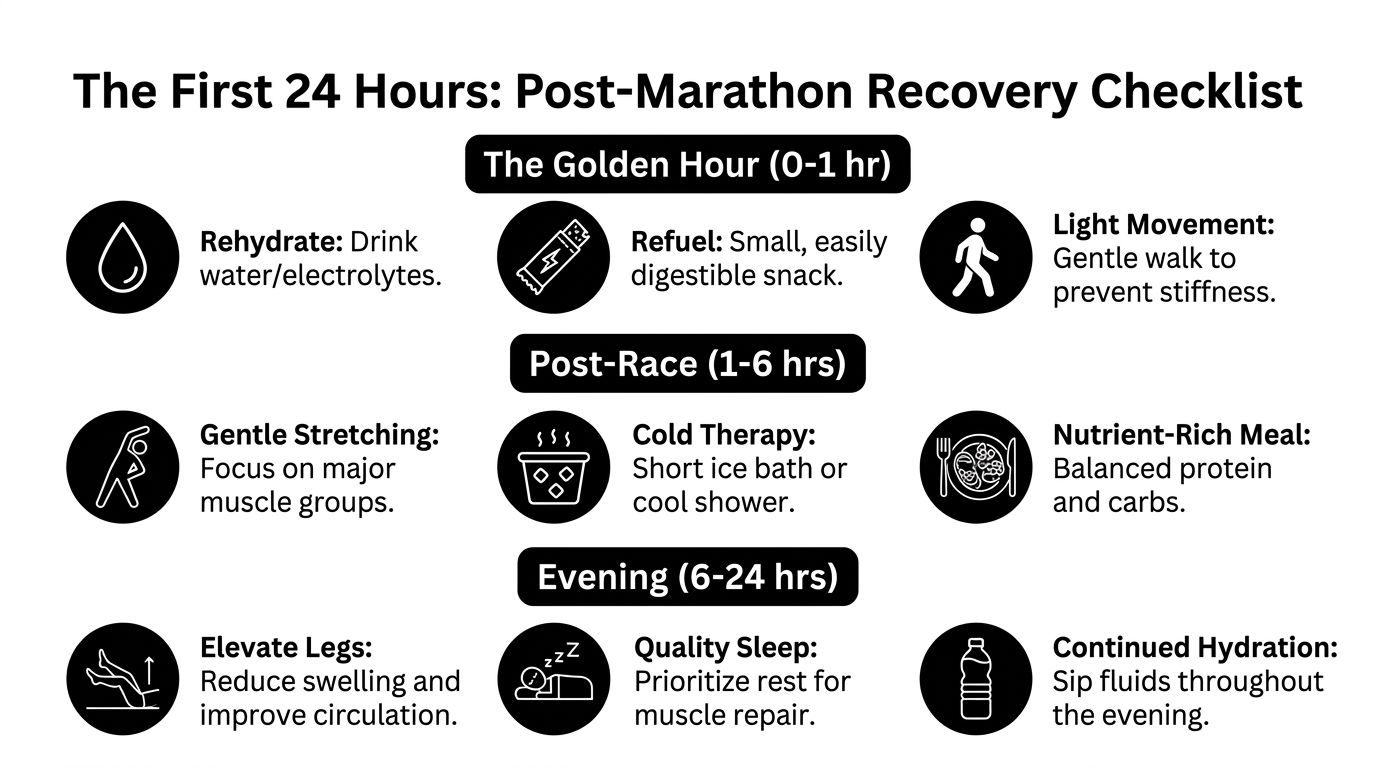
What to do in the first hour
Start with fuel, fluids, and gentle movement. The American College of Sports Medicine's nutrition and athletic performance guidance supports early carbohydrate, protein, and fluid replacement after prolonged endurance work, especially when glycogen stores and hydration have taken a hit.
Keep it simple and tolerable:
- Drink first: Water plus electrolytes is usually easier on the stomach than trying to chug a large volume at once.
- Eat something you can handle: Chocolate milk, a recovery shake, yogurt with fruit, rice, toast, or a bagel with some protein all work.
- Keep moving for a few minutes: Easy walking helps more than dropping straight to the ground and staying there.
Appetite is often low right after a race. That is common. Small amounts still count.
The goal is straightforward: replace what you used, settle the system, and avoid turning normal post-race soreness into a rougher next 24 hours.
What matters for the rest of the day
The biggest mistake I see is treating all discomfort the same. Sore all over and tired is one pattern. A calf that tightens with every step, pain on one side of the knee going downstairs, or foot pain that makes you unload that leg is another. One can usually be managed with calm recovery habits. The other may need the day scaled down hard and watched closely.
For the rest of day one, use this checklist:
- Eat a real meal: Build it around carbohydrates and protein, then add fluids and enough sodium to replace what you lost in sweat.
- Alternate rest with short walks: A few easy laps around the house or hotel usually beats sitting still for hours.
- Use gentle mobility only: Ankles, hips, and light range of motion are fine. Aggressive stretching into sore muscle is usually a poor trade-off that first day.
- Use recovery tools for comfort, not as a fix: Some runners like compression for heavy, puffy legs. PTU's overview of NormaTec compression boot benefits explains where they may help and where they do not change the bigger recovery picture.
- Get off your feet when your body asks for it: Elevation can help if swelling and heaviness build through the afternoon.
- Protect sleep that night: A shower, food, fluids, and an earlier bedtime usually do more for recovery than any fancy add-on.
What usually makes runners feel worse
The first day should lower stress on the system, not add more.
| If you do this | Expect a better result from this |
|---|---|
| Skip food because your stomach feels off | Start with small, bland, easy calories and build from there |
| Stay planted on the couch all day | Mix rest with brief, easy walking |
| Test the legs with a run | Wait and let walking tell you how the tissues are responding |
| Book hard bodywork right away | Keep treatment light and calming on day one |
Calendar advice has limits here. Two runners can finish the same race and look very different by that evening. If your symptoms stay broad, symmetrical, and ease as you warm up, that usually fits normal marathon soreness. If pain is sharp, localized, worsening, or tied to a limp, treat it like a possible injury until proven otherwise.
The First Week Navigating Active Recovery
By day three or four, many runners hit the same question. The broad soreness is still there, but one spot starts talking louder. The decision is no longer “Should I rest or move?” It is “Is this normal marathon fallout, or is something getting irritated?”
That is why the first week works better with a symptom-guided plan than a rigid calendar. A generic timeline cannot tell you whether your calf tightness is settling the way it should or whether that sharp ache near the knee is the start of a real problem.
Yale Medicine advises taking several days off from running, using low-impact cross-training instead of complete inactivity, and keeping the first few runs back short and easy in their guidance on how to recover after a marathon.
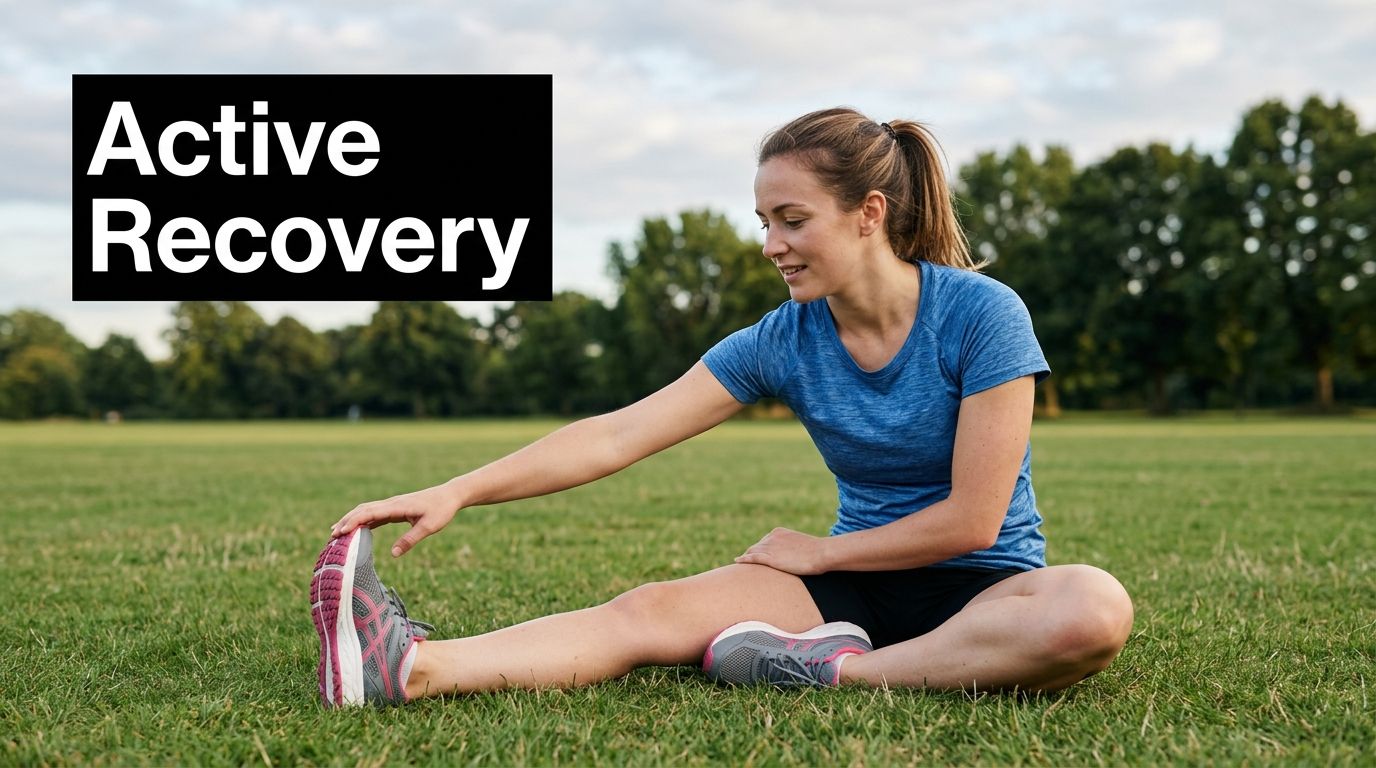
What active recovery should actually feel like
Good first-week movement usually leaves you less stiff within a few hours and no worse the next morning. Walking loosens up. Easy spinning improves circulation. Pool work can feel good when impact still feels harsh.
The trade-off is simple. Enough movement helps the body settle. Too much movement turns recovery back into training stress.
Use this screen after any session:
- Green light: soreness feels diffuse, symmetrical, and a little better once you get moving
- Yellow light: you feel okay during activity, but one area is more irritated later that day
- Red light: pain is sharp, localized, changes your stride, or lingers into the next day
That red-light pattern is where runners get in trouble by assuming they are “just tight.”
A practical first-week framework
Keep the goal narrow. Restore normal walking, calm the tissues down, and watch how symptoms behave.
- Early in the week: walk in short bouts, then stop before your gait gets sloppy or sore spots light up
- Midweek: add easy cycling, swimming, or pool running if it feels better than walking, not harder
- Late in the week: consider a run only if walking feels normal, stairs are manageable, and you have no focal pain that is building day to day
Mobility work should stay controlled and boring. Ankles, calves, hips, and mid-back usually respond well to gentle range of motion. Aggressive stretching, hard foam rolling, and digging into sore muscles often buy a short-lived “release” and a crankier leg later.
If you want a better menu than random social media routines, PTU's guide to physical therapy exercises for runners lays out useful mobility and strength options that fit this stage.
The habits that matter more than extra training
Recovery still depends on basics in this first week, especially once the race excitement wears off.
- Sleep: protect it. Poor sleep keeps soreness louder and slows the sense that your legs are coming back online.
- Food: eat regularly, even if appetite is inconsistent. Marathon recovery costs energy.
- Hydration: keep fluids up across the week, especially if travel, heat, or GI issues threw you off after the race.
- Monitoring: use wearables as context, not as the final answer. Qaly's insights on low HRV are helpful here, but HRV only adds information. It does not overrule a limp, pinpoint pain, or worsening symptoms.
By the end of the first week, soreness alone is not the main issue. Pattern matters more. Diffuse stiffness that gradually eases is common after a marathon. Pain that is focal, worsening, or altering how you move deserves a closer look before you return to running.
Weeks 2-6 The Gradual Return to Running
Two weeks after the marathon, this is the moment runners often get fooled. The soreness has settled down, stairs are easier, and one decent day creates the urge to "see what happens" on a run. Sometimes that goes fine. Sometimes it turns a normal recovery into three more irritated weeks.
A calendar helps, but symptoms make the decision. Research summarized by the American College of Sports Medicine supports a gradual return after marathon racing because muscle damage, neuromuscular fatigue, and connective tissue stress can outlast the point when your legs feel less sore. The question to ask is more specific than "Am I ready?" Ask whether you can handle an easy run, recover from it by the next day, and keep your gait normal throughout.
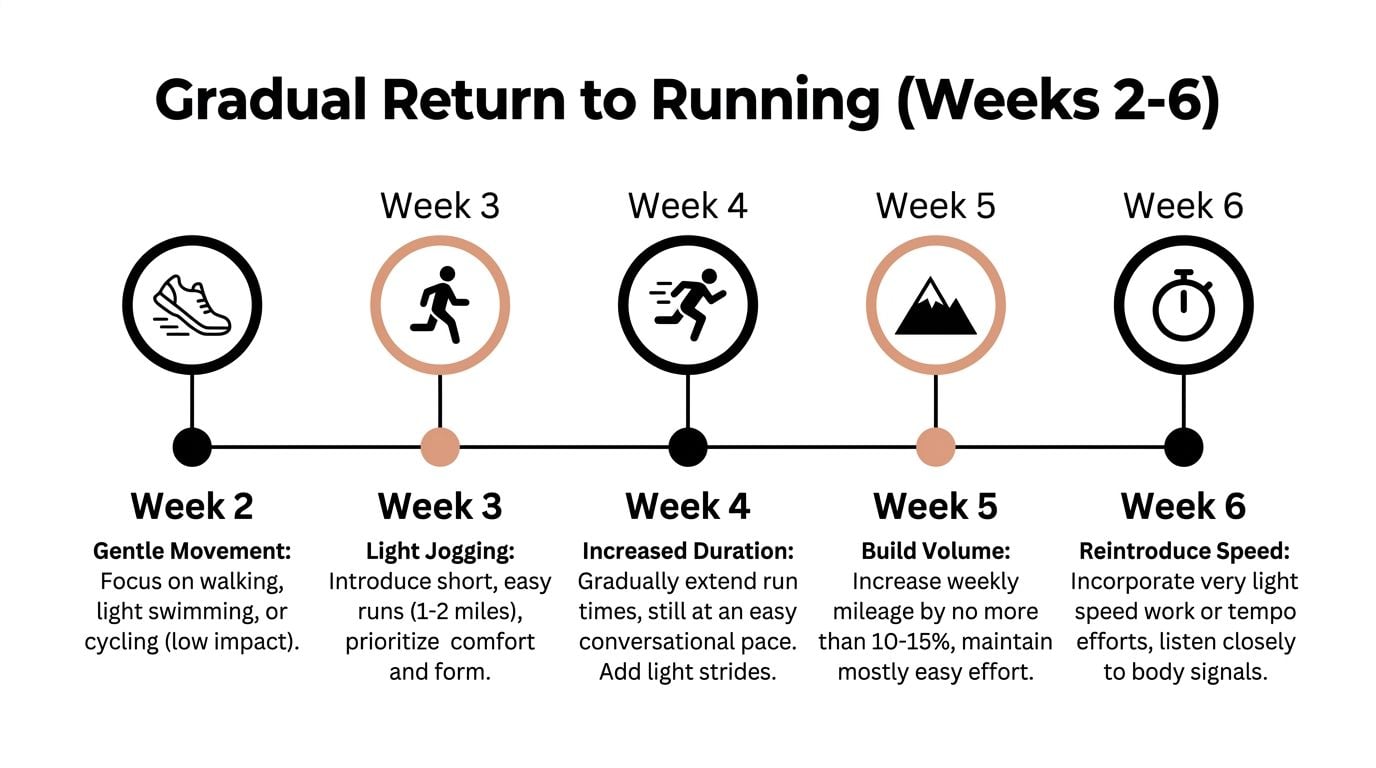
Why a cautious return works better
In the clinic, I see the same pattern every season. A runner waits until they feel decent, then tests fitness instead of testing tolerance. The first run may pass. The next morning reveals the truth.
Good early runs are quiet. Breathing stays easy. Form stays symmetrical. Nothing sharpens during the run, and nothing new lights up later that day.
Wearables can support that decision, but they do not overrule symptoms. If recovery markers still look suppressed, Qaly's insights on low HRV offer useful context. HRV is one piece of the picture. A stable watch score does not make a limping runner ready, and a low score alone does not mean running is automatically off the table.
Use a symptom-guided return instead of a fixed timeline
Some runners jog comfortably in the second or third week. Others need longer. The difference is rarely motivation. It is load tolerance.
Before the first run back, these checkpoints should be in place:
- Walking feels normal at regular daily volume.
- Stairs are manageable without grabbing the rail because of pain.
- There is no swelling that builds through the day.
- You are not guarding one side during squats, calf raises, or step-downs.
- Any residual soreness is broad and settling, not sharp and pinpoint.
If those boxes are not checked, keep building capacity without forcing mileage. A few extra days of bike, pool running, or brisk walking usually cost less than a setback. PTU's guide to best cross-training for runners can help you choose options that maintain fitness without aggravating tissues that are still irritable.
What the first runs back should look like
Start smaller than your ego wants.
The first run should be short, conversational, and boring enough that you finish feeling like you could have done more. Flat routes help. Softer surfaces can help if they do not change your mechanics. Walk breaks are fine, especially if they keep your stride relaxed.
Use a simple progression:
| Stage | Goal |
|---|---|
| Run 1 to 2 | Short, easy effort. Stop while you still feel good. |
| Run 3 to 4 | Add a little time if symptoms stay quiet for 24 hours. |
| Next step | Increase frequency or duration, not both in the same jump. |
| Later | Bring back hills or moderate workouts only after easy running feels routine again. |
Keep one rule at the center of the whole phase. Progress only from a stable baseline. If a run leaves you more sore in one specific area, changes your stride, or makes the next run feel worse instead of easier, the answer is not to push through. It is to back the load down and reassess.
Strength work can return too
This period is a good time to restart lifting, but the goal is support, not fatigue. Use movements that restore control on one leg, build calf capacity, and clean up hip and trunk strength. Keep loads reasonable enough that strength work does not wreck the next run.
That trade-off matters. A hard leg session can feel productive, but if it leaves your calves, Achilles, or knees overloaded for two days, it is not helping your return to running.
Clinical takeaway: The safest comeback is earned by repeating easy, well-tolerated sessions. The body that handles modest load consistently is the body that is ready for the next step.
When Sore Becomes Injured Recognizing Red Flags
The hardest part of marathon recovery isn't usually soreness. It's uncertainty. Runners can tolerate discomfort. What they hate is not knowing whether the pain is expected or whether they're digging a deeper hole.
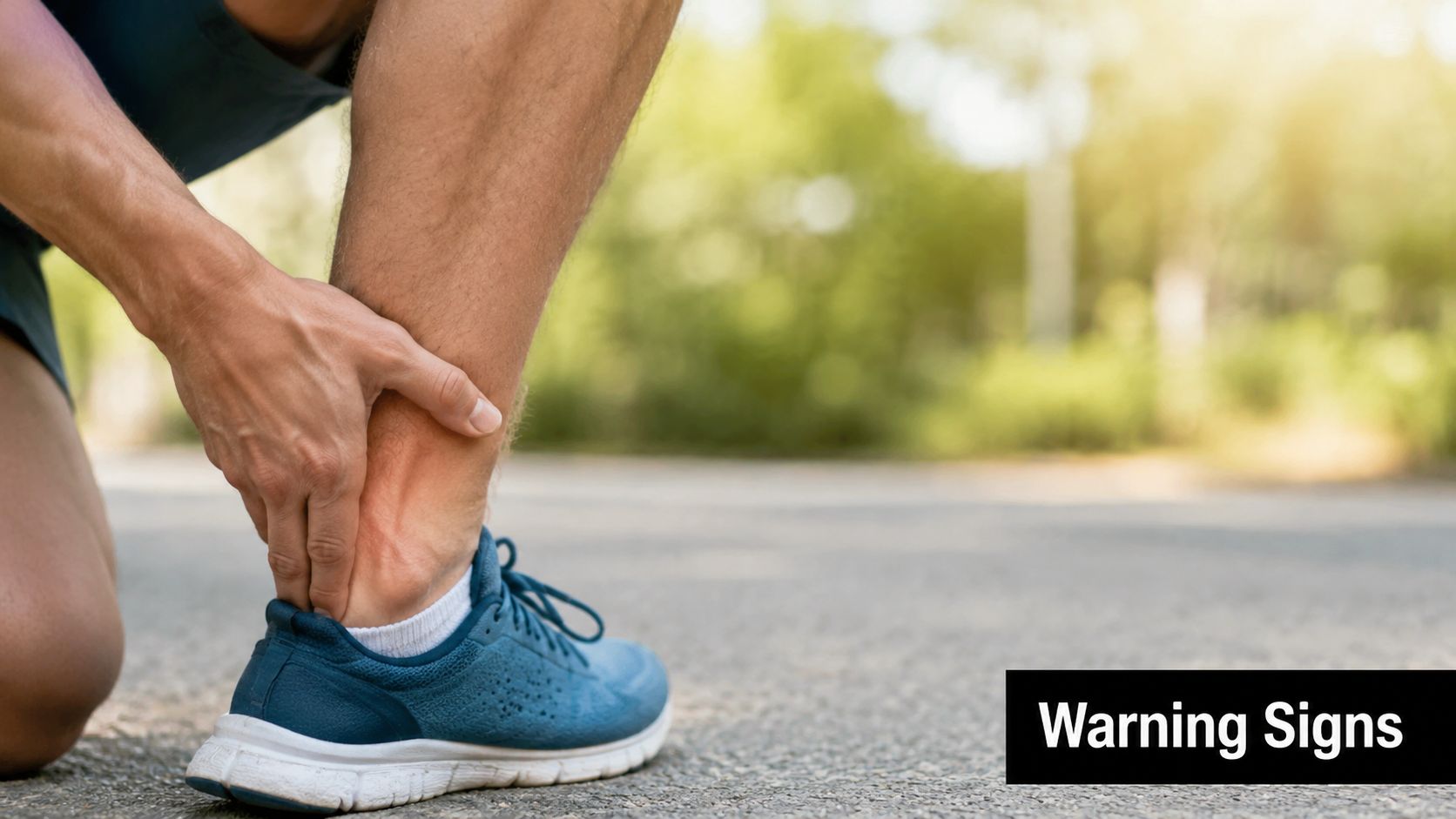
Guidance in this area is often too vague. CEP points out that many post-race guides under-explain what to do when calves, Achilles, knees, or feet remain painful after race day, which leaves runners guessing about whether they need assessment, imaging, or physical therapy.
What normal soreness usually feels like
Normal post-marathon soreness is usually broad, symmetrical, and tied to muscle groups that took a beating. Quads, calves, glutes, and hips commonly feel stiff, heavy, or tender. It usually improves as you warm up gently and trends better over days, not worse.
It can still be intense. “Normal” doesn't always mean mild.
Red flags that deserve assessment
These patterns deserve more caution:
- Localized pain: One exact spot in the foot, shin, Achilles, calf, or knee hurts every step.
- Limping: If you're changing the way you walk, your body is already telling you load tolerance is off.
- Swelling that hangs on: Especially if it stays concentrated in one area.
- Pain that increases with light activity: A short walk should not steadily ramp symptoms up.
- Night pain or pain at rest: That's different from muscles feeling generally sore.
- Mechanical compensation: You're twisting, guarding, or offloading one side.
Here's the simple self-check I use with runners: if the pain feels more precise than tired, more reactive than stiff, or more protective than sore, stop guessing.
What a sports PT evaluation can add
Sports physical therapy is different from generic rest advice. A runner-specific exam looks at symptom behavior, loading tolerance, joint mobility, calf and foot strength, tendon irritability, and whether your gait changed after race stress exposed an underlying weakness.
Later in the recovery process, tools like running gait analysis, return-to-sport testing, targeted manual therapy, and dry needling may be useful depending on the problem. The key is matching the tool to the presentation, not throwing every modality at soreness.
For runners around Bridgewater, Massachusetts, East Bridgewater, West Bridgewater, Taunton, Plymouth, Buzzards Bay, and Middleborough, that means a sports PT can help answer three practical questions:
- Is this normal post-marathon recovery?
- Is this an overload injury that needs a modified loading plan?
- What's the safest path back to running without losing unnecessary time?
If you want a quick visual walkthrough of common lower-leg running pain patterns, this video gives a helpful starting point before an in-person exam:
A clinic visit doesn't replace your judgment. It sharpens it. That's especially true when pain sticks around beyond the early recovery window or keeps returning each time you try to run.
Frequently Asked Marathon Recovery Questions
You cross the finish line, sit down on the curb, and a few hours later the important questions start. What should you eat first. When is it safe to run again. Is that calf tightness normal soreness, or the start of an injury.
When should I eat after a marathon
Eat as soon as your stomach will tolerate it. Earlier is usually better, but the goal is to get something in that you can keep down. Start with fluids, then add a simple mix of carbohydrate and protein such as chocolate milk, yogurt with fruit, a recovery shake, or a sandwich if solid food sounds manageable.
How much protein should I aim for right after the race
Aim for a recovery snack or meal that includes a solid serving of protein plus enough carbohydrate to refill what you burned. You do not need to force a perfect formula in the first hour. If your appetite is low, start small and build from there over the rest of the day.
When can I get a massage
Usually not right away. A marathon already leaves muscle and connective tissue irritated, so deep pressure on race day can make you feel worse instead of better. If you want bodywork, waiting a couple of days is often the smarter call.
Should I take a full week off from running
A short break from running makes sense for many runners, but the better question is how your body is responding to load. If stairs feel rough, walking is stiff, or you are changing your gait to avoid discomfort, more rest is usually the right move. If soreness is fading and daily movement feels normal, low-impact cross-training can bridge the gap without adding the same pounding.
When can I run again after a marathon
Use symptoms, not just the calendar. The first run back should wait until walking is comfortable, swelling is under control, and you can hop lightly on each leg without sharp pain. For some runners that happens sooner. For others it takes longer, especially after a hard effort or if a nagging issue was already brewing before race day.
Is an ice bath required
No. Some runners feel better with cool water, a cold shower, or compression, and that is fine if it helps you settle symptoms. Recovery still comes back to the basics. Eat, rehydrate, sleep, and return to loading in a way your tissues can handle.
Can I race again soon after a marathon
You can, but that does not make it a good idea. A marathon creates fatigue that outlasts the soreness you feel in the first few days. Back-to-back racing blocks often work poorly unless the second event is treated as a controlled effort rather than another all-out day.
What if my calf, foot, knee, or Achilles still hurts
Location, behavior, and progression matter. General muscle soreness that improves day by day is common. Sharp pain, limping, swelling in one spot, pain that warms up and then slams back later, or symptoms that keep showing up every time you try to run deserve a proper assessment.
That is where runners get stuck. They wait for a timeline to give them the answer, when the better question is whether the tissue is tolerating load.
If you're unsure whether your post-marathon pain is normal soreness or an actual injury, book with Physical Therapy U. Our licensed sports PT team works with runners in Bridgewater, Massachusetts, Buzzards Bay, and Middleborough on symptom-guided recovery, running gait analysis, dry needling, return-to-sport testing, and sport-specific strength planning so you can get back to running with a clear plan, not guesses.
