
You're probably in the part of rehab nobody talks about enough. Pain is better. Swelling is down. You're doing the exercises. But your knee still doesn't trust a hard cut, your ankle still hates impact, or your shoulder feels fine until practice gets fast.
That stall is where standard rehab often stops being enough for an athlete.
At a sports physical therapy clinic, advanced physical and aquatic therapy isn't about choosing pool work or gym work. It's about sequencing both on purpose. A post-op ACL athlete might need water to restore gait and confidence before loading hard on land. A runner may need land-based strength and gait retraining, but use the pool to keep conditioning up while irritated tissue settles down. A dancer may need precise neuromuscular control on land while using water to move with less pain during a flare.
For athletes across South Shore Massachusetts, including Bridgewater, Massachusetts, Buzzards Bay, Middleborough, Plymouth, Taunton, East Bridgewater, West Bridgewater, and Raynham, that combined approach often makes the difference between “back to activity” and ready for sport.
Table of Contents
- Beyond the Plateau Your Next Step in Recovery
- What Is Advanced Land-Based Physical Therapy
- The Clinical Power of Aquatic Physical Therapy
- Land vs Aquatic Therapy A Clinical Comparison
- How We Integrate Therapies for Return to Sport
- Finding the Right Advanced Therapy Provider in Massachusetts
- Frequently Asked Questions About Advanced Rehab
Beyond the Plateau Your Next Step in Recovery
A soccer player after ACL reconstruction is a common example. Early rehab goes well. Range of motion improves. Basic strength comes back. Then the hard part starts. Single-leg control is shaky, deceleration feels off, and every jump landing exposes the gap between “healed” and “game ready.”
That's the point where athletes get frustrated. They're no longer in the crisis stage, but they're not close enough to trust the body under speed, fatigue, and contact. Runners hit the same wall when they can jog in a straight line but can't tolerate mileage. Dancers hit it when they can mark choreography but can't repeat explosive movement cleanly.
Practical rule: If rehab has become a loop of the same exercises with no clear progression toward your sport, it's time to change the plan, not just work harder.
Advanced rehab solves that by tightening the match between the exercise and the demand. Instead of treating strength, pain, gait, balance, and conditioning as separate issues, a sports DPT blends them into one progression. That may include force production on land, movement retraining, dry needling for stubborn muscle tone, running gait analysis for inefficient mechanics, or return-to-sport testing to see whether the athlete is ready.
Why athletes plateau
Plateaus usually come from one of a few problems:
- Load is too conservative: The tissue may be ready for more challenge, but the program hasn't advanced.
- Load is too aggressive: Symptoms flare, then training backs off, and progress stalls.
- Movement quality is poor: The athlete gets stronger around a bad pattern.
- Conditioning lags behind healing: The joint may tolerate more than the athlete's system can support.
- Sport demands were never built back in: Rehab stops at general fitness.
For some athletes, the missing piece is water-based work. Not as a replacement for real training, but as a bridge that lets them move earlier, longer, and with less symptom aggravation while they build toward higher loads.
That's where advanced physical and aquatic therapy becomes useful. It gives the clinician more than one environment to train in, which means fewer dead ends when one variable is limiting progress.
What Is Advanced Land-Based Physical Therapy
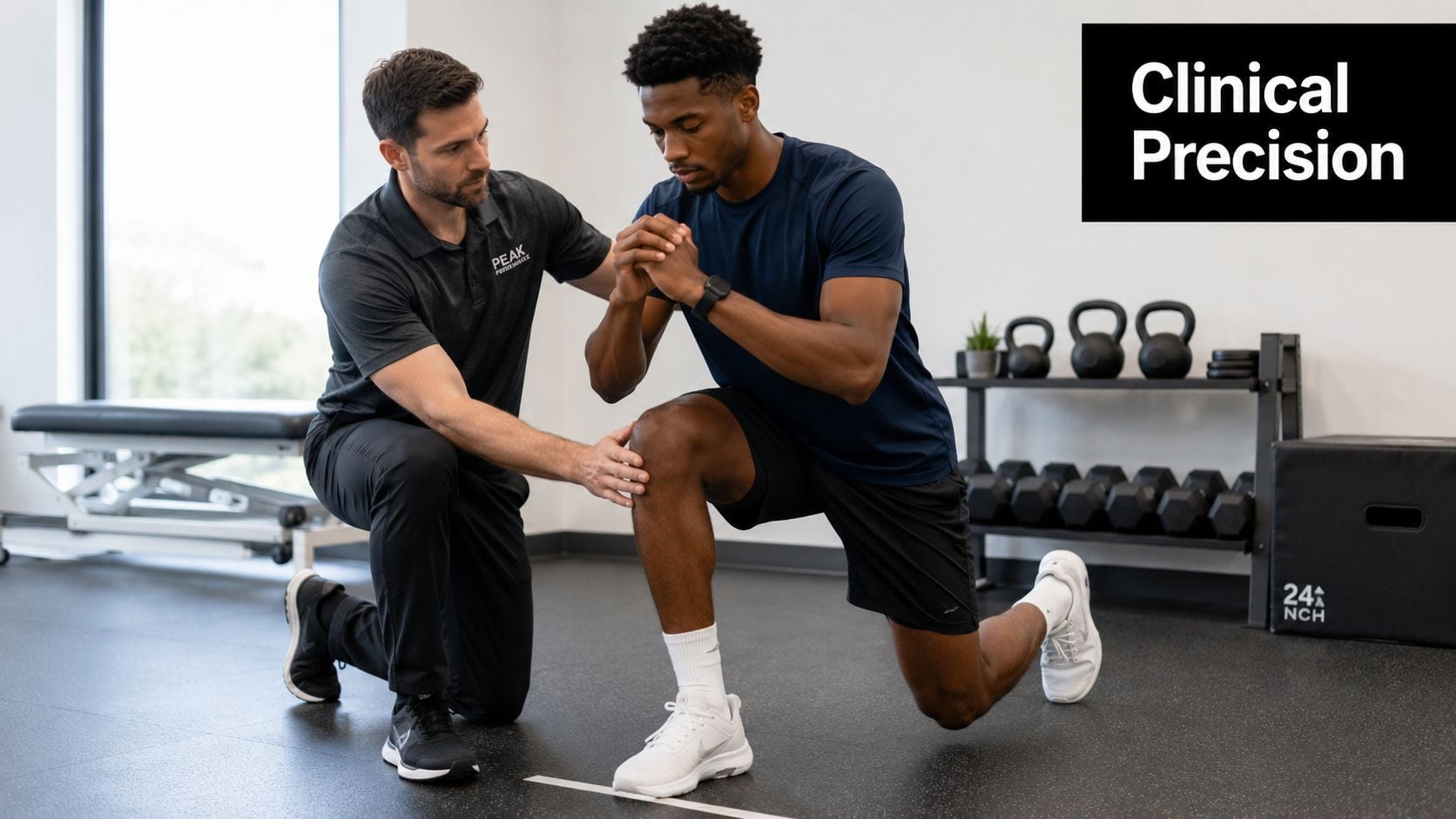
Advanced land-based sports PT isn't fancy because it uses more equipment. It's advanced because every exercise has a reason. The DPT is matching tissue tolerance, movement quality, and sport demand in real time.
Load management is the real upgrade
Athletes don't need random intensity. They need the right stress at the right point in recovery.
For a post-surgical knee, that starts with restoring clean motion, reducing compensation, and rebuilding basic force production. Then the focus shifts to single-leg strength, rate of force development, deceleration, and change-of-direction mechanics. If the athlete plays a rotational sport, the program has to reflect that. If they're a runner, impact tolerance and stride mechanics matter. If they're a dancer, turnout control, foot intrinsic strength, and repeated landing quality become central.
A lot of this comes down to posture and alignment under load. If you want a useful primer outside the clinic, this guide on how posture impacts health and performance gives a solid broad view of why setup and movement mechanics affect both efficiency and symptom load.
On land, advanced programming may include:
- Blood flow restriction training: Useful when the athlete can't yet tolerate heavier loading but still needs a meaningful strength stimulus.
- Running gait analysis: Helpful when pain keeps returning with mileage, cadence changes, or asymmetrical mechanics.
- Plyometric progressions: From landing strategy to elastic recoil and repeat-effort power.
- Manual and adjunctive care: Dry needling, soft tissue work, and targeted recovery tools can support training when used for a purpose.
- Symptom-guided recovery support: In some cases, clinicians may pair exercise progression with treatments such as laser therapy for pain and tissue irritability.
Land rehab has to answer one question: does this drill make you better at your sport, or just better at rehab?
How an ACL program should progress on land
An ACL athlete shouldn't stay in “basic strengthening” mode for too long. Squats, step-ups, and bridges matter, but they're only the beginning.
A stronger land-based progression often looks like this:
- Early strength and control: Quad activation, terminal knee extension work, controlled split squat patterns, step-down mechanics.
- Single-leg loading: Rear-foot-raised split squats, single-leg RDL variations, lateral step patterns, anti-rotation work.
- Power development: Snap-downs, pogo variations, med-ball drills, jump progressions.
- Field or court preparation: Acceleration, deceleration, cutting, reactive drills, contact preparation when appropriate.
- Testing: Return-to-sport testing to measure whether force, control, and confidence match the demands ahead.
That's what makes land therapy essential. Sport happens on the ground. At some point, the athlete must absorb force, produce force, and control force in the same environment where they compete.
The Clinical Power of Aquatic Physical Therapy
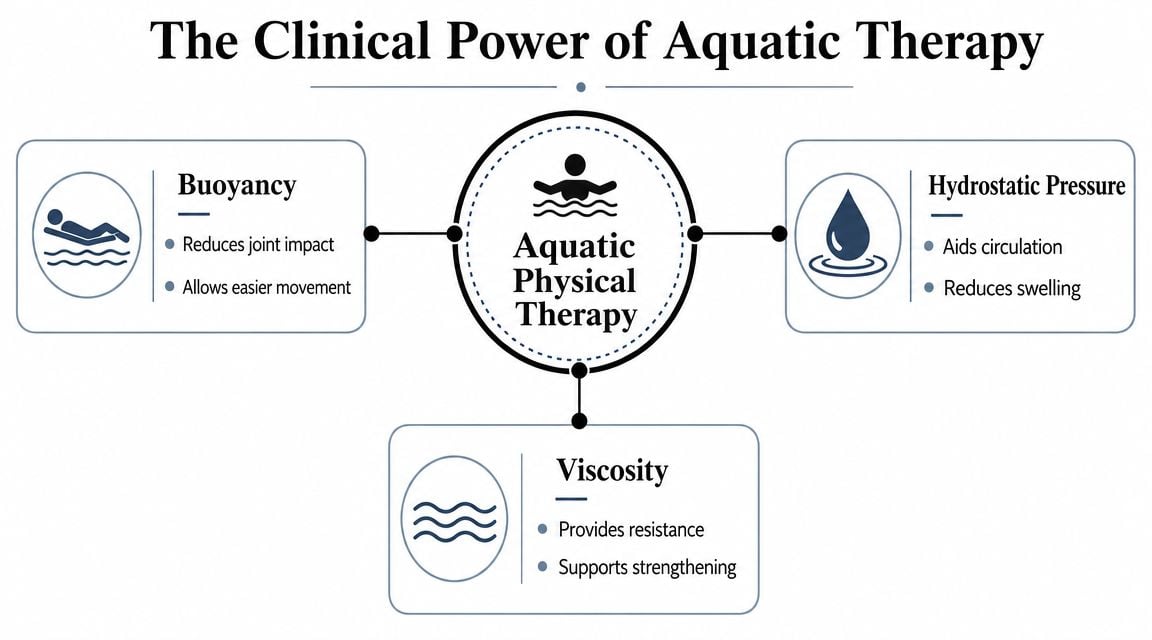
Aquatic rehab isn't just easier exercise. Used well, it changes the mechanical demands enough to let an athlete train when land still feels too sharp, too heavy, or too irritating.
Why water changes the rehab equation
The biggest advantage is buoyancy. Water can support up to 90% of body weight, which reduces joint loading while still allowing exercise, range-of-motion work, and cardiovascular training, as described by Loyola Medicine's overview of aquatic therapy benefits. For an athlete with painful weight-bearing, that matters immediately.
Then there's hydrostatic pressure. In plain terms, the water applies even pressure around the body. Clinically, that can help an athlete feel less “full” or guarded around an irritated joint, which often improves tolerance to movement.
The third property is viscosity. Water resists movement in every direction. That gives you built-in resistance without the abrupt impact of land-based loading. It also slows the athlete down enough that both therapist and patient can catch movement errors sooner.
Who tends to benefit most
Water tends to be useful when land is limited by irritability more than by motivation. The athlete wants to work, but the tissue doesn't tolerate enough force yet.
Common examples include:
- Early post-op athletes: They need gait work, range of motion, and conditioning before hard loading makes sense.
- Pain-sensitive runners: They still need aerobic work and lower-extremity movement, but impact is provoking symptoms.
- Athletes with low weight-bearing tolerance: The joint or surgical site can't handle normal ground reaction forces yet.
- Deconditioned patients after a rough recovery: Water can help rebuild movement confidence.
A pool is valuable when it opens a training window that land can't open yet.
What doesn't work is using aquatic therapy as a forever plan. If an athlete never transitions out of reduced-load training, they won't be ready for the demands of a court, field, stage, or road race. Water is a tool. It's a strong one, but it's still part of a progression.
Land vs Aquatic Therapy A Clinical Comparison
Athletes sometimes ask which one is better. That's the wrong question.
The better question is which setting gives the right challenge today. Land gives you real-world force, impact, and transfer. Water gives you symptom control, offloading, and a safer entry point when normal loading still isn't tolerated.
A useful example comes from older adults. A 2023 systematic review and meta-analysis found that aquatic physical therapy improved balance more than land-based physical therapy in community-dwelling older adults, with the Functional Reach Test improving by 6.36 cm, 95% CI 5.22 to 7.50, p < 0.00001 in the pooled analysis, according to this peer-reviewed review on aquatic physical therapy and balance. The same review noted the overall evidence quality was low, so it shouldn't be overgeneralized to every athletic population, but it does support the idea that water can create a meaningful training advantage in the right context.
Clinical Comparison Land vs Aquatic Therapy
| Feature | Land-Based Therapy | Aquatic Therapy |
|---|---|---|
| Joint loading | Higher and more sport-specific | Reduced loading, often better tolerated early |
| Resistance type | Gravity, external load, ground reaction force | Multi-directional water resistance with lower impact |
| Balance challenge | Direct transfer to sport and daily movement | Useful when land balance is limited by pain or guarding |
| Best recovery stage | Mid to late rehab, performance rebuild, return-to-sport prep | Early rehab, painful flare-ups, re-entry to movement |
| Conditioning use | Strong transfer to running and field demands | Helpful when athletes need fitness without full impact |
| Main limitation | May aggravate symptoms too soon | Doesn't fully prepare athletes for land impact |
A smart rehab plan often uses both. The ratio changes as recovery changes.
How We Integrate Therapies for Return to Sport
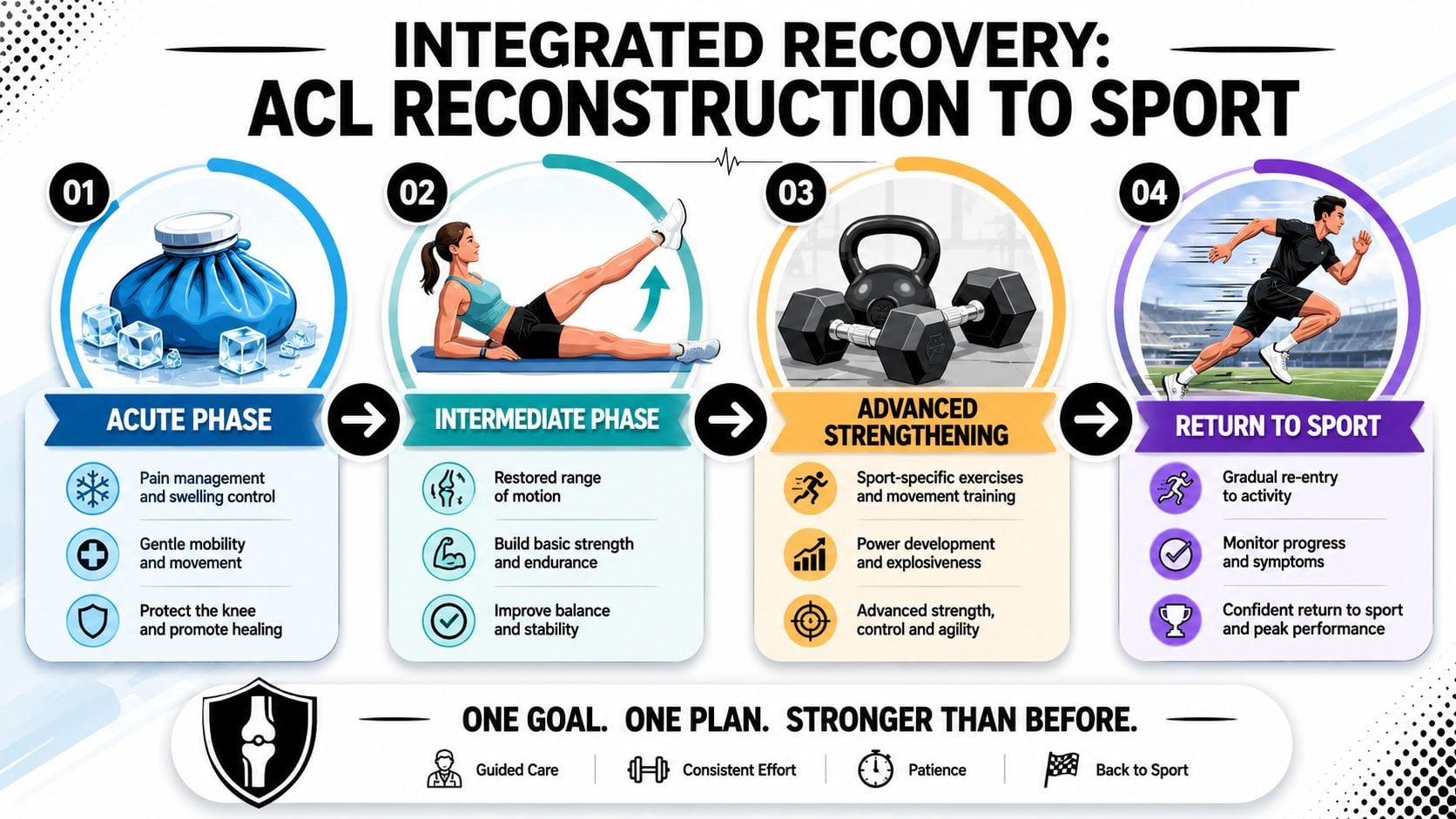
The best results usually come from progression, not loyalty to one setting. An ACL athlete, for example, may start with more water-based work, then shift toward land as strength, control, and tolerance improve.
A phased model for ACL recovery
Aquatic therapy is especially useful for progressive loading because the water environment can reduce joint compression while still allowing gait, resistance, and plyometric work. Aquatic therapy references note that clinicians can progress from unloaded walking to resisted locomotion and sport-specific drills while monitoring symptom response, which is particularly relevant after orthopedic surgery, as outlined in this aquatic therapy guide for progressive rehab.
A practical sequence often looks like this:
Acute phase
- Priorities are pain management, motion, swelling control, and restoring a more normal gait pattern.
- Water can help the athlete walk with better mechanics before full land tolerance is there.
- Land work stays simple and precise. Quad activation, controlled transfers, early strength.
Intermediate phase
- Land loading increases. So does demand on single-leg control.
- Water sessions become a place to extend gait work, add lower-impact conditioning, and rehearse movement with less guarding.
- The athlete starts earning more force, not just more motion.
A visual overview helps if you're trying to picture the progression.
What this looks like in real training
Later in rehab, the balance shifts.
Advanced strengthening
- Land takes the lead. Heavier strength work, deceleration drills, jumping, cutting, rotational control.
- Water doesn't disappear. It becomes a useful place for conditioning, active recovery, or lower-irritation plyometric exposure.
Return to sport
- Testing matters. So does graded exposure to the actual demands of practice.
- Field drills, reactive movement, and sport-specific sessions carry the most weight here.
- Supplemental work may still include recovery-based pool sessions if symptoms spike after heavy training blocks.
The athlete should leave each phase with something specific they couldn't do before, not just less pain.
This same thinking works beyond ACL rehab. Runners can build tissue capacity on land while keeping aerobic work alive in the pool. Dancers can unload painful tissues without fully stopping movement practice. Court and field athletes can use strength and conditioning to bridge the gap between rehab and performance. For athletes who need that final step, structured strength and conditioning support for return to sport can help connect clinical rehab to real competition demands.
Finding the Right Advanced Therapy Provider in Massachusetts
Not every clinic is built for athletes. If your goal is to return to sport, dance, or high-level training, the provider should look and think differently than a general rehab office.

What athletes should look for
Start with the basics. You want licensed Doctors of Physical Therapy who regularly treat orthopedic and sports injuries, not just occasional athletic cases mixed into a general caseload.
Then look closer at the actual tools and services:
- Sport-specific progression: The clinic should train cutting, jumping, sprint mechanics, throwing demands, or dance-specific movement when needed.
- Objective testing: Return-to-sport testing helps separate hope from readiness.
- Performance crossover: Strength and conditioning matters when rehab is no longer enough.
- Specialized support: Running gait analysis, dry needling, dance therapy, and post-surgical rehab should be available when they fit the athlete.
- Geographic convenience: Consistency matters. A long drive can hurt adherence.
For athletes in South Shore Massachusetts, access matters almost as much as expertise. If you live in Bridgewater, Plymouth, Taunton, Raynham, East Bridgewater, West Bridgewater, Buzzards Bay, or Middleborough, getting to a sports-focused clinic has to be realistic enough to sustain a full rehab plan. If you're starting your search nearby, this Bridgewater, Massachusetts clinic location page is a useful place to begin.
A good clinic should also be honest about trade-offs. Not every athlete needs aquatic therapy. Not every athlete needs dry needling. Not every sore runner needs a maximal return-to-sport battery. The right provider will explain what fits your case, what doesn't, and why.
Frequently Asked Questions About Advanced Rehab
FAQ
Q1. Who's a good candidate for aquatic therapy?
Athletes are often good candidates when they have poor weight-bearing tolerance, high pain sensitivity, are in an early post-operative phase, or otherwise can't load safely on land, as described by Advanced Rehabilitation's aquatic therapy guidance. In those situations, the added logistics can be worth it because the pool allows meaningful training sooner.
Q2. Is aquatic therapy basically swimming?
No. Rehab in the pool is usually structured around gait, controlled strengthening, range of motion, balance, and symptom-guided conditioning. The point isn't to swim laps. The point is to use the water environment to train what land won't tolerate yet.
Q3. Will I still need land-based therapy if I'm doing pool rehab?
Usually yes, especially if your goal is return to sport. Sport happens against the ground, so you still need to rebuild force production, impact tolerance, and movement quality on land before full return.
Q4. What happens at the first visit?
A licensed PT should evaluate your injury history, movement quality, irritability, strength deficits, and sport demands. From there, the therapist can decide whether you need land-only rehab, aquatic support, or an integrated plan. That evaluation matters more than any generic protocol.
Q5. What if pain is worst at night or after training?
Recovery setup matters. Sleep position, mattress support, and baseline spinal comfort can affect how you feel the next day. For general recovery reading, this article on ways to improve spinal alignment can be a reasonable non-clinical resource, though it doesn't replace an in-person assessment.
Q6. Does insurance cover advanced rehab?
Coverage depends on the plan, location, and service. The simplest move is to ask the clinic to verify benefits before you start, then ask which parts of care are typically billed as physical therapy versus specialty or performance-based services.
Q7. Is this the right fit for youth athletes and dancers too?
Often yes. Youth athletes still need sport-specific progression, and dancers need movement analysis that respects the demands of turnout, landing, repetition, and performance schedules. The exact plan should always be individualized by a licensed PT.
If you're stuck between “better” and “back,” Physical Therapy U can help you build a smarter path forward. Our licensed DPTs work with athletes, runners, dancers, and post-surgical patients across Bridgewater, Buzzards Bay, and Middleborough, using sport-specific rehab, return-to-sport testing, running gait analysis, dry needling, dance therapy, and performance training to connect recovery to real competition. Book an evaluation and get a plan that matches your sport, your injury, and the level you're trying to return to.
