
If you're an athlete, the first question after an ACL injury is always the same: "When can I get back in the game?" At Physical Therapy U, our Doctors of Physical Therapy hear this every day. The reality is, a successful return isn't about circling a date on the calendar. It’s a 9 to 12-month journey built on hitting specific, data-driven goals, and rushing it is the single biggest mistake you can make.
Table of Contents
- The Modern ACL Recovery Timeline for Athletes
- Phase 1: Protecting the New Graft and Getting Your Motion Back
- Phase 2: Building Foundational Strength and Movement
- Phase 3: Developing Power and Returning to Running
- Phase 4: Sport-Specific Training and Return-to-Play Testing
- Why a 9-Month Timeline Is Non-Negotiable
- Frequently Asked Questions (FAQ)
The Modern ACL Recovery Timeline for Athletes
As a sports physical therapy clinic with locations in Bridgewater, Buzzards Bay, and Middleborough, MA, we guide athletes on this exact path every single day. The first step is often helping them unlearn the old—and dangerous—6-month myth. That outdated timeline is a recipe for re-injury.
Today, we know better. Our licensed DPTs use a criteria-based progression. This means you only advance to the next stage when you’ve proven your body is ready. Your new ACL graft needs time to take root and mature into a strong, resilient ligament—you simply can't rush biology. Throughout this process, your physical therapist will be your expert guide, focusing on rebuilding your strength, perfecting your movement, and getting you mentally prepared for competition.
Key Recovery Phases
Having a clear roadmap makes the journey feel less daunting. These core rehab phases are the foundation of a successful comeback, whether you’re a soccer player in Plymouth, a dancer from Taunton, or a runner right here in Bridgewater, Massachusetts.
This timeline lays out the critical stages, showing how each one logically builds on the last.
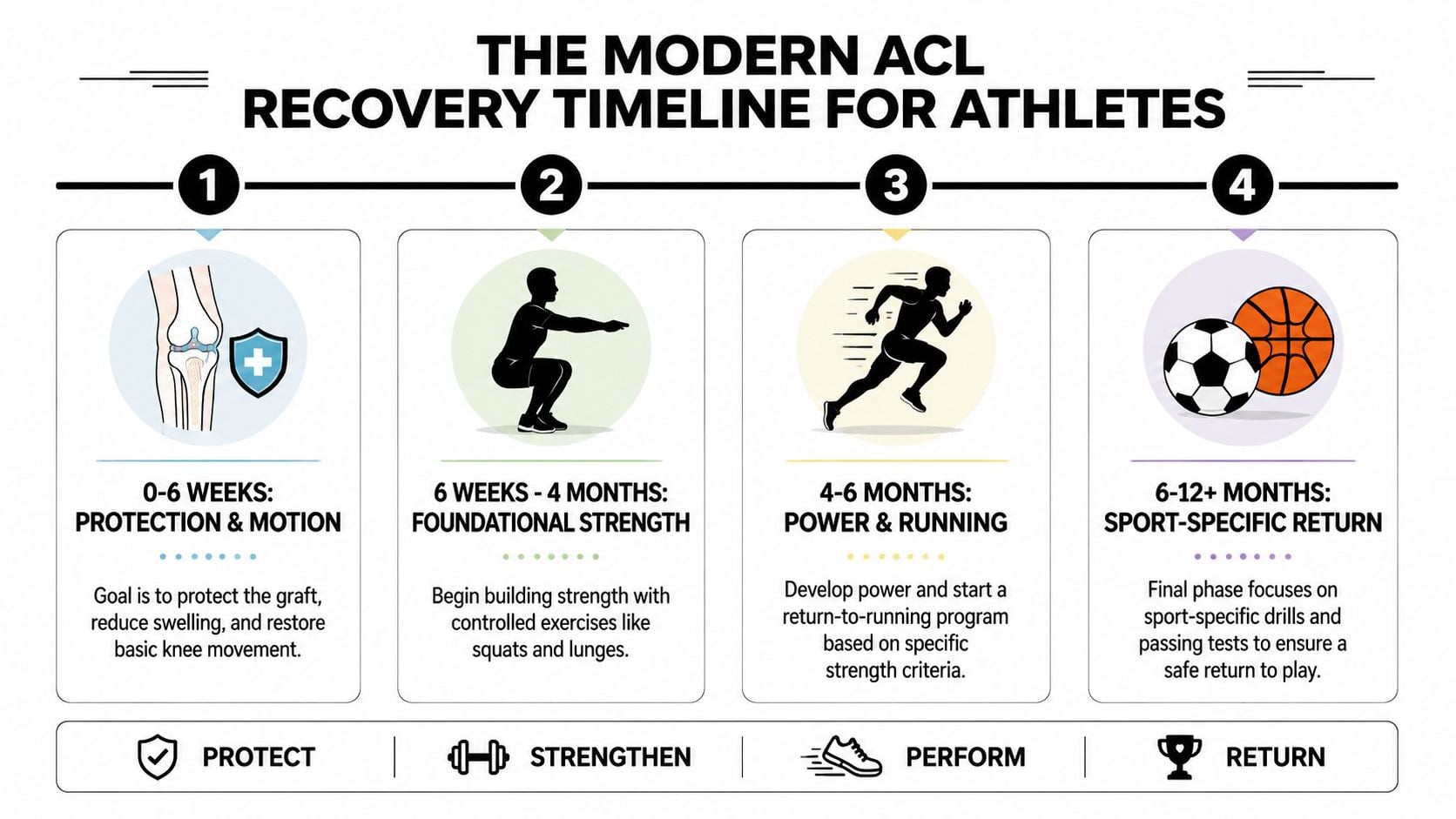
As you can see, everything progresses logically. We protect the knee and restore motion, then build a solid strength foundation, and finally, layer on the power and sport-specific skills you need to perform.
To ensure you're truly ready, we use advanced tools like return-to-sport testing, running gait analysis, sport-specific training, and even dry needling to guide athletes from our Middleborough, Buzzards Bay, and Bridgewater, MA, clinics. Our goal is to ensure that when we clear you, you step back on the field with complete confidence. This guide walks you through what that looks like.
Phase 1: Protecting the New Graft and Getting Your Motion Back
The first six weeks after your ACL surgery are about one thing: creating the absolute best environment for that new graft to heal. From our perspective at Physical Therapy U, this initial phase has a few non-negotiable goals. We must protect the surgical repair, get pain and swelling under control, regain full knee extension (straightening), and start gently restoring your bend.
This is not the time to be a hero. Your main job is to "calm the knee down" and listen to your body and your physical therapist. Managing post-op inflammation is the key that unlocks all future progress. In our clinics, we often use tools like cryotherapy and NormaTec compression to help athletes manage swelling and kickstart recovery.
Right now, your new ACL graft is at its most fragile. Pushing through pain or doing too much can compromise the surgeon's work. The focus is on building a solid foundation for healing so you can crush the rest of your rehab.
What to Expect Weeks 0-6
Your world will shrink a bit, focusing on managing swelling and waking up your quad muscle. You'll be on crutches, putting only as much weight on your leg as your surgeon and PT advise. Getting around on one leg can be tricky; using assistive devices correctly is a skill. For instance, a good DME Superstore knee walker guide can be a huge help.
The early exercises our DPTs prescribe are simple but incredibly important:
- Quad Sets: This is your first step in reconnecting your brain to your quad muscle. It's a simple tightening of your thigh muscle without joint movement, but it's crucial for preventing muscle loss.
- Heel Slides: While lying down, you’ll gently slide your heel towards your butt to work on knee flexion (bending). The goal is smooth, pain-free motion, not forcing it.
- Full Knee Extension: This is the single most important goal of this phase. Getting your knee to lie perfectly flat is critical for a normal walking pattern. We often have athletes prop their heel on a pillow and just let gravity do the work.
Your Goals for Phase 1
By the end of these first six weeks, we want to see a much calmer, happier knee. Moving to the next phase isn't about hitting a date on the calendar; it's about meeting specific goals that show you're ready.
Our DPTs will be looking for a few key signs:
- Minimal to no swelling in the knee joint.
- Full, symmetrical knee extension (your surgical knee gets just as straight as your other one).
- At least 110-120 degrees of comfortable knee flexion.
- The ability to do a straight leg raise without any "quad lag" (meaning your quad is strong enough to lift your leg straight without the knee bending).
Once you've ticked these boxes, you've successfully laid the groundwork. Now the real work can begin.
Phase 2: Building Foundational Strength and Movement
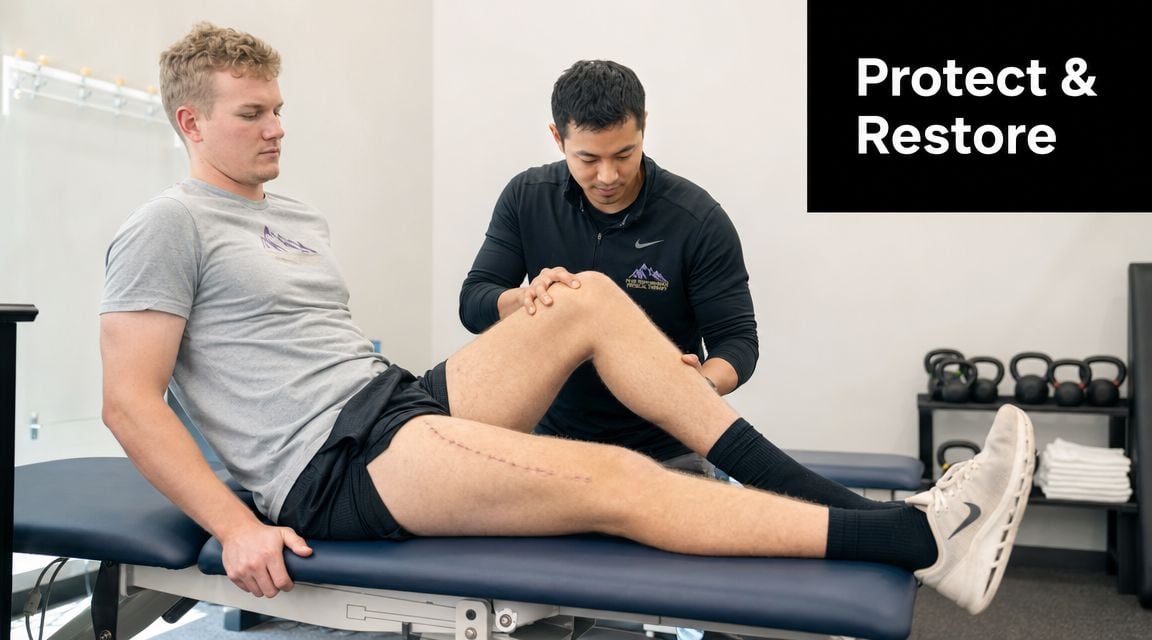
Once you hit the six-week mark, your ACL recovery timeline makes a huge shift. We move from protecting the knee to rebuilding it. This phase, which typically runs up to month four, is all about laying a rock-solid foundation of strength. Think of it as building the frame of a house—every piece must be strong and perfectly placed.
We start by loading the knee in a controlled way. You'll begin doing more closed-chain exercises, where your foot stays planted on the ground. Think squats, lunges, and leg presses. This is the safest way to challenge the new graft while teaching your leg muscles how to fire together as a team again—an essential skill for any athlete.
Why Strength Symmetry Is a Game-Changer
One of the most critical parts of this phase is tracking strength symmetry. We're constantly comparing the strength of your surgical leg to your healthy one. Why? Because jumping into dynamic activities with a major strength imbalance is asking for trouble—either a setback with your ACL or a new injury. We have to close that gap.
This isn't a suggestion; it's a rule we live by at PTU. You can't just feel ready. You have to be ready, and the numbers have to prove it.
To help track progress, we use objective milestones. This table shows what our DPTs look for as you move through this crucial strength-building phase.
ACL Recovery Milestones and Strength Symmetry Goals
| Milestone | Typical Timeframe | Required Quadriceps Symmetry | Rehab Focus |
|---|---|---|---|
| Full Weight Bearing | 0-2 Weeks | <50% | Pain/swelling control, knee extension |
| Begin Strength Training | 2-6 Weeks | 50-60% | Basic activation, light closed-chain |
| Initiate Running Program | 12-16 Weeks | >70% | Foundational strength, neuromuscular control |
| Begin Sport-Specific Drills | 4-6 Months | >85% | Power development, agility, plyometrics |
| Return to Sport | 9-12+ Months | >95% | Sport-specific endurance, mental readiness |
As you can see, trying to run before hitting at least 70% strength symmetry is a major red flag. This data-driven approach, as detailed in this comprehensive ACL surgery recovery timeline, is what separates a successful recovery from one plagued by setbacks.
The Building Blocks of Phase 2
Perfecting your form now is everything. Our clinicians are meticulous about how you move because this is where bad habits sneak in. We’d rather you do five perfect squats than 20 sloppy ones. Compensations developed to avoid pain or weakness can cause a cascade of other problems.
While every program is unique, the core exercises rebuild your athletic base:
- Bodyweight and Goblet Squats: To master alignment and rebuild foundational quad and glute strength.
- Step-Ups and Lunges: To challenge your balance and control on a single leg.
- Hamstring Curls and Romanian Deadlifts (RDLs): To build up the key muscles that act as a backup for your ACL.
- Balance and Proprioception Drills: To reconnect the communication lines between your brain and your knee.
This foundation is universal, but how we build on it is tailored to you. For a dancer, we'll implement principles from our dance therapy program to focus on control through extreme ranges of motion. For a football player from East Bridgewater, this is the base we’ll use to build explosive power. Nailing this phase earns you the right to move on to the more dynamic stages. To see how these principles fit into a larger plan, check out our guide on building a strength and conditioning program for athletes.
Phase 3: Developing Power and Returning to Running
This is the phase where you truly start to feel like an athlete again. Kicking in around months four through six, this part of your ACL recovery is all about bridging the gap—taking the strength you’ve painstakingly built and translating it into the dynamic, explosive movements your sport demands.
The big headliner of this phase? Running. It's a huge milestone, but at PTU, we don't just look at the calendar and send you out the door. We're sticklers for meeting objective, non-negotiable criteria first. This protects your new graft, keeps your recovery on track, and prevents setbacks. You have to earn the right to run.
Earning the Right to Run
Think of this as a critical pre-flight check for your knee. Your physical therapist will be looking for a few key green lights to ensure your body is truly ready for the impact of running.
- No Pain, All Gain: You should be able to get through your strength workouts and daily life completely pain-free.
- Full Range of Motion: A normal running stride is impossible without full knee extension and nearly full flexion.
- Proven Strength: This is a big one. We need to see at least 70% quadriceps strength symmetry—meaning your surgical leg is at least 70% as strong as your other leg.
- Rock-Solid Single-Leg Control: You must be able to knock out multiple single-leg squats and single-leg bridges with perfect form and zero pain.
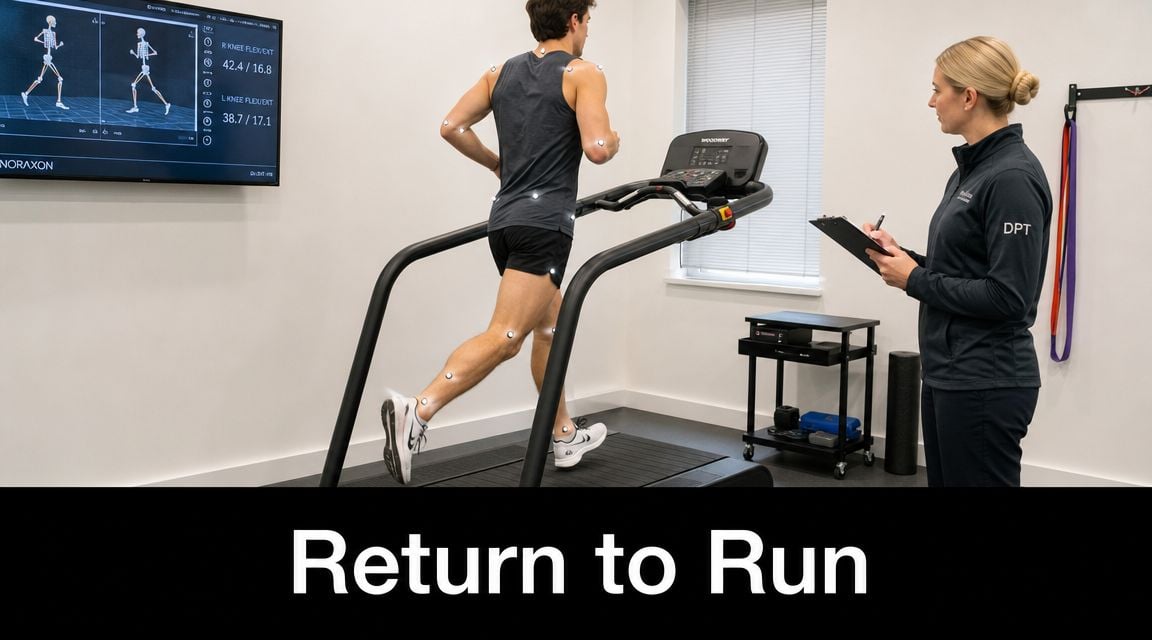
Once you’ve checked all those boxes, we start slow and smart. At our Bridgewater, Massachusetts clinic, our Doctors of Physical Therapy will often put you through a running gait analysis. We meticulously break down your running form on video to spot any subtle compensations that could overload your knee. It’s our way of making sure South Shore Massachusetts athletes from Plymouth to Middleborough are running with mechanics that are not just efficient, but safe. You can see how we apply these same detailed principles in our guide on physical therapy exercises for runners.
Introducing Power and Agility
Running isn't the only thing we reintroduce. This is when we start adding foundational plyometrics (jumping) and agility work back into the mix. This is how we reteach your nervous system to absorb and produce force in a split second—a non-negotiable skill for any sport.
This is not about max-effort jumps. We prioritize movement quality over quantity, every single time. The goal is to land softly and with control, teaching your muscles to absorb impact like a shock absorber.
We start with the basics and only progress when you can demonstrate complete control. Your program will likely include:
- Double-Leg Jumps: We begin with simple drills like jumping from the floor onto a low box or doing controlled broad jumps for distance.
- Basic Agility Drills: Think ladder drills and gentle weaves around cones. The goal is to get your brain and body comfortable with changing direction again.
- Deceleration Training: This is crucial. We practice "sticking" the landing from small hops to master your body's braking system.
This phase is where the real transformation happens. You’re not just getting stronger; you’re building the explosive, resilient power that will carry you into the final stage of your return to sport.
Phase 4: Sport-Specific Training and Return-to-Play Testing
This is it—the final stretch. Starting around month six and extending to month nine or even longer, this phase is where your recovery gets dialed in specifically for your sport. We move beyond foundational gym work and step into training that looks, feels, and moves like your sport.
For a soccer player from Raynham, this means we're programming cutting drills and powerful strikes on goal. If you're a dancer from Taunton, we're rehearsing complex choreography, focusing on control for explosive leaps and landings. It's the most exciting part of the journey, but it’s also where the stakes are highest.
Sports medicine has shifted dramatically. It used to be a race against the clock. Now, we understand a successful return isn't about getting back fast; it's about getting back for good. That’s why we rely on objective data, pushing a safe return closer to the 9-12 month mark as the new graft fully matures. You can read more about how these modern timelines reduce long-term risk.
Passing the Test, Not Just the Time
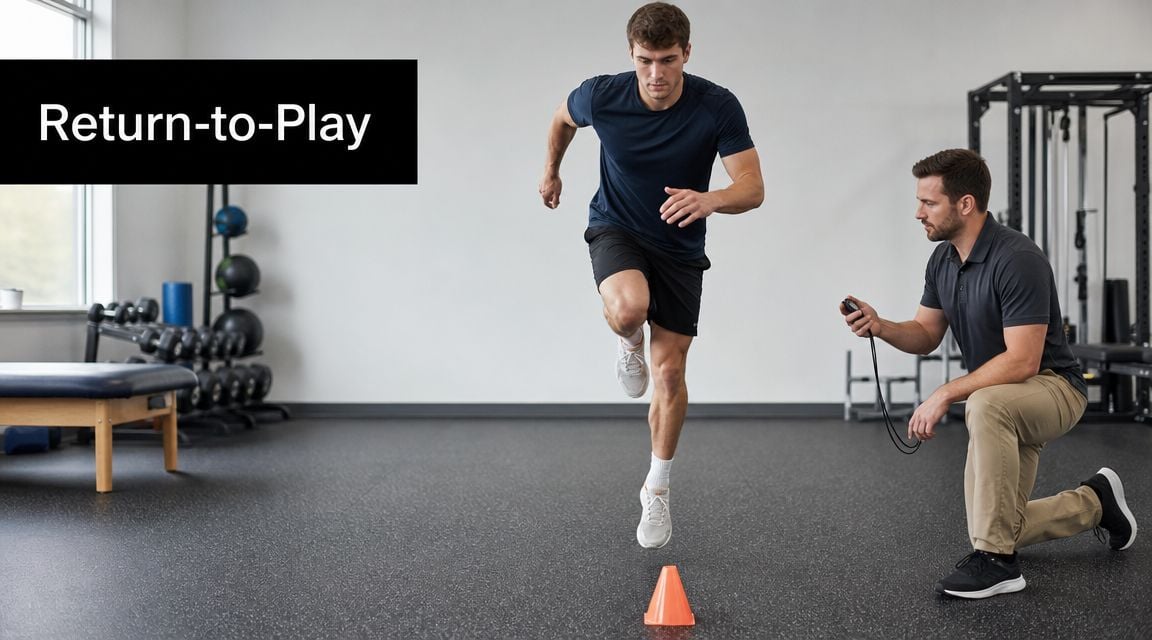
At PTU, we live by a simple rule: we test, we don’t guess. The calendar turning to month nine doesn't clear you to play. What does? Passing a full battery of objective, data-driven tests that prove your body is ready for the demands of competition. This is your final gatekeeper.
Our DPTs in Bridgewater, Buzzards Bay, and Middleborough use a comprehensive return-to-sport testing protocol that is a non-negotiable final step for every athlete.
- Strength Symmetry: We measure your quad and hamstring strength. Your surgical leg needs to be at least 95% as strong as your non-surgical leg. Anything less is a red flag for re-injury.
- Hop Testing: This isn't just about jumping. We run a series of single-leg hop tests to measure distance and time, which tells us about your power, control, and confidence in the knee. Your performance must be at least 95% symmetrical.
- Movement Quality Analysis: We watch you move. We analyze your form while you run, cut, pivot, and jump. We're looking for clean, fluid mechanics without a hint of hesitation. If you're still favoring one side, the work isn't done.
Building Your Long-Term Game Plan
Passing return-to-sport tests is a massive milestone, but it’s not the finish line. As you get back to practice and competition, the focus shifts to long-term health and injury prevention. Keeping the strength, mobility, and clean movement patterns you've fought for is key to a long career. Resources like Lola's expert guide on sports injuries offer great frameworks for staying healthy.
Ultimately, this phase is about more than just your body. It's about rebuilding the confidence to go all out without fear. When you finally step back on that field, court, or stage, you'll know you didn't just wait—you earned it.
Why a 9-Month Timeline Is Non-Negotiable
As an athlete, the second you get off the operating table, you’re counting the days until you can get back on the field. But when we talk about a 9-month ACL recovery timeline, it isn't a conservative estimate—it’s a biological necessity. Rushing it significantly increases your chances of ending up right back where you started.
The key reason is a process called ligamentization. Your new graft isn't a ligament yet; it's a scaffold. Over the next nine months or more, your body undertakes the incredible task of slowly remodeling that tissue, giving it a blood supply, and transforming it into a living, functional ligament. You simply can't speed that up.
Think of it like concrete curing. It might look and feel solid on the surface quickly, but the internal strength needed to handle the torque of an athletic career takes much longer to develop. Pushing it too soon is like driving a truck over fresh concrete—you’re testing a structure that isn't ready for the load.
The Mental Hurdle: Overcoming Kinesiophobia
But physical healing is only half the story. There’s a massive psychological mountain to climb: kinesiophobia, a very real fear of movement and re-injury. Your brain hasn't forgotten the "pop" or the instability. Rebuilding the trust to plant your foot on a hard cut without hesitation is a battle of its own.
A physical therapist who understands the athlete’s mindset is your best asset for a recovery that addresses both body and mind. We are your partner in rebuilding that confidence, one successful drill at a time.
Here at Physical Therapy U, guiding athletes from East Bridgewater, West Bridgewater, and Raynham through these dual challenges is at the core of what we do. Our Doctors of Physical Therapy are experts at designing programs that don't just rebuild muscle—they systematically rebuild your confidence.
We create a controlled environment where you can safely test your knee's limits, proving to yourself again and again that it’s strong and ready. This mental readiness is just as critical as any physical test and is a cornerstone of our approach for athletes in Bridgewater, Massachusetts, and the surrounding South Shore towns.
Frequently Asked Questions (FAQ)
After working with hundreds of athletes post-ACL surgery at our clinics, we've found the same questions pop up time and again. Here are some straight answers based on our clinical experience.
When can I get off crutches after ACL surgery?
You can expect to be off crutches within 2 to 4 weeks post-op, but this is a guideline, not a guarantee. The real answer is when your body is ready. Your DPT will be looking for you to walk with a normal, smooth gait—no limping—and have enough quadriceps control to confidently support your full body weight. It's about safety and setting your recovery up for success.
Is pain and swelling normal months after ACL surgery?
Yes, to a degree. It's normal to experience some minor swelling or a dull ache after a demanding physical therapy session or a long day on your feet. This can pop up for several months. What's not normal is sharp, unrelenting pain or significant swelling that doesn’t calm down with rest. Think of it as your body’s communication system. Always let your PT know if things feel off. Fueling your body correctly is also huge for managing inflammation. Ensuring you get enough protein is non-negotiable for muscle repair. If you need ideas, take a look at PlateBird's protein intake strategies.
When can I drive after ACL surgery?
Getting back behind the wheel depends entirely on your specific situation. If you had surgery on your left leg and drive an automatic, you might be back on the road in just 1 to 2 weeks. However, if the surgery was on your right leg—your gas and brake pedal leg—you're looking at a longer wait, typically 4 to 6 weeks. You must be completely off narcotic pain medication and able to slam on the brakes instantly without hesitation. Your safety, and the safety of others, depends on it.
Disclaimer: This is not medical advice. Always consult a licensed physical therapist for an in-person evaluation to determine if you are safe to drive.
Why is my hamstring so weak after surgery?
If your hamstring feels surprisingly weak, there’s a good chance your surgeon used a hamstring autograft for your new ACL. This means they took a piece of one or two of your hamstring tendons to reconstruct the ligament. So, not only is your knee recovering, but your hamstring has also been through its own trauma and needs dedicated time to heal and strengthen. For a deeper look into surgical options, check out our podcast episode covering the ABCs of the ACL with Dr. Eric Rightmire.
Ready to get a recovery plan that’s built around you and your sport? The Doctors of Physical Therapy at Physical Therapy U are specialists in guiding athletes from the operating table back to the field with confidence. With locations in Bridgewater, Buzzards Bay, and Middleborough, MA, expert care is nearby. Book your appointment online today and let’s start building your comeback story.
