
At Physical Therapy U, our Doctors of Physical Therapy get one thing straight: correcting an anterior pelvic tilt isn’t about chasing a “perfect” posture. It’s about rebalancing your body to unlock more power, efficiency, and resilience against injury. For an athlete, this means stretching tight muscles like the hip flexors and activating underused powerhouses like the glutes and core.
Table of Contents
- Is Your Pelvic Tilt Affecting Your Athletic Performance?
- Self-Screening: How to Check Your Pelvic Tilt
- Your Foundational Corrective Exercise Program
- Progressive Strengthening for Long-Term Results
- How Long Does It Take to Correct Anterior Pelvic Tilt?
- When to See a Physical Therapist in Southeastern MA
- Anterior Pelvic Tilt FAQ for Athletes
Is Your Pelvic Tilt Affecting Your Athletic Performance?
Does your low back ache after a run? Do you feel like you’re leaving power on the table during squats or jumps? These are classic signs that your pelvic position might be holding you back. This is often due to an anterior pelvic tilt (APT), where the front of the pelvis dips forward, exaggerating the curve in your lower back.
But here’s the critical distinction: APT isn’t a medical diagnosis. It’s a postural tendency. For many people, it’s not a problem at all.

For an athlete, though, it’s a different story. Whether you’re a dancer in Middleborough, a runner training near Plymouth, or a soccer player from Taunton, a significant tilt often points to a muscular tug-of-war. Your hip flexors and quads are working overtime, while your glutes and core are underutilized. Understanding these mechanics is a core part of sports science; this guide for youth coaches on performance breaks down how physical balance impacts athletic output.
At Physical Therapy U, our Doctors of Physical Therapy look at function first. Our goal isn’t to force your pelvis into a static “neutral” position. It’s to give you the strength and motor control to move powerfully through your sport’s demands, whether that’s sprinting, jumping, or recovering from ACL surgery.
What Is a Normal Pelvic Tilt?
The idea of a single “perfectly neutral” pelvis is a clinical myth. A certain degree of anterior tilt is completely normal and, for some athletes, can be biomechanically advantageous.
Research on healthy, active adults and collegiate athletes shows an average tilt is around 9.6 degrees for men and 11.7 degrees for women. These numbers confirm what we see in our Southeastern Massachusetts clinics daily: some tilt is natural. Our job as sports physical therapists is to determine if that posture is actually causing pain or limiting your performance.
How APT Impacts Athletes
When that muscular tug-of-war becomes too one-sided, performance inevitably suffers. Here’s what we often see at our PTU clinics:
- Reduced Glute Activation: An excessive anterior tilt makes it mechanically difficult for your glutes to fire powerfully. This robs you of power for sprinting, jumping, and lifting. Our guide on strength and conditioning for soccer players dives deep into why glute power is non-negotiable for field sports.
- Increased Hamstring Strain: When the glutes don’t do their job, the hamstrings are forced to pick up the slack. They weren’t designed for that primary role, which puts them at a much higher risk for strains and pulls—a common issue we treat with return-to-sport testing.
- Inefficient Core Stability: Your pelvis is the foundation for your core. If it’s unstable, your core can’t brace effectively. This instability can sabotage everything from a dancer’s balance to a runner’s stride efficiency, something we analyze in detail during a running gait analysis.
For athletes in the Bridgewater, Massachusetts area, or nearby towns like East Bridgewater and West Bridgewater, learning to control your pelvic position is a key to unlocking new levels of performance and preventing nagging injuries.
Self-Screening: How to Check Your Pelvic Tilt
Before you can address an anterior pelvic tilt, you need to establish a baseline. These are two quick self-screens we use in our Bridgewater, MA, clinic to give athletes an awareness of their body’s default position.
Remember, these screens are for awareness, not a formal diagnosis. A complete picture, especially how your pelvic tilt impacts complex athletic movements, requires a full evaluation from a licensed Doctor of Physical Therapy.
The Thomas Test for Hip Flexor Length
Tight hip flexors are a primary driver of anterior pelvic tilt. This test gives you a clear idea of your hip flexor length.
- Get into position: Lie flat on your back on a sturdy table or bench, scooting back so your legs hang off the edge from the knees down.
- Perform the test: Grab one knee and pull it snugly towards your chest. Let the other leg relax and hang freely.
- Check the result: Observe the thigh of the relaxed, hanging leg. Does it lift off the table? If it does, it’s a strong indicator of hip flexor tightness on that side. Ideally, the back of your thigh should rest flat against the surface.
When that thigh lifts, it demonstrates how tight muscles are pulling your pelvis forward. We see this constantly in runners and field athletes who rely on explosive sprinting.
A Quick Word of Caution: A “positive” Thomas Test isn’t a command to start aggressive stretching. In our clinic, it’s a data point. It tells our DPTs to look closer at how that tightness might affect your running gait or squat mechanics during a full movement screen.
The Wall Test for Your Lower Back Curve
This is a simple visual check for your standing posture and the curve in your lower back.
Find a flat wall and stand with your head, upper back, and glutes touching it. Your heels should be about two to four inches away from the wall.
Now, try to slide your flat hand into the space between your lower back and the wall.
You’re looking for a snug fit. If your hand slides in with just a little room to spare, that’s generally a neutral position. If there’s a large gap—enough to fit your forearm—it suggests an excessive anterior tilt. This isn’t a diagnostic tool, but it’s highly effective for building postural awareness, which is the first step toward active control during athletic activity.
Your Foundational Corrective Exercise Program
Now for the work. Correcting a problematic anterior pelvic tilt is about motor retraining. You are building a stronger mind-muscle connection and teaching your pelvis to find and hold a more functional, balanced position. This starts with precision and control, not heavy weights.
This is your foundation. We need to release the chronically tight muscles pulling you out of alignment, then activate the muscles that have become weak from disuse. This approach, reviewed by our licensed DPTs, ensures long-term success.
Step 1: Release Tight Muscles
First, we need to calm down the overactive muscles. For most athletes with APT, this means the hip flexors and quads. Gentle, targeted mobility is your best tool.
- Foam Rolling Quads: Spend 30-60 seconds on the front of each thigh. Use slow, controlled passes from just above the knee to the hip. Avoid rolling directly on the kneecap.
- Kneeling Hip Flexor Stretch: On a soft surface, get into a kneeling lunge position. Gently tuck your tailbone (think “belt buckle to chin”) and press your hips forward until you feel a stretch in the front of the back leg’s hip. Hold for 30 seconds per side. Do not arch your back to get deeper.
PTU Pro Tip: The most common mistake our clinicians see is people arching their back during this stretch, completely missing the point. The secret is to actively squeeze the glute of the back leg. This creates a posterior pelvic tilt that locks in the pelvis and isolates the stretch right where it’s needed.
Step 2: Activate Weak Muscles
With the front side quieted, it’s time to wake up the posterior chain—your glutes and deep core muscles. These are the muscles that hold your pelvis in a powerful, stable position. Quality over quantity is the rule. For athletes who also have a desk job, this is critical; Sit Healthier’s posture exercise guide offers great ideas for the workday.
Before you start, knowing your body’s baseline is key.
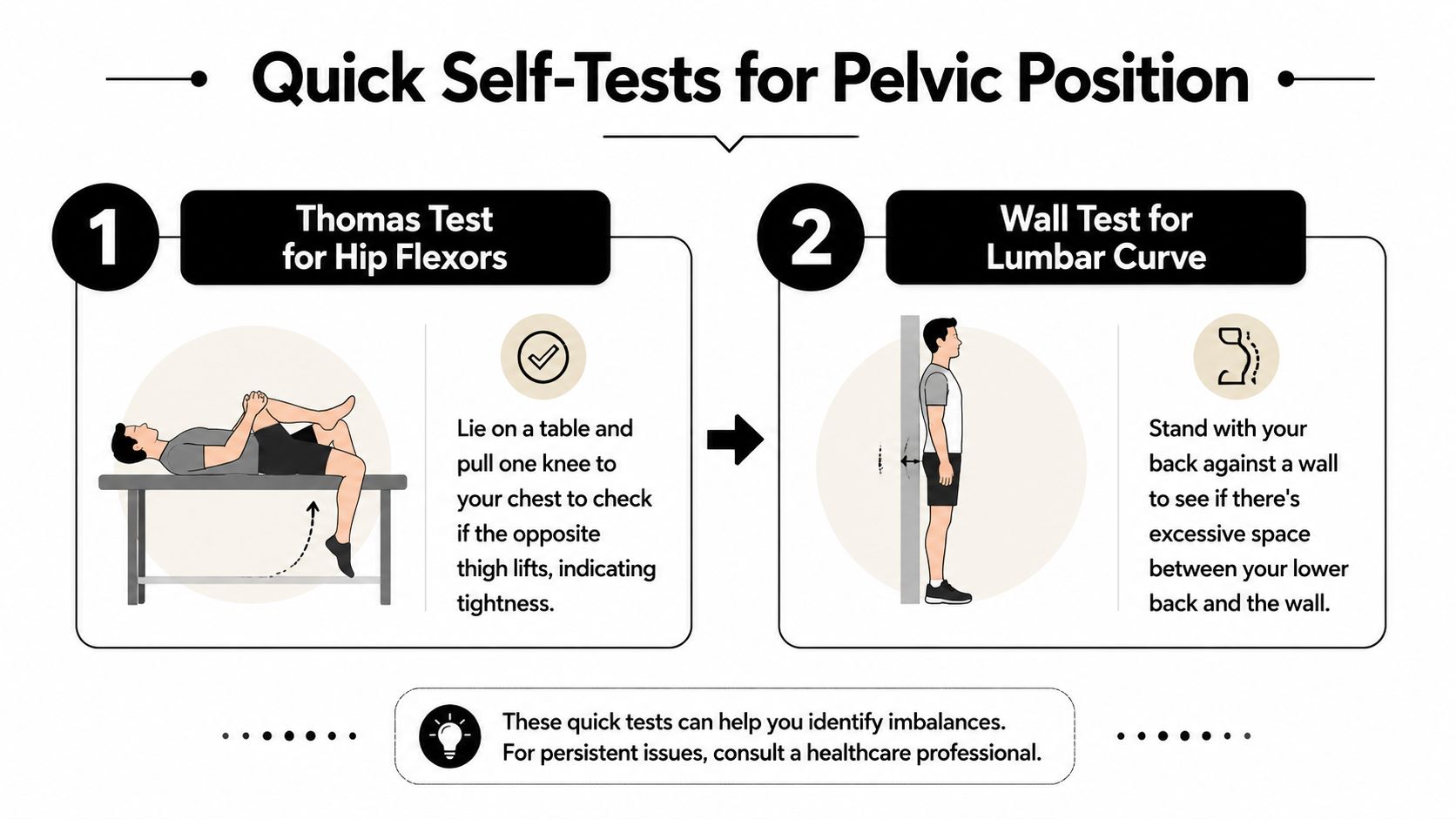
This self-assessment is invaluable for any athlete. Understanding these imbalances is fundamental to injury prevention and performance enhancement, a topic we cover in our guide to physical therapy exercises for runners.
- Glute Bridges: Lie on your back with knees bent and feet flat on the floor. Drive through your heels and squeeze your glutes to lift your hips toward the ceiling, creating a straight line from shoulders to knees. Hold the peak contraction for a second before lowering with control.
- Dead Bugs: A core stability all-star. Lie on your back, arms pointing to the ceiling, legs in a “tabletop” position (knees at 90 degrees over hips). Slowly lower your right arm and left leg toward the floor, going only as far as you can without your lower back arching. Exhale as you lower, inhale as you return to the start, and then switch sides.
Progressive Strengthening for Long-Term Results
Activation is the first step, but it’s not the final one. To make a lasting change, you need to build genuine strength. This is where the real work—and the real results—happen.
This is where we move from simply feeling the muscles to teaching them to handle load and dynamic movement. This principle, progressive overload, is how you make a permanent change in your posture and get rid of nagging APT for good. Bodyweight exercises alone won’t get you there.
Advancing Your Program
The goal is to ensure your glutes and core can stabilize your pelvis not just on a mat, but when you’re sprinting, squatting heavy, or cutting on the field. It’s about embedding this pelvic control into your muscle memory until it’s automatic.
Here are a few ways we progress these movements for athletes at our clinics:
- From Glute Bridge to Banded Hip Thrust: The floor bridge was for activation. Now we build power. Add a resistance band just above the knees and a weight (dumbbell or barbell) across your hips. This forces your glutes to fight the weight vertically and the band laterally, building multi-planar strength.
- From Plank to Dynamic Carries: A static plank builds endurance. The next step is to challenge that stability while moving. The Farmer’s Carry, simply walking with heavy weights, ignites your entire core, forcing it to work overtime to keep your pelvis and torso stable with every step.
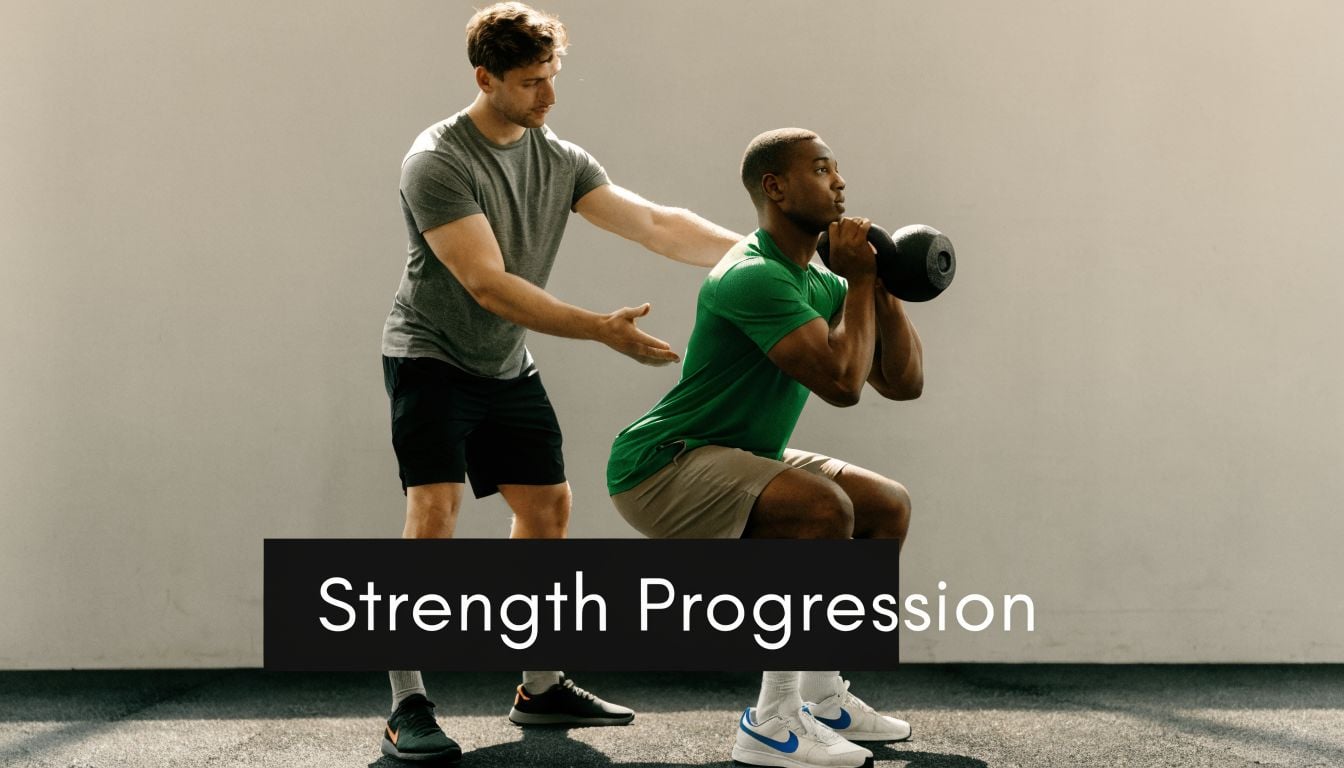
- The Goblet Squat with Pelvic Focus: The Goblet Squat is a perfect posture-teaching tool. Holding a weight at your chest acts as a counterbalance, encouraging an upright torso and making it easier to control your pelvic position. Your job throughout the squat is to maintain a neutral pelvis, actively fighting the urge to let your tailbone hike up at the bottom.
DPT Insight: A common mistake our clinicians see at our Bridgewater, Massachusetts, clinic is athletes rushing progressions to lift heavier. You have to understand the why. A Farmer’s Carry is a walking plank. A Goblet Squat is a rehearsal for the perfect pelvic mechanics that will directly carry over to your heavier lifts and sport-specific movements.
Weave these stronger variations into your current routine as dynamic warm-ups or accessory work. This way, your corrective work actively supports your performance goals. For a comprehensive look, see our guide for building a strength and conditioning program for athletes.
How Long Does It Take to Correct Anterior Pelvic Tilt?
This is the question every athlete asks: how long will this take? The honest, clinical answer is: it depends. You are retraining movement patterns developed over years, so there’s no overnight fix. But with a consistent, targeted approach, you will feel a difference quickly.
Many athletes feel an initial change within a few weeks. This isn’t your posture magically fixing itself, but your brain and muscles communicating better. That first “aha” moment when you feel your glutes fire correctly is a huge win and a sign you’re on the right track.
A Realistic Timeline for Lasting Change
Making these changes stick requires consistency. Your personal timeline depends on a few key factors.
An athlete with a more significant tilt and deep-seated imbalances will have a longer path than someone with a milder case. Your training history also matters; athletes with good body awareness often adapt more quickly. But above all, consistency is king. You will get far better results from 15-20 minutes of focused drill-work daily than from one heroic session on the weekend.
Clinically, most athletes with mild-to-moderate APT can expect to see significant, lasting improvement within 6 to 12 weeks of consistent effort. For more on the variables at play, you can read about the factors influencing pelvic tilt recovery on orlandoortho.com. The key is sticking with it—you’re teaching your body a stronger, more efficient way to move.
When to See a Physical Therapist in Southeastern MA
Following online exercises is a great start. But if progress stalls, or if you’re dealing with pain that’s sidelining you from your sport, it’s time to get a professional evaluation from a Doctor of Physical Therapy. Self-treatment can only take you so far.
At Physical Therapy U, we know that for an athlete, APT isn’t just about posture—it’s a direct brake on performance. A one-on-one assessment at one of our clinics in Bridgewater, Buzzards Bay, or Middleborough is the fastest way to diagnose the root cause.
Is It Time to Book an Evaluation?
Here are clear signs that it’s time to switch from self-help to expert guidance:
- You’re dealing with stubborn low back, hip, or hamstring pain that won’t resolve.
- You’ve hit a performance plateau. Your strength gains have vanished, or you feel slower and less agile.
- You’re experiencing numbness, tingling, or radiating pain in your legs. This requires immediate professional evaluation.
- You’re unsure if you’re doing the exercises correctly or are overwhelmed by generic advice.
An anterior pelvic tilt is a movement pattern, not a life sentence. Your body is incredibly adaptable with the right input.
A fascinating study showed that simply using therapeutic tape to provide pelvic position feedback decreased anterior tilt by over 5 degrees in a single day, leading to a significant drop in pain. You can read the full research about posture retraining.
This highlights how responsive your body is to targeted interventions. It’s not about endless exercises; it’s about the right exercises and cues for your body and your sport. Our team of DPTs uses advanced tools like running gait analysis, dry needling, and return-to-sport testing to build a plan 100% tailored to your athletic goals.
Anterior Pelvic Tilt FAQ for Athletes
At our clinics in Bridgewater, Buzzards Bay, and Middleborough, we work with athletes every day. Our Doctors of Physical Therapy have answered these common APT questions hundreds of times.
Will Fixing My Anterior Pelvic Tilt Make Me Taller?
No, but it will make you appear taller. Correcting an excessive tilt won’t change the length of your bones.
What it will do is improve your functional posture. By reducing the deep arch in your low back, you’ll stand straighter and carry your height more effectively. You’ll look taller and more confident because you’ll be reclaiming the height you already have.
Can Anterior Pelvic Tilt Cause a “Belly Pooch”?
Yes, and it’s a frustrating issue for many lean athletes. When your pelvis tips forward, it pushes your abdominal contents outward, creating the appearance of a protruding stomach even with low body fat.
This is a structural issue, not a “fat” problem. The great news is that by strengthening your deep core stabilizers (like the transverse abdominis) and controlling your pelvic position, you can significantly improve your abdominal profile and reduce that “pooch” effect.
Are There Specific Sports That Make APT Worse?
Definitely. Any activity can contribute if mechanics are poor, but some sports create movement patterns that encourage an anterior tilt. We see it most often in sports involving powerful hip extension and repetitive back arching.
- Gymnastics and Dance: The demand for extreme flexibility and arched-back “lines” can overstretch the abs while tightening the hip flexors and low back. Our dance therapy programs are designed to counteract this.
- Soccer and Hockey: A powerful skating or sprinting stride relies on explosive hip flexor drive. Without proper glute and core work to counterbalance this, the hip flexors can become chronically tight and overactive.
- Weightlifting: Lifters, especially when fatigued, often default to an excessive low back arch to complete a squat or overhead press, reinforcing the very pattern they need to avoid.
At PTU, our sport-specific programs are designed to counteract these demands. Through tools like running gait analysis and individualized strength programming, we build balanced strength that supports your sport, improves performance, and keeps you off the sidelines.
Can Dry Needling Help With Anterior Pelvic Tilt?
It can be a total game-changer. While exercise is the foundation for long-term correction, dry needling is our go-to modality for breaking the cycle of muscle tightness that locks your pelvis into a tilted position.
By targeting deep trigger points in stubbornly tight hip flexors or low back muscles, our DPTs can induce a release and “reset” the muscle. This immediate reduction in tension makes it significantly easier for you to feel and activate the correct muscles—your glutes and core—during your corrective exercises. It clears the path for your strengthening work to be more effective, faster.
If you’re an athlete in Southeastern Massachusetts tired of dealing with nagging pain or hitting a performance plateau, it’s time to stop guessing. The expert team at Physical Therapy U can build a personalized plan to get you back in the game. Book your evaluation at our Bridgewater, Buzzards Bay, or Middleborough clinic today.

