
You're standing at the barre, your feet look turned out, and your teacher says, “Use more rotation from the hip.” That cue makes sense until your knees start gripping, your arches collapse, or the front of your hips feels pinchy. At that point, the primary question isn't how to fake a wider line. It's how to improve turnout safely, in a way your body can naturally own.
At a sports physical therapy clinic, we look at turnout the same way we look at sprint mechanics, cutting mechanics, or return-to-sport testing after ACL rehab. The goal isn't the prettiest position for one second. The goal is a position you can control, repeat, and load without irritating the hips, knees, ankles, or low back.
Table of Contents
- Rethinking Turnout It's More Than Just Your Hips
- A Quick Self-Assessment for Your Turnout Profile
- Targeted Exercises for Mobility and Strength
- Bringing It to the Barre Applying Strength to Technique
- Your Progressive Plan and Injury Prevention
- When to See a Dance Physical Therapist
Rethinking Turnout It's More Than Just Your Hips
The biggest mistake dancers make is assuming turnout is just a flexibility problem. It isn't. Turnout is a whole-chain skill, and expert guidance emphasizes that it comes from a combination of hip, tibia, and foot contribution, not just the hip alone. The same guidance warns that forcing a 180° line can cause pain and injury in the hips, knees, and ankles, which is why “more” isn't automatically “better” for every dancer's body (Dance Informa on safe, functional turnout).
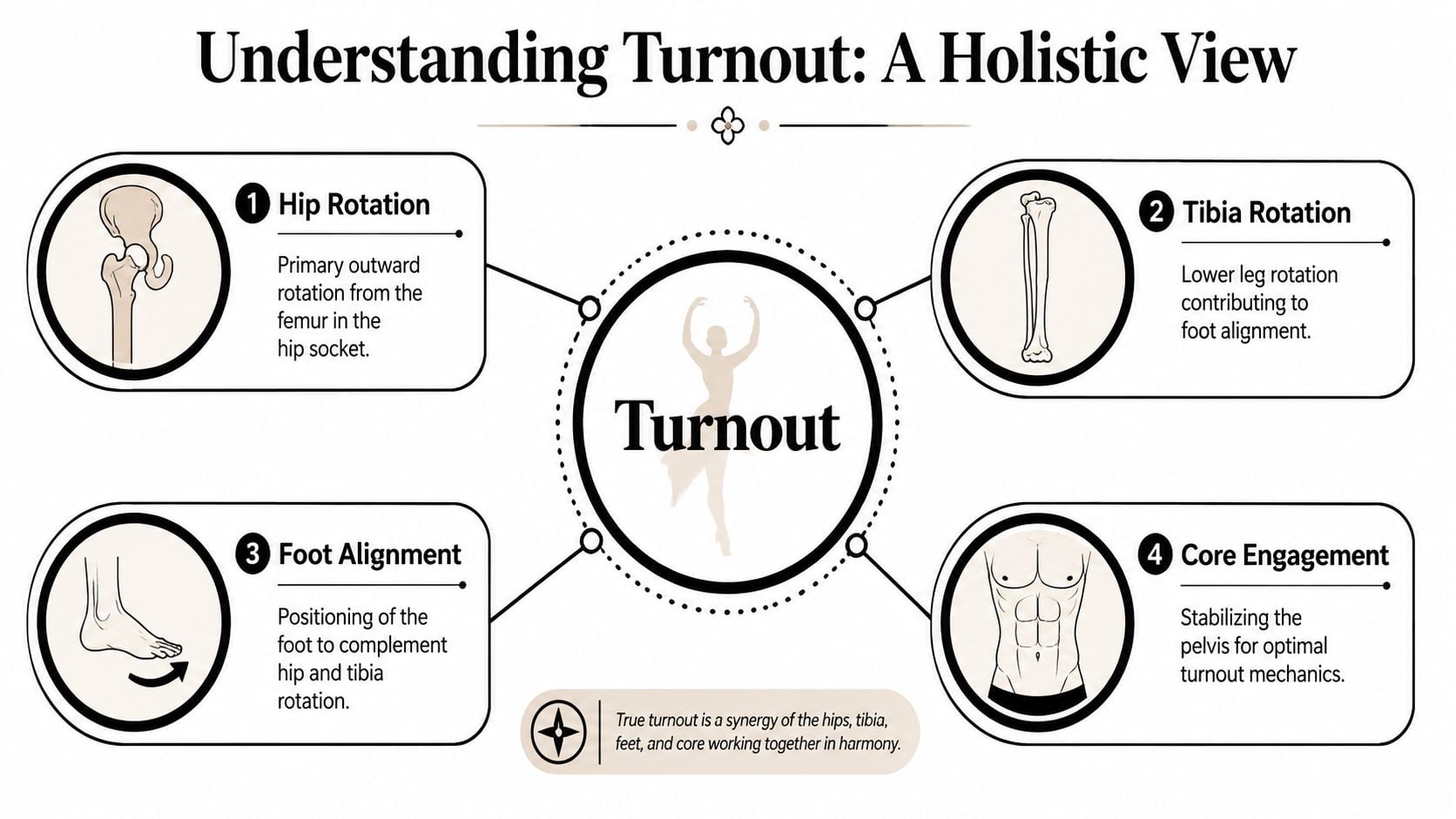
Why the 180 degree goal can mislead dancers
A lot of dancers chase the look of turnout from the floor up. They crank the feet wider, roll the arches, twist the knees, tuck the pelvis, and call it technique. The line may look impressive for a moment, but the body usually tells the truth later.
When turnout is borrowed from the wrong places, several compensations show up fast:
- Feet gripping the floor instead of spreading pressure through the tripod of the foot
- Knees drifting inward or twisting as the shin tries to create rotation it can't control
- Pelvis tucking under to create the illusion of more range
- Low back extension replacing true hip rotation
Practical rule: If your feet can create the position but your hips can't control it, that's not usable turnout.
Structural limit or trainable limit
This distinction matters more than any turnout exercise list.
Some dancers have a structural limit. That means the shape of the hip joint, the orientation of the femur, and other bony factors influence how much external rotation is realistically available. You can improve strength, control, and movement quality around that structure, but you can't stretch your way into a completely different skeleton.
Other dancers have a more trainable limit. They may have enough available hip rotation, but they're losing it because of soft tissue restriction, weak deep external rotators, poor pelvic control, or ankle and foot compensations. Those dancers often do improve when the program is specific.
A useful approach to consider:
| Pattern | What it usually means |
|---|---|
| Plenty of range lying down, much less in standing | Control problem more than a mobility problem |
| Stiffness both lying down and standing | Mobility restriction may be a bigger factor |
| One side clearly different from the other | Asymmetry in strength, motor control, or anatomy |
| Turnout causes pinching or sharp pain | Stop forcing it and get assessed |
This is why generic “stretch harder” advice falls flat. Dancers don't just need more motion. They need the right motion from the right joint, then enough strength to hold it in plié, tendu, rond de jambe, jumps, and center work.
A Quick Self-Assessment for Your Turnout Profile
You can learn a lot at home with a few simple checks. These aren't a diagnosis, and they shouldn't replace an in-person evaluation with a licensed PT, but they can help you notice whether your turnout challenge looks more like mobility, control, or compensation.
If any test causes pain, stop. Don't push through pinching, sharpness, or a sense that the joint is getting jammed.
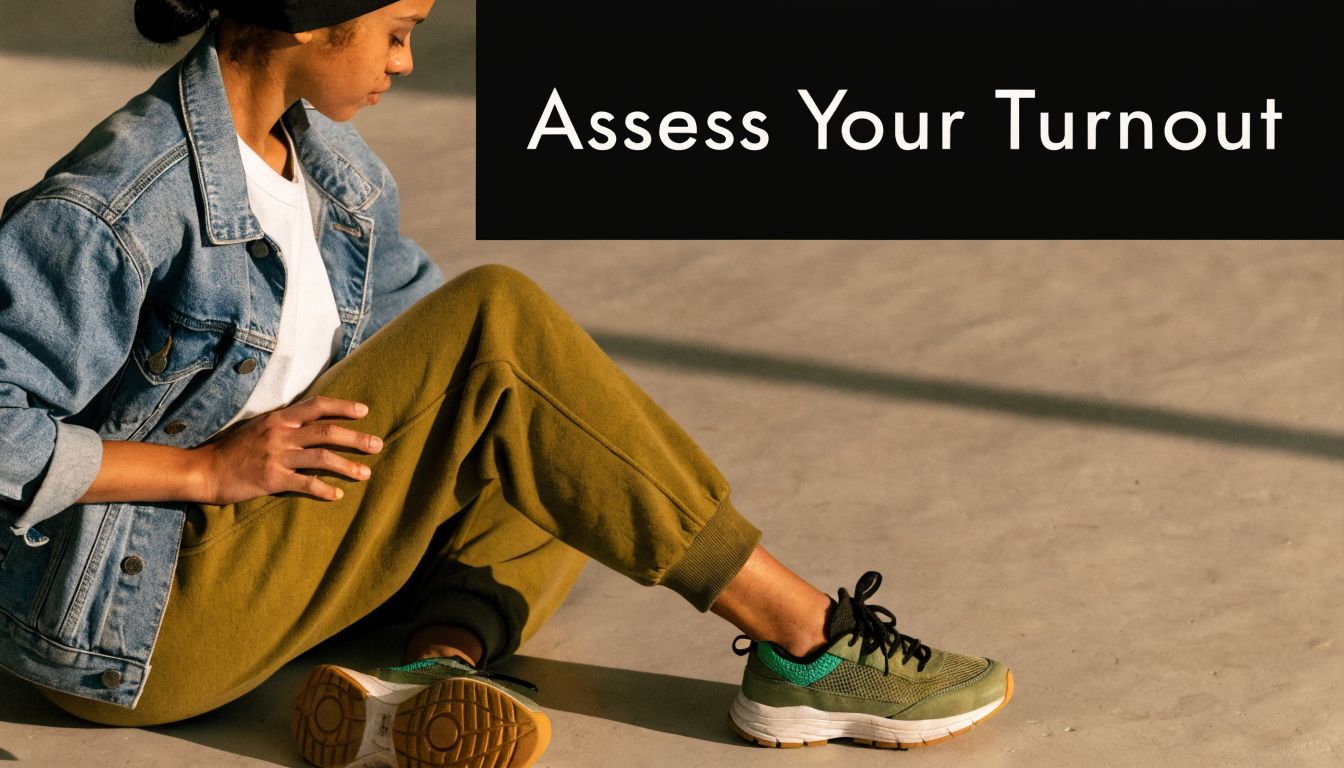
Test one supine hip rotation check
Lie on your back with your hips and knees bent. Keep your pelvis quiet. Let one lower leg move outward while the thigh stays steady, then bring it back and repeat on the other side.
What you're looking for:
- Pelvis staying still rather than rolling with the leg
- A clear end feel that feels like tension, not a pinch
- Side-to-side differences in ease or smoothness
- Whether the knee drifts inward or outward during the motion
If you have decent motion here but can't show the same turnout when standing, your problem probably isn't raw range alone.
Test two standing turnout reality check
Stand in a comfortable first position. Then slowly widen your turnout only to the point where you can keep the kneecaps tracking over the second toe and the arches from collapsing.
Try this twice:
- First, turn out as much as you can make your feet do.
- Then reset and turn out only as much as you can maintain without gripping, rolling in, or tucking.
The second version is your more honest starting point. It may look smaller. That's fine. Functional turnout usually starts by getting rid of the borrowed range.
The turnout you can stand on quietly is more useful than the turnout you can pose in for two seconds.
Test three single-leg control screen
Stand on one leg in parallel, then in a small turned-out position. Notice what changes.
Ask yourself:
- Does the standing arch collapse?
- Does the knee rotate or wobble?
- Does the pelvis hike or drop?
- Can you breathe normally, or do you brace and clench?
Single-leg control matters because dance rarely happens in perfect bilateral symmetry. Relevé, landing mechanics, développé, and traveling steps all expose whether turnout strength is integrated.
A simple summary can help:
| What you notice | Likely takeaway |
|---|---|
| Good floor position, poor single-leg control | Strength and motor control need work |
| Stiffness with a hard stop | Mobility may be limited |
| Pinching in front of the hip | Don’t force turnout into that range |
| Feet and knees doing all the work | You’re compensating below the hip |
Write down what you notice. Bring it to a dance PT if you need help sorting out what's structural and what's trainable.
Targeted Exercises for Mobility and Strength
Turnout usually improves when the program matches the actual limitation. If your hips are stiff, you need mobility work that respects the joint. If you have range but can't keep it in class, you need strength and control. Most dancers need some of both.
A study in the Journal of Dance Medicine & Science found that an 8-week program of hip abductor and external rotator strengthening increased functional turnout by an average of 5 degrees while also reducing reported hip pain in pre-professional dancers (IADMS journal reference). That finding lines up with what dance medicine clinicians see all the time. Better turnout often comes from better control, not more forcing.
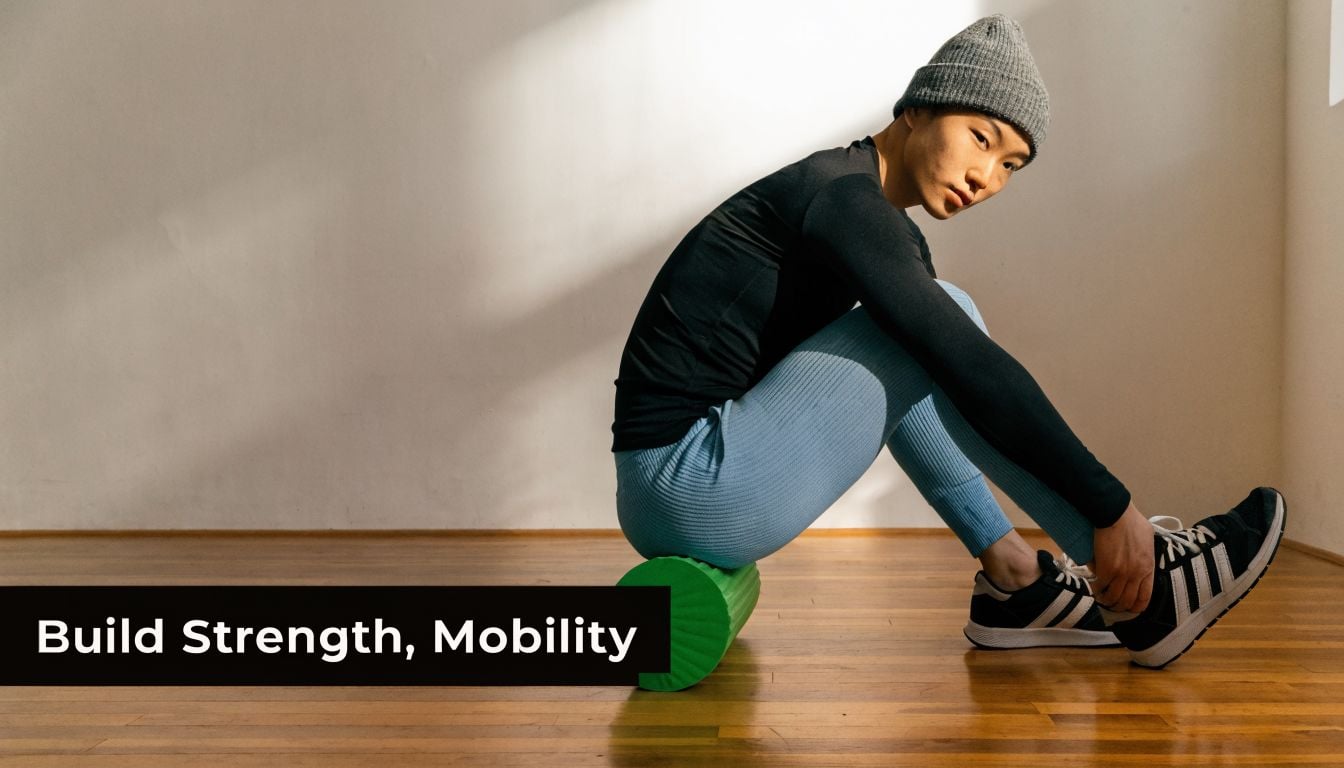
Mobility work that supports turnout
Mobility should create cleaner motion, not looser chaos. Keep the movements controlled and stop short of joint irritation.
-
Adductor rock-back
- How to do it: Start on hands and knees with one leg out to the side. Keep a long spine and gently rock your hips back.
- Dose: 2 sets of smooth reps per side
- PTU Pro-Tip: Don't twist your torso to fake extra range. The stretch should stay in the inner thigh, not your back.
-
Half-kneeling hip flexor mobility
- How to do it: Kneel with one foot in front, lightly tuck the pelvis, and shift forward until you feel length in the front of the hip.
- Dose: 2 sets per side with steady breathing
- PTU Pro-Tip: If you arch the low back, you'll miss the target and just dump into the lumbar spine.
-
90 90 hip transitions
- How to do it: Sit with both knees bent, rotate from one 90 90 position to the other without lifting the chest.
- Dose: 2 sets of controlled reps
- PTU Pro-Tip: Think rotation from the hip socket, not a swing from the feet.
-
Foam rolling for lateral hip and posterior glutes
- How to do it: Roll slowly over the back and side of the hip, avoiding bony pressure.
- Dose: Short passes before class or strength work
- PTU Pro-Tip: Foam rolling is a prep tool, not the main event. Follow it with active control.
If you tend to pinch in the front of the hip, don't keep stretching into that sensation. Movements that aggravate anterior hip symptoms can be worth screening against guidance on hip impingement exercises to avoid.
Strength work that helps you keep turnout
Dancers usually get the biggest payoff here. The goal is to strengthen the deep rotators and lateral hip without turning every exercise into a low-back or TFL compensation pattern.
-
Clamshell
- How to do it: Lie on your side with knees bent and feet together. Lift the top knee without rolling your pelvis back.
- Dose: 2 to 3 sets of controlled reps per side
- PTU Pro-Tip: Smaller and cleaner beats bigger and sloppy. If your pelvis rocks, you've gone too far.
-
Side-lying leg lift
- How to do it: Keep the top leg long and slightly behind you. Lift without letting the toes turn up to the ceiling.
- Dose: 2 to 3 sets per side
- PTU Pro-Tip: If you feel it mostly in the front of the hip, reset your leg slightly back and think long through the heel.
-
Fire hydrant
- How to do it: On hands and knees, lift one knee out to the side while keeping the trunk stable.
- Dose: 2 sets per side
- PTU Pro-Tip: Don't shift all your weight into the standing side. Keep your ribs quiet.
-
Bridge with turnout awareness
- How to do it: Lift into a bridge with feet parallel first. Then lower and repeat while thinking about gentle outward rotational control from the hips, not by twisting the feet.
- Dose: 2 sets
- PTU Pro-Tip: Hamstrings should help, but they shouldn't dominate the movement.
-
Banded seated external rotation
- How to do it: Sit tall and rotate from the hip against light resistance.
- Dose: 2 to 3 sets per side
- PTU Pro-Tip: If you need a visual refresher on proper form for external rotations, use it to check that the motion is coming from the hip and not from trunk lean or momentum.
A short movement demo can help dancers clean up those patterns before adding intensity:
A simple way to organize the work
If you're unsure where to start, try this order:
- Prep the tissue with brief foam rolling or dynamic mobility
- Train rotation control with clamshells or seated external rotation
- Add standing carryover with single-leg or barre-based work
- Use the new range immediately in technique drills
That sequence matters. Mobility without strength doesn't stick. Strength without technique transfer doesn't show up in class.
Bringing It to the Barre Applying Strength to Technique
A lot of dancers do the rehab exercises correctly, then lose everything as soon as class starts. That usually means the body hasn't linked strength to skill yet. Barre is where turnout becomes either controlled technique or a compensation pattern.
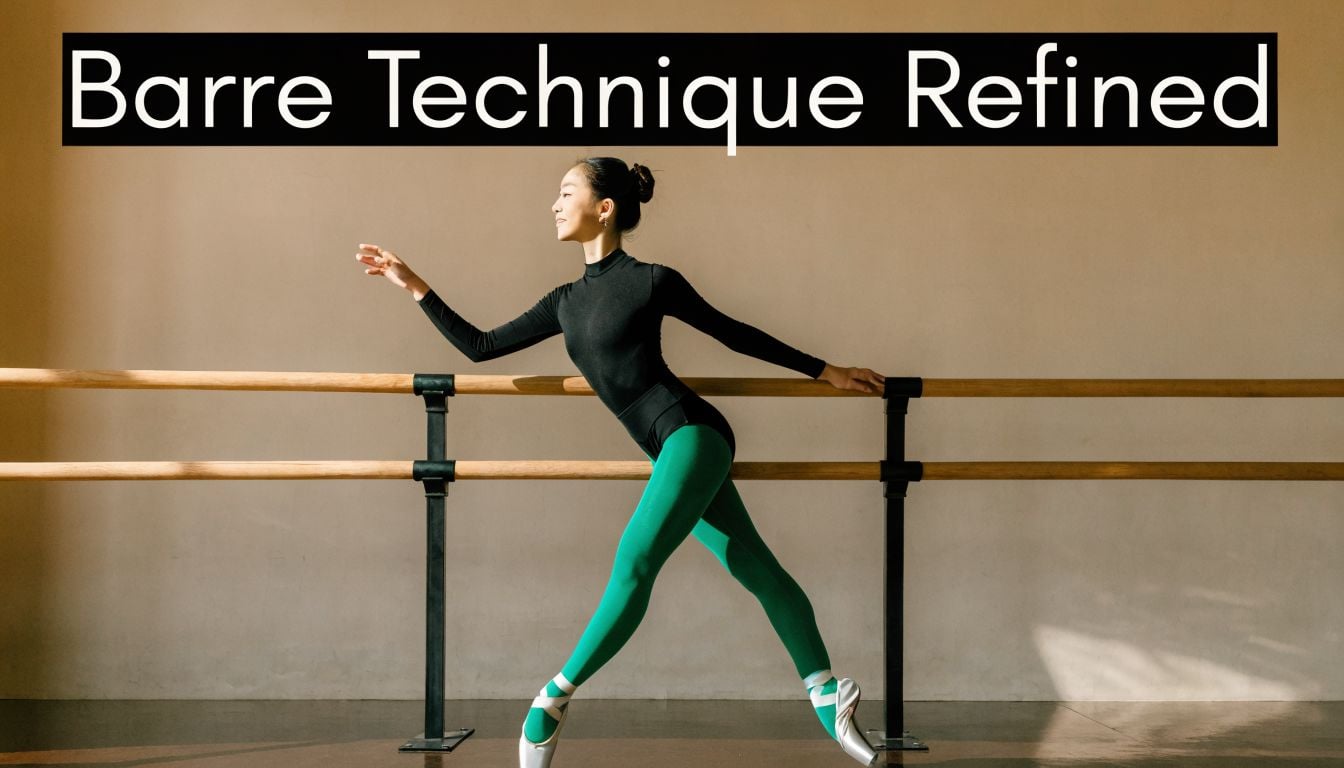
Biomechanical analysis shows that forcing turnout beyond the hip's natural range can cause up to a 200% increase in rotational stress on the knee's medial collateral ligament and patellofemoral joint, which is one reason dancers develop knee irritation when they “find” turnout below the hip (biomechanical analysis summary).
Pliés without dumping into the knees
In plié, turnout should stay organized from the hip while the foot remains grounded. If the knees dive, the arches collapse, or the pelvis tucks under early, the dancer is usually borrowing range.
Try these cues:
- Track the knees consistently over the toes you can actually control, not the toes you've twisted wider.
- Keep pressure across the whole foot instead of rolling to the inside edge.
- Think sit between the hips rather than shove the knees outward.
Your plié shouldn't feel like a battle between your feet and your knees.
A useful trick is to rehearse demi-plié in a slightly smaller first position, then widen only if the shape stays clean. That teaches the body what supported turnout feels like.
Développé and standing leg control
Développé exposes turnout problems fast because the standing leg has to stabilize while the gesture leg moves. Many dancers focus on the working leg and forget that the standing side is doing most of the hard work.
Key ideas at the barre:
- Standing leg first: Find the tripod foot, lift through the arch, and lightly engage the lateral hip.
- Pelvis level: Don't hike one side to make the leg feel higher.
- Rotate before you lift: The quality of the path matters more than the final height.
For center and allegro, the same principle applies. If you can't control turnout in landing mechanics, jumps become another place where stress shifts into the knees and ankles. That's why cross-training matters. Even resources built for other athletes, like this guide to physical therapy exercises for runners, are useful reminders that foot control, hip stability, and loading mechanics always travel together.
Your Progressive Plan and Injury Prevention
The dancers who improve turnout most reliably aren't the ones doing the hardest stretch once in a while. They're the ones who build a repeatable rhythm and stop trying to win the process in one weekend.
A weekly rhythm that dancers can stick to
You don't need an all-day program. You need consistency and enough recovery to let the hips adapt.
A practical weekly flow looks like this:
-
Before technique class
- Use brief mobility prep such as adductor rock-backs, 90 90 transitions, or light foam rolling.
- Keep it short so you feel more organized, not fatigued.
-
On two to three separate days
- Do focused hip strength work using clamshells, side-lying leg lifts, bridges, and standing control drills.
- Move slowly enough that you can tell where the work is happening.
-
After heavier rehearsal days
- Choose recovery over more stretching if the front of the hip feels compressed or the knees feel irritated.
- Use simple reset work like breath, gentle mobility, and light tissue work.
-
Once each week
- Re-check your standing turnout quality instead of chasing visual width.
- Notice control markers like quieter feet, cleaner plié tracking, and less gripping.
For dancers who also cross-train, a structured strength and conditioning program for athletes can help organize lower-body loading, recovery days, and movement quality outside the studio.
Red flags that mean back off
Pain changes the conversation. Stretch discomfort is one thing. Joint warning signs are another.
The American Physical Therapy Association advises dancers to seek evaluation for sharp, localized joint pain that persists for more than two classes, especially in the hip, knee, or ankle, because it can be an early sign of stress injury or impingement (APTA guidance for dancers).
Back off and get assessed if you notice:
- Front-of-hip pinching during turnout, développés, or grand plié
- Sharp knee pain rather than muscular effort around the hip
- Repeated ankle rolling or arch collapse when you try to hold turnout
- Snapping with pain at the hip, especially if range is getting worse
- Pain that lingers instead of settling after class
Good training creates effort, heat, and fatigue. It shouldn't create sharp joint pain.
When to See a Dance Physical Therapist
Can you still improve turnout after puberty?
Sometimes, yes. What changes depends on what's limiting you. Structural anatomy won't become something else, but dancers can still improve functional turnout, control, strength, and tolerance for class demands.
What's the difference between stretching discomfort and a problem?
A muscular stretch usually feels broad and fades when you stop. Trouble tends to feel sharp, pinchy, localized, or mechanically blocked.
What happens in a dance PT evaluation?
A good assessment looks at hip rotation, pelvic control, foot mechanics, single-leg stability, class-specific movement patterns, and symptom triggers. In sports PT settings, that may also include strength testing, movement analysis, and a plan to bridge rehab back to performance.
If you're comparing options, it's worth seeing how other clinics describe dance-specific rehabilitation services so you know what a focused dance medicine approach should include.
At Physical Therapy U, dancers in Bridgewater, Massachusetts, Middleborough, Buzzards Bay, Plymouth, Taunton, East Bridgewater, West Bridgewater, Raynham, and across the South Shore Massachusetts area can book a one-on-one assessment with a licensed DPT. Care may include dance therapy, hands-on treatment, dry needling when appropriate, strength work, movement analysis, and return-to-sport testing principles specific to your technique demands.
If your turnout feels stuck, painful, or inconsistent, book an evaluation with Physical Therapy U. With athlete-centered care in Bridgewater, Buzzards Bay, and Middleborough, PTU helps dancers build safe, functional turnout through individualized assessment, sport-specific training, and clear return-to-performance planning.

