
You know the feeling. A run that starts fine, then your outer knee tightens at mile three. Your shin starts talking on downhills. Your hip feels stiff the day after speed work, and now you’re wondering whether to push through it, back off, or finally do the strength work you’ve been skipping.
For runners, that familiar ache is rarely random. It usually points to a load problem, a movement problem, or both. At PTU, our licensed DPTs treat runners as athletes first. That matters whether you’re training for a local race near Plymouth, logging early miles in Bridgewater, Massachusetts, or trying to get back to running after surgery or a long layoff.
This guide breaks down physical therapy exercises for runners in a way that fits real training weeks. Not just a list of drills. What to do before a run, after a run, and on off-days. Which exercises build durability. Which ones improve efficiency. Which ones help, and which ones are a waste of time if they aren’t matched to your actual weakness.
Table of Contents
- That Familiar Ache An Introduction for Runners
- Why Strength Training is Non-Negotiable for Runners
- The Runner’s Powerhouse Hip Glute and Core Exercises
- Building Resilient Lower Legs and Advanced Drills
- Putting It All Together Sample Weekly Schedules
- When to Modify or See a Sports Physical Therapist
- Frequently Asked Questions for Runners
That Familiar Ache An Introduction for Runners
Most runners don’t come in saying, “My glute medius is underperforming.” They say their knee hurts on hills. Their calf keeps tightening. Their hip feels off on one side. The body gives simple signals, even when the cause is more mechanical.
Running is common, but injury is common too. 30% to 75% of runners experience running-related injuries annually, and one study found that runners who added strength training had an injury rate of 26.2% compared to 72.4% in runners who did not, a 64% relative risk reduction according to this running injury and strength training review.
That’s why the answer usually isn’t “just stretch more” or “take a few days off.” Sometimes rest settles symptoms. It usually doesn’t solve the reason the tissue got overloaded in the first place. A better plan looks at hip control, trunk stability, calf capacity, foot mechanics, and training structure.
At our sports physical therapy clinics across the South Shore Massachusetts region, we often start with how the runner moves. A formal running gait analysis at PTU can show whether the problem is overstriding, poor frontal plane control at the knee, low cadence, a stiff ankle, or a strength deficit that shows up only under fatigue.
Practical rule: Pain during running isn’t always damage, but it is information. If your form changes to protect an area, that run just became a compensation drill.
The right physical therapy exercises for runners do more than quiet pain. They build a stride that wastes less motion, tolerates more load, and holds up when training gets harder.
Why Strength Training is Non-Negotiable for Runners
Some runners still treat strength work like optional cross-training. It isn’t. If you want to run well for years, strength training belongs in the same category as mileage, sleep, and recovery.
Running economy and force control
A runner doesn’t just need strong muscles. A runner needs muscles and tendons that accept force, store force, and redirect force cleanly. That’s what keeps the pelvis level, controls the femur, helps the ankle stay springy, and prevents the trunk from leaking energy side to side.
That’s also why running economy matters. In plain language, it means using less energy to run at a given pace. Systematic reviews show that physical therapy-prescribed strength training can improve running economy. In one example, a 9-week plyometric program improved running economy by 4.1%, and a 4-week heavy weight training program improved it by 6.3% according to this systematic review on strength training and running economy.
For the skeptical runner, that matters because the gym isn’t stealing time from running. Done correctly, it supports better mechanics at pace and better tissue tolerance when fatigue sets in.
What actually works and what usually doesn’t
What works is specific loading. Heavy lower-body lifts, controlled single-leg work, calf loading, and plyometrics when appropriate. What usually doesn’t work is collecting random band exercises, doing them inconsistently, and calling that a program.
A useful runner strength plan should do three things:
- Build capacity at the hip and trunk: So the pelvis and femur stay organized under impact.
- Improve lower-leg stiffness and control: So the calf-Achilles-foot complex can absorb and return force.
- Match the training week: Hard strength near hard run days, easier mobility near easy runs, and enough recovery between demanding sessions.
If you want a broader look at how runners blend lifting into their training, Swift Running’s running workouts offer a practical reference point. The key is still the same. Choose fewer exercises, load them well, and repeat them long enough to adapt.
Strong runners don’t just produce force. They control where that force goes.
In the clinic, the trade-off is straightforward. More running alone may improve fitness, but it can also magnify the same weak link. Strength training addresses that weak link directly.
The Runner’s Powerhouse Hip Glute and Core Exercises
The hip, glute, and core system is where many runners either clean up their stride or keep leaking force into the knee, low back, and calf. If that system isn’t doing its job, the leg below it has to manage more motion than it should.
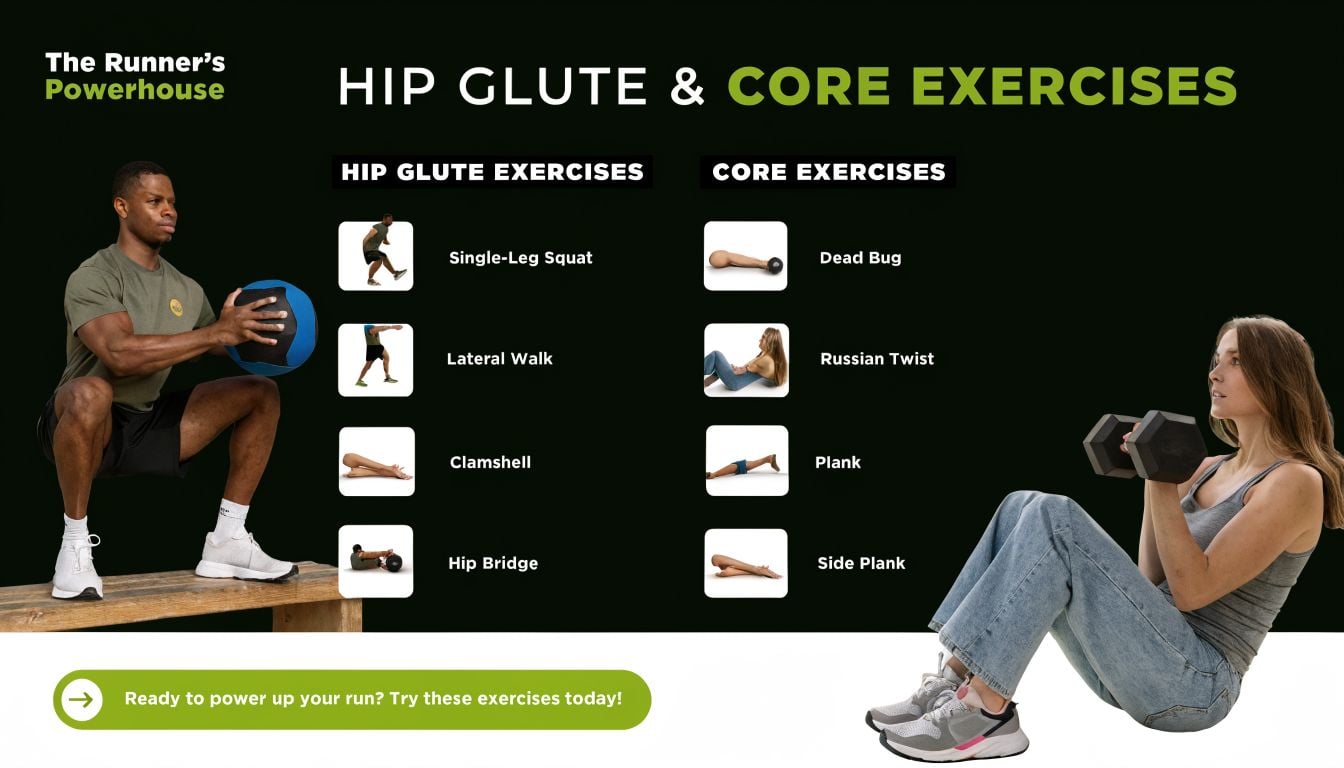
A targeted glute strengthening approach has shown a 70% to 80% reduction in knee pain and IT band syndrome incidence after 6 to 8 weeks, and 40% of runners overuse speed over form, which can lead to knee valgus that’s often corrected with mirror feedback or video analysis, as described in this glute strengthening overview for runners.
Why runners need the hip complex to do more work
When the stance leg hits the ground, the gluteus medius helps control pelvic drop and femoral internal rotation. The gluteus maximus helps drive hip extension. The deep abdominal system and obliques help keep the rib cage and pelvis stacked so the leg can push from a stable base.
If that chain is weak or poorly timed, runners often show the same patterns:
- Knee diving inward: Often seen during step-downs, landings, and hills.
- Excessive trunk sway: Usually a sign the body is trying to find stability elsewhere.
- Low back tightness after runs: Often the lumbar spine is doing work the hip should handle.
- Hamstring overuse: A common compensation when hip extension power is limited.
Four staples we use for runners
Clamshell
What it does
Clamshells target the lateral hip, especially the gluteus medius. For runners, that matters because the lateral hip helps keep the knee from collapsing inward when the foot meets the ground.
How to do it
- Set up on your side: Knees bent, hips stacked, heels together.
- Brace lightly through your trunk: Don’t roll backward to cheat the motion.
- Open the top knee: Keep the feet touching and move from the hip.
- Lower slowly: Control the return instead of dropping the leg.
Clinician’s cue
Think “pelvis stays quiet.” If your body rocks backward, you’re borrowing motion from the trunk instead of loading the hip.
Glute bridge
What it does
This teaches hip extension without asking the low back to lead. It’s a good entry point for runners who feel their hamstrings and back more than their glutes during lifting or climbing.
How to do it
- Lie on your back: Knees bent, feet flat, heels under the knees.
- Exhale and brace: Keep the ribs down.
- Drive through the heels: Lift the hips until the trunk and thighs line up.
- Pause briefly at the top: Then lower under control.
Clinician’s cue
Don’t chase height. A smaller bridge with glute tension is better than a high bridge driven by lumbar extension.
Single-leg deadlift
What it does
This is one of the most useful physical therapy exercises for runners because it blends hip strength, balance, foot control, and trunk positioning. It also exposes side-to-side differences quickly.
How to do it
- Stand tall on one leg: Keep a soft bend in the stance knee.
- Reach the free leg back: Hinge from the hip, not the spine.
- Keep the pelvis level: Let the chest come forward as one unit with the back leg.
- Return by driving the stance foot down: Finish tall through the hip.
Clinician’s cue
Watch the belt line. If one side opens up, you’ve lost pelvic control. Start bodyweight before adding a dumbbell or kettlebell.
Lateral band walk
What it does
This drill wakes up the lateral hip in a way many runners can feel immediately. It’s especially useful pre-run when you want activation without fatigue.
How to do it
- Place a band around the ankles or above the knees: Choose a resistance you can control.
- Get into a quarter squat: Hips back, chest relaxed, feet parallel.
- Step sideways without dragging the trail leg: Keep tension on the band both ways.
- Stay level: Don’t bob up and down.
Clinician’s cue
Short steps beat long sloppy ones. The goal is hip tension, not surviving the band.
Plank with leg lift
What it does
This adds anti-rotation demand to a basic plank. Runners need that because each stride is single-leg support with rotational forces passing through the trunk.
How to do it
- Start in forearm plank or high plank: Stack shoulders and keep the neck long.
- Brace the abdominals: Avoid sagging through the low back.
- Lift one leg slightly: Keep the pelvis square.
- Alternate sides slowly: No rushing.
Clinician’s cue
If your hips twist, the movement is too advanced at your current strength level. Regress to a standard plank or shorter hold.
If a runner only has time for three exercises, I’d rather see consistent single-leg hinges, bridges, and a lateral hip drill than a long list done once.
A practical place to use these is simple:
- Before a run: lateral band walks, a few bridges, and dynamic hip motion
- After a run: one or two accessory drills if the run was easy
- On strength days: single-leg deadlifts, bridge progressions, and trunk work with intent
Building Resilient Lower Legs and Advanced Drills
The lower leg takes the first conversation with the ground. If the foot, ankle, calf, and Achilles can’t manage load, runners often feel it as Achilles soreness, plantar irritation, shin pain, or a calf that’s “always tight.”
Research and clinical guidance support this area strongly. Plyometric training paired with calf and ankle work such as eccentric heel drops has been associated with a 60% to 70% resolution of Achilles and plantar fasciitis symptoms in 6 weeks. The same source notes that 50% of runners skip eccentrics, which is tied to 30% higher tendon strain, underscoring the value of slow lowering phases, according to this overview of lower-leg loading and plyometrics.
Why the foot ankle and calf system matters
Your calf complex does more than push you forward. It controls tibial progression, stores elastic energy, and helps create a reactive leg at ground contact. When it’s weak, stiff in the wrong way, or poorly conditioned, runners often compensate by changing stride length, pushing harder from the knee, or avoiding proper push-off.
This is also where many runners make a mistake. They stretch the calf repeatedly when the primary issue is load tolerance. Mobility matters. Capacity matters more.
Lower leg drills that carry over to running
Eccentric heel drop
What it does
This loads the Achilles and calf under control. It’s one of the most useful drills for tendon resilience because running requires the lower leg to handle force on the way down before it can rebound.
How to do it
- Stand on a step: Forefoot on the edge, heel free.
- Rise up with both feet if needed: Get to the top position.
- Shift weight to the target side: Then lower slowly.
- Take 4 to 6 seconds to descend: Control the heel below the step.
Clinician’s cue
The lowering phase is the exercise. If you drop fast, you miss the tendon stimulus you’re trying to build.
Bent-knee calf raise
What it does
This biases the soleus, the deeper calf muscle that matters a lot for distance runners. It works hard during mid-stance and helps manage repeated ground contacts.
How to do it
- Stand with fingertips on a wall or rack: Light support only.
- Bend the knees slightly: Keep that bend throughout.
- Lift the heels smoothly: Press through the big toe side of the foot.
- Pause at the top: Then lower under control.
Clinician’s cue
Most runners live in straight-knee calf work. Don’t ignore the soleus. It often matters more than they think.
Banded ankle dorsiflexion
What it does
This improves ankle motion that supports good shin progression over the foot. If you can’t get there, the body often finds motion somewhere else, usually in ways that irritate the knee or foot.
How to do it
- Anchor a resistance band low: Place it around the front of the ankle.
- Step into a half-kneeling or standing position: Keep the foot flat.
- Drive the knee forward over the toes: Let the band guide the joint backward.
- Repeat with smooth motion: Don’t let the heel pop up.
Clinician’s cue
You should feel movement at the ankle joint, not the arch collapsing.
Toe yoga or short-foot drill

What it does
This trains the intrinsic foot muscles that help maintain a stable platform. It won’t replace higher-level strength, but it improves awareness and helps runners who collapse through the arch.
How to do it
- Stand barefoot: Relax the toes first.
- Lift the big toe while keeping the others down: Then switch.
- Practice creating a gentle arch without curling the toes: Think “shorten the foot.”
- Keep the heel and forefoot grounded: No gripping.
Clinician’s cue
If the toes cramp, you’re probably overworking the flexors instead of building foot control.
When advanced drills make sense
Plyometrics are useful when a runner already tolerates basic strength and easy mileage. They train rapid force acceptance and return. Good options include pogo hops, skipping, low box jumps, and bounds, but only when symptoms are calm and landing quality is good.
What doesn’t work is adding jump training on top of an already overloaded week. Advanced drills need spacing. They belong near quality sessions, not randomly after a long run when tissues are already cooked.
Healthy tendons don’t just need stretching. They need well-dosed loading.
Putting It All Together Sample Weekly Schedules
The missing piece for most runners isn’t knowing a few exercises. It’s knowing where those exercises fit. Timing changes how effective the work is and how likely you are to keep doing it.
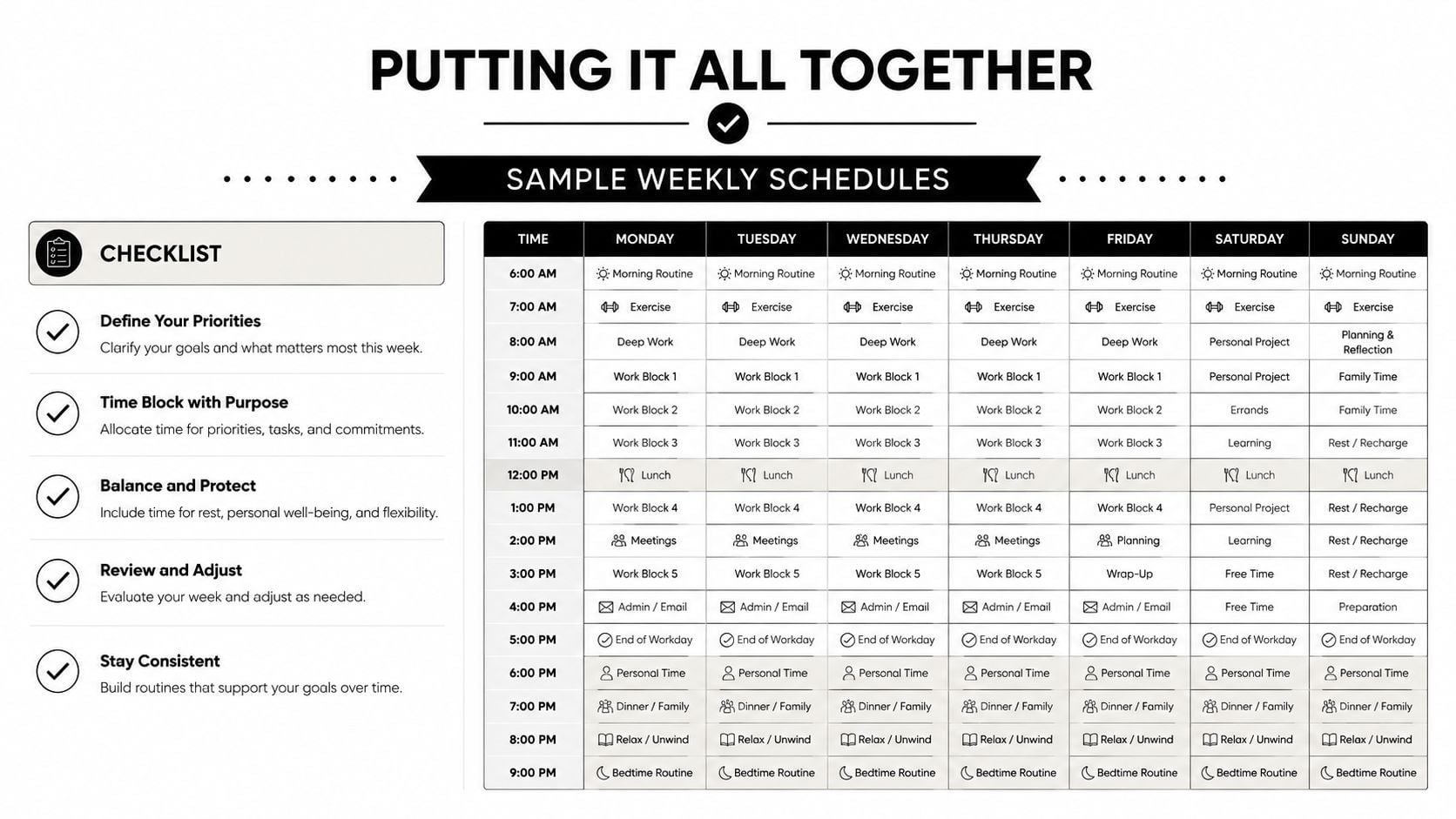
How to place strength around your runs
Most runners do better when they pair harder strength with harder run days and protect recovery on easy days. That keeps stress consolidated instead of turning every day into a medium-hard day.
A simple framework works well:
- Pre-run work: Short activation and mobility only. Think band walks, ankle mobility, and a few bridges.
- Post-run work: Best after easy runs if you’re doing short accessory work.
- Off-day or low-mileage day: Best for your more focused lifting session.
- Plyometrics: Place them when your legs are fresh enough to land well.
One practical option for staying consistent is using a guided schedule inside the PTU app for training and rehab support. It’s one way runners can keep exercises tied to the rest of the week instead of treating rehab as a separate task.
Sample Weekly Strength Schedules for Runners
| Day | Injury Prevention Plan | Early Rehab Plan | Performance Plan |
|---|---|---|---|
| Monday | Easy run plus short pre-run hip activation | Mobility and gait-focused drills, no aggressive loading if symptoms are active | Workout day plus short activation before the run |
| Tuesday | Strength Day A with single-leg deadlift, glute bridge, plank work | Rehab strength with bridge progression, calf loading, foot control | Strength Day A with heavier lower-body work and trunk stability |
| Wednesday | Easy run or rest | Easy run or run-walk if mechanics stay clean | Recovery run and light mobility |
| Thursday | Short lower-leg session after easy mileage | Rehab session with controlled eccentric work and balance drills | Plyometric session plus lower-leg work |
| Friday | Rest or mobility | Rest or recovery session | Easy run plus brief hip accessory work |
| Saturday | Long run, no extra strength after | Long run only if symptoms stay manageable | Long run |
| Sunday | Strength Day B with calf raises, heel drops, lateral band walks | Focused rehab strength, lower volume and controlled tempo | Strength Day B with single-leg work, calf loading, and core |
A few rules make these schedules work better in real life:
- Keep pre-run work brief: You’re preparing, not tiring yourself out.
- Don’t cram every exercise into one day: A smaller plan you repeat beats a giant plan you abandon.
- Protect the day after your heaviest loading: Recovery lets the adaptation happen.
- Adjust for race weeks: Maintain some activation and light strength, but don’t chase fatigue.
If you’re training around Taunton, East Bridgewater, Raynham, or Plymouth, the details may change with terrain, schedule, and race goals. The principle doesn’t. Strength should support the run week, not compete with it.
When to Modify or See a Sports Physical Therapist
There’s a difference between training discomfort and warning signs. Runners do better when they can tell the difference early.
A simple traffic light for runners
Green light: Mild muscle soreness, stiffness that warms up, or fatigue that doesn’t change your stride. Usually manageable with recovery, smart scheduling, and temporary exercise adjustments.
Yellow light: Pain that increases during the run, pain that makes you shorten your stride, or symptoms that return every time you add pace, hills, or volume. Often, self-management stalls at this point because the body has already started compensating.
Red light: Sharp pain, pain at rest, night pain, marked swelling, or pain that changes walking mechanics. At that point, continuing to test it usually makes the picture noisier, not clearer.
If you have to change your form to keep running, you’re no longer training the system you think you are.
A sports physical therapist can sort out whether the limiter is tissue irritability, joint mobility, force production, motor control, or training load. For runners, that matters because the plan should match the goal. A high school athlete returning to sport after ACL rehab won’t train like an adult marathoner in Buzzards Bay. A dancer with hip pain won’t need the same progressions as a runner with Achilles symptoms.
If pain keeps cycling back, book a sports-focused evaluation instead of guessing. At PTU, runners and other athletes in Bridgewater, Buzzards Bay, and Middleborough can start with sports physical therapy care at PTU, including gait analysis, dry needling when appropriate, and return-to-sport testing when a bigger rehab process is involved. Individual care should always be guided by a licensed physical therapist who can examine you in person.
Frequently Asked Questions for Runners
Should I stretch before I run
Usually, start with dynamic mobility instead of long static stretching. Leg swings, hip motion, ankle mobility, and a few activation drills prepare the body better for running than passive holds right before you head out.
Static stretching can still help some runners later in the day or after training if a specific muscle group feels guarded. It just shouldn’t be the entire warm-up.
Is it okay to run through mild pain
Sometimes, but only if the pain stays mild, doesn’t worsen, and doesn’t change your form. Once you start limping, shortening stride, or protecting one side, you’re practicing a compensation pattern.
When runners in West Bridgewater or Middleborough tell us, “It hurts, but only after the first mile,” the next question is whether their mechanics stay the same. If they don’t, the run needs to be modified.
How is a running gait analysis different from a shoe store fitting
A shoe fitting can help with footwear selection. A running gait analysis looks at how you move. That includes cadence tendencies, trunk position, pelvic control, foot strike behavior, joint loading patterns, and how fatigue changes your form.
That level of analysis is useful when symptoms keep recurring or performance stalls even though training is consistent.
What’s the difference between general PT and sports PT for a runner
General orthopedic care can help pain. Sports PT should also account for pace demands, mileage, race goals, lifting tolerance, tendon loading, and return-to-sport progressions. The endpoint isn’t just feeling better on a treatment table. It’s handling training again.
That distinction matters for youth athletes, adult runners, dancers, and post-surgical patients alike. A sports-focused plan should connect rehab to the actual demands waiting outside the clinic.
Can I do strength work on the same day as a run
Yes, and many runners should. It often works better to stack stress on the same day than to spread moderate stress across too many days.
The main point is intent. Keep pre-run work short. Place heavier lifting away from your longest or most symptom-sensitive run if you know that combination tends to flare you up.
If your running keeps getting interrupted by the same knee, hip, shin, or Achilles issue, schedule an evaluation with Physical Therapy U. Our licensed DPTs work with runners, dancers, youth athletes, and post-surgical patients across Bridgewater, Buzzards Bay, and Middleborough, with sport-specific rehab that can include gait analysis, dry needling, strength progressions, and return-to-sport testing when needed.
