
You're sore, limping, frustrated, and trying to decide whether the next clinic that pops up for physical therapy clinic near me will help you get back to running, lifting, dancing, or competing.
That search matters more for athletes and active adults than is often understood. If your goal is only to hurt less at rest, a lot of clinics can help. If your goal is to cut, pivot, sprint, jump, throw, land, or trust your knee again after surgery, you need a different level of rehab.
At PTU, we look at this through a sports lens first. For someone in Bridgewater, Massachusetts, or anywhere across the South Shore Massachusetts area, that means choosing care based on return-to-sport demands, not just proximity.
Table of Contents
- Why Your Search for Physical Therapy Needs a Sports Focus
- Finding Potential Clinics on the South Shore
- Beyond the Basics A Checklist for Athlete-Focused Care
- The Practical Side Insurance and Scheduling Your First Visit
- Your First Visit The Initial Evaluation
- Take the First Step Toward Your Recovery
- Frequently Asked Questions About Starting Physical Therapy
Why Your Search for Physical Therapy Needs a Sports Focus
An ankle sprain for a dancer isn't just an ankle sprain. A shoulder issue for a baseball player isn't just shoulder pain. A runner with knee pain doesn't only need symptoms calmed down. They need a plan that gets them back to mileage, pace changes, hills, and race prep.
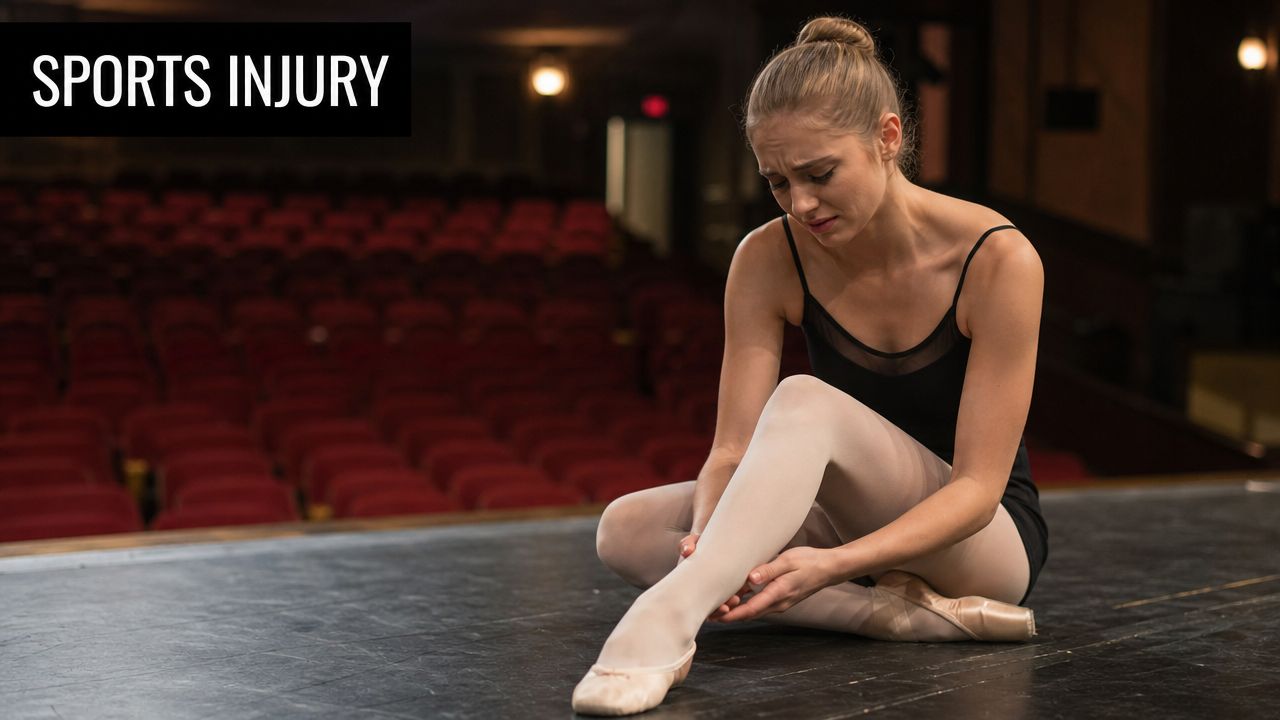
That's why a generic search can be misleading. Physical therapy is a mainstream, regulated part of healthcare, and the profession has a standardized training pathway. The Bureau of Labor Statistics notes that physical therapists are licensed professionals, and that DPT education is heavily clinical, with about 23% of the curriculum devoted to clinical education in its overview of physical therapists. That gives you a strong baseline. It doesn't tell you whether a clinic is built for athletes.
Sports rehab asks different questions. Can the therapist progress from pain control to force production? Do they understand throwing volume, dance loading, sprint mechanics, ACL timelines, and return-to-sport decision-making? If you're active, “better” isn't enough. You need ready.
Practical rule: If a clinic only talks about pain relief and never talks about performance, testing, or sport demands, keep looking.
A sports-focused clinic should speak your language. You should see treatment options and performance tools that fit active people, including return-to-sport progression, running analysis, and sport-specific exercise planning. If you want a sense of how that model blends rehab and performance, this sports medicine and rehab overview is the kind of framework worth looking for when you compare clinics.
Finding Potential Clinics on the South Shore
It is Tuesday afternoon. Your knee feels good enough for daily life, but cutting, landing, or pushing pace still does not feel right. You search physical therapy clinic near me, and the map fills with options from Bridgewater to Plymouth to Taunton. The hard part is not finding a clinic. It is finding one that can get an active person back to sport with a plan that matches the demands of training and competition.
For athletes and active adults on the South Shore, I recommend building a short list of clinics first, then screening them with a sports lens. Commute matters, especially if you need care two or three times per week. The better clinic is still the one you can attend consistently. But if you are deciding between a general office five minutes away and a sports-focused clinic fifteen or twenty minutes away, that extra drive can be worth it when the care includes gait analysis, return-to-run progressions, post-op testing, or dry needling from a clinician who uses it well.
Start with the people who actually see sports injuries
The fastest useful referrals usually come from your own training circle and medical team. Ask the orthopedic surgeon who manages local post-op cases. Ask the sports medicine physician who sees overuse injuries all season. Ask your coach, strength coach, running partner, or teammate who recently finished rehab and returned to practice.
Their feedback tends to be more specific than online reviews. You want to hear whether the therapist watched movement closely, adjusted loading week to week, and had a clear progression back to sprinting, jumping, throwing, dancing, or lifting. General comments like “friendly staff” matter, but they do not tell you much about sports rehab quality.
Referral patterns can still help as a practical screen. In clinic, I pay attention when a practice is trusted repeatedly by local orthopedists, athletic trainers, and coaches. That does not guarantee the right fit for every athlete, but it often points you toward clinics that are comfortable with higher-demand cases.
Use the website to screen for sports capability
A clinic website should answer one question fast. Do they treat active people who want to return to performance, or do they mainly treat general pain complaints?
Look for specifics:
- Sport-specific conditions and plans: ACL rehab, throwing rehab, dance injury care, running gait analysis, return-to-sport testing, post-op progression
- Treatment tools that fit active patients: dry needling, manual therapy, strength and power work, video movement analysis, treadmill running assessment
- Clinician background: DPT credentials, orthopedic or sports specialization, real bios that mention the populations they treat
- Facility setup: open gym space, squat racks, turf, sleds, treadmills, boxes, or testing tools that allow actual movement instead of only table-based care
Facility type matters more than many patients realize. A small private room can work well early after injury, when pain control and mobility are the main goals. Later phases are different. If you need to rebuild deceleration, change of direction, or jumping tolerance, the clinic needs enough space and equipment to train those skills.
A targeted local search helps narrow the field. Try terms like “sports physical therapy Bridgewater Massachusetts,” “ACL rehab South Shore Massachusetts,” or “running gait analysis Plymouth MA.” If you want to compare offices across the region, review these South Shore physical therapy clinic locations and check which sites fit your drive from work, school, or practice.
One more screen is whether the clinic talks about testing in concrete terms. Return to sport should not rely only on time since injury or how you feel that day. A clinic that uses objective measures is usually better prepared to guide an athlete through the later stages of rehab. If you want a reference for what that process can include, this comprehensive RTS testing battery gives you a useful picture of the strength, hop, balance, and movement measures that often support return-to-sport decisions.
A polished website is not proof of quality. It is still a useful filter. The good clinics usually make their sports focus easy to verify.
Beyond the Basics A Checklist for Athlete-Focused Care
You tweak a hamstring in a weekend soccer match in Hingham, or your knee starts barking halfway through a marathon build in Plymouth. The first clinic with an open slot might get you started. It may not get you back to cutting, sprinting, or racing with confidence.
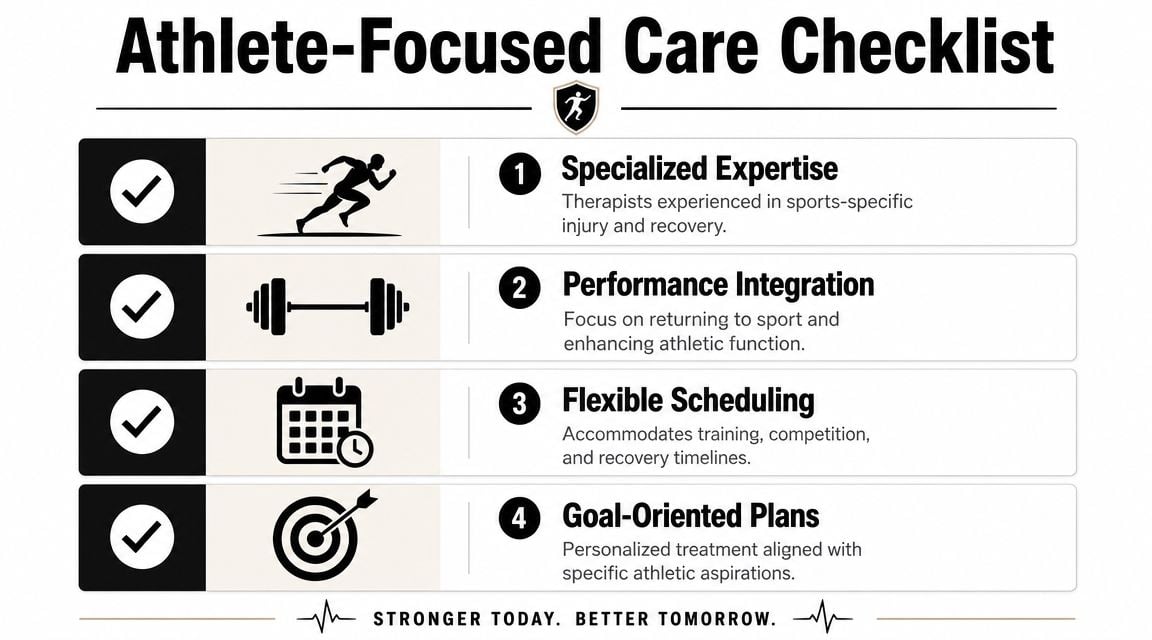
For athletes and active adults on the South Shore, the difference usually shows up after pain settles down. Early rehab can look similar from clinic to clinic. Later rehab is where quality separates itself. A stronger sports clinic can tell you how it will rebuild force, speed, coordination, and tolerance for your specific sport, whether that means return to lifting, running, tennis, dance, hockey, or field sports.
What to look for in the therapist
Credentials are a starting point, not the whole answer. A licensed DPT should be standard. After that, ask questions that matter for your goal. Does the therapist regularly handle post-op knees, throwing shoulders, running injuries, or persistent tendon pain? Have they worked with athletes training through a season, not just patients trying to get through daily activity?
Good sports PTs usually show their value early.
A few green flags:
- They ask sport-specific questions right away: Position, weekly training volume, competition timeline, practice surface, lifting routine, and the exact movement that breaks down.
- They set a performance goal, not just a pain goal: An active adult in Southeastern Massachusetts may need to get back to road racing, adult league basketball, or weekend trail running, not just walk around the house comfortably.
- They can justify each treatment choice: Dry needling, manual therapy, strength work, gait retraining, and neuromuscular drills should each connect to a problem you have.
- They know when a tool is useful and when it is not: Dry needling can help in the right case. It does not replace loading, movement work, or progression.
At PTU, athlete-centered services are emphasized. Depending on the case, that can include dry needling, running gait analysis, dance therapy, and return-to-sport testing. Those are not automatic add-ons. They are tools used when the exam supports them.
What to look for in the plan of care
A good sports rehab plan changes as you improve. It starts by settling symptoms enough to restore clean movement. Then it builds capacity. After that, it should expose you to the demands relevant in your sport.
That often means:
- Pain and irritation control: Enough relief to move normally and train productively.
- Progressive strength loading: More than light bands and table exercises.
- Movement retraining: Running form, landing mechanics, rotation, cutting, acceleration, deceleration, or overhead mechanics.
- Energy system and workload planning: A runner, field athlete, and lifter do not build back the same way.
- Objective retesting: Measurable checks before full return to play or hard training.
For ACL rehab, ankle instability, and other return-to-sport cases, testing matters because “it feels pretty good” is not a plan. If you want a useful outside reference on what a comprehensive RTS testing battery can include, that guide shows the kinds of strength, hop, balance, and movement measures many clinicians use to support return-to-sport decisions.
A strong clinic should be able to define what “ready” means for your sport, then show you how it will measure that standard.
What weak sports rehab usually looks like
The challenge is that weak rehab can feel busy without being effective. Patients get treatment. They leave with exercises. Weeks pass. Their sport still feels far away.
Watch for these signs:
- Every visit looks almost identical: The plan does not change as pain, strength, and movement improve.
- Your therapist spends little time watching movement: No real look at squatting, landing, running, cutting, or overhead mechanics.
- Progression is vague: You hear “let's give it time” more often than clear criteria.
- Your schedule and season are ignored: In-season management, off-season rebuilding, and post-op rehab require different decisions.
- You rarely work with the licensed PT directing the case: For athletes, close oversight matters when exercises become faster, heavier, and more sport-specific.
Staffing also affects the experience. Clinics vary in how much one-on-one time you get and who is directing the harder parts of rehab. That does not make every support staff model poor care. It does mean you should ask a direct question before you commit. Who evaluates you, who progresses your program, and who will be with you when it is time to run, jump, cut, or return to lifting?
The Practical Side Insurance and Scheduling Your First Visit
Plenty of athletes delay care for the same reasons. They're not sure if they need a referral, they don't know what insurance will cover, and they can't fit appointments around school, work, or practice.
That's fixable if you ask the right questions before the first visit.
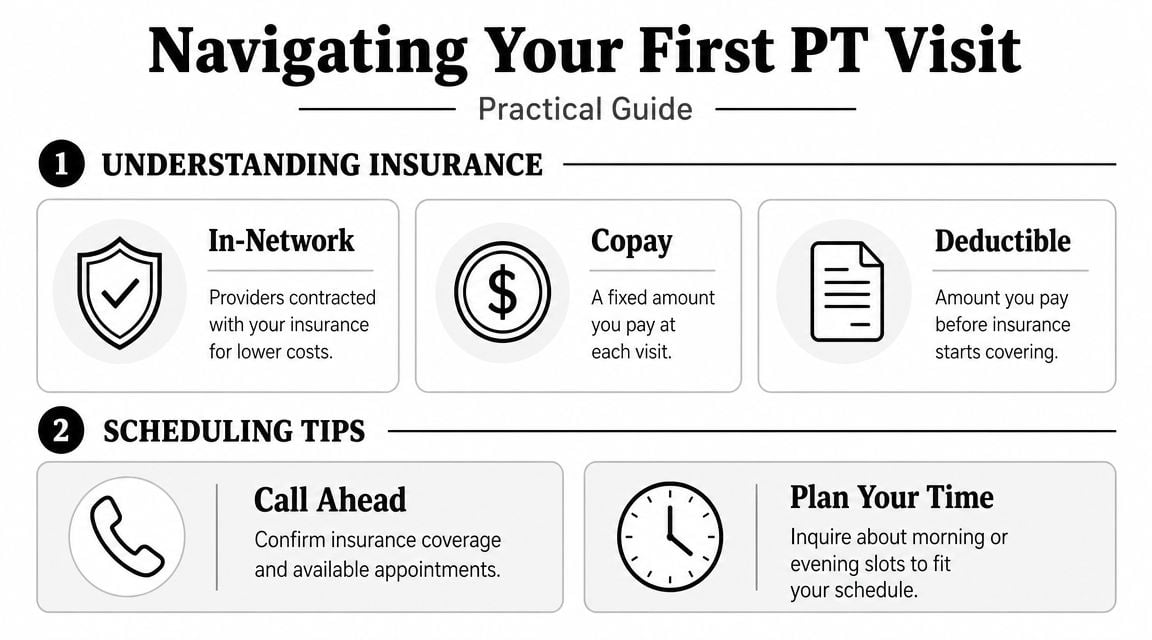
Questions worth asking before you book
When you call a clinic, don't just ask, “Do you take my insurance?” Ask better questions.
Try these:
- Am I in-network or out-of-network with your office? That affects your cost structure.
- Do I have a copay or coinsurance? You want to know what each visit may cost.
- Do I need a referral for my specific plan? Massachusetts direct access can help many patients start PT without a physician referral, but insurance rules can still vary.
- Who will I see each visit? Ask whether you'll work consistently with a licensed physical therapist.
- Do you treat athletes in my situation? Be specific. ACL post-op, distance running pain, dance overuse injuries, shoulder return to throwing.
If insurance language feels murky, this outside guide to network status is a useful plain-English reference before you call.
Convenience affects follow-through
A clinic can be clinically excellent and still be a poor fit if getting there wrecks your week.
Access and convenience matter. Patients often prioritize late or weekend hours, easy booking, and transit or commute-friendly locations, which is one reason those details stand out on this clinic access example. For athletes, that practical side of care affects whether you can attend consistently enough to make progress.
Front desk tip: Ask for the earliest morning and latest evening options before you book. If the schedule only works in theory, you'll start missing visits.
For busy families and working adults on the South Shore, the right setup usually looks like this:
| What to check | Why it matters |
|---|---|
| Office hours | You need visits that fit around class, work, and training |
| Online scheduling | Faster booking reduces delays after an injury flare-up |
| Location | Bridgewater, Buzzards Bay, or Middleborough may each make sense depending on your weekly routine |
| Visit consistency | Rebooking with the same therapist helps continuity |
| Payment clarity | Clear estimates reduce surprises after care starts |
If a clinic sounds evasive on cost or scheduling, that's usually a sign to keep looking.
Your First Visit The Initial Evaluation
The first appointment shouldn't feel like a mystery. For an athlete, it should feel like a working session that starts answering the right questions right away.
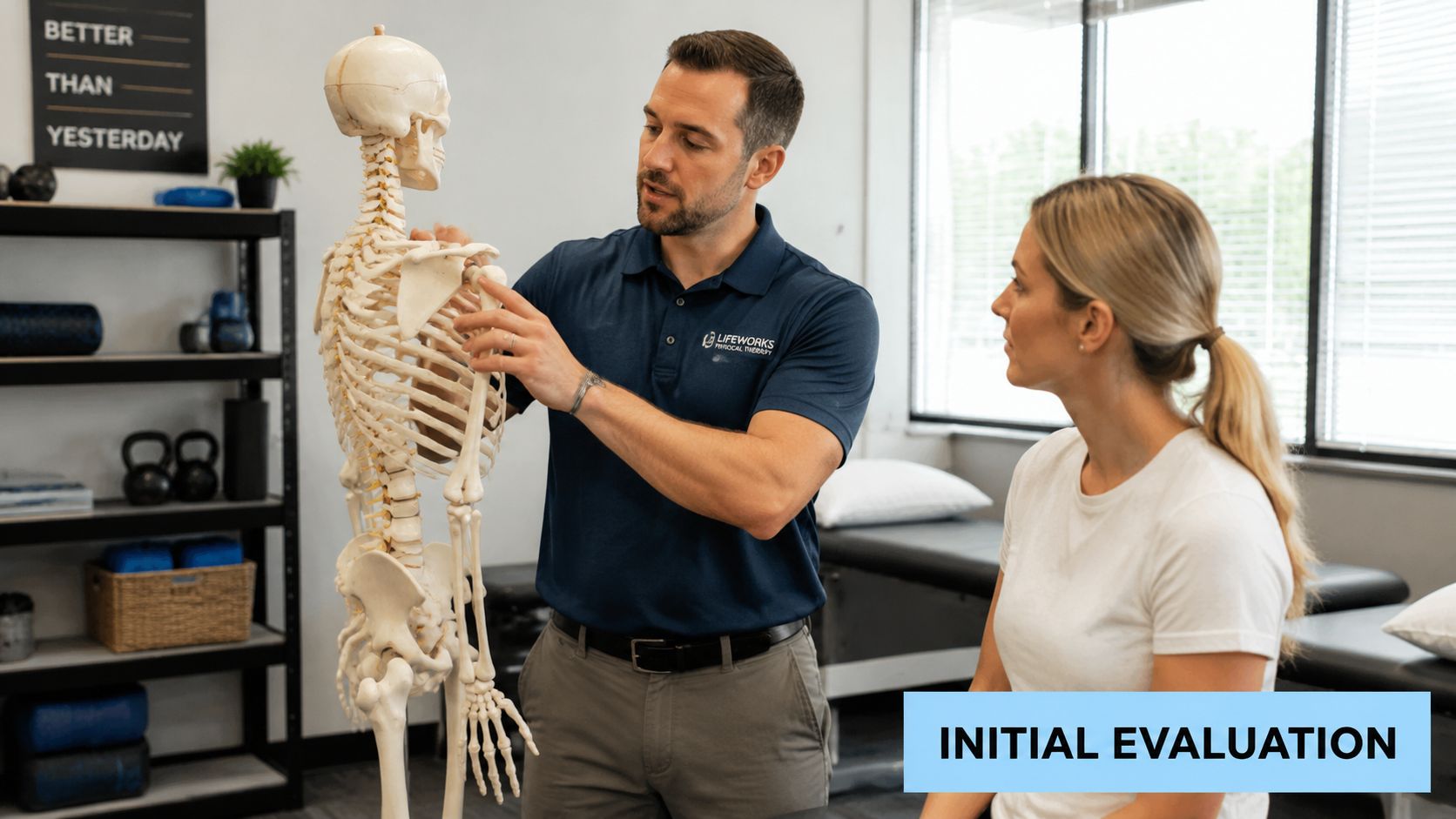
You'll usually start with a conversation, not a machine. The therapist should ask what happened, what you've already tried, what your sport or activity requires, and what you need to get back to. For a high school soccer player, that may be cutting and contact tolerance. For a runner, it may be mileage buildup. For a dancer, it may be turnout, pointe work, and repeated landing.
What happens in the room
After that history, the evaluation should get physical. Expect movement testing, strength checks, range of motion, symptom reproduction, and basic functional tasks tied to your complaint.
That may include:
- Movement screens: Squat, step-down, lunge, reach, balance, or landing tasks
- Strength testing: Looking for side-to-side deficits and weak links
- Joint and tissue assessment: To separate mobility limits from strength or control issues
- Sport-specific discussion: What practice, class, or competition currently brings on symptoms
For runners, a movement assessment may lead into more detailed analysis later. If that's relevant to your case, a clinic that offers running gait analysis can often connect symptom patterns to stride mechanics, loading habits, and training errors.
A quick visual overview can help if this is all new:
What a sports-minded evaluation should produce
By the end of the visit, you should leave with more than a diagnosis label.
You should have:
- A working explanation: What seems to be driving the pain or limitation
- A plan: What treatment will focus on first, and what comes next
- Initial home work: Usually a short exercise program or activity modification plan
- A goal framework: What milestones matter before full return to sport
Sometimes treatment starts on day one. Sometimes the therapist uses the first session mostly to evaluate, educate, and establish priorities. Both can be appropriate. What matters is whether the visit makes your next steps clearer.
Good evaluations reduce uncertainty. You should walk out knowing why you hurt, what you're going to do about it, and what progress will be judged against.
No article can replace an in-person assessment, especially after surgery, a traumatic injury, or persistent symptoms. A licensed physical therapist should evaluate your specific case.
Take the First Step Toward Your Recovery
Choosing a clinic isn't just an administrative task. For athletes and active adults, it's the first rehab decision that shapes everything after it.
The right choice usually isn't the clinic with the nicest slogan or the one that happens to be closest to your house. It's the clinic that understands your sport, measures progress, explains the plan clearly, and works within the realities of your schedule.
If you're in Bridgewater, Massachusetts, or nearby towns across the South Shore Massachusetts area, don't settle for generic rehab if your goal is to return to sport with confidence. Look for a clinic that can handle the whole path, from pain reduction to strength building to testing and sport-specific progression.
Frequently Asked Questions About Starting Physical Therapy
Do I need a referral to start physical therapy in Massachusetts
Often, no. Massachusetts direct access allows many patients to start physical therapy without first getting a physician referral. Insurance plans can still have their own requirements, so it's smart to verify when you schedule.
What should I wear to my first appointment
Wear clothing that lets the therapist see and assess the injured area. Shorts are helpful for hip, knee, ankle, or running issues. A tank top or loose T-shirt helps for shoulder and neck problems.
Will I get exercises on day one
Usually, yes. Most athletes leave with a starting home program, activity guidance, or both. Early exercises are often simple on purpose. The first goal is to match the plan to your irritability level and movement quality.
Does dry needling hurt
It depends on the area and your sensitivity. Many patients describe it as brief, deep, or twitchy rather than sharply painful. If it's recommended, your therapist should explain why it fits your case and what to expect afterward.
If you're ready to stop searching and start progressing, book an evaluation with Physical Therapy U. PTU serves athletes and active adults in Bridgewater, Buzzards Bay, and Middleborough with sports physical therapy, post-surgical rehab, dry needling, running gait analysis, dance therapy, and return-to-sport testing designed around real performance goals.
